A few weeks of high fuel prices have destroyed 20 years of climate propaganda, pfft!
Australians have barely mentioned drilling for oil in Australia in the last twenty years. It was unthinkable. But two new polls show a dramatic awakening. Suddenly Australian voters want more oil and gas. In the first poll, 65% support more drilling for oil and gas, and in the second poll, it was 57%. These are whopping majorities. And we’ve barely started to discuss it.
Only a small minority (just 16%) were still waving the Green flag and are opposed to oil drilling. Rarely in a democracy, do we see so many people line up on the opposite side of the government policy.
Negativity to Renewables is rising. I don’t see how the Net Zero forced revolution is going to survive high fuel and electricity prices.
Only 10 per cent of Australians oppose developing more refineries and 16 per cent reject allowing more oil and gas drilling.
The Mood of the Nation survey, (April 7-13), revealed “record high negativity towards the renewable energy transition”. The SECNewgate Mood of the Nation survey of 1237 voters across every state and territory
A new Sky News poll of 1.500 Australians also finds that an overwhelming majority want more oil and gas drilling, even if it undermines Net Zero emissions.
The numbers are so stark, that even 47% of Labor voters support oil and gas exploration. If the Opposition makes this an election issue, the Labor party will bleed voters. But the Liberals are vulnerable too. If they don’t champion oil and gas exploration, they will bleed votes to the Nationals and One Nation.
Finally, the horror show that is “renewable energy” has had one expose on the mainstream media. A full hour of hard hitting investigation into the environmental destruction, the clubbed koalas, the dead bats, and the poor whipped slaves of Africa.
For the first time, there are none of the usual caveats explaining how climate change is still a threat and we will “have to” do something.
And Liam Bartlett mentions China or Chinese involvement more than 50 times. That will bite hard with Australians feeling the cost-of-living squeeze and it will be a dark new theme for most mainstream TV watchers who are used to soaking in the green fairytale story.
The awful truth of our renewable fantasy is that it’s so uncompetitive, it’s so uneconomic, that we have the second largest reserves in the world for Cobalt, but we can’t afford to mine it, because it would push up the price or renewables even higher.
Renewable energy is so uneconomic we have to use slave labor in Africa to even pretend it’s affordable.
In Liam Bartlett’s questioning at the end Bowen tells us we are 150 million kilometers from the sun, like a grade schooler trying to show how smart he is in a trivia contest. If only he could cite how many barrels of diesel we need each day and where they are going to come from if the Strait of Hormuz doesn’t open soon. Because all the refineries in Asia that we normally buy from, rely on ships from the Middle East.
Bartlett might have done better asking what percentage of the giant mining haul trucks and combine harvesters were solar or wind powered, and how exactly, our renewable future will power the heavy machinery that our economy depends upon.
So they knew it was happening and kept promoting the panels and batteries anyway? How does that that moral equation pan out — we worry more about the children born in a hundred years time suffering through one extra hot day than we worry about the living children of Africa dying right now in a primitive mine?
And cobalt is still used in NMC batteries (the C stands for Cobalt) and magnets for wind turbines, and all the mobile phones, and lap tops.
–hat tip Paul Michael, Another Delcon and Jim Simpson. Thank you!
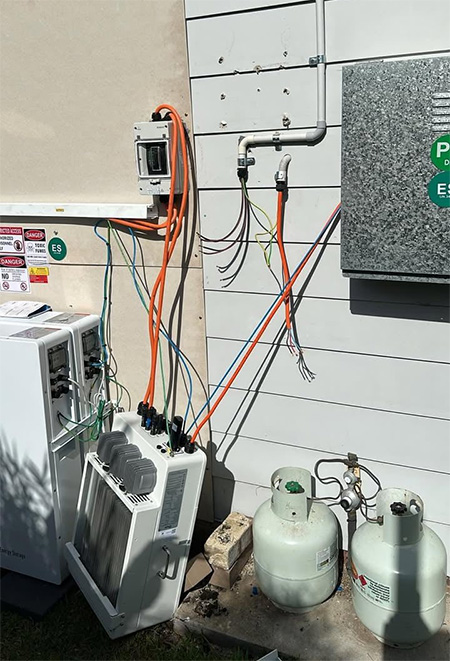
Facebook “Crap Home Battery Installs Australia”. It seems the inverter fell off the wall, but luckily missed the gas bottles.
By Jo Nova
It’s like the “Pink Batts” debacle but this time with potentially explosive electrochemical gear
The costs have blown out in the subsidized home battery scheme– and now so have the safety standards.
Costs of the Cheaper Home Batteries Program were supposed to be $2.3 billion but when homeowners realized they got huge subsidies for installing bigger batteries than they needed, they … installed bigger batteries than they needed. Thus and verily the Cheaper Home Batteries Program blew out to $7.2 billion. And since most of the lucky homeowners won’t be sharing their battery with the voracious energy cartels, their batteries will sit at home barely used.
The government only woke up to their own inept scheme after 160,000 home units had been installed. Then they suddenly had to slap an end point on the scheme in order to stem the bleeding. So just as night follows day — that created a rush to install as many batteries as possible before the deadline, eventually reaching 250,000. Ponder that a 25kWh battery (the average size in Australia) is around 200 to 300 kg. It’s a big piece of equipment.
But a new survey of 1,250 installations shows that 1.2% were actually unsafe.
Between July 2025 and April 2026, the Clean Energy Regulator carried out 1,278 compliance inspections on battery systems installed under the program.
Some 60.8 per cent of inspected system installations were found to be “substandard” and 1.2 per cent of installs were found to be “unsafe”. The problems weren’t about the batteries themselves, but the way they had been installed.
The sample size in the regulator’s report is small — 0.5 per cent of the total number of systems installed.
With such a small sample size, it is hard to extrapolate the level of installation non-compliance across all systems in Australia. But if similar trends continue in inspections over a larger sample size, there could be approximately 3,000 battery installs that are unsafe and a further 152,000 that are non-compliant.
Exposed wiring is also a common issue that needs to be addressed as a priority. If wiring is not enclosed, it can be damaged and increase the risk of a severe electric shock if touched. The independent solar energy website, SolarQuotes, highlights the exposed wiring issue well, showcasing several installations with non-compliant wiring.
For batteries, no amount of exposed cable is compliant. Cables need to be protected from mechanical damage for the full cable run, using electrical conduit or metal ducting.
Alarmingly, reports from experts in the field indicate that only 10 peer cent of installers are following these wiring practices correctly.
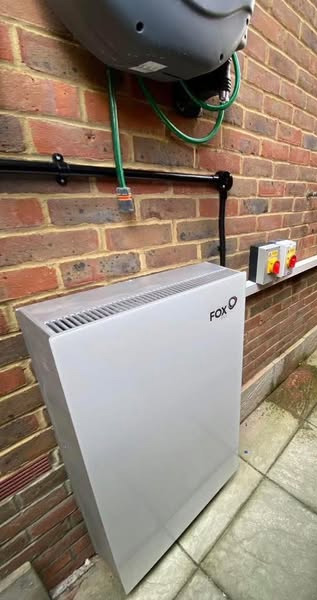
A quick scroll of social media groups that rate battery installation jobs visually confirms the issues. Posts of substandard installations show exposed cables, batteries placed in full sun, delicately anchored to a wall with standard masonry wall plugs or supported with loose bits of timber and pavers.
After creating all the right conditions for dangerous rushed boom the government is talking tough about “ramping up inspections” and identifying the poor performers. More money on this bonfire!
The regulator is even talking about limiting the number of installations that each installer can do in one day.
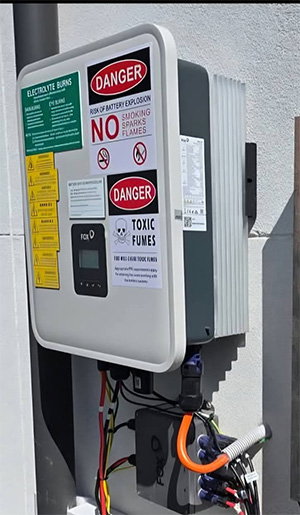
Many of the non-compliant issues relate to the sticker forest that has grown on most batteries. And while a misplaced sticker won’t set the battery on fire, if a battery is deemed non-compliant, it may void the insurance. Wouldn’t that be a nasty surprise?
There are a lot of jokes about stickers, like “A few more stickers would’ve fixed that”.
The Solar Quotes article on “cheap batteries” has plenty of photos.
An advert for “Cheap Home Batteries” in Qld shows that customers only needed to pay a few hundred dollars more to drain the public purse by $4,000 extra and get a battery three times larger than they will probably ever use.
Some readers may remember his great contributions at this blog. He trained as a Nuclear Physicist, attended Harvard Business School and was a Fellow at Oxford. Not exactly the stereotypical knucklehead climate denier, he worked at Fermilab and CERN, and was once Deputy of VENCorp — managing the gas and electricity market in Victoria, which made him very well qualified to point out how subsidized wind power would drive out reliable baseload generators that keep the system running (and cheap).
When others might have retired to play golf, Tom was indefatigable, volunteering to warn us of the expensive mistakes the nation was making. His work with Paul Miskelly was years ahead of anyone else. If only the nation had listened more carefully to Tom and Paul, we could have saved a few hundred billion dollars or more. We don’t appreciate our star science talent…
In other words, the Iranians have blinked first, but the US Navy will stick around until the deal is done properly. Iran has agreed to give up the enriched uranium. It was a “GREAT AND BRILLIANT DAY FOR THE WORLD!” Donald Trump wrote on TruthSocial.
Ships apparently are waiting for insurance calls and confirmation.
Like a comedy team, France and the UK hosted a multinational teleconference call and bravely offered to lead a mission to protect freedom of navigation in the Strait, which they’ve now realized is important to “the whole world”. Trump wryly remarked that: “Now that the Hormuz Strait situation is over, I received a call from NATO asking if we would need some help”. He told them to stay home, “UNLESS THEY WANT TO LOAD UP THEIR SHIPS WITH OIL“. Adding that “They were useless when needed, a Paper Tiger!”
The Australian Prime Minister must be thrilled that he might be spared from further ignominy, as Australia’s pathetic state of energy vulnerability is obvious to everyone, and, if the Strait isn’t opened, we may be mere weeks away from running out of fuel, despite having oil deposits waiting for years to get approval to use.
Trump said he was not happy with Australia, and the PM and Treasurer protest on a weaselly technicality, that they weren’t asked for anything. All they had to do, and for free, was just endorse what Trump was doing.
When Trump says Australia wasn’t there when we needed them, he is almost certainly talking about moral support, and not our thirty year old frigates. We did send one plane, but when the key moment came, the PM called for a de-escalation which was exactly the opposite of what Trump was doing. Anthony Albanese could have said: “We must stop Iran getting a nuclear weapon.” That would have been enough
Australia’s national security swamp means we have diesel subs, but almost no diesel. As Leith van Onselen wrote “Due to its immense size, isolation, and industry composition (i.e., heavy mining and agriculture), Australia is literally one of the most diesel-dependent economies in the world.”
Albanese must have been sweating when the news came in that the refinery was on fire. He talks down the risks, but cut his fuel hunting trip short and flew straight there. And this political mistake is so obvious — the smoke has barely cleared and there is already talk of building another oil refinery in Australia. It would have been a blasphemy two months ago. But times have changed.
The PM’s big strategic trip to South East Asia is best described as theatre. He was pleased to tell the world he got 100 million litres of fuel. But the Russians mocked the size: “Daily usage is 92 million liters (sic),” [they] wrote. “Saving Australia 1 day at a time.”
One in five British teens hide their political views out of fear of ostracism (and half the rest probably don’t know they agree with them because they’ve never heard them speak.) We all know which side of politics has to hide their views and it’s not the trans-activist communists who believe in using power plants and plastic bags to change the weather. They’re treated like heroes and given a keynote at the UN.
But what does someone do when they believe something crazy, counterproductive and resembling witchcraft? — They call it science, and prey upon the young and impressionable. But this approach is vulnerable to people who speak the truth. One little wicked joke about the cult programming can spread like wildfire and undo years of work.
The only way to stop the truth going viral spread is a wall of mockery, ridicule and good old social ostracism.
The people speaking truth don’t need to shut down opponents with namecalling and social manipulation, but the people pushing a fantasy do — you climate denying, oil shill, racist, conspiracy theorist.
This is how the Left control the weak and vulnerable — through coercion and fear. This study was done on 4,000 students, some as young as ten years.
No wonder The Blob wants to give 16 year olds the vote. No one is easier to bully.
One in five teenagers in the UK do not share their political views due to a fear of being “cancelled”, according to a new report.
A survey by the Economist Educational Foundation found that 22% of 15 to 17-year-olds had stopped themselves sharing political opinions because they were worried about criticism, along with 20% of 10 to 14-year-olds.
Nearly one in four of the 4,000 students aged between 10 and 17 who took part in the survey said they have been asked to stop voicing their political views at school.
The results also showed that 44% of 15 to 17-year-olds said they would not feel ready to vote in the next election.
And the big fear of course, is that children might find “online ‘fringe’ communities” where their views might become more right wing….
The Economist Educational Foundation’s chief growth officer, Tiffany Smyly, said the fear of being cancelled could push teenagers to online “fringe” communities where their views could become more extreme.
And the solution, of course, is free speech. Let the kids hear both sides free of judgmental coercion and trust that they will figure it out for themselves. Give them the tools to recognise namecalling and bullying, and teach them that Democracy means people are supposed to disagree and open debate is essential.
The more crazy the cult, the more extreme the censorship has to be. Last year 12,000 Brits were arrested for tweets they wrote. Starmer and the British Labour Party wouldn’t have to shut down discussion if they could defend their actions.
PS: We know this is happening in Australian schools. I know of one situation where girl A has used the threat of ostracism on girl B for just being the friend of Girl C . Girl C’s crime was that she doesn’t openly scorn Donald Trump and is therefore described as “A Trump supporter”. So Girl B (who is actually fairly center left) was subject to the campaign, possibly because she is the softer target. “How can you be friends with her?” The only socially acceptable response is outspoken Trump-hate.
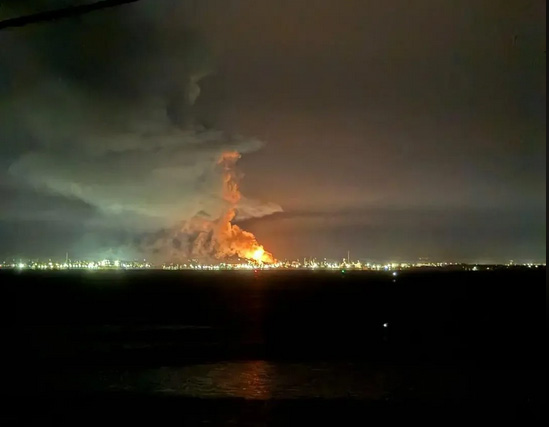
Details are sketchy, but the Viva refinery in Corio, Geelong Victoria is reportedly on fire in a big way. This is (or was) one of Australia’s last two remaining oil refineries supplying 10% of domestic needs. Reports on X and Reddit claim the fire started with an explosion at about 11pm in Victoria, with “flames 100ft high”. The glow is visible from Melbourne. Others report the fire started in the “gas separator unit”. with some saying they heard, as many as 7 or 8 explosions. The Victorian Fire Dept has issued a watch and act and stay indoors for people in Geelong. As many as 16 fire units are attending a “Building Fire” on Refinery Rd, Corio which (at this time) is not yet under control.
What are the odds? Speculation is rife: “I’m sure it’s just a coincidence” says every second person.
We’re praying the staff are somehow OK, and someone has sent the SAS to guard our other refinery.
But we’ll be fine, right? As our energy Minister Chris Blackout Bowen says: “No war can impede the flow of sun to Australia” (only nighttime and clouds can do that…).
We’re living in a bubble downunder, and it may have just popped. The ships that have been bringing our oil are mostly ones that were already on the water before the war in Iran broke out. No one is 100% sure what happens next. We are cruising barely a few weeks from potential disaster. This is not a loss of 10% in normal times, it’s potentially a loss of 10% on top of a crisis. It may mean some of the ships we are counting on will not be able to unload and get processed anywhere in Australia. The other refinery, Lytton in Queensland, may be booked at full capacity and it’s not clear whether there will still be storage available in Geelong.
Footage of the Corio oil refinery on fire in Geelong, Victoria (Australia).
Substantial flames billowing into the sky.
Corio supplies ~120k barrels per day of fuel and refined products, equivalent to over 10% of Australia’s daily consumption.
Australians were frustrated that three overseas newspapers appear to have reported on this before the local press. The Mirror. The Express. The Daily Mail. The ABC have now sent a reporter.
The billion dollar question is whether the refinery was pushing the safety bounds at a facility presumably being run at full speed under immense pressure, or whether this is no accident. With Australia being a star player in the “Miss Unprepared Nation” stakes, there are few better candidates where one little domestic terror incident could bring us to our knees, begging for oil, and an end to the war.
Construction is slowing, petrol stations are running out of fuel and businesses are already talking of shutting down. Flights are being cancelled. Things are so dire, it’s possible we might actually run out of diesel and jet fuel in… three or four weeks. To solve this the Labor government spent $20 million running adverts telling Australians how to improve the fuel economy of their family car. On social media Victorians have been heard saying, Dang, now they’ll have to take the roof rack and the tow ball off the car…
How’s that ban on fracking looking now? Victoria not only banned it permanently but enshrined it in the constitution just in case the voters changed their minds. Who exactly are the politicians serving…?
It’s 4:30am in Victoria and the extent of the damage to the plant is unknown. I’ll have to leave it to commenters and moderators to update the situation below.
Let’s hope the damage is not as bad as it seems.
—
update: by Raquel (9am local).
All refinery staff and emergency workers have been accounted for and there are no reports of injury.
At 5.27am (local time), the Country Fire Authority (CFA) said the threat had reduced and people in surrounding suburbs could resume normal activities. Earlier advice had been for residents to remain indoors with windows closed, and to turn off heating / cooling that would draw air in.
Viva Energy is one of two oil refineries in the country and supplies half of Victoria’s fuel and 10 per cent of the nation’s.
Viva refinery advise there has been no immediate impact on fuel supplies.
Federal Energy Minister Chris Bowen says “It will impact on production, and at this point, petrol rather than diesel and jet fuel”. A state govt spokesperson says it is not impacting production or storage.
—
update: by Raquel (11:30am local)
Viva Energy CEO Scott Wyatt says two production units have been damaged, used for petrol production and some other products. While reducing production broadly at the refinery while the situation is handled, Wyatt is confident overall supplies will not be affected and shortfalls will be covered by imports.
We have a high degree of confidence to the extent that we have any production shortfalls, we have a very strong import program right through the rest of the month and through May that we can then substitute loss production at Geelong and maintain supply to the market
UPDATE: Refinery operations face months of disruptions
Luckily Viva Energy can arrange some extra ships of petrol to cover the losses:
A fire at Viva Energy’s Geelong refinery is expected to disrupt operations for anywhere between three weeks and three months, threatening a hit to earnings and tightening petrol supply at a critical time for the domestic market, Macquarie has estimated.
While Viva Energy has indicated it can offset lost petrol output through imports…
If finding extra ships of petrol so easy, why didn’t they do it a few weeks ago? It would have been handy.
Defence Minister Richard Marles has vowed the government would do “all within our power” to turn a temporary two-week ceasefire between the US, Israel and Iran into a permanent peace.
Apparently we will use our fuel deficiency, our diesel subs, our non-existent merchant navy and achieve exactly what? What leverage do we have? We’ll stop sending iron ore and gold to China unless Iran plays nice?
Two trendlines and the climate distraction converged
Just before Easter, the Page Research Centre put out a policy paper that ought to rivet Australians.
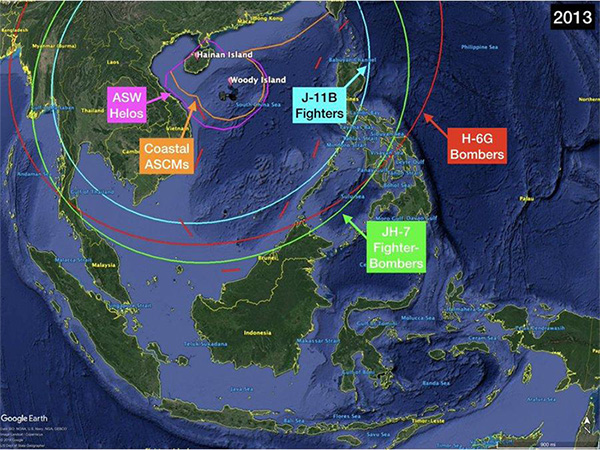
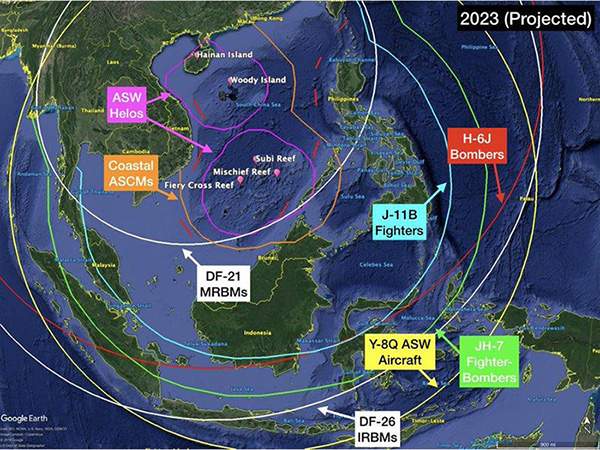
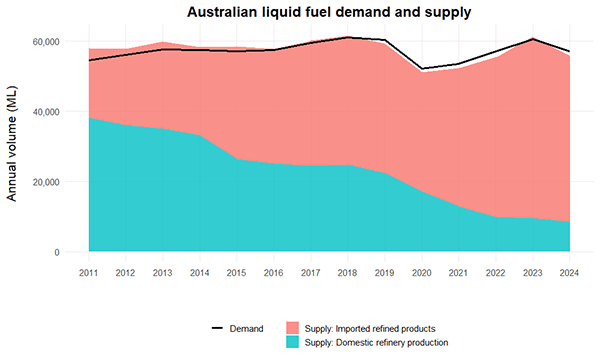
We have so casually sleepwalked (sprinted) blindfolded to the edge of cliff. Twenty years ago we were self-sufficient in liquid fuels, then we got distracted trying to change the rain and clouds in 2100 AD. Meanwhile in 2013, the area of South East Asia under the potential control of China was starting to grow rapidly. It is only now, after we have closed 6 of 8 refineries, banned oil exploration and shale use in some states in an Ode to Gaia, but we find that at a moment’s notice, China could potentially put three quarters of our liquid fuel supply under threat.
“In an Asian war scenario, 76% of our liquid fuel requirements would be in immediate jeopardy.”
The situation in 2013 regarding China’s ability to control supply lines:
China’s area of denial capacity 2013
But the world is a different place in 2026:
China’s area of denial capacity 2025
How rapidly we ran towards the pit, closing refineries, assuming it didn’t matter even after China had been dishonest about and leaked a bioweapon, revealing a hostile intent, or at best a callous indifference to our health and welfare.
Figure 10 – Australian domestic liquid fuel demand and supply
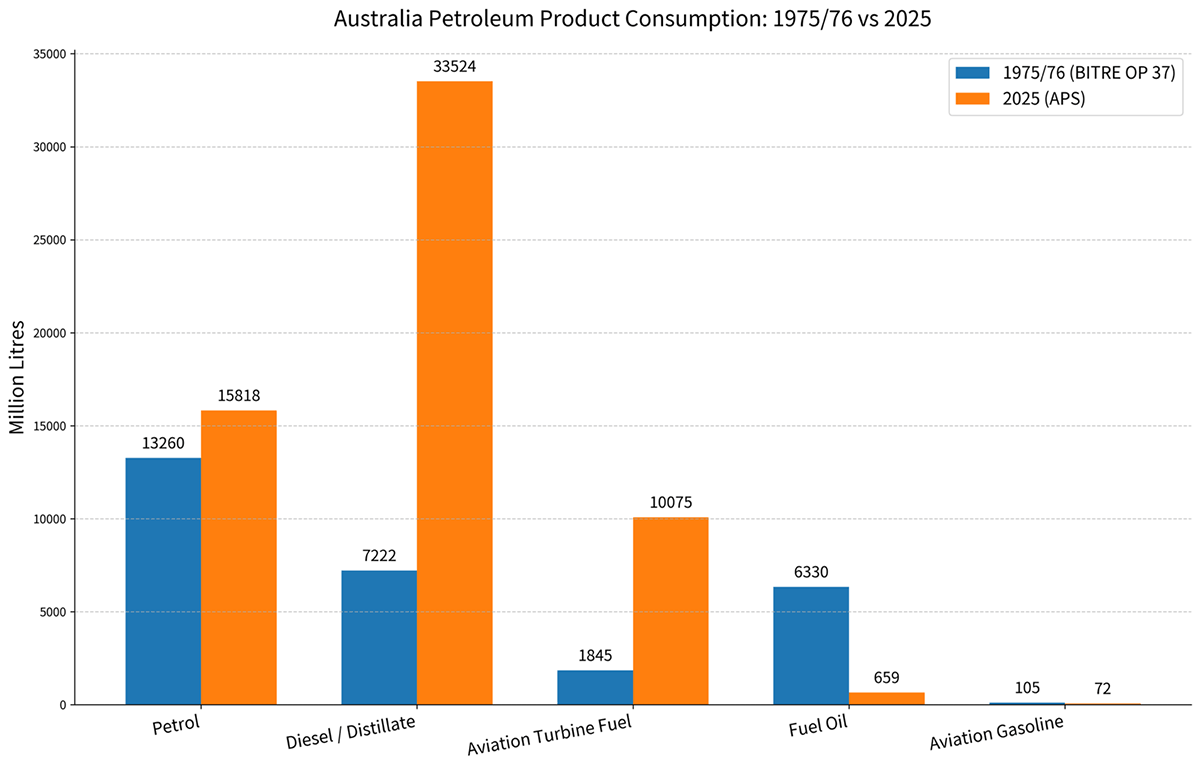
Remarkably, we don’t use much more petrol than we did 50 years ago. But staggeringly we use nearly five times as much diesel.
Figure 13 – Comparison of Australian Consumption of major petroleum products in 1975 and 2025 | Page Research Centre
We are a diesel nation that would grind to a halt in days if the ships stopped arriving.
The two authors of the Page Research Report, Gerard Holland and Jude Blik, lay bare the four options we have, three of which aren’t much use:
1. Diversify our sources — (Good for peace-time, but likely to fall in a whole once a war breaks out).
When war breaks out everything changes. Right now, 800 ships are stuck in the Persian Gulf which is about 10% of the official global cargo fleet, not delivering anything to anyone. When 20% of the world is short of oil, no one wants to give it up, so most countries are suddenly competing in the same diversity game.
A disruption anywhere in the global oil chain can change the direction of every ship that we don’t control, and we control none, not a single ship. The Australian merchant fleet is zero. With an acerbic wit, they ask the core question that both sides of government forgot to ask:
“Given the current reserve requirement is 30 days, do we intend to maintain sovereignty and economic function for longer than a month?”
ie. Would you like to still be a country in 30 days?
And as they point out, our fuel stocks are public information, and any malign actor could easily use this vulnerability to extort our submission. Indeed, we are encouraging them to do exactly that:
…an adversary can tailor a naval capability around cutting off our seaborne supplies, knowing that at some certain future point (determined by our reserves, which are publicly known) Australia would be economically crippled. This allows considerable leverage to intimidate us short of conflict breaking out, since their ability to impose catastrophic pain is so clear. This further encourages an opponent to develop such a capability, since the pay-off is clear. With only 30 days of reserves, and near-total dependence on imports, successfully sinking a single convoy would bring us to our knees. Honing the ability to do this has clear returns for an adversary.
2. Increasing our 30 day fuel reserves is a band-aid:
Australia’s pitiful reserves are embarrassing, but we must not be distracted thinking that making them 60 days or 90 days is “the answer”.
Increasing our reserves just makes the bridge-to-nowhere a bit longer if we have no destination — that is, no way to restore our ongoing supply. We are still in danger of falling off the cliff. No matter how long our reserves are, the question that matters is how we ensure our fuel supply in a crisis? Security only comes from self sufficiency.
3. Demand Reduction: “Pretend we don’t need oil”
Painless demand reduction is an illusion. There are no easy efficiency gains left. We use barely any more petrol now than we did in 1976 (See figure 13), even though the national car fleet has increased from 6 million to 20 million vehicles. As the Page Research team note, even during the pandemic lockdowns, with all the pain that brought, we only saw a 20% reduction in total fuel use.
Even if we all caught the bus to school, work, shopping and soccer, (if that were even possible) passenger vehicles only consume 30% of the total liquid fuel demand. And miners and farmers don’t take their 130 ton Haul Trucks, or Combine Harvesters on frivolous trips to the corner store that they can easily do on a bike.
4. Produce oil ourselves
If a real war breaks out, the only protection comes from domestic production. We can drill, baby drill for oil and shale, perhaps even approve some fields in less than seven years, but there’s no time to waste.
We can also store large reserves of crude oil like the US does in salt caverns. Crude oil needs refining, so we’d need to build-back a refinery or two, but it has a long expiry date. And then there’s the biggie — we can convert our coal into liquid fuel. Something that China is doing at the astonishing rate of 380 million tons a year.
Maybe, if we can tame the Maritime Workers Union, the island continent could even afford to own a merchant ship?
There is so much more to say…
Thanks to Aidan Morrison for pointing me at this report, and Vic in Perth.
We use cookies to ensure that we give you the best experience on our website. If you continue to use this site we will assume that you are happy with it.












Recent Comments