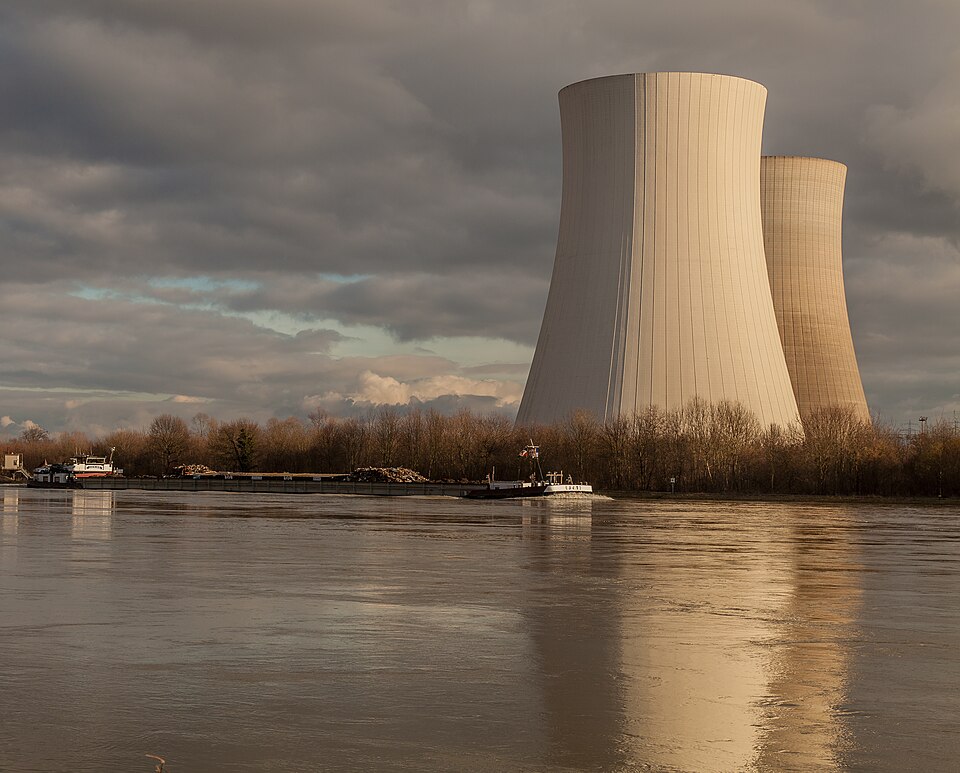
Germany had nuclear power for 66 years | Kühltürme AKW in Phillipsburg, Baden-Württemberg, Germany By Fischer.H
By Jo Nova
If renewables are expensive, it’s volatile coal’s fault!
How can it be? Germany has all that free wind and solar power but the price of electricity is the second highest in Europe.
Apparently a nation with 45% of its generation from wind and solar is still “tied to volatile fossil fuel”. This is like a hostage situation, it’s so cruel?!
EuroNews is spinning a fairy tale at 100 miles an hour.
Germany is a leader in renewables, so why does it have one of the highest EU electricity prices?
German households pay around a third more for electricity than the EU average, despite the country’s impressive efforts to ditch fossil fuels.
According to energy think tank Ember, Germany is one of the “global leaders” for wind and solar energy deployment, with 59 per cent of its electricity coming from clean sources in 2025.
Since the introduction of its landmark renewable energy law (Erneuerbare-Energien-Gesetz) in 2000, the country’s share of generation from wind and solar alone has skyrocketed from less than two per cent to almost 45 per cent last year.
At the same time, coal – which is often described as the ‘dirtiest’ form of energy – fell from supplying more than half of Germany’s electricity to just 21 per cent.
The stark truth: The system costs are awful
A wind and solar grid is really two grids for the price of … two grids. One grid helps impress your shallow academic friends at dinner, while the other grid (the reliable one) could run all the time, but has to sit around waiting for the first grid to fail, which it does often, and then it swings in to gear to save the day. Neither grid is running efficiently, the unreliable one forces the reliable one to stop and start. So we get the worst of all worlds and a big electricity bill.
Wind and solar power are only cheap if you don’t mind blackouts or shutting down factories and destroying your manufacturing base (BASF, Volkswagen, anyone?)
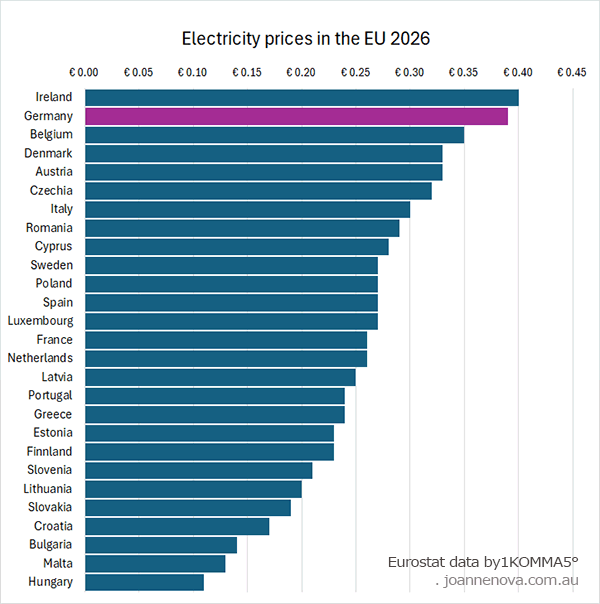
EuroNews delivers the bad news: €500 a family wasted on a weather shifting project
For a typical single household (consuming 1,500 kWh), Germany’s high electricity prices mean households will be paying around €150 per year compared to the EU average – or an additional €500 for a family with a 5,000 kWh electricity consumption.
The one thing wind and solar can’t buy — Flexibility
Why does Germany waste clean energy?
But as Jannik Schall, co-founder of 1KOMMA5°, points out: “Germany does not have too much cheap wind and solar power, but too little flexibility in the system.”
Last year, Germany spent €435 billion euros on renewable energy curtailment. This involves intentionally shutting down electricity production in areas of oversupply and ramping up supply elsewhere.
System costs get you every time
Unreliable generators need a massive oversupply of generation, frequency stability, transmission lines, back up batteries, new market arrangements, payments for curtailment of the oversupply of generators, and then you have to throw away all the generators after 20 to 25 years, bury them in a big hole and start again.
Crazy people thought two grids would be cheaper than one.






If wind and sun are free (the sun doesn’t send a bill), why then isn’t our power free.
440
It’s similar to owning a yacht, the wind is free but the equipment required to utilise the wind is expensive
450
True. Most sailboats nowadays have an auxiliary engine for back up. What do renewables have for back up apart from batteries with short term capacity? Oh, that would be base load power or diesel…we are transitioning away from common sense.
270
Our son-in-law owns a sail boat worth a gazillion dollars. The “expensive boat to catch the free wind” is a great argument but I’ll need to watch the auxiliary motor, it’s electric charged by the free sun. Oh wait, same argument, how much did the motor and panels cost?
180
My favorite definition of sailing is “Going nowhere very slowly at great expense”.
It’s an expression that could easily apply excessive renewable generation in the power grid.
50
Be careful what you wish for. Australia’s Capacity Investment Scheme is heading toward guaranteed return on estimated cost of projects. The proponents get their return on capital without even producing anything. That is how the transmission and distribution networks are funded already but generation and storage are heading the same way.
With this sort of financing, the actual generation does not matter so energy can be supplied free because the money spent is already guaranteed a return irrespective of output. Any return on energy sold is a bonus.
You will already be seeing the impact of this as cost of energy is stable or even falling but the service fee is on steroids.
460
Yes. It’s the cost of transporting electrons to the cities from windmills in the Strzelecki Desert.
A quite recent social conversation with a now-retired neurologist, who of course is extremely sharp on most topics, showed me that most people (including the highly educated ones) do not know or recognise the impossibly expensive duality of the power grid as it has now lobbed up – and do not wish to know.
Any comment, even the mildest, to demonstrate the issue is regarded as “anti-science” and wilfully disregarding 99% of climate scientists.
ON is an electoral cattle prod, throttled back with real malice by the MSM.
320
Not a climate scientist, so I can say that wind/solar are intermittent. Even attaching them to gigantic batteries will not be sufficient
and could burn down the whole place and kill people.
10
So they just have to inflate the estimated project cost knowing that no public serpent will ever be responsible enough with taxpayer money to check the real cost?
80
But there is competition for the projects and I expect the proponents carry the risk of cost overruns. Higher capital and operating cost would reduce ROI.
UK Labour has told the proponents of wind farms that they must support trade unions otherwise risk subsidies. So this is an after market impost imposed by the government that could increase costs where there is possibly no recourse. Australian Labor would have some difficulty imposing after market union rules on the Singapore backed proponents of the CIS big batteries now going in.
Labor governments forcing unionised worksites is an old racket. Labor force the unions into the site then rake in a cut of the union dues. It keeps them well funded. They obviously push for unionised sites.
None of the small contractors doing household “renewable” installs in Victoria are unionised. So Labor needs to push the big projects toward unionisation to keep dues flowing. SH2 is now the greatest socialist racket since the State’s lost monopoly on power generation.
50
The Germans have a reputation for being stubborn. They are likely to keep working at this wind and solar thing, now that they are committed to it,
in that same way they keep the engine in the trunk of the Beetle for 60 years. But their economy has changed considerably. If they decided today
they wanted to be a manufacturing superpower again, I doubt they could manage without abundant, low cost energy, another choice they could make.
But the energy choice they’ve made seems to preclude the foundries and forges, and giant machines at the bottom of the manufacturing pyramid,
In reality they are having a problem keeping their car plants open and competitive. Unlike many countries, their past frugality gives them a balance sheet
that is buying them some time, but decisions must be made. And without the economic beating heart of Germany, wither Brussels?
The US has reversed a lot of its energy (and economy) stupidity, and although we are drowning in dept we are also fully employed, moderately self-sufficient,
able to export both food and fuel, and growing such that a way out of debt is at least imaginable. For a place like Australia, if your attitudes changed it’s
pretty easy to imagine a small population with the resources of a continent trading with a world that is short on many thing can be as prosperous as they wish to be.
II fear for Europe, with obvious dysfunction, both in Brussels and in the various capitals; double the opportunity to mess things up and a vast number of little
fiefdoms desperate to protect what they have. Perhaps grid failure in, say, communist Spain, will sharpen people’s minds. Or perhaps, like socialism, there will
be a new crop of zealots to flog climate fear driving stupid policy no matter how many times it failed.
340
Not often mentioned is that many European vehicle brands are now manufactured in India.
330
The data is very clear that we must use very safe and reliable BASELOAD energy like Coal, Gas, Nuclear or Hydro and never invest in unreliable rubbish like toxic W & S.
Just follow proper data and evidence and don’t allow clueless, unreliable W & S to destroy your environments for a zero return on the so called investment.
IOW why continue to waste endless billions of $ for nothing but misery and a much lower standard of living for future generations.
240
There is hope. As a voting block, the millennials favor One Nation over the other options. These started formal education when the climate propaganda was already embedded in primary school teaching so these kids have spent their entire formative life being bombarded with scary stories of thermageddon unless humanity stops burning fossil fuels. Many now know they have been lied to their entire life and are revolting.
410
Rick, you’re a much sharper tool than me and I just hope you’re correct about the Millennials.
240
I hope you’re right Rick, you’re more of an optimist than I am.
70
Pfft! Germany a global leader with 59% so-called clean power generation? Up from 2% 26 years ago? Minnows! Mere beginners learning to walk [stumble, then fall?].
Little old New Zealand with less than 6 million souls – equivalent to a small town in China – has been running on approx. 85% natural generation since the first hydro dam was built in the late 1800s. As a disgraced ex-PM used to blather, WE are ‘world leaders’ in saving the planet – or was it saving the children? Her reign seems like a bad nightmare now, better left to fade into oblivion [or the fires of hell].
And thanks to our conscientious old-school engineers using concrete & steel & bulldozers & diesel trucks to build a series of dams, hence providing renewable energy, we’re doing our bit to keep the planet cool [read: cold!] with today’s 1st of July 7-below-freezing black ice closing highways down south and causing numerous crashes for early morning commuters in Dunedin and other parts of Otago / Queenstown.
Nope, absolutely NO globular wobbly warming happening down here to speak of, and with no wind anywhere this week, all those monumental bird-chopping prayer wheels are sitting idle… whose loopy idea was this anyway?
310
Here’s the complete GLOBAL energy mix from 1988 to 2024 and note the huge increase in FFs since this W & S lunacy started in 1988 or 2000 etc.
W & S is that tiny toxic sliver at the top and the graph is active so you can highlight any of the mix with your mouse.
So when will our stupid donkeys start to wake up?
https://ourworldindata.org/grapher/global-energy-substitution
90
Neville, if you move the slider to start the graph at year 2000 there’s really no spike in FF use but a gradual increase, and as you say the wind and solar portions are absolutely minuscule in comparison.
The main rise in Coal, Gas and Oil has been from the development and adopted use of those fuels in 3rd world areas bringing millions out of subsistence living to a better quality of life.
It’s also interesting to see the dip in the graph from the covid disruption.
60
A summary of the EU:
I shot myself in the foot. It’s not fair I’m limping. (It’s all your fault.)
170
How does the German energy grid cope during wind droughts and solar panels covered with snow?
130
Not very well Jaye. That’s why you need to pay for two systems, instead of one very reliable baseload system that lasts beyond 2100.
150
They are connected to many other nations, so Germany can get electricity during Dunkelflautes.
Specifically they get hydro from Norway, nuclear from Sweden and coal-fired from Poland. They would also like to get more from France but the French don’t want to upset their voting public (who are a bit volatile) so much less than Germany would like.
In the last Dunkelflaute electricity prices shot up 600% This affected much of Europe.
Norway is annoyed because their hydro reserves are being diminished, and also Sweden. They were talking about cutting off Denmark as that is connection.
Czechia have altered their electric system to prevent Germany getting it.
Finland has a new nuclear station (now 7 in all) and won’t discuss any connections to Germany.
70
Stupid eh? Net Zero is bad enough, but mix that with wacky EU politics and it’s a famine of common sense. This is probably the perfect example of that absurdity. German politics mixed with Climate zealotry. We in Australia sometime see this stupidity up front. There’s a bunch of Aussie canola farmers about to sign contracts to supply canola into the EU. But the paperwork is horrendous.
This is what has to be provided to get a contract- Council rates, fuel invoices, chem invoices, lime and gypsum invoices, drummuster receipt, bio security plan, pollinator protection plan, environmental protection plan, green house gas pollution plan, proof of oil recycling, employee contracts, lease and share farming agreements, contractor invoices, crop rotations, soil testing records, weight notes , grain contracts, workshop organisation and compliance, spray diary records just to start! All this to ensure imports to the EU are clean and green.
Once all this is supplied and contract confirmed, guess where the canola is used?
Majority into biodiesel, where it’s combusted almost immediately.
250
It seems not to be even worth it.
They should focus on easier-to-deal-with markets.
30
System Costs get you every time.
Read that again Blackout Bowen and let that sink in if it can into your Thick Head.
120
I drove to the VW factory north of Berlin in 2002, there where wind farms as far as the eye could see about 1 in ten not working. My passenger was a multi millionaire from investing in part of these wind farms. They have been a total failure, every Australian member of parliament should go and witness. VW is on the verge of bankruptcy due to high electricity costs plus a failed entry into economic vandalism (non ice cars)
200
They talk about the cost per family.
Given Snowy II alone with its entire transmission line and borrowed moneys will cost $1.2Trillion, 1.2 million million, the cost per person in Australia will be $46,000. Per family perhaps $200,000.
Renewables and endless mad projects, ‘big builds’ are churning up more billions. Australia is already $2.2Trillion debt, so $400,000 per family. For what?
And they talk of wind being required with the ‘retirement’ of coal. So one of the most coal rich countries in the world is not allowed use FREE coal.
Mad men are in charge. Or villains. or China.
320
And the benefit of all this Australian war on Australian CO2 is what exactly?
And just electricity is only 1/3 of our energy needs. How do we reach zero fossil fuel CO2 in Australia without shutting down mining, chemical manufacture including fertilizer, explosive manufacture, smelting, trucking, transport, glass making, flying, sailing, export? Gas alone is a major chemical source. And we really need CO2 for preservation, medicine and more.
Passing laws to minimize use of the sixth member of the periodic table is science gone nuts. Perhaps H2O is next? After all fossil fuel releases H2O into the atmosphere and we will all drown as seas rise or boil as humidity keeps going up.
In Australia I blame the CSIRO, Chief Scientist and every university science and engineering staff member who does not call out this incredible hoax. I do not really blame the ones who do not know what carbon is other than black. The people who do not know they breathe out CO2 like every living thing. Or that they are made entirely from CO2.
260
It’s as though the fake conservative Liberal initiated Snowy Hydro 2 is the final straw that is designed to economically break Australia.
That is, apart from “renewables” in general, unrestrained and unaccounted spending of taxpayer monies; and the mass importation of some of the world’s most uneducated and violent people, all destined as future Labor voters to embed Labor in power forever.
120
I looked at the chart. I’m right there with Hungary. 🙂
81
Here’s the current cost per unit of electricity for all States in the US.
For comparison’s sake, multiply the figure you see there by 1.45 to convert to Australian costs.
As a checking ‘thing’, and used to remember previous addresses, I have kept the last electricity bill from each residence I have lived in, and since 2010 there’s only been three moves.
That earliest power bill dates from August 2010, from Coomera on The Gold Coast, and I now live at Beenleigh, just 25Km up the M1.
On that 2010 power bill, I was paying 17 cents per KWH, and I’m now paying 29 cents per KWH
However, of note here, and the ‘cunning’ way they have increased electricity costs over the years, you know, and kept those increases, well, sort of reasonable, have a look at this little kicker.
The supply charge, the cost PER DAY to supply your home with electricity.
Back in 2010, that cost was 11 cents PER DAY.
It’s now $1.13 per day.
So while it cost $9.90 per 90 day bill cycle in 2010. that cost is now $101.70. So, an extra $100 across that time, or $400 per year.
See how they’ve increased the cost of electricity, you know, when all people ‘really’ see is the ….. total – how much do we have to pay them?
Tony.
260
Umm ….. whoops! That’s Natural Gas cost.
the Unit cost for electricity for each State is at this link.
Best I can find.
Sorry for that.
Incidentally, that vastly huge database the EIA was once super easy to navigate around, and I could find anything at all. Nowadays, it’s just a maze really. Hiding everything in plain sight.
Tony.
130
Here’s that original State by State table, this one from 2024 that I saved. I tried to update to 2026, using the same table number Table 5.a pdf, and it gave me the new table 5am, which was that Natural Gas cost.
Tony.
90
The natural gas supply mob in QLD got onto this supply charge rort quite early back in the early 90’s, a family member complained that the supply charge for gas was $ 120 odd, and the actual gas usage charge was $5,
then the water mob got onto it next decades ago and now electricity, so no matter how careful you are with your usage, they’ll always get a decent whack out of you.
90
Just wait until you cannot get a certificate of occupancy (even for existing) unless you are grid connected?
20
I’d love to see that electricity prices chart overlaid with a second chart of the percentage of renewables on the grid. I suspect the results would be quite similar, with all the most expensive countries also having the most renewables.
50
It’s uncanny, it looks and sounds to be exactly like Australia’s two main grids with exactly the same results regardless of how much addition sunshine and wind we apparently have, expensive power, inefficiencies, curtailment of excess power when it isn’t required and not enough power when its needed.
I really like this part, it sums it up perfectly:
80
The strange things about “renewables” are:
1) We are endlessly told they are the cheapest form of electricity production despite the obvious facts before our eyes.
2) The more we get the more expensive electricity becomes.
But apparently most of the dumbed-down masses accept it, why else would they keep voting for the Lib/Labs, Greens and Teals?
It’s Orwellian.
130
It’s funny David that both points you state are so obvious.
I have an opinion that they know exactly what they are doing. They just keep quoting it, knowing that NO ONE (literally) has the technical or engineering background know how to go and check. They feel like they want to, but they just don’t know how to go about it. The truth is hidden in plain sight, but couched in so much engineering, they can get away with saying anything they want to. You go and try and look, and at the very first hurdle, it’s so technical that people just stop looking, and nine out of ten people wouldn’t know what question to even ask in the first place.
I get exactly the same thing when I try and explain, well, anything about power generation from any source. Over so long now, I’ve learned to try and make it as simple as is possible, and yet, as soon as I start, I see eyes just glazing over.
What people know absolutely is that the power comes out of the proverbial ‘hole in the wall’ when they flick the switch, and that’s the extent of it for 99% of the populace. Any further back than that hole in the wall is beyond their understanding.
The minutest fraction of people do know, but they have no way to make the rest of them even see it. And those with the agendas know exactly that, and that’s how they can get away with saying what they do, knowing that no one will ever know what they have just said.
Knowing what I do know, I can see what they are doing, but again, there’s no way I can explain that to people either.
It’s like I wrote in 12.1 about how that cost of supply has gone up. See what trick they used there, and no one even knows.
Tony.
180
The modern German socialists are just reviving old ideas from their predecessors, the National Socialists.
Few realise that the New Left have also adopted many ideas from the Old Left such as the National Socialists. Among them “green energy”, veganism/vegetarianism, thought control and antisemitism.
They even use much of the same propaganda. In the 1930’s they wrote:
Notice the similarity with contemporary Leftist propaganda? The only difference is not using coal to make hydrocarbon fuels, rather they want to use the “green hydrogen” to make dangerous transport fuels like hydrogen and ammonia. The National Socialists actually had a more practical idea than the International Socialists.
ALSO SEE
AND
The Left have been pushing these insane ideas for nearly 100 years.
110
Europe is having a crisis of religion, in more ways than one.
60
When the Saracens take over Europe, I don’t think they’ll be too concerned with “green” energy, or perhaps no energy at all, as they revert Europe to the desired 7th century lifestyle.
70
Hmmm …
‘Pope Leo XIV has emerged as a prominent advocate for urgent climate action, strongly criticizing global warming deniers and calling for swift political and international measures to mitigate the environmental crisis.’ (AI)
51
“Crazy people thought two grids would be cheaper than one”
As long as they keep talking about ” the transition” they can pretend that we are moving from one state to another state. Really we are just wading deeper into a worsening mess.
I think I will use this two grids point in future, rather than trying to explain the complexity and futility of the faux “transition”
80
A “transition” from a proper power source like coal or gas makes about as much sense as that other “transition” heavily promoted by the Left, a supposed gender transition which is, of course, a biological absurdity.
40
“the country’s share of generation from wind and solar alone has skyrocketed from less than two per cent to almost 45 per cent last year”
As TonyFromOz points out, try to explain that generation is not the only cost factor in power bills and the eyes glaze over.
My daily supply charge has just gone from 92c/day to $1.44/day. This is for the poles and wires necessary to bring the ‘generation’ to the point of use.
BOBowen often states the ‘renewables are the cheapest form of generation” or words to that effect. Generating at times when it cannot be utilised should not be included in any discussion of costs.
The latest I heard in my discussions on this topic is ‘but battery technology is getting better’ with no regard for batteries are not generators, are very expensive when used, must be replaced often, are prone to fires and toxic when alight, etc, etc
60
While politicians are to blame for even trying this ‘transition’, another, almost as culpable are the mainstream media.
I’m in the U.K. where our domestic electricity beats Germany by a small margin, but the absolute rubbish published in the media here demonstrates a woeful ignorance of electrical grid systems.
The relatively non technical information is available with very little work on the journalist’s part, which shows that just because a technology can generate electricity does not mean it is suitable to supply a grid. In the case of renewables, they are absolutely not suited at all. Intermittency and the complete lack of required technical attributes make this obvious.
70
Too many big fat Elephants in the room. 🐘🐘🐘🐘🐘🐘🐘🐘
1. Coal is still being burnt even when wind and solar are generating 100% of Germany’s electricity.
2. Coal is being burnt NOT to generate electricity but to be on standby to able start up and cover for wind and solar when they shut down.
3. The Coal that is burnt and the theoretical electrical power that would have been generated is NOT included in the calculation of the percentage of energy generated. Only when the electricity from Coal is needed and used is it counted. 💰💰💰💰
80