By Jo Nova
It was supposed to be so ambitious, clean and green but turned out to be unreliable, noisy and hard to live with
Things are so bad, some farmers just want the old grid back, but the government won’t let them.
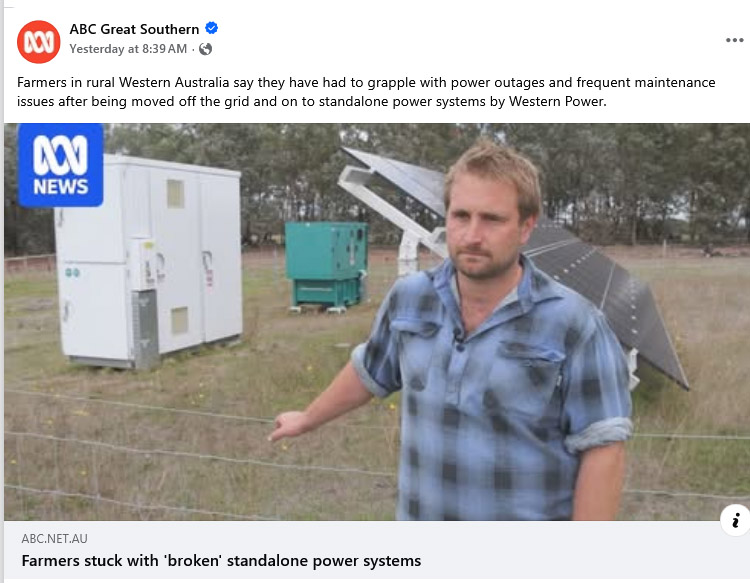
Back in 2022, Western Power was excited about their big plan to get rid of 23,000 kilometers of wire in regional Western Australia by forcing about 4,000 farmers off-grid and supplying them with solar panels and batteries. As of 2026, they have installed about 500 systems. Those farmers are the guinea pigs for the forced transition, whether they like it or not.
If renewable microgrids were going to work anywhere, it is surely in sunny vast first-world Western Australia, where renewable installations are only competing with a high-cost sparse long distance network.
But it hasn’t worked out as well as they hoped:
Maintenance issues, outages plague WA standalone power systems
By Mark Bennett and Rosemary Murphy, ABC News Stateline, WA
“We probably used to get three or four power outages a year and we thought it’s going to be great, we’ll have power all year round,” Mr [Ben] Parsons said. “Since it’s been installed, we’ve had untold power outages, probably getting up towards 70 power outages.“
He has asked Western Power to switch him back on to the main grid, but the utility rejected his request. “We’ve had kids in the bath, and the power’s dropped out, 7 o’clock at night middle of winter pitch black, you’ve got kids screaming in the bathroom,” he said. “It sounds like the generator is right outside the kids’ bedroom. My seven-year-old said to me the other day, ‘Oh Dad what’s that noise I can’t get to sleep’ … and it was the generator running.”
Big-Government isn’t giving people any choices. They turned up at one 85 year old’s house and told her they were cutting off her power and installing a standalone system. She had no warning. And apparently under the legislation, this is all fine, they don’t need to ask permission, and if you refuse them access to your land, they’ll just get a warrant.
According to Western Power 96% of customers are getting more reliable power now. The noise might be driving them nuts, but at least it’s reliable.
Here’s what the ABC was saying just 4 years ago –” It’s just a simple piece of technology, right?”
Farmers are getting renewable Standalone Power Systems as Western Australia’s regional power grid is dismantled
— By James Purtill, for The ABC, 2 Oct, 2022
Each “Standalone Power System” (SPS) is a fairly simple piece of technology, but the cumulative effect of the planned rollout will be enormous: 23,000km of wire will be taken down, or enough to string a power line around mainland Australia.
According to Western Power, no other network operator has embraced off-grid power on this scale, anywhere in the world.
[At Craig Poultney’s farm…] a fenced area contains about 60 ground-mounted solar panels providing nearly 20kW of energy, of about four-times the amount of a standard rooftop solar array. Western Power plans to install 4,000 SPS in the next decade, and up to 6,000 within 20-30 years. So far, it’s managed about 100.
But even back in 2022, there were signs of trouble. Farmers at the end of the line used to get blackouts which the solar panels and batteries were meant to improve, but if a storm knocked out the new generator or the solar panels, farmers were not allowed to switch it back on. They had to wait for an official to drive out and flick the switch, which sometimes took 12 hours.
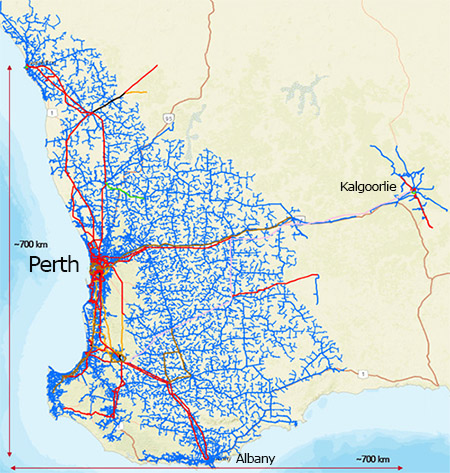
The map of the South West Interconnected System (SWIS) of Western Australia covers more than half a million square kilometers. — most of which is farmland.
The Cost, The Cost…
The key question, of course, is “what does it cost”, and “who pays” and the answer is — “unknown” and “we all do”.
The farmers are charged at the same rate for electricity as city folk and everything is subsidized, though Western Power was not saying how much in 2022:
Western Power declined to say how much a standard-size SPS cost to install, but other sources have estimated they’re about $150,000 each.
Installing an SPS became economical when a single customer had at least 4km of lines, Western Power’s Ben Bristow said. “Our modelling shows that over their 50-year life, installing standalone power systems is actually more cost efficient than poles and wires for certain parts of our network,” he said.
Horizon Power, the state-owned corporation which manages the network for the parts of Western Australia outside of the SWIS, is also using SPS to supply remote farms and properties. It’s so far received $6 million to deliver 150 systems across regional Western Australia.
They modeled a 50 year life?
Parts of South West WA has some of the lowest population density in the inhabited world, so renewables only have to compete against a sparse grid that’s expensive to run. And yet, here we are, just four years later, and even the ABC can’t find that many nice things to say about it.
REFERENCE
Map of SouthWest Grid: A Fereidouni et al Online Security Assessment of Low-Inertia Power Systems: A Real-Time Frequency Stability Tool for the Australian South-West Interconnected System DOI:10.48550/arXiv.2010.14016
h/t Bally, TonyfromOz, ABC News.






What does it Cost? “Unknown”
Who pays? “All of Us”
So how could they possibly do 50 year modelling if the Cost is “Unknown”?
Voodoo Economics
510
Not just voodoo economics, which implies a degree of uncertainty, but flat-out [snip “deceptive”] economics. The lifespan limitations of solar cells and batteries are well known. The fact that they modeled a 50-year lifespan without degradation or replacement for either one of them is intentionally fraudulent.
At a bare minimum, they should have factored in an annual degradation in capacity for 25 years, then a complete system overhaul at the halfway point, then another 25 years of degradation. And that’s being generous. You could just as easily model a 20-year lifecycle that requires two complete overhauls in 50 years.
240
Perhaps they did model the replacement of the solar panels after 25 years and the batteries after ten or fifteen? The fact that they needed to model it out for 50 year to be able to say “it’s worth doing” says something in itself, and it isn’t good.
Without seeing the modeling we don’t know whether they allowed for any degradation, or were aware of the recent study showing that solar photovoltaics are degrading much faster than expected — 8% may only last 11 years.
230
Jo, there is always the big issue that everyone overlooks and that is severe thunderstorms. When the conditions are right they form in a big line and do enormous damage to everything in their path – the problem is we have not seen that weather for many years and that is why it is not considered. The recent line of storms that hit South Dakota and destroyed or damaged 20 wind turbines is an example but even that line only had a few severe cells that did the damage. Wait until you get a line 500 miles long with tops above 40,000′ to 50,000′ and see what sort of blackouts we will have and not for just a few days either.
10
This entire caper was, from the start, ONLY about the “SPILLAGE” from the “money-go-round.
40
The “Modelling Mantra” – “if in doubt leave it out”
00
Funny (NOT) how they are forcing the farmers in WA to operate without overhead electric string
while in Victoria they are forcing farmers to accept (by “law”) overhead electric string OVER their farms.
Oh, the irony of it all.
OUR Grubbnmnts are NOT there FOR the Australian people.
750
Vic farmers are fighting against a renewable interconnector that is designed to deliver power to cities with little if any connection to the local distribution grid. The zwer pole at my farm was put up in 1963. Farmers will have a super highway of high voltage running across their properties to run data centres 24/7 and in return get unreliable Chinese renewable junk as the poles and wires are allowed to degrade into failure.
All brought to you by idiots in parliament.
120
50 year modeling – bunkum! Inverters last 15 years until they need to replace parts or the whole system with a new generation. Batteries probably less. Solar panels max 15-20 years. Multiple replacement cycles of single standalone systems somehow are economical against a single centralised power station with planned scheduled maintenance – no way.
600
A relative is on his 3rd inverter in about 20 years or so.
So roughly 7-9 year life span.
Could be poorer quality or brand, I don’t know.
210
What’s to say when the bleeding obvious happens?
“We probably used to get three or four power outages a year and we thought it’s going to be great, we’ll have power all year round,” Mr [Ben] Parsons said. “Since it’s been installed, we’ve had untold power outages, probably getting up towards 70 power outages.”
I’ll bet this lightweight was one of the idiots who voted for this rubbish. It was a lot longer ago than 2022 when a whole lot of people figured out this bullstein was fraught. I know, I keep saying it isn’t bad enough yet. What this dill has experienced needs to be experienced by cities. By States. By the Nation. And then maybe – after a year or more of pain, inflation, unemployment, poverty – enough people will label themselves “Argentina II” for something to change. It’s what happens, Human behaviour is predictable.
390
I doubt very much if Ben is a lightweight as you suggest. Any farmer out in the weeds is not a weakling and he would also know the futility of climate change and associated policies. Yes. He was told this was the answer to his power problems and thought it could be a game changer. Many remote farms have had their own power systems running on batteries and diesel generators for the last 70 years. Ben was assured that the solar panels would be much cheaper than all diesel. It should be. It should also be reliable. I’ll bet Ben did not vote for Labor.
270
One central new coal or gas station would’ve been preferable to this toxic, unreliable, noisy rubbish and would last much longer with proper maintenance.
But who cares what the farmers have to put up with and anyway the city people are not affected.
340
I doubt they will be building many data centres out there then.
250
I wouldn’t put it past them…Victoriastan is moving full steam ahead on AI data centres without sufficient energy in the grid.
140
There is already a fantasy to build data centres in the Kimberley region.
I’d be willing to bet it’s mostly powered by natural gas.
And the other question raised is what subsidies or “gifts” of land will be harvested?
70
Meanwhile in outback Qld it’s a lack of electricians
Although, maybe not
100
Hi Ted. They may have the same problems that Ben experienced except it will affect more people when it goes down. Those solar panels appear vulnerable to hail damage. Ergon seem to support panels over a few turbines. The sun is more reliable than the wind.
70
Why are we returning to energy poverty in some OECD countries and why do we believe in silly fairy tales when the science tells us the true story?
Here’s the latest post from the co2 Coalition’s Vijay Jayaraj.
We should be building many more baseload power stations and ensure we have cheap, safe, reliable energy beyond 2100.
https://wattsupwiththat.com/2026/07/06/europes-crisis-is-energy-poverty-not-a-heat-wave/
230
Not returning to energy poverty, the wokest OECD nations like Australia are already in a state of energy poverty considering that one of the most common causes of economic failure or high costs in Australia is energy poverty.
Of course, the high costs and business failures don’t affect the politicians or senior public serpents who make these rules or the wealthy subsidy harvesters.
60
My grandfather had a stand alone power system on his farm, before mains power was available. It consisted of a single cylinder diesel engine with a big flywheel ( RonaldsonTippett if I remember correctly), a generator and a bank of lead acid batteries.
I think it provided lighting only.
The diesel generator would run during the afternoon and early evening and then battery powered lights til bed time.
Hot water came from the slow combustion stove.
My grandfather was more than happy to pay for the SWER ( singe wire earth return) connnection to the grid when main lines were installed along the highway.
300
Maybe you’re not young enough to be my grandson but I fit your grandfather. I’m not on grid and have battled with generators, batteries and solar panels fifty years.
Modern (lithium) batteries, cheap solar panels and auto start diesel have vastly improved life and I have had no blackouts for couple years.
However, I still do “heavy lifting” with wood and gas. There is also a few thousand dollars investment. Learning to think about (worry?) what is going on is a disadvantage but not terribly.
Experience taught me you do have to do something about the noise.
And no it shouldn’t be cheaper.
130
This raises some interesting questions for me that are also relevant to this article.
Was your grandfather married or partnered? If so, did your grandmother/partner outlive him and stay on the property?
The reason I ask is that neither of my grandfathers made plans for my grandmothers past their death. My paternal grandmother was no longer capable of wielding an axe to chop wood. My father offered our weekender on the Gold Coast to my grandmother after grandfather’s death. By contrast, my father arranged for a granny flat on my sister’s house for my mother and passed away soon after she was settled in. He never got to spend any time in the granny flat other than during its construction.
So the issue of system maintenance may have weighed heavily on your grandfather. And that is clearly an issue for what is happening in WA. All the farmers should be given basic safety training on the systems and then access within their ability then phone number of local agents or neighbours who can help sort the issues. Over time, the bugs get ironed out and the systems become almost maintenance free.
The solar/battery systems are not yet into economic phase so lots of bugs to sort out yet. There is somewhere close to 200.000 solar electric pumping systems in Australia that have been installed based on economic merit. Solar water pump market is around $200M. More than hlaf of new submersible pumps are solar operated. Hybrid solar/diesel is growing strongly.
This is what an economic transition should look like. The grid would be gradually shrinking under economic forces. Not expanding under kleptocratic government authority aimed at subduing the pupolation’s will to survive.
150
Rick
Yes. Pretty much my experience. Most of my neighbours have just sold up and retired to the coast. Their children have decided farming, on less than big scale, is just not a goer.
System maintenance will become an issue in a few years but so will living on a rural farm and no my wife has never felt she could manage. Son would help but he is hours away.
“Given basic training” is not going to work if said participant has no basic understanding of what is going on. A liking, enthusiasm, for the scheme is required.
70
I agree with that. It should be a shared value arrangement where the land owner can gradually take full ownership and control. Let them decide at what pace.
The current grid will be subsidised by the more densely populated locations. The cost of the grid for those still connected would come down.
A packaged solar system should be much less maintenance than a motor vehicle. There are plenty of single women in their 80s still operating a motor vehicle. And having it maintained.
I would way overbuild on the solar panels and avoid the complexity of tying in a diesel. Most people take shock when I point out my off-grid solar system achieves a capacity factor of 3.8%. But I did that for simplicity and reduced maintenance. Panels should be aligned for maximum winter output, which mine are not. Easy to do if it is not a roof mounted array. And panels sloping at 70 degrees to horizontal are free from hail damage.
I am constantly surprised by my $250 Chinese built inverter still going after 14 years.
What you have identified is the problem with forcing wind and solar onto the grid for UN kleptocratic ambition. The solar technology is wonderful providing it is not force fed to people. Let the market decide – that should be the One Nation campaign slogan.
70
Grandfather died in 1967 at the age of 79. Grandmother lived for another 8 years but not on the farm, even though it had full mains power. I am not sure when the mains power came, maybe about 1950.
Grandmother would not have been able to chop wood, nor start the diesel generator.
I would have thought that solar with a battery pack and diesel backup would be economic on outback properties and give reliable service. There must be people who have tried it by now.
30
“Economic on outback properties”.
Often is, especialy if supply costs are added realisticaly. It is often a political subsity entanglement.
Rick. I get on well with my, newer, generator. Turn it on for serious loads, welder, but you are right about plenty of panel. Economically it, generator, would be poor but it supplies “insurance”. Any sort of backup is going to be days away and I have to do it. It has done very few hours in the last three years.
Is your $250 inverter modified square wave ? And if so how well do modern electronic stuff get on ? Mine, since defunct, wrecked a few mercury light bulbs and an old tv
20
Yep a cheap modified square wave. I anticipated it would caused an end of life episode with our 35 year old fridge but it has probably extended it by enabling softer starts. Freezer is also free of electronics and now mid 20s. So both have taken well to the modified square wave.
I unthinkingly placed an electronic power meter in the circuit when I was doing testing. It did not last a day. LED lighting may not like it either. Would not use it with electronic stuff.
I have a Victron full sine wave inverter rated at 800VA that will not start the fridge or freezer if the other is running. But if we end up with an inverter fridge or freezer then I will just use the Victron. It was on special some years ago so I bought it. The Chinese inverter has a continuous rating of 1250VA and overload double that.
10
Peter C,
After we discovered uranium in the South Alligator region of the Northern Territory, 250 km east of Darwin, we built and named the town of Jabiru starting 1970. There was diesel power with generators for a decade, supporting about 150 people then more diesel for the first Ranger One open cut mine and processing plant within the next decade. We looked into solar but there were no adequate products at required scale.
In 1956 I had helped my dad build and install rooftop solar water heating to CSIRO plans, so I was not averse to solar used properly. Still the case. But so much now is not used properly, including a lot that my taxes pay for without my approval. Geoff S
40
I span from wick kero lights through Tilley lights (big improvement for homework and reading), 32 volts via diesel engine, generator and batteries to SWER power. Also a Ronaldson Tippet – a friend used to refer to the Moffat Virtue badged ones as the “More Fat (oil) and Torture”)
32 volts did allow some appliances – the original Hoover single tub with hand wringer could be used on batteries, more elaborate washers beeded the engine running.
00
There is an article in The Australian Commentary section by Cristina Talacho
Australia’s energy policy is living in its own private Idaho – the references is to 1980s soundtrack: the B-52s’ Private Idaho – “living in your own private Idaho, underground, like a wild potato”. Well worth reading it, if you can.
https://www.theaustralian.com.au/commentary/australias-energy-policy-is-living-in-its-own-private-idaho/news-story/951cc3324e495a99c2aac5f2d9b02c64
70
A good summation of how out of step Australia is. The fascination with nuclear is misplaced in our circumstances. We have abundant thermal coal to run a much bigger grid for decades to come. It is relatively cheap to mine, transport and burn and new stations merely replace existing stations utilizing the established transmission grid. We know that CO2 is not a problem, in fact a blessing.
It does require an education effort by the opposition, numbers not slogans. One transmission line costs more than a new power station. Put it in the context of the consumer’s benefit. Imagine the savings of dropping the CIS, the climate subsidies, climate studies and university grants, the climate change department and the mandatory use of renewables.
180
Lawrie:
The fascination with nuclear is that it doesn’t emit CO2 which the clueless ones think is warming the planet.
Which reminds me, I must send a letter to the local paper including some prediction from the 1980’s. Will include the prediction that alligators will soon be living in the Thames. There are others just as bizarre.
90
If people are stupid enough to think CO2 is bad, they’re also stupid enough to think nuclear power is dangerous.
They can’t have it both ways which is why Australia will never get nuclear power no matter how desperate we get for power.
As one of the stupidest, wokest, most self-destructive countries on the planet, Australians, most present company excepted, got exactly what they wanted and voted for.
90
There’s that magic word again…”modelling”.
If the “modelling” results in X then X must be true! Right?
It appears that an awful lot of garbage is being fed in to make the “modelling” give the answer that they want. How often has the modelling proven to be wrong?
Only the true zealots believe any of the garbage that is being spruiked now.
310
‘Modelling’, garbage in, garbage out.
180
This would be the second phase of an economic transition.
Proof of solar’s economic merit would be to set these systems up on remote farms currently using diesel generators. Once the wrinkles are ironed out and the property owners are saying things like “best thing since sliced bread”, the program moved to the second phase of the transition by replacing the most remote poles and wires.
I asked Copilot how many remote minesites in Australia are using solar/battery systems. It did not offer a number but said there was data on diesel/solar/battery hybrids achieving $360-$364/MWh. Copilot offered diesel alone ranges from $400 – $1000/MWh in Australia depending on location and size. That range fits with my observations when I was visiting mine sites around the country.
Just a reminder for comparison. Latrobe Valley output was sold for average price of $23/MWh back in 2003 before the grid became weather dependent.
The $364/MWh is probably close to the optimum hybrid cost using diesel firming. It could be a bit lower using Ngas firming. But Ngas alone would be lower cost. So $360/MWh is close to the real wholesale cost for 80+% “renewable” grid. That translates to 36c/kWh at the end of the transmission line before the cost of distribution and retailing are added. I see 70c/kWh retail price in Australia’s future.
I wonder how long the gullible will remain gullible.
170
It is in these remote areas that SMR and local grids could prove the best solution.
By using advanced construction methods, the BWRX-300 SMR can be built in approximately 24–36 months from first nuclear concrete pour to ready for fuel load for nth-of-a-kind units.
Ontario is installing 4 such units and want them all up and running within 5 years. Bozo Bowen is not aware of such things.
130
No grid is the economic choice in these regions. So the relevant current nuclear technology is what is being sent into space. If it can be priced to challenge solar without a grid then let it compete there.
No grid is the economic option for locations where farmhouses are kilometers apart.
Solar powered irrigation systems is a fast growing application. A lot more sensible to set up solar powered pumps around a property to control water supply than having to refuel diesel pumps every few days or run cabling across a large property.
50
Someone wise said “A perfectly good civilization is going to waste…”. Not sure who that was, can someone Google it (or CoPilot,Grok, Claude, ChatGPt, Gemini, Perplexity it)?
To think that once upon a time Australia had a grid that supplied plentiful, relatively reliable CHEAP electricity and we have thrown that away in a stupid exercise to chase rainbows.
210
The quote is attributable to JoNova.
https://x.com/joannenova
120
All this about energy management and the economy floundering is just part of the MANAGED DECLINE of Australia by all our political parties.
140
With the exception of One Nation and the minor conservative parties who don’t support the managed decline.
70
A few farmers in WA losing power because they have been forced off-grid will be nothing compared to that time when the whole population is forced to generate their own power and are forced into managing their own systems. Can you imagine the chaos when hundreds of houses all over big cities are calling for support. They’ll pine for the days of occasional suburban blackouts.
120
The guys who ran the tram system in Melbourne back in the day of horses probably had the same thought about the new fangled automobile.
I know for sure that the guys who operated the computer centres in banks and large businesses had similar thoughts about desktop PCs when they first came out as well.
Philips thought they knew everything about electronics when they produced their first color TV. It was such a big deal that I got invited to an IEA meeting that focused on the design of the TV set. They had done thorough failure analysis and recognised the growing complexity of the TV compared with B&W that they realised they would need a lot of maintenance/adjustment so made construction decision based on ease of access. Meanwhile others (Japanese) just focused on design simplicity aimed at eliminating the need for adjustment.
The Japanese focused on smaller and more stable through solid state electronics, lighter, more reliable, lower cost. They dominated the market within a decade after color TVs came out in Australia. Are there any TV repair shops still going? Aldi have 40″ for under $200. The first Philips color TV was over $1000 in the early 70s and I think 23″.
This 5yo laptop I am typing on has been my main office machine up until this year. I do not expect it to fail although I do back up key data. I have replaced it as my main office machine and use this as a browser now. I am told the operating system is no longer supported but it operates well. So obsolescence will most likely be its mode of demise rather than failure. If the battery gets low then I probably will replace the machine rather than the battery.
It is hard to predict the future. But if houses came with their own lifetime power source that would probably be a nice thing. Whether the power comes from energy collectors on the outside cladding or a tiny nuclear generator under the floor or a combination or some currently unknown source would not be of much concern.
When you can go to the local ag supplier and pick up your new solar power source like you do a solar pump or diesel generator the technology will be economically viable – let the market decide. I notice now that small building sites around my area use solar powered pole mounted security systems that have all the gear about 6m above ground level and include mobile service. An economic use of solar/battery power. Lots of mobile solar powered temporary street lighting systems. I have just fitted solar panels to my remote security cameras so they are always charged. The tiny panels were supplied by the camera maker.
50
That would be the Philips K9 chassis with 11 removable circuit boards and swing out chassis.
https://obsoletetellyemuseum.blogspot.com/2012/01/philips-26c46558-chassis-k9-internal.html?m=1
40
I meant in the context of taking electricity for granted as opposed to suddenly having to manage their own system.
Horse to car and B&W to colour are essentially upgrading an appliance.
00
Doesent say much for our education system. How can Government be so stupid. Coal has always been cheaper than any renewable.
220
Sorry Angus but not always.
Transmission is an issue and costs need to include environmental.
In 97% cases I’ll agree
21
The old saying , repeat a lie often enough until the majority believes it…
30
Several decades ago at Speech Night for my high school in Victoria the guest speaker was from the American Nuclear Energy Commission??? ; he said that in a few years we could have a unit the size of dustbin at each house which could supply all our heating,cooling and electricity.Sounds like a mini nuclear reactor.
70
It’s doable and viable although it won’t happen because of the scare of nuclear materials accessible to the usual suspects. A thorium system might be worthwhile as it can’t be used to produce a bomb.
20
Micro reactors are being developed.
30
Voyagers 1 and 2 a bit scaled up
20
Follow the money. Might be an idea to find out exactly who has the contract to supply these systems. Whoever that is is doing very well out of this. Wonder how politically connected they are.
I can’t believe that this can be in any way cheaper than maintaining a few SWER lines.
Sounds like someone whispered into a Minister’s ear and in his child like enthusiasm he glommed onto it. Bit like the bullshit Queensland interconnected fire alarms scam because somebody stole the 9 volt batteries out a of the alarms in a backpackers’ hostel years ago.
I’m now in an interesting situation. Moved to a rural five acres and am off grid although there is a power line and even a property pole right there. Last owner got sufficiently annoyed with the power company that he got them to disconnect and put on 6.5 KW solar panels, 13.2 KW-h of LiFePO4 batteries and an LPG powered 10 Kilowatt generator. There is even a small wind turbine which is more decorative then anything. Allegedly rated at 2 kilowatts but best I’ve seen in 700 watts during a storm gust front.
Haven’t needed the generator in the 3 months since moving in. You need to be a little mindful of total load but no problem so far.
Given the $400 per annum supply charge (and going up) and reconnection costs it is likely that my best strategy for more power is more solar panels and more batteries.
50
A bizarre assumption. A real power station has a life of 50 years, not a domestic off-grid installation. Anyone who has had to replace a lithium or other battery would know that. Apparently the “modellers” don’t.
Back in the day “modelling” of economic or physical phenomena was a legitimate thing and was a simplified representation of actual reality.
A model was based on physical parameters and known behaviour and was validated with real-world data.
Now it’s just a vacuous buzzword to impress poorly informed, low IQ dumbed-down people like Lib/Lab/Green/Teal voters and politicians.
For instance, most, if not all climate-related “models” embed dozens or hundreds of tunable parameters and uncertain feedbacks specifically designed to give the desired result of catastrophe or in this case of off-grid power, no catastrophe.
Today’s woke modelling tracks incentives such publications, grants, sunsidy-harvesting, media and social engineering policies etc..
Traditional rigorous modelling based on physical reality remains valid, e.g. Lattice QCD or lattice quantum chromodynamics in particle physics which uses just a few physical inputs, no freely adjustable parameters, is validated by real-world data etc. and works.
Woke modelling should not use the good reputation of real modelling with the Leftist agenda-driven fake modelling.
The Left ruin everything that is good, including modelling.
150
Back in the day the problems of vast numbers of small individual power generation systems was solved by producing large centralised power systems called power stations which were extremely economical and near perfectly reliable.
Now the Left are regressing us to the time before power stations.
What did Australia use before candles? Electricity. Oh, but we can’t use candles either, they’re made up of evil hydrocarbons. We’ll have to ask the natives what they used for night time lighting before the evil white man came.
130
These days common business modelling and graphic presentation software make it too easy for the clueless to produce faux “models” and to produce impressive graphics that mesmerise the low information voter, politician and senior public serpent.
And there is never any attempt to validate the model or its predictions. Also, because these same people have memories like goldfish (no offence to the goldfish community) they have forgotten by the time the model prediction is meant to come true.
Who will remember in 50 years that these off-grid installations didn’t last that long, or even in five years?
Low IQ and low information people have short memories and don’t care in any case.
50
Just like the modelling that showed a 275 dollar reduction in Electricity price by ………
Electrickery on the Australian Voter.
30
The Government doesn’t care about any of this as they’re trying to drive farmers out of business anyway.
Farming (except native “farming” as they did when they “lived in complete harmony with the land and each other” LoL) is bad for the environment, didn’t you know?
And remember that the “carbon” pollution (sic) they want to get rid of is YOU (non-Elites).
100
So in the latter half of the 20th century, with a tiny population WA had industrious, clever people that said we can get cheap electricity to 90+% of the population no matter how remote.
They build thousands of kilometres of reliable poles and wires, transformers and interconnectors and over the decades build multiple coal fired power stations to bring cheap electricity to the mases, but over the last 20-30 years bureaucrats and dunce accountants said “it costs too much to maintain”, lets tear it down and offer them something sub standard but more complex and just as costly.
Similar with the rail network, it was vastly bigger 50-100 years ago and bean counters said it costs too much, now we have hundreds of huge trucks sharing our roads moving freight that should have been on rail.
120
The quiet bit out loud: 😱
Western Power’s Ben Bristow said.
“Our modelling shows that over their 50-year life, installing standalone power systems is actually more cost efficient than poles and wires for certain parts of our network,” he said.
NOTE: All it is about the cost to “their network” not “your farm”. 😭💰
80
We simply get the government we deserve – after all it’s the public who voted for these imbeciles. So we have 3 choices – vote the b*stards out, suck it up or leave. I now favour the latter.
30
Tonight’s TV news reported that a robot vacuum cleaner suddenly exploded in a kitchen, took out a gent with 70% burns. Reporters carefully avoided mentioning the possibility of another lithium battery failure.
What else could it possibly be? Why won’t they admit that under some circumstances, lithium batteries are dangerous.
20
Sorry Mods, just realised was looking at the wrong thread. Can this be moved to the Tuesday thread?
[Sorry, that is hard to do. I wish I could. – Jo]
20
“They turned up at one 85 year old’s house and told her they were cutting off the power….”
We had an Optus modem fail a fortnight ago. We arranged a new one but they failed to tell us that the new agreement meant no more “landline” phone, which went dead. My 83 year old wife is in a wheelchair. Some years ago we bought 4 hand phones with cords so that if I was not there, she could get to a phone in a short time. All gone now.
There have been a dozen or so communications to and from Optus but she still has no phone. Cannot use a normal mobile, hands are too crippled, but old phones were ok.
Optus now sends messages of assurance in poor India-English sent from no-reply email addresses, with no phone number.
It is a circus, except there is emergency danger.
Optus is supposed to be in communication. Best they can do is send out meaningless drivel while avoiding responsibility.
Geoff S
80
Does this also mark a transition to low voltage (<48v) lighting systems, simply allow the property owner to self maintain.
Or will the ban on simple 240v changes (change the permanent light fixture) be changed?
00
FWIW –
And just so we don’t feel neglected here in SW Qld we seem to have a major Telstra mobile network outage ATM.
00
“…about 60 ground-mounted solar panels providing nearly 20kW of energy,” kilowatts (kW) are NOT energy, it is power. kWh is unit for energy.
00