Recent Posts
-
Monday
-
Sunday
-
UK facing devastating 36 degree heat — can’t decide whether to use air conditioners or rip them out
-
Saturday
-
Batteries failed on day One: A four day wind drought in South Australia wreaks havoc, high prices
-
Friday
-
The UN wants to be One World Government and it starts with a carbon tax on ships and planes
-
Thursday
-
What if Global Warming was just because something made the clouds go away…
-
Wednesday
-
Snowy 2.0 is the Trillion dollar Black Hole of Australia — sucking in energy, money, land, industrial relations, the dollar, our lifestyle
-
Tuesday
-
Monday
-
Winter Solstice
-
Saturday
-
We were throwing-renewable-energy away at record levels in 2025
-
Friday
-
Pauline Hanson, the centrist, just wants a free market in electricity, and an end to the renewable energy bribery
-
Thursday
-
Blame the Climate Yeti again for making your life more expensive! (It’s a smokescreen)
-
Wednesday
-
The Sunrise Project funneled $343 million from overseas to push net zero
-
Tuesday
-
Monday
-
Sunday
-
The US government has been secretly funding 120 dangerous biolabs around the world
-
Saturday
-
New report shows renewables are a drag on our national productivity
-
Friday
-
Thursday
-
Well, how convenient. AI data centers have arrived to be the fall guy for the Energy Minister
-
Wednesday
-
Billionaires are leaving the room with excuses — Bezos says “AI will solve climate crisis”
-
Tuesday
-
Monday
-
Sunday
-
The Craziest eco laws against Farmers. Let’s check that science…
-
Saturday
-
China cooks the carbon accounting books by 400 million tons
-
Friday
-
The Wind Power Puzzle (add more wind turbines and get the same output)
-
Thursday
-
To save the world, Cement Australia stops burning coal and burns trees instead
-
Wednesday
-
On Fire! US hunger for gas power so large, wait time for turbines blows out to 5+ years
-
Tuesday
-
Monday
-
Sunday
-
Saturday
-
Perth event Saturday May 30th: Green Greed and the Grid
-
Catastrophic warming already happened in Antarctica 130,000 years ago
-
Friday
|
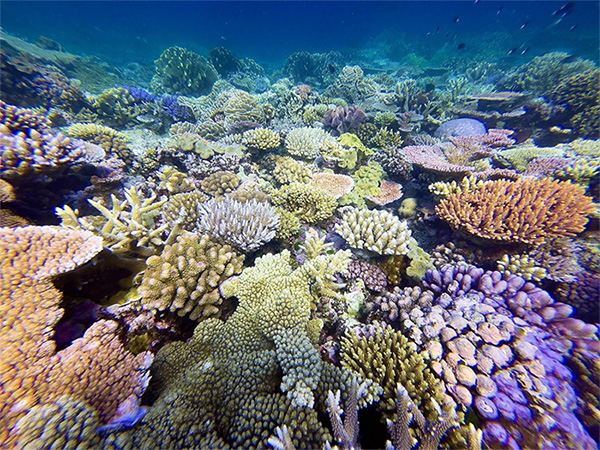 Corals in the Great Barrier Reef off the coast of Australia. (Courtesy of Jessica Hankins) By Jo Nova
Everyone was sure that corals would be degraded by our “increasingly acidic oceans” (a political-activist-term for “slightly less alkaline”). But when a team took cores from 200 year old corals in the ocean — instead of studying them for a few months in a laboratory — they discovered some corals have adjusted to the pace of “acidification” much more effectively than anyone thought. The corals actively manage the chemistry of the thin layer of fluid next to the skeleton as the ocean chemistry shifts.
Who would have thought that corals would have the ability to cope with rapid changes in the climate?
In the last 4 million years, corals have only survived 90 or more ice-age cycles.
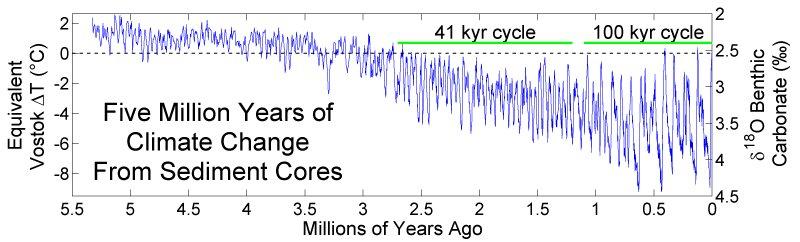
L. E. Lisiecki and M. E. Raymo (2005)
If only someone had thought to test actual corals at sea before they spent twenty years scaring little children at school?
Thanks to Oldbrew at Tallboke’s.
From the Press Release: Corals are “More resilient than previously thought”
Corals, the foundation of ocean biodiversity, are threatened by climate change. But new research suggests that these organisms might be more resilient than previously thought.
In a study published August 27 in Science Advances, a CU Boulder researcher showed that despite a gradual increase in ocean acidity levels over the past 200 years, some corals seem to be able to adjust and continue to generate their hard, stony skeleton structures.
While it remains unclear how the corals adapted to the changing environment, Hankins said the secret might lie in their calcifying fluid.
“It could be that the processes corals use to modify and regulate their calcifying fluid are more complex than we’ve been able to constrain previously,” said Hankins. “More studies are needed to determine if different species, or if the same species in a different location, have similar responses,” she said.
The ocean absorbs about 30% of carbon dioxide emissions from human activities. As more CO2 dissolves in the ocean, the seawater undergoes a chemical reaction that makes the ocean surface more acidic. Previous studies suggest that ocean acidity has increased by 40% since the Industrial Revolution and is likely to rise further.
Corals use aragonite, or calcium carbonate to build their skeleton. It turns out that pH of the water is so important that corals don’t leave it up to chance, but manage the right pH in the calcifying fluid around the skeleton. Corals build their skeleton in a microscopic compartment between the coral’s tissue and the skeleton. The area is only micrometers thick, and they use proton pumps to get rid of H+ molecules and control the pH themselves.
In the graph below, in part A we can see that the aragonite in the calcifying fluid (Ωcf) has been increasing since about 1840 in the oldest coral. In B the aragonite in the seawater starts to fall rapidly from about 1970 onwards, which ought to “change everything”. However in D, despite all that, the annual calcification rate stays remarkably similar.
 Fig. 2. Multidecadal time series of coral growth parameters and seawater conditions.
Coral Sea (blue) and Yonge Reef (red) core (A) calcifying fluid ΩAr (Ωcf), (B) seawater ΩAr (Ωsw), (C) sea surface temperature, (D) annual calcification rate, (E) linear extension (i.e., annual vertical growth), and (F) skeletal density. In each panel, monthly (for Ωcf) or annual (all other parameters) data are plotted along with linear regression trendlines. Significant (P value <0.05) trends are plotted as solid lines, and nonsignificant trends are plotted as dashed lines. Shading in (A) indicates ±1 standard error of the mean among three replicate down-core sampling transects. The Ωcf data were treated with change-point analysis, hence the two trendlines per coral record (see Materials and Methods). Just because one study in one type of coral shows that corals may be more resilient than thought doesn’t mean the whole Great Barrier Reef will be fine. But it does show that the experts have been talking out of their hats, whipping up dramas they really didn’t understand.
REFERENCES
Jessica Hankins and Thomas M Decarlo (2025) Multidecadal decoupling between coral calcifying fluid and seawater saturation states, Science Advances, 27 Aug 2025 Vol 11, Issue 35 DOI: 10.1126/sciadv.adr0264
L. E. Lisiecki and M. E. Raymo (2005) — A Pliocene-Pleistocene stack of 57 globally distributed benthic δ18O records, Paleoceanography 20, 1003
10 out of 10 based on 84 ratings
10 out of 10 based on 11 ratings
By Jo Nova
This is the state of national energy debate in Australia — preschooler taunts
The Nationals have finally decided to dump the Net Zero target (an excellent step*). In reply, Chris Bowen, the Minister of Electricity and Weather, could have reeled off all the countries with unreliable energy that are building aluminum smelters, except there aren’t any. He could have dazzled us with talk of terrawatt-hours, or fantasy hydrogen tankers that are just around the corner, but no one believes that any more — so he just went for dinosaur joke he heard in Grade two.
Mr Smug, Chris Bowen:
“The old National Party — deciding whether the Earth is flat, and whether the Earth rotates around the sun, or visa versa in 2025. Like get with the program…”
Effectively the Energy Minister has nothing at all, so he’s calling the National Party stupid like a rock. He hopes you don’t notice. It’s a cheap childish trick, but hey, it fooled the ABC. They were so impressed with his sneering condescension, they played it on the nightly news on Saturday night and introduced this wit as “standing firm on policy”, as if he said something meaningful.
Most of the climate change debate is a bluff. It has always been that way.
When an impertinent sod asks a hard question, the believers launch into a scathing pantomine — calling them deniers, or mocking them as lizard-brain flat-Earthers. It’s a rhetorical trick that implies the answer is so bleeding obvious, and the questioner is so stupid, they don’t even need to answer the question. When done well, the debate is won before it even starts. And onlookers learn that they don’t want to ask questions like that. It’s just a form of bullying.
What’s really extraordinary is the ABC didn’t recognise how silly this makes Bowen look. They usually work as the Labor-Green promotion team, so they must have thought this was not A-Grade moral-preening, but something impressive. Scary.
It will be a great day when we see the opposition mock Bowen (and the ABC) for this unprofessional petty behaviour.
Namecalling only works until someone calls it out. Make them pay.
If anyone wants to see the context, here’s the 40 second segment.
*The Nationals leader, David Littleproud, sadly, is still pandering to the “We Believe In Climate Change” crowd, which is a shame, because it will deprive The Nationals of their best points and funniest lines, but in order to get to the Land of Sensible, they have to get over the Net Zero bridge, so it’s a significant win, and may yet drag the Liberals over the line, or split them.
10 out of 10 based on 107 ratings
10 out of 10 based on 10 ratings
8.7 out of 10 based on 24 ratings
8.9 out of 10 based on 19 ratings

By Jo Nova
Only a few schmuck countries are even trying anymore
Ten years ago 196 countries signed legally binding pledges to fix the weather. Every five years they agreed they would update their plans, and the plans could only go upwards, and never retreat.
So here we are, with a week to go before the COP30 party starts again, but this time only 64 countries have bothered to update their plan.
The best guess is that the UN is on target to reach cuts of 10% instead of the 57% cut they said the world needed to stop a 1.5°C rise by 2035.
What does legally binding mean? — Turns out, not much.
By Matt McGrath, BBC
Recently drafted climate plans from scores of countries fall drastically short of what is needed to stave off the worst effects of climate breakdown, analysis has shown.
Only 64 countries have submitted new plans to cut carbon, the UN says, despite all being required to do so ahead of next month’s COP30 summit. Taken together, these plans would cut carbon by only about 10% by 2035 compared with 2019 levels. This is only about a sixth of the drop in global emissions needed to limit global heating to 1.5C.
To keep that goal alive will require steep cuts in greenhouse gas emissions, up to 57% by 2035, according to the UN last year.
These include around 30% of global emissions, which incredibly includes the US, because Joe Biden, or one of his minders, put in an update early. Given that the US emits 14% of global emissions and is not going to be meeting any agreement, except accidentally, the current Paris agreement covers what’s left, which is 17% of global emissions.
Most countries are not even going through the motions of setting pretend targets that they have no hope of meeting. That’s how little they care. Though the EU, riven with political strife, is still arguing over how ambitious to make their commitment. By the time the US is officially out, the EU may be back in.
But at this point, even the UN effectively admits defeat on the 1.5°C target
“One thing is already clear: we will not be able to contain the global warming below 1.5 °C in the next few years. Overshooting is now inevitable. Which means that we’re going to have a period, bigger or smaller, with higher or lower intensity, above 1.5 °C in the years to come.”
— António Guterres, address to the World Meteorological Organization meeting, Geneva, late October 2025
But they got the money and another decade of junkets, which was really the point wasn’t it?
The Liberal Party need to get out and about because most of the world knows The Paris Agreement will not recover. Australia is nearly the last Global Schmuck left standing.
9.8 out of 10 based on 117 ratings
9.4 out of 10 based on 12 ratings
By Jo Nova
Everyone’s new favourite Bureau of Meteorology page is the old one (reg.bom.gov.au)
UPDATE: People don’t seem to realize this is the golden link (above) to the old BoM site. You can remake your bookmarks. Eg: The Old Rain Radars.
UPDATE #2: Good news! The BoM has decided to keep the old radar style, but allow people to choose the mm/h newer style if they want. Sounds like a choice!
Despite 4 million dollars and 18 months of beta testing the new BoM website was met with anger and dismay and accusations that they put lives at risk by rolling out big unnecessary changes just before the storm season begins in the north.
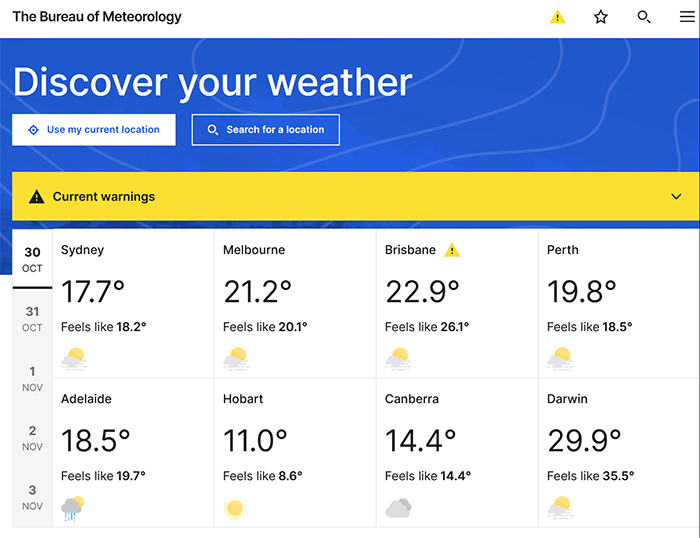
The new design radiates smug condescension. They are the experts and you are the kindy kids. The headers are done in 100 point font, with acres of screen-space used to convey almost nothing at all, apart from the temperature of the capital city near you. The BoM, apparently, thought this is what Australians wanted — “the temperature now”. Except that most people with a computer or a phone can see the temperature in the task bar or home screen. If only someone had told them “there’s an App for that” they could have saved the money.
Across the top of the home page is a giant message for four-year-old taxpayers — “Discover Your Weather”. The BoM are the authority and you, a crusty old farmer/brickie/businessman, have never known weather before.
This headline is designed to remind you of how stupid you are
It “feels like” Dick and Dora would like to teach you about clouds today.
If it grates on you, there’s a reason.
The feedback has been so bad even the federal Labor government is demanding answers.
But really, it’s your fault and you need to adjust faster:
The BoM’s top man acknowledged ‘some’ people (i.e. the stupid ones) will take time to adjust. In other words, they are sorry, not sorry.
The BoM’s CEO, Dr Peter Stone, said he recognised the unpopularity of the changes.
“We didn’t make the change lightly and we appreciate that it will take time for some to adjust. I sincerely apologise for the challenges the change has caused,” he said in a statement on Wednesday.
Because they live off constant taxpayer funding, the BoM don’t realize out in the real world, the hours Australians spend learning how to use a new website costs real money. All the knowledge millions of Australians had of how to find meteorological-data has been tossed to the wind. The BoM just drained 10 million hours of productivity from the country.
One of reasons for the change is that the “upgrade was overdue”:
“The old website served us really well, but it had been well over a decade since there has been any upgrades to it,” he said.
So? It’s as if a ten year old site simply had to change because there was grant money to spend and no one had spent it yet, right? The old public service axiom.
Compare the new site to the old. In the same space on the home page, the old site has a satellite map, temperatures, wind direction, wind speed, max and min temperatures, and rainfall in mm. There are one click links to warnings, forecasts and observations. That’s about 50 times as much information.
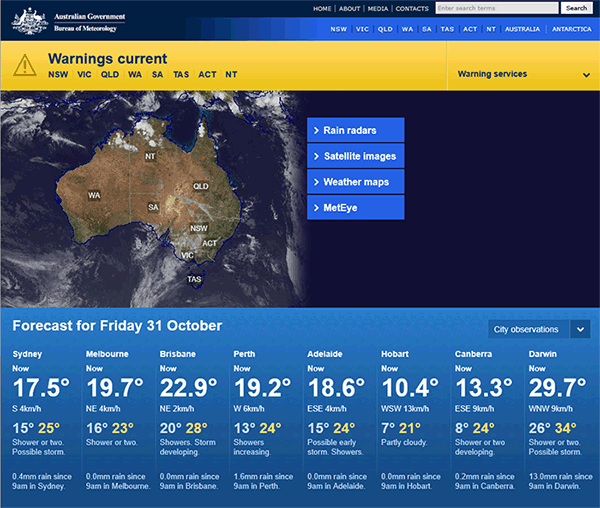
Many people are especially unhappy about the rain radars
Some people in Queensland were up in arms when storms hit a few days after the new site opened, and the rain radar appeared to be underestimating the intensity of the rain. Below is the old and new versions of the same rain patterns at the same time around Brisbane last night just for comparison.
The designers have added a white halo around the town names to improve readability on a busy background, but it makes the town names stand out which obscures the rain. Kinda defeats the point…
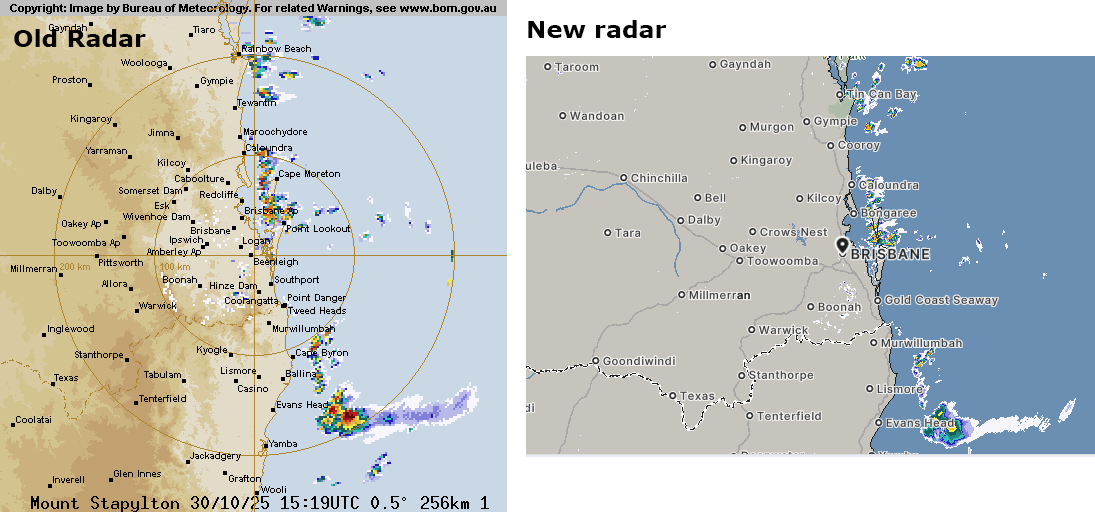 Old Radar page and the New radar BOM. The two scales are not exactly the same (they don’t have the same menu options). The new site works a bit better zoomed in.
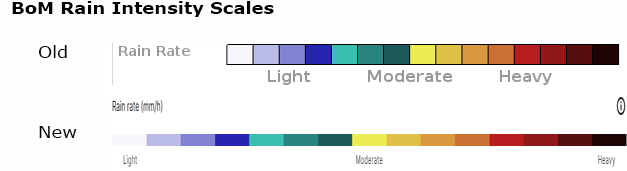
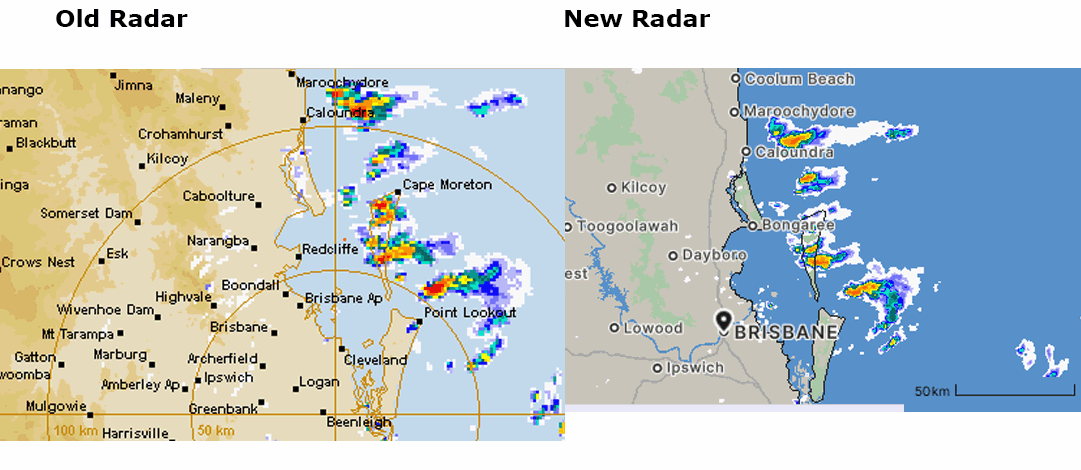 Up closer, Brisbane to Caloundra 2:20am The two color scales appear to be the same in the key (below). But the colors are applied in different conditions. According to Steve Turton, the old radar site uses radar reflectivity units (dbz) while the new one uses a rainfall rate in millimeters (mm/h). Rainfall that appeared black in the old scale was only red in the new scale. Hence people got a nasty surprise because they underestimated how heavy it was.
Steve Turton also says the Doppler wind function is gone:
Farmers and fishers have been frustrated by the disappearance of the Doppler wind function. On the old site, this function was a vital way to track the intensity of winds associated with supercell storms, cold fronts and tropical cyclones.
In hilly regions such as the area between Cooktown and Townsville, local weather radars are essential as a way to give residents and farmers a better way to see rainfall. But in the new update, some areas appear to have been completely wiped from the radar view. Places such as Cape Tribulation – one of the wettest locations in Australia – can no longer access this crucial information.
Around Broome last night the oncoming rain looked remarkably different in the two radar displays. The vast rain dropping north of Bidyadanga almost disappears (as does Broome itself, in the new radar, oops).
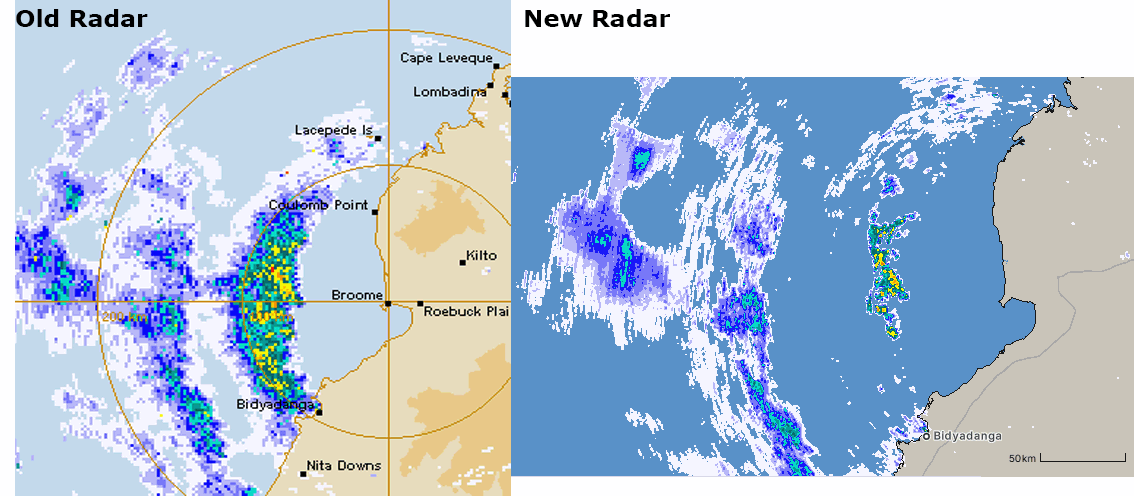 Broome rain radar — old and new Let the BoM (and your MP) know what you think. The BoM wants your feedback they say:
Customers and the community can continue to provide feedback via:
•On-page: Customers can submit anonymous feedback using the feedback pop-up window or the ‘Was this page useful’ button at the bottom of every page.
•Contact form: Customers can submit feedback and enquiries on the new website’s contact form.
•Phone line: Customers can call 1300 754 389 for website help (operating hours 8am-6pm AEDT weekdays).
The BoM are too detached from real Australians:
The real problem seems to be that the BoM is a long way from any accountability or competition in anything it does. They got away with hiding their methods, making huge adjustments to data, throwing away data, not being honest about the uncertainties they are dealing with, and using electronic equipment that records “one second records”. At times they have made flagrantly bizarre and radical changes to our historic data, or homogenized data from 1,500 kilometers away. Sometimes, they pretend the 1800s didn’t happen (don’t mention the Federation Drought or all the times it was 50 degrees Celsius in Australia).
It appears they think taxpayers are simpletons. (Perhaps because 69% of them don’t believe in the BoM’s favourite climate religion?) Wrapped up in their inner city enclaves, many BoM staff may have never met a real farmer. Yet farmers are businessmen who make a living out of placing bets of hundreds of thousands of dollars on the weather every year. And fishermen and firemen sometimes risk their lives.
Who were testing the beta site for 18 months — not farmers, firefighters and fishermen?
h/t Geoff D, J.J. Peter C, Vicki, David Maddison, Old Ozzie, Yarpos, Ronin, OzFred
Keep reading →
9.8 out of 10 based on 106 ratings
9.3 out of 10 based on 16 ratings
9.2 out of 10 based on 11 ratings

By Jo Nova
Yet another climate change heavyweight abandons ship
It’s the beginning of the end of the renewables fantasy, but there will be no apology — no admission they were wrong, or that thousands upon millions of people have suffered because of climate sorcery.
Watch as the billionaire who lectured us from private jets, pivots into word salad. Now he says we still have to solve climate change (whatever that means), but the doomsday view is wrong, and that awful carbon pollution “will not be the end of civilization.” He’s suddenly turned into a kind of Bjorn Lomborg. Forget Mitigation, say hello to Adaptation.
On the cusp of COP30 in Brazil, Bill Gates has launched a life raft for his reputation — a 17 page memo called Three tough truths about climate.
Bill Gates can see what’s coming (a reckoning for the renewables debacle), and he is repositioning himself so he doesn’t go down with the ship. Indeed, he’s almost writing an escape plan for the whole Blob. In a nutshell, he’s admitting between the lines that wind and solar power are unaffordable, and since climate change won’t actually be that catastrophic, everyone should calm down while we invent technologies, and in the mean time, get back to stopping people from starving. Wouldn’t you know, he says “Health and prosperity are the best defense against climate change.” (That’s Truth #3 ).
What he’s not saying is that he and his friends wasted untold billions (maybe trillions) of dollars of our money installing wind and solar panels which aren’t very good. He is not joining those dots.
We still need that breakthrough mythical technology to save us from the climate monster.
by Bill Gates
…though climate change will have serious consequences—particularly for people in the poorest countries—it will not lead to humanity’s demise. People will be able to live and thrive in most places on Earth for the foreseeable future. Emissions projections have gone down, and with the right policies and investments, innovation will allow us to drive emissions down much further.
Unfortunately, the doomsday outlook is causing much of the climate community to focus too much on near-term emissions goals, and it’s diverting resources from the most effective things we should be doing to improve life in a warming world.
He’s still painting himself as a savior, of course:
If given a choice between eradicating malaria and a tenth of a degree increase in warming, Gates told reporters, “I’ll let the temperature go up 0.1 degree to get rid of malaria. People don’t understand the suffering that exists today.” –– AP News
Now, at long last, he says the first priority should be to prevent suffering in the here and now. Which is all very noble, but where were you Bill for the last ten years when people in Africa needed coal plants — you were telling them to invest in wind and solar.
Compare this to Bill Gates in 2021:
“The countries that build great zero-carbon companies and industries will be the ones that lead the global economy in the coming decades.”
–Bill Gates, How to Avoid a Climate Disaster
 Bill Gates Bill Gates set up Breakthrough Energy Ventures (BEV) “the future of energy” in 2015 and often put in a star performance at the UN COP Junkets.
Only a few short years ago climate change was going to be awful in our lifetimes according to Bill:
-
-
-
Unless we move fast toward zero, bad things (and probably many of them) will happen well within most people’s lifetime, and very bad things will happen within a generation.”
-
“In other words, by mid-century, climate change could be just as deadly as COVID-19, and by 2100 it could be five times as deadly.”
Between the lines Bill Gates is admitting the wind and solar experiments were a waste of money
The tough truth he dances around is that we don’t have a realistic way to get to Net Zero yet, we still need those breakthroughs. This is a polite way of saying that we wasted lots of money, and made life tougher for poor people.
Sometimes the world acts as if any effort to fight climate change is as worthwhile as any other. As a result, less-effective projects are diverting money and attention from efforts that will have more impact on the human condition: namely, making it affordable to eliminate all greenhouse gas emissions and reducing extreme poverty with improvements in agriculture and health.
What he doesn’t say is that the UN doesn’t care less about the poor, it’s just a vehicle for dictators and corporations to profit or sabotage competitors. That’s why they are jumping up and down over the best managed reef in the world, and not spending more time talking about the murder of Christians in Nigeria.
The big shift away from climate dogma
This is the Big-pivot away from Climate Doom, the obsession with a tiny 0.14°C of warming (per decade) and wind and solar subsidy harvesting:
Truth #1: Climate Change is a serious problem but it won’t be the end of civilization.
Truth #2: Temperature is not the best way to measure our progress on climate.
Truth #3: Health and prosperity are the best defense against climate change.
Expect The Blob to spend less time talking about temperatures and 1.5 degrees of warming, and more time talking about quality of life suddenly.
The New York Times makes out that it is a bit controversial, but really, we’ll solve climate change faster if we stop harping on about the prophesies of doom. Optimism, they now say, is the most effective way to motivate people.
Bill Gates Says Climate Change ‘Will Not Lead to Humanity’s Demise’
by David Gelles, New York Times
In a memo, the Microsoft co-founder warned against a “doomsday outlook” and appears to have shifted some of his views about climate change.
Politics aside, Mr. Callahan said Mr. Gates’s change in messaging was in line with studies that have shown that alarmist rhetoric about climate change is not the most effective way to motivate people to take action. “The result of a lot of research is that it’s much better to lean into the optimism than the pessimism,” Mr. Callahan said.
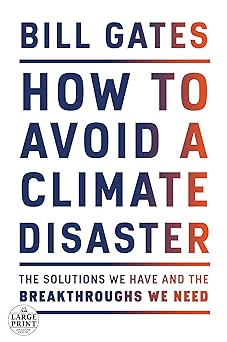 This is the man who wrote How to Avoid a Climate Disaster only 4 years ago. In it “Gates explains why the world must completely eliminate greenhouse gas emissions (“getting to zero”), rather than simply reducing them.” — Wikipedia This is the man who wrote How to Avoid a Climate Disaster only 4 years ago. In it “Gates explains why the world must completely eliminate greenhouse gas emissions (“getting to zero”), rather than simply reducing them.” — Wikipedia
Feel the Quickening: the green retreat is accelerating
As I said before, The Australian conservatives could end up being the last people on Earth still endorsing Net Zero.
h/t ClimateDepot
Photo Bill Gates: Kuhlmann /MSC
10 out of 10 based on 108 ratings
9.3 out of 10 based on 13 ratings

By Jo Nova
The truth is most Australians are skeptics
The Liberals are tearing themselves apart this week over what to do with Net Zero policy. Yet there is polling this week by the Centre for Independent Studies that apparently shows 69% of people would rather use more coal and gas if it made their electricity bills lower. And 55% supported delaying the Net Zero target if it meant electricity was cheaper. As reported in The Australian.
So two thirds of the nation clearly don’t think the oceans are going to boil. And lets not forget this is on the back of years of relentless Net Zero propaganda, lessons in schools, and the support of both the government and the opposition. There are no popular sit-coms mocking the windmills, nor are there celebrity endorsements, or football clubs with sponsorship from Big-coal or shirts that say “Instant Power”. There is no Trump or Farage figure here on TV (because the Blob media wouldn’t let them on). Yet somehow the voters have figured it out anyway, but they don’t know they’re in the majority. They don’t wear activist T-shirts and they don’t have bumper stickers on their car.
There’s an electoral fire here waiting for a spark
Imagine how big the support would be for cheap electricity and coal and gas if the leader of the Opposition was brave enough to take on the Global Bullies of Warming? To just laugh at the petty namecalling (“denier” — it’s a political ploy, not a term of science). To mock the delusion that we can control storms and tides with our solar panels. To calmly say that they will not cave in to coercion, when China, India and the US are increasing emissions. Australians need electricity we can afford. We need our own industries, we are not just a quarry.
A real opposition leader could point out our wholesale electricity prices were 3 cents a kilowatt hour for year after year until we started trying to change the jet streams and ocean currents with our power stations. Who knew fiddling with the clouds would be so expensive — everyone knew. That’s why they never published reports saying “we just need 2 billion more solar panels to save Bangladesh”.
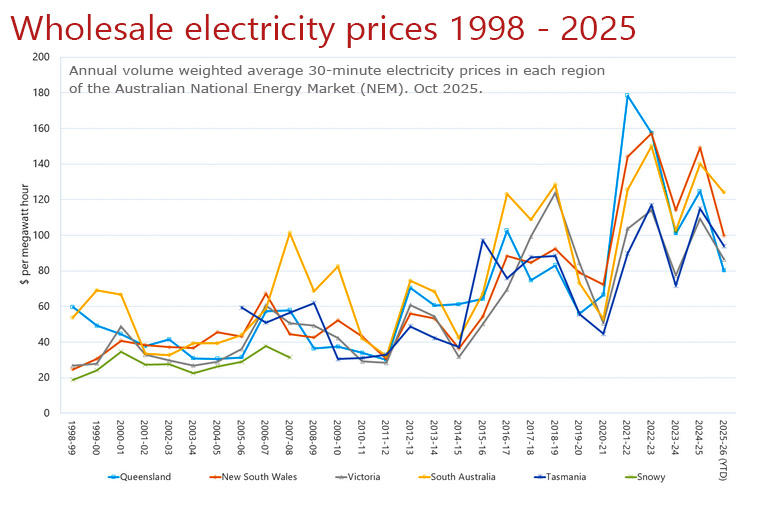 The more renewables we add the more expensive electricity gets. | Graph: AER And that’s the thing, even without the idea being put in front of them, two thirds of Australians don’t believe the CSIRO, they don’t believe the BOM, or the UN anymore. They don’t need to have a PhD to know that people who constantly forecast doom and gloom keep getting it wrong. And they don’t need a degree in climate science to know the models don’t work, because they can see the contradictions — that CO2 causes heatwaves and cold snaps and more wind and less wind, and more rain but more bushfires too.
So will the Liberals stand on the same side as 69% of the voters, or will they chicken out? Do we live in a democracy or don’t we? A genuine question.
Real leaders try to figure out what the right answer is, then lead the way. In this case the unwashed masses have already figured it out — they’re just waiting for a leader to arise to represent them. If Sussan Ley can’t rise to the test, when even the taxi drivers can see through a fake ‘science’ debate, the Liberals need a new leader.
With Shadow Ministers like Andrew Hastie stepping down, and Barnaby Joyce talking of leaving the Nationals, the Coalition is in an existential crisis. Months after the electoral-bloodbath the Liberals still don’t know whether to try to win the old conservative inner-city seats or to follow the Trump and Farage winning formula and call a spade a spade and take the working class away from the Labor Party.
The British conservatives missed the moment, and may never recover.
Photo by Leo_Visions on Unsplash
10 out of 10 based on 101 ratings
9.8 out of 10 based on 10 ratings

By Jo Nova
Spare us from being the Boring Nation
Today is the last day to put in a submission. Extended now to Nov 10th!
The Nanny State wants to reduce speed limits to save lives, instead of building better roads
Lord help us — a few bureaucrats who probably have never driven past Parramatta think our country roads will be safer at 70 or 80 kilometers an hour. By making road trips 10 to 30% longer, and 100% more boring, they may even kill more people than they save.
When every trip becomes a longer trip there will be more drivers still on the road at dusk and in the dark. Every extra hour on the road is an hour less to sleep or an hour less with family and friends. So drivers will either be more tired or more lonely. And when a four hour trip becomes a five hour trip, some will choose not to go. Some weddings will be a bit smaller, hospital visitors a bit rarer. Tourism will suffer. Businesses will close.
The repercussions of this change is a burden on so many aspects of our lives, most of which the “safety modelers” didn’t even think of. We are in effect slowing the whole nation. It will lower productivity, raise the cost-of-living, increase social isolation, causing mental health damage and depression. On the nation with one of the lowest population densities on Earth, it is some kind of anti-human plan to increase the distances between us. Technology brings us together, but bureaucrats push us apart. It will reduce health care in country areas, and limit holidays all over the country. Add some heart attacks, suicides and divorces to the mix. Almost none of which the “modeled” costs include.
Australia — the slow nation?
What price the reputational damage as Australia becomes known as a tedious nanny state of quaking chickens afraid to drive at normal speeds on straight, dry highways with hardly any traffic? How many tourists will be turned off — bored away? How many skilled migrants will balk at moving to a grandma nation?
Any driver with sense can already slow to 90 km/h when the road is rough, the weather bad, or the traffic heavy. Changing the signs just forces safe drivers to crawl on good roads in good conditions, while the reckless ones keep being reckless — they will just have to dodge the slow cars.
The deadline for submissions about this is today, Monday. (click here.) UPDATE: Extended to Nov 10th
Australians have just a few days left to have their say on a Federal Government proposal to reduce speed limits on rural and regional roads.
The Federal Department of Transport is seeking feedback on a proposed reduction of the speed limit on roads outside of built-up areas where there are no sign-posted speed limits.
A consultation paper released in conjunction with the review suggests speed limits could be reduced to 80km/h on sealed roads and 70km/h on unsealed roads.
David Littleproud, leader of the National Party says:
“Regional Australia have lost over $3300 a kilometre in federal funding to maintain our roads, our national highways.
“This is about saying regional Australia doesn’t matter and that we’re not going to fix your roads, we’re going to let them crumble and you’re just going to have to drive slower.
The window for public feedback closes this coming Monday, October 27.
For more information or to have your say on the Department website click here.
This could be one of the more absurdly incompetent, biased reports I’ve ever seen
Consultation Regulatory Impact Analysis, Sept 2025
It’s like the researchers added in every benefit they could think of, forgot almost all the real costs, and ignored the twenty other variables that matter. One of their core points is that people die on country roads 11 times more often than city people do. Strangely, this is “per capita” not “per kilometer”? How did they not bother to do this properly?
Also strangely, they seem to think that these rates should be the same. Country deaths are “over-represented” they say. It’s like hoping that workplace accidents on oil rigs will be as low are they are for check-out chicks at Coles. I mean, we want them to be less, but we don’t stop drilling until they are.
If speed was the main killer why are the inner regions at 100km/h so much safer than remote regions at the same speed?
Statistics show that the big killer on Australian roads is the distance from the major cities, not the speed limit. In very remote areas the speed limit is the same as the inner regional areas, but the death rates are twice as high.
— REFERENCE: Road Trauma Australia 2024. Statistical Report on fatalities and hospitalized injuries from road crashes in Australia, Bureau of Infrastructure and Transport Research Economics (BITRE). p7
Could it be that more people die in these areas because the roads are worse and if they crash it takes them 2 hours longer for the ambulance or flying doctor to get there (if they are lucky)?
The cause of deaths on remote roads is probably due to roads being in poor condition, with people driving run-down 40 year old Holden Commodores without ABS, and dealing with fatigue from driving ten hours in a row on a Chico roll and Barbecue chips. Ask yourself if slower driving speeds will solve that?
Ask yourself if a go-getting nation would fix deaths on bad roads in old cars by making new cars drive slower on good roads, or by building better roads, increasing prosperity and making newer cars more affordable?
Freight costs up just 10%? I don’t think so…
Truck drivers have strict fatigue limits. Some one-day return runs will now become two-day jobs with overnight stops. The modelers claim freight costs rise just 10 %, but once duty-hour caps are breached, costs jump 30–50 %. They also claim trucks will emit less CO2 because they’ll be driving slower — yet we’ll need more trucks to move the same freight in the same time.
Australia moves roughly 80 billion tonne-kilometres of freight by road each year (BITRE 2024). This keeps our mines, farms, supermarkets and petrol stations in operation. Even a 5 % system-wide productivity loss adds billions in costs — all feeding into regional produce prices, construction materials, and rural tourism.
What’s the cost of rebuilding trade-routes?
The nation is set up for 100km/h travel. Distances from cattleyard to cattleyard, petrol station to petrol station were all planned for human drivers at 100 kilometers an hour (except in WA where it is 110km/h and the NT where it 130 km/h). If we mess with that, all kinds of little things will break. More food will be wasted on longer hauls that have to sit overnight. Some crops may no longer make it to market in time. On the edge of the “travel day” farmers may have to change crops. Routes and rest stops will have to be shifted. Patterns will have to be moved. It all costs.
Reducing road noise will help… the kangaroos to sleep at night?
The paper claims slower driving speeds will save lives because traveling slower reduces noise pollution and that “therefore” will improve sleep. Say what? We are talking about 750,000 kilometers of roads that mostly don’t have houses beside them? Are we worried about REM sleep in Bunyips?
It’s like this report was written by a high school student in Ultimo.
To reinforce their point (and their incompetence) they cite a US study where people were “willing to pay $8.83 annually” to reduce it. Ouch, that much? (It must be a typo? p61)
Furthermore, they say, there was a Swiss study that estimated deaths would be reduced if cars drove slower. That team modeled the effect of reducing city speeds to 30 kilometers an hour, and the Australian team are extrapolating that to unpopulated areas at the back of Bourke and beyond at 100km/h? But, hey, it might save some kangaroos.
Getting carried away, they tell us slower speeds will improve traffic flow. (More proof they’ve never gone west of Parramatta). They have so little evidence of benefits, clutching at straws, they dig out a twenty year old study of peak hour traffic in an urban situation that shows reducing speeds to 60km an hour “may improve traffic flow”. (p62) Which will be a huge benefit the next time there is a peak hour rush at Cunnamulla.
They’re obviously desperate to find things to fill out the benefits column…
Words not mentioned in the consultation paper include: dusk, tourism, divorce, sleep loss, darkness, night time, poverty, business closure and cost of living.
With a careless flick, some bureaucrats will make Australians poorer and more isolated, then, when financially stressed people who are driving older cars crash more often — the bureaucrats will reduce the speed limits again.
Traffic safety is so much more complicated that a computer model
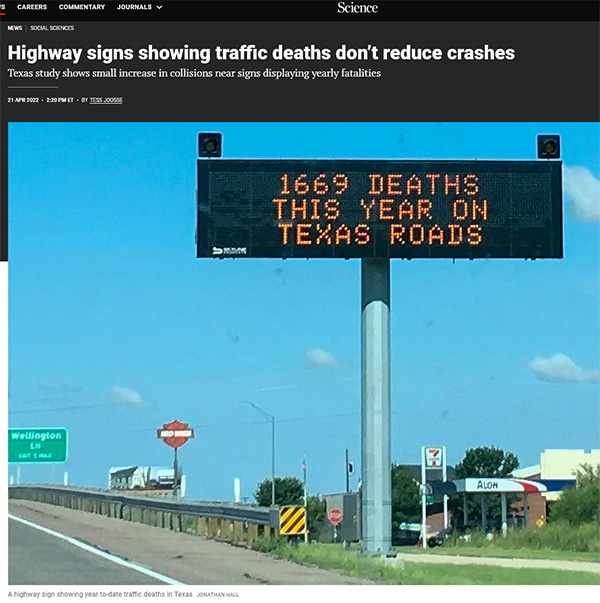
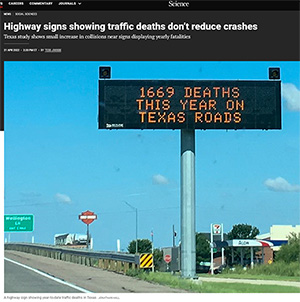 Some bright sparks in Texas put up glowing death toll score board message in neon lights near a highway in Texas. They were sure they’d save lives, but the study showed the giant death toll messages actually increased accidents by 1%. Some bright sparks in Texas put up glowing death toll score board message in neon lights near a highway in Texas. They were sure they’d save lives, but the study showed the giant death toll messages actually increased accidents by 1%.
Australia could make this kind of mistake on a national scale. Let’s not do that.
h/t another Ian, El Gordo
REFERENCE
Consultation Regulatory Impact Analysis, Sept 2025
Car image at the top by Cortex Zone from Pixabay
10 out of 10 based on 84 ratings
9.9 out of 10 based on 9 ratings
9.5 out of 10 based on 16 ratings
 Image by AngMoKio By Jo Nova
The Daily Telegraph has discovered a major Net Zero project has signed up several Chinese companies. The huge battery and solar scheme in Bundey South Australia has been given the red carpet treatment by the Albanese government. It will be fast tracked as a priority by the government and cash will rain down from the “Capital Investment Scheme (CIS)” .
The group running the project is Ganaspi Energy. Supposedly it is based in Sydney, except that when the Daily Telegraph visited the office there, it was empty. No one was responding to emails or text messages, and the phone number didn’t connect. If this company was a ghost corporation, or a front for Chinese interests, they don’t seem to be trying hard to disguise it?
Ganaspi Energy has brought in several Chinese firms, and held a party with some them in Suzhou to celebrate. Supposedly, the Bundey BESS and Solar project will be the largest battery storage power station in the Southern Hemisphere.
Taxpayers are underwriting the project for the first 15 years.
By James Willis, The Daily Telegraph
National security expert Michael Shoebridge, a director at Strategic Analysis Australia, said it appeared the Chinese Government had successfully completed a “backdoor Belt and Road Initiative” with an Australian company.
“The Chinese Government can by law direct its companies to hand over all its data and even interrupt the operation of its systems,” Mr Shoebridge said.
Two of the suppliers are the China Energy Engineering Corporation, and CEEC Energy Storage Technology, both of which are owned by the Chinese Communist Party. Indeed, the CEEC is listed as a stakeholder of the BRI (Belt and Road Initiative).
The danger with battery projects is that unlike coal or gas plants, they are digitally connected, full of sensors, and often linked by remote management systems. If a state-owned Chinese firm or its subsidiaries help design or integrate these systems, Beijing potentially gains a lot of real time data:
- Telemetry data (power flows, grid vulnerabilities, frequency control info).
- Firmware access (e.g., backdoors in battery-management systems).
- A future sabotage vector, should relations deteriorate.
Access like this to the national grid not only gives China oversight over our energy flows, it gives it a foot in the door, and a precedent to bring in other Chinese projects. How can we object when there is already a large piece of critical infrastructure approved. If and when the Australian government ever wanted to criticize the CCP, it would only take a small nudge from a friend of the CCP to silence the PM. Nice grid you have there…
We know China wants to bring Australia into the Belt and Road program. In 2021 Dan Andrews tried to sign up Victoria to the Belt and Road program but it was rejected by the Coalition government as “inconsistent with Australia’s foreign policy…”
This is a win for China on so many levels
Keeping the renewable dream alive in Australia is good for China. It helps sabotage our reliable coal power. A few more Australian factories will close and move to Shanghai. We’ll buy even more Chinese made windmills, more EVs, battery packs and solar panels. It embeds Chinese standards in electronics and battery control software, a form of “technological colonisation” that increases the odds and advantages of future Chinese projects.
Indeed, we can almost imagine a Chinese representative siding up to Anthony Albanese in his darkest Net Zero days, and generously offering to help rescue him from the mess it has become. Who knows? Anthony Albanese and Chris Bowen might have been very amenable to offers of rapid big batteries, with the guarantee it will profit from taxpayer schemes, as long as they look the other way on the foreign investment risk.
When asked, Mr Bowen told The Daily Telegraph that “Labor was delivering “the maximum value to the taxpayer.” But all the details are hidden from the public because they are ‘commercial in confidence’. It could just as easily mean the Albanese government sold our national security for a sweet deal to rescue their own reputations. How would we know this wasn’t the case?
The Opposition has fittingly demanded there be an inquiry into the $2.6 billion dollar project. However government sources told the Daily Telegraph that Ganaspi is an Australian owned company and usually the sub-contracting arrangements of Australian companies don’t trigger investigations under the foreign investment framework.
A $2.6 billion dollar foot in the door…
9.9 out of 10 based on 99 ratings
9.1 out of 10 based on 14 ratings
|
JoNova A science presenter, writer, speaker & former TV host; author of The Skeptic's Handbook (over 200,000 copies distributed & available in 15 languages).

Jo appreciates your support to help her keep doing what she does. This blog is funded by donations. Thanks!


 Follow Jo's Tweets
 To report "lost" comments or defamatory and offensive remarks, email the moderators at: support.jonova AT proton.me
Statistics
The nerds have the numbers on precious metals investments on the ASX
|






.jpg)
Recent Comments