
By Jo Nova
Spare us from being the Boring Nation
Today is the last day to put in a submission. Extended now to Nov 10th!
The Nanny State wants to reduce speed limits to save lives, instead of building better roads
Lord help us — a few bureaucrats who probably have never driven past Parramatta think our country roads will be safer at 70 or 80 kilometers an hour. By making road trips 10 to 30% longer, and 100% more boring, they may even kill more people than they save.
When every trip becomes a longer trip there will be more drivers still on the road at dusk and in the dark. Every extra hour on the road is an hour less to sleep or an hour less with family and friends. So drivers will either be more tired or more lonely. And when a four hour trip becomes a five hour trip, some will choose not to go. Some weddings will be a bit smaller, hospital visitors a bit rarer. Tourism will suffer. Businesses will close.
The repercussions of this change is a burden on so many aspects of our lives, most of which the “safety modelers” didn’t even think of. We are in effect slowing the whole nation. It will lower productivity, raise the cost-of-living, increase social isolation, causing mental health damage and depression. On the nation with one of the lowest population densities on Earth, it is some kind of anti-human plan to increase the distances between us. Technology brings us together, but bureaucrats push us apart. It will reduce health care in country areas, and limit holidays all over the country. Add some heart attacks, suicides and divorces to the mix. Almost none of which the “modeled” costs include.
Australia — the slow nation?
What price the reputational damage as Australia becomes known as a tedious nanny state of quaking chickens afraid to drive at normal speeds on straight, dry highways with hardly any traffic? How many tourists will be turned off — bored away? How many skilled migrants will balk at moving to a grandma nation?
Any driver with sense can already slow to 90 km/h when the road is rough, the weather bad, or the traffic heavy. Changing the signs just forces safe drivers to crawl on good roads in good conditions, while the reckless ones keep being reckless — they will just have to dodge the slow cars.
The deadline for submissions about this is today, Monday. (click here.) UPDATE: Extended to Nov 10th
Just [a day] left to have your say on country road speed limits
Australians have just a few days left to have their say on a Federal Government proposal to reduce speed limits on rural and regional roads.
The Federal Department of Transport is seeking feedback on a proposed reduction of the speed limit on roads outside of built-up areas where there are no sign-posted speed limits.
A consultation paper released in conjunction with the review suggests speed limits could be reduced to 80km/h on sealed roads and 70km/h on unsealed roads.
David Littleproud, leader of the National Party says:
“Regional Australia have lost over $3300 a kilometre in federal funding to maintain our roads, our national highways.
“This is about saying regional Australia doesn’t matter and that we’re not going to fix your roads, we’re going to let them crumble and you’re just going to have to drive slower.
The window for public feedback closes this coming Monday, October 27.
For more information or to have your say on the Department website click here.
This could be one of the more absurdly incompetent, biased reports I’ve ever seen
Consultation Regulatory Impact Analysis, Sept 2025
It’s like the researchers added in every benefit they could think of, forgot almost all the real costs, and ignored the twenty other variables that matter. One of their core points is that people die on country roads 11 times more often than city people do. Strangely, this is “per capita” not “per kilometer”? How did they not bother to do this properly?
Also strangely, they seem to think that these rates should be the same. Country deaths are “over-represented” they say. It’s like hoping that workplace accidents on oil rigs will be as low are they are for check-out chicks at Coles. I mean, we want them to be less, but we don’t stop drilling until they are.
If speed was the main killer why are the inner regions at 100km/h so much safer than remote regions at the same speed?
Statistics show that the big killer on Australian roads is the distance from the major cities, not the speed limit. In very remote areas the speed limit is the same as the inner regional areas, but the death rates are twice as high.
-
The annual road-death rate per capita for Australia in 2024 was ~ 4.78 deaths per 100,000 population. But there is much higher risk in regional/remote areas:
- Major cities: ~ 2.0 deaths per 100,000 population.
- Inner regional: ~ 9.1 deaths per 100,000.
- Outer regional: ~ 12.4 deaths per 100,000.
- Remote: ~ 18.4 deaths per 100,000.
- Very remote: ~ 22.2 deaths per 100,000
— REFERENCE: Road Trauma Australia 2024. Statistical Report on fatalities and hospitalized injuries from road crashes in Australia, Bureau of Infrastructure and Transport Research Economics (BITRE). p7
Could it be that more people die in these areas because the roads are worse and if they crash it takes them 2 hours longer for the ambulance or flying doctor to get there (if they are lucky)?
The cause of deaths on remote roads is probably due to roads being in poor condition, with people driving run-down 40 year old Holden Commodores without ABS, and dealing with fatigue from driving ten hours in a row on a Chico roll and Barbecue chips. Ask yourself if slower driving speeds will solve that?
Ask yourself if a go-getting nation would fix deaths on bad roads in old cars by making new cars drive slower on good roads, or by building better roads, increasing prosperity and making newer cars more affordable?
Freight costs up just 10%? I don’t think so…
Truck drivers have strict fatigue limits. Some one-day return runs will now become two-day jobs with overnight stops. The modelers claim freight costs rise just 10 %, but once duty-hour caps are breached, costs jump 30–50 %. They also claim trucks will emit less CO2 because they’ll be driving slower — yet we’ll need more trucks to move the same freight in the same time.
Australia moves roughly 80 billion tonne-kilometres of freight by road each year (BITRE 2024). This keeps our mines, farms, supermarkets and petrol stations in operation. Even a 5 % system-wide productivity loss adds billions in costs — all feeding into regional produce prices, construction materials, and rural tourism.
What’s the cost of rebuilding trade-routes?
The nation is set up for 100km/h travel. Distances from cattleyard to cattleyard, petrol station to petrol station were all planned for human drivers at 100 kilometers an hour (except in WA where it is 110km/h and the NT where it 130 km/h). If we mess with that, all kinds of little things will break. More food will be wasted on longer hauls that have to sit overnight. Some crops may no longer make it to market in time. On the edge of the “travel day” farmers may have to change crops. Routes and rest stops will have to be shifted. Patterns will have to be moved. It all costs.
Reducing road noise will help… the kangaroos to sleep at night?
The paper claims slower driving speeds will save lives because traveling slower reduces noise pollution and that “therefore” will improve sleep. Say what? We are talking about 750,000 kilometers of roads that mostly don’t have houses beside them? Are we worried about REM sleep in Bunyips?
It’s like this report was written by a high school student in Ultimo.
To reinforce their point (and their incompetence) they cite a US study where people were “willing to pay $8.83 annually” to reduce it. Ouch, that much? (It must be a typo? p61)
Furthermore, they say, there was a Swiss study that estimated deaths would be reduced if cars drove slower. That team modeled the effect of reducing city speeds to 30 kilometers an hour, and the Australian team are extrapolating that to unpopulated areas at the back of Bourke and beyond at 100km/h? But, hey, it might save some kangaroos.
Getting carried away, they tell us slower speeds will improve traffic flow. (More proof they’ve never gone west of Parramatta). They have so little evidence of benefits, clutching at straws, they dig out a twenty year old study of peak hour traffic in an urban situation that shows reducing speeds to 60km an hour “may improve traffic flow”. (p62) Which will be a huge benefit the next time there is a peak hour rush at Cunnamulla.
They’re obviously desperate to find things to fill out the benefits column…
Words not mentioned in the consultation paper include: dusk, tourism, divorce, sleep loss, darkness, night time, poverty, business closure and cost of living.
With a careless flick, some bureaucrats will make Australians poorer and more isolated, then, when financially stressed people who are driving older cars crash more often — the bureaucrats will reduce the speed limits again.
Traffic safety is so much more complicated that a computer model
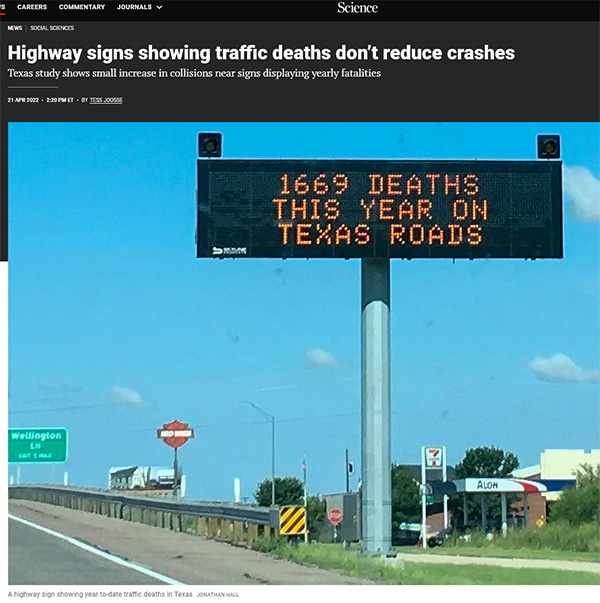 Some bright sparks in Texas put up glowing death toll score board message in neon lights near a highway in Texas. They were sure they’d save lives, but the study showed the giant death toll messages actually increased accidents by 1%.
Australia could make this kind of mistake on a national scale. Let’s not do that.
h/t another Ian, El Gordo
REFERENCE
Consultation Regulatory Impact Analysis, Sept 2025
Car image at the top by Cortex Zone from Pixabay