By Jo Nova
For some reason the pursuit of global teenage-girly weather-control has meant Australian workers are less productive. Who could have guessed that attempts to stop storms, floods and droughts in a hundred years would not make us richer today? I mean, apart from everyone?
“Australians are working harder for less”
In the last 25 years we’ve spent 126% more on capital costs but only improved output by 14%. It’s bad!
Now even the Productivity Commission is warning that renewable green investment is holding back the nation.
Australian productivity was rising until it suddenly fell off a cliff around May 2022 (see the graph below). Coincidentally this was the moment the Albanese Labor Party first got elected and went gangbusters with renewable energy. It seemed to be worthy of an annotated arrow, so I added that in…
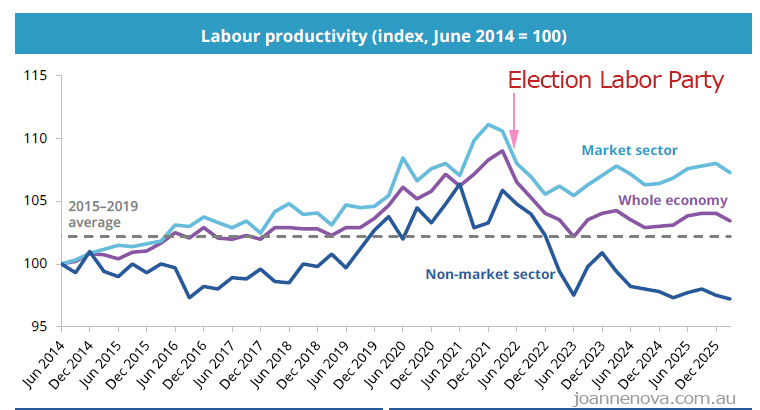
Productivity Commission: Quarterly productivity bulletin June 26
From The Australian:
Renewables and green spending drag down productivity, PC warns
By Matthew Cranston, The Australian
Australia’s falling productivity levels have been driven down by the replacement of coal-fired power plants with billions of dollars in renewable energy projects, the Productivity Commission has declared, as it warns governments to make only the most efficient, cost-effective investments.
After Energy Minister Chris Bowen made a push alongside the UN’s top climate official this week for further investment in renewable energy, Productivity Commission deputy chair Alex Robson released a study showing that such investment had “contributed to a productivity decline” and Australians were working harder for less...
The warnings follow Jim Chalmers and Anthony Albanese nominating improved productivity as a cornerstone of the Labor government’s second term, and Mr Bowen in his role as COP31 president of negotiations encouraging a push for a new global electrification target.
Estimates have placed the government’s annual spending commitments to climate and renewable energy at more than $9bn a year.
In other news this week, families are in shock at the cost of electricity:
‘It’s not sustainable’: families reveal their desperate struggle as ‘insane’ power bills soar
While the 17 solar panels on her roof used to cut her electricity bill down to almost nothing, now even that is not enough. “We used to only ever get a bill in the winter months,” she says. “It was always very low, sometimes even $100 a quarter. Over the last 12 months, the bills have just gone up by hundreds and hundreds of dollars.”
In September 2022, Ms Killorn paid $412 for a quarterly electricity bill. In 2025, her September bill came to an eye-watering $1506. Her most recent bill in March this year was $893.
And the government has to prop up our smelters or they would go out of business because they can’t afford the electricity either:
Ayres open to more Nyrstar funding as taxpayer aid tops $240m
Industry Minister Tim Ayres has left the door open to further support for Nyrstar’s loss-making Port Pirie lead smelter and Hobart’s zinc refinery, saying overseas “non-market practices” would be a key factor in future funding decisions.
On Wednesday, the Albanese government announced a further $105m support package…
This is a Singaporean company we’re paying to dig up our minerals using our green expensive electrons. Go figure…






“The UK currently spends about 10% of its GDP on overall low-carbon investments required to transition to a net-zero economy. However, the net direct cost (the actual financial burden on the economy after accounting for savings from phasing out fossil fuels and efficiency) is estimated to be roughly 0.2% to 1% of GDP annually.”
The net cost estimate is obviously delusional and comes from the deranged Climate Change Committee.
Meanwhile the UK defence minister just resigned unable to get the cash to defend our country. Starmer is so weak he could not force Miliband to relinquish any of his budget.
https://www.bbc.co.uk/news/live/cgqeg09p3p1t
https://www.express.co.uk/news/politics/2216339/ed-miliband-keir-starmer-net-zero-row-labour
NetZero is not only financially ruinous, it is destroying national security too.
400
Once the greatest military force in human history, the British Navy is no longer fit for purpose. They have more flag officers than capital ships, it took them nearly a month to get a warship to defend their bases in Cyprus and on it’s arrival the HMS Dragon had to be docked due to technical difficulties, and Russian ‘shadow fleet’ vessels have been running through the English Channel largely unmolested for the past six months because the Brits don’t have any ship available to deter them.
For the past couple of decades, the British navy has been little more than used car lot for every nation that aspires to build it’s own navy (as Britain’s dwindles). It’s a shame the Admirals weren’t sold with them.
https://www.portsmouth.co.uk/news/defence/royal-navy-sold-scrapped-ships-21st-century-5216707
360
Imagine having your military might focussed on molesting ships because they arent insured by Lloyd’s.
31
.
>NetZero is not only financially ruinous, it is destroying national security too.
Surely that can’t be accidental.
Many of us openly predicted it and warned loudly too.
190
It is not just John Healey, the UK Minster of Defence who has resigned. The Parliamentary Under-Secretary of State for the Armed Forces Al Carns DSO OBE MC has also resigned. Two years ago Al Carns was going to be promoted from colonel to brigadier but decided instead to enter politics. At that time it was stated that he had served in every major conflict Britain had been engaged in for the last two dozen year but ffew details of his military career have been published for security reasons since he was in the Special Boat Service but it is known that he did five operational tours of duty in Afghanistan. He is still a reserve Royal Marines officer.
Last year Al Carns was one of four ex-special forces members trialling the use of xenon gas to speed up altitude acclimatisation and they reached the summit of Everest on 21 May. The xenon gas probably did help with acclimatisation because they only took a week to get up and down Everest. Some people criticised them for using xenon but Al Carns said in reply “the reality is if I had six to eight weeks to climb Everest, I would, but I’m a government minister and I don’t have time.”
I cannot imagine the Labour Party, or any other left wing party in the UK, finding someone like Al Carns again for a long time unless they make big changes in their policies.
40
It’s all part of the plan.
The Left have always hated the productivity and high standard of living provided to non-Elites by free enterprise (capitalism) and the abundant inexpensive energy it provides (which contributes to a high standard of living).
Even among the fully woke OECD countries, Australia is doing poorly. But it is one of the most resource and energy-rich countries in the world with what used to be a highly educated population. Educated with useful skills and knowledge that is, not the woke nonsense taught in “schools” and “universities” today which churn out people who are almost illiterate and innumerate.
It takes a special kind of evil to degrade and regress the country as much as has happened, it can’t be accidental.
One Nation or no nation.
420
For comparison purposes, taken from the 2006 Budget Report;
Standard of Living (rank)
Labor to 1995/96 was 13th in OECD
Coalition to 2005/06 was 8th in OECD
91
One Nation in a show of truth, honesty & openness must publish a full list of agreements, obligations & such material that ties Australia to international agreements which affect our security &. Economic viability.
The Uniparty ( Labor / Liberal ) have been signing agreements with the UN for many years now without a mandate from the electorate & it’s time the electorate are made aware of agreements,
350
“One Nation in a show of truth, honesty & openness must publish a full list of agreements, obligations & such material that ties Australia to international agreements which affect our security &. Economic viability.”
Excellent idea! It will embarrass both sides of the Uniparty and they will show their true colours in a united vociferous attack on Pauline. The peasantry might actually notice how much of our sovereignty has been given away.
250
Please don’t ignore that State governments have legislated complimentary legislation and they have the powers and responsibilities: eg; environmental, development for building and construction permits and related matters, electricity and gas supply within states (before privatisation by state governments all of power stations and transmission lines were state assets sold by state governments), and most other affairs of state as compared to national and international that Commonwealth or Federal Government deals with.
It is not as simple as it might seem to be.
And add the approving or rejecting of legislation etc in the Federal Parliament Senate and State Parliament Legislative Councils, if passed by House of Representatives and Legislative Assemblies
20
Not exposing the whole & nothing but the truth is the worst outcome.
We ALL need to be aware of the politics of skulduggery & cowardice. The truth has never harmed anyone. Only the DIL ( devious immoral liars ) will be harmed when they’re held to account. This is simultaneously a warning to ANY smartass would be leader that the people are ultimately in control!
50
Australians have to reconsider their position in the world.
We can no longer identify as being among the top richest nations in the world and are rapidly declining.
Australia’s future lies with a much lower standard of living, as per the plan. You’ll probably still be able to drink the water, and the sewers may work, but don’t assume the lights will stay on.
Even if we elect a conservative government like One Nation, the damage done by the past 30 years of Lib/Lab governments is so extreme that it will take decades to fix.
For example, how long will it take us to extricate us from the renewables mess and to build power stations? And how much compensation to be paid to renewables grifters? We don’t even know because the Government has signed BS “commercial-in-confidence” deals.
And there are massive debts to be paid off, total Government debt, federal, state and local in excess of $2.3 trillion.
Also massive immigration beyond the country’s ability to absorb people in terms of infrastructure, housing or socially.
The problems are massive. Any conservative Government will be focussed on first fixing the huge mess before it can progress.
But I’m not even sure it’s fixable, not any time soon anyway.
In any case, it might not be possible to elect a conservative Government because the Governments (federal, state and local) are massively increasing the size of the public “service”, nearly all of them Labor voters, as are most Third World immigrants. On top of that there is massive public works programs with benefits going to feral unions, again Labor voters (because the Labor Party is the political arm of the union movement).
Staggering amounts of money thrown away on renewables, SH2, desal plants, Naarmastan train tunnels etc. etc.. Just imagine if even a small proportion was spent on something useful like drought-proofing and flood-proofing the country and also paying off the debt?
In addition to all that, we have two generations of thoroughly indoctrinated people, bought up and educated/indoctrinated under a Leftist-dominated system.
There are many more problems beyond those few as well…
Interesting times ahead, “interesting” as in the 1898 expression of Joseph Chamberlain (i.e. chaos, upheaval, crisis). [Not a Chinese curse as per popular belief.]
330
“We can no longer identify as being among the top richest nations in the world”
By “identify as“, you mean “pretend to be“, right?
230
So long as the Govt can whip out a graph showing Aussie to be better off than the UK or Italy or Spain, they will keep the peasants quiet as our generational standard of living drops.
‘pretend to be’ is exactly the right meaning!
120
Thirty (30) Years extreme David?
You ignore the inheritance from Hawke-Keating Labor governments handed to Howard Coalition in 1996 and 30 years ago!
And that late in 2007 Howard Government handed over to Rudd Labor
* Net Government Debt zero, Labor debt repaid with interest by 30 June 2006.
* Inflation down from 5.2% to 2.5% average
* Real wages growth up from average 0.3% Labor to 16.7% by 2005/06.
* Real Net Household Wealth up from $2,047 billion to 4,632 billion.
* Credit Rating that was downgraded twice: AA upgraded twice: AAA
And many other indicators including a strong economy, sovereign wealth Future Fund and other smaller funds, ten years of budgets in surplus, and despite managing through the Asian Economic Crisis … and leaving very strong financial and economic conditions November 2007 that enabled Australia to avoid the Global Financial Crisis and recession danger.
From 2007 to 2013 Rudd and Gillard (and Rudd a second time PM) dealt with the GFC from 2008/09 and racked up new debt and even handed over their 2013/14 Budget with a sixth year of deficit they had under estimated along with other independent audit reported items such as no provision made to pay for major spending commitments like the NDIS and the Gonski State Education Grants.
From September 2013 Abbott Coalition inherited a budget mess and when Treasurer Hockey announced details and his “budget repair” Budget for 2014/15 Labor was in denial and the relentless regativity began based on Labor’s usual blame games. Abbott also tried to overturn Labor renewable energy target, and did get carbon tax abolished. And many other achievements including overturning (with QLD LNP Newman Government) Labor’s “wild river legislation” stopping development of Northern Australia rivers for irrigation farming and extension of the Ord River Scheme at Kununurra WA.
I of course agree that from late 2015 to late 2018 Turnbull Coalition made a number of bad decisions and following on from Rudd Gillard Labor on climate politics.
From 2019 to 2022 the Morrison Coalition changed direction away from the Turnbull Government climate related politics. They also dealt with the pandemic 2020-2022 and were blamed for what was and remains State governments areas of responsibilities and powers (see Constitution).
As for budgeting, Treasurer Hockey said in 2014/15 Budget address that returning to budget surplus would take a few years of tough decisions. The first surplus forecast (as you know budget plans are forecasts) was for 2019/20 and was on track until COVID-19 was discovered here start of January 2020. Thereafter the surplus forecast was not achievable. However, the first surplus forecast by Albanese Labor government was for part year end 2022/23 – Treasurer Chalmers announced a revised Budget in October 2022 and based on creative accounting after windfall tax revenue collection from post-pandemic economic recovery.
Period late 2015 to late 2018 aside (Turnbull Government), and not most governance done during those three years was counter productive, and from 2025 election to early 2026 when the left faction gained the Opposition Leader role and then she was voted out by two thirds of Liberal MPs in a secret ballot, to claim “uniparty” and similar lumping the major parties together, minor party rhetoric, is misinformation.
910
Dennis, 30 years, 40 years, 50 years, David M was being kind, the Lib / Lab duopoly of the last 50 years has destroyed Australia from being one of the richest, most independent and sovereign to just the sand pit of the world with a rapidly declining standard of living and prospects.
We haven’t had a decent Government since Menzies.
Howard only “saved” money by not spending, not building and selling off citizen owned assets, same with any state government in the last 50 years that didn’t create a huge debt .
All we’ve had for the last 50 years are self serving parasites that since Howard, got rapidly worse.
As numerous commentators have stated with the facts to back their claims, Australia had all the ingredients to be THE wealthiest nation on the planet, but useless, self serving, short sighted grubs frittered it all away.
152
Past achievements in government by Coalition detailed;
https://www.liberal.org.au/achievements-in-government
02
Best to ignore achievements as they do not fit the politics of One Nation.
How about a link to what they have achieved over 30 years past and we can compare?
00
Best to ignore achievements as they do not fit the politics of One Nation.
How about a link to what they have achieved over 30 years past and we can compare?
00
Green Steel is a Green Steal……………
120
We still have national productivity?
I learn something new every day…
240
I had a quick look at the Robson report. It seems to me that anyone who still believes in renewable energy will see nothing at all in the report to change their mind. They can easily read it as saying that renewables are great and just need more time. The report is a great opportunity wasted. I will be very generous and give it a rating of 1 (out of 10).
140
Question.
How much does the massive expenditure of taxpayer money on useless projects like SH2 and the Naarmistan train tunnels etc. contribute to the “productivity” numbers?
160
They’ll tell you it contributes by creating jobs.
To which Milton Friedman would respond … if it’s a jobs program, why not give them spoons?
210
I was working on an IT upgrade project in Malaysia years ago and noted the factory had nicely manicured grounds. A group of gardeners worked continously on the tropical lawns with whipper snippers.
I commented to manager, another Australian, jeez couldnt you spring for a couple of ride on lawn mowers? The response was it wasnt about efficiency it was about employing enough rural Malayans to keep the government happy enough to permit the factory.
120
As a retired female at home, I operate on this principle. I cook, sew, clean and garden, even though I could employ others to do the jobs much more efficiently.
50
Why on earth did anyone need a report? Productivity is a result of energy being applied. Higher energy prices means lower productivity. Manufacturing fleeing overseas or just closing. It could not be simpler.
Now we get absurd reports like tariffs on imported steel will increase the price of windmills? And the only Australian windmill manufacturer Keppel Prince in Victoria closed ultimately because of high energy prices, zero support and cut price windmills from China with Chinese steel.
So now the importation of Chinese windmills is essential for productivity and low renewable energy prices. It’s all beyond laughable nonsense if it were not so serious.
360
The country that has the highest industrial productivity per capita is the U.S.
110
Cheap energy. And plenty of it. The US are not blowing up working power stations like the more enlightened socialists. That’s something your enemies do. Or communist politicians who work for someone else.
100
I asked google AI what is the most reliable cost efficient energy source for the long term in Australia.
It stated renewables, of course, and referenced the usual AEMO, CSIRO, government ministers and even renewable energy companies and spruikers.
I then asked further on reliability. It again spewed forth on renewables wind and solar but this time with the new buzz words “firming” and “firmed renewables”.
So upon further quizzing I was reliably informed that Australia will be fine with batteries and pumped hydro and you guessed it Green Hydrogen. Oh, and the ubiquitous “energy demand management” including “scaling back heavy industry”
Then I asked “Are firmed renewables going to supply all the long term energy Australia needs?”
Answer: “Yes, energy experts and the Australian Energy Market Operator (AEMO) confirm that a grid powered by firmed renewables is the primary, least-cost pathway to supply Australia’s long-term electricity needs…”
I then asked: “If firmed renewables are going to supply all the long term energy Australia needs, what is going to power shipping airplanes and large road transport?”
AI answer? “Airplanes, ships, and heavy road transport will be powered by zero-emission liquid fuels like Sustainable Aviation Fuel (SAF), green ammonia, renewable methanol, and green hydrogen.”
I asked “By what year?”
The answer? “The Australian Government’s Transport and Infrastructure Net Zero Roadmap outlines a clear strategy for these sectors to achieve net-zero emissions by 2050”
Just goes to prove what we already know that current AI is nothing more than a simple regurgitative program to repeat the most repeated.
And so the lie becomes the truth, as long as you repeat something long enough and often enough.
341
“outlines a clear strategy ”
With a large dash of hopium.
90
You asked the wrong question if you want the truth.
What is the break even cost for electricity from the Latrobe Valley generators excluding royalties and climate imposts – Copilot answer $25 -$40/MWh. In reality it is close to $23/MWh if all the artificial inflation due to “renewables” was wound back.
Now to get 1MW average from a solar/battery combination in Victoria, you need 24MW of solar panels and 50MWh of battery. Assuming 20 year life and 5% discount rate, Copilot gives the average cost is $600/MWh.
I know this unit cost is close because I have operated an off-grid system now for 14 years. It was economic when I was getting $660/MWh.
Even to build a new coal plant in the Latrobe Valley would be well under $100/MWh taking 50 year life and 5% or lower discount rate.
200
Pity I wont be around in 2050 to see this Green Nirvana.
Less than 25 years away and all signs are we are going backwards
80
For background information on Snowy 2.0 Project …
https://www.webuild-group.com.au/en/what-we-do/projects/snowy-mountains-hydro-electric-scheme/
10
An interesting read. Apparently the big battery can supply electricity to half a million homes for up to one week. An estimate of houses in Sydney is 2. 1 million, private dwellings.
So not really enough to power a city for very long. Essential services of course would take priority in the event of a major power outage, so the metric of how many houses is somewhat misleading..
I haven’t quite read the lot but so far have not seen how long it takes to “recharge ” this engineering wonder, or what the actual power inputs versus power out puts are.
80
Here is an answer from AI
https://joannenova.com.au/2026/06/the-wind-power-puzzle-add-more-wind-turbines-and-get-the-same-output/#comment-2915882
I posed the following question to AI…
“I have read that snowy 2 would take approximately 3 months to refill the top reservoir.
Is this correct?”
Yes, your reading is correct. Independent energy analysts and technical reviews have confirmed that if the Snowy 2.0 upper reservoir (Tantangara) were completely emptied, it would take months of continuous, opportunistic pumping to refill it to capacity.
If the system pumped water uphill at absolute maximum capacity, 24 hours a day, without stopping, it would take roughly 250 to 300 hours (about 10 to 12 days) of continuous pumping.
The Economic Reality: The “Three-Month” Timeline
In the real world, continuous pumping is impossible. Snowy 2.0 cannot pump water 24/7 because it only makes commercial sense to pump when electricity is cheap and abundant (e.g., during peak solar generation in the middle of the day).
120
So, we run it flat-out for 4hours in the evening, 6-10pm.
But if it empties in a week and takes 2weeks to fill, we need 8hours the next day to pump it back up… and we only have 4 hours of cheap power! Which means we might as well hook diesel generators up to it and run them for the extra 4hours of pumping, say diesel from 8-10, solar 10-2, diesel 2-4pm, then discharge at 6pm again.
Makes perfect sense to people like Bowen.
80
The only time pumped hydro ever works is when you can utilise excess electricity from coal. So, the night time generation ( off peak ) where its the cheapest. So SH2 is situated in the wrong spot. It really should have been in either Victoria or Qld right near a present coal powered generator with mountains close by. If you look at geography probably the best position was just north of the Latrobe Valley in Victoria. Lots of coal, lots of mountains. But probably the bestest thing, not build the useless thing in the first place and just burn coal. We’ve got 500 years supply of the stuff.
100
Sambar,
That’s reasonable to say, but how will it be done?
*Some* places (e.g. Westmead Hospital) have their own substations, which can easily be kept live, but many essential services (e.g. suburban ambulance stations) share grid segments with ordinary consumers. Backup generators on site would be one answer. The other answer might explain the big push for everyone to have smart meters.
Incidentally, Westmead Hospital substation is rated for 20 MW. (or 15,000 homes in modern units)
50
I was musing along the lines of water supply and sewage treatment rather than the “smaller” essential services that could be powered more easily with diesel generators, either way it could not be called a major back up to very much at all. The huge unknown final cost of this project for very little real returns should frighten the daylights out of any proper accountant.
50
Sambar,
I don’t think water and sewerage would fare any better than ambulance stations. Few, if any, would draw enough power to warrant a separate supply. E.g. Google tells me Sydney Water has 153 drinking water pumping stations and 695 wastewater pumping stations. Most will be scattered around the ‘burbs, and lose power during blackouts like traffic lights do.
Apparently few have on-site backup, but Sydney Water has mobile generators that will be driven to the pumping station if the blackout is lengthy. They may need to stock-up on generators and drivers as renewables help our grid evolve to a third-world standard.
70
A friend of mine still living in Cape Town said she can’t afford to move out of their 3rd-floor apartment, even though her husband has had a stroke, because the block is right beside a hospital and has guaranteed electricity…
Coming to a town near you soon!
80
They always give the estimate for solar energy in homes, when of course it should be given in day homes. Since Australia doesn’t actually have any day homes, and none are planned, that reduces the need for renewable energy somewhat. Same for wind, but we don’t have a name for that kind of home (I think it would be a lot tougher to live in than a day home).
20
RE is the biggest culprit of our falling productivity, but this is also made worse by a huge increase in the public sector along with Chalmers re-imagined economics. Under this “re-imagined” Marxist economics regime, we have moved from market based capitalism to crony capitalism, where the government uses taxpayer funds to determine which business is allowed to succeed and which ones must die. And, massive government spending and mass immigration have compounded the problem by further driving up inflation and housing costs. The latest tax changes will work to speed up the total demise of the free market, which seems to be the clear government aim. Who wants to invest in an economy where the government takes half the profit and leaves you with 100% of the risk ?. It’s no coincidence we now have long queues outside food bank outlets that are reminiscent of the great depression era, yet most of these people still have jobs. The difference now is that you need subsidies to pay for your energy bills and basic essentials, because the cost of everything has exploded due to bad government.
As a footnote – After seeing Albo on TV last night try and claim that the big One Nation “Fire the liar” donation tally was fake, I went in and made a donation. I’m thinking the next election will be a bloodbath, but can we survive two more years of this total BS ?
300
Under this “re-imagined” Marxist economics regime, we have moved from market based capitalism to crony capitalism, where the government uses taxpayer funds to determine which business is allowed to succeed and which ones must die.
Unfortunately, the political attraction of crony capitalism and ‘picking winners’ is contagious.
At the risk of incurring the Wrath of Dennis, the Liberal energy policy also plans to divert public funds into risky CO2 abatement technologies. Some, like CCS and ‘green metals’, ridiculously risky.
In fact, this is foundational.
“Our approach is technology-led. We will
prioritise scalable solutions such as carbon
capture and storage, commercial and
industrial solar, low emissions metals, soil
carbon, biofuels and advanced nuclear.
We will modernise the mandates of the
multi-billion dollar Clean Energy Finance
Corporation and Australian Renewable Energy
Agency so they can invest across the full range
of low emissions technologies that deliver
results.”
The ‘results’ – as delivered by Canberra and OPM – can be imagined.
130
It appears someone in the Productivity commission read my submission to AEMO 2026 ISP review:
https://www.aemo.com.au/-/media/files/major-publications/isp/draft-2026/consultation-submissions/willoughby-richard.pdf?rev=c5f5c2bf59ff4b28b2d1b8e84c27e615&sc_lang=en
I have not yet had an invitation to give verbal evidence.
FIRE THE LIARS – That includes all Labor, all their ABC, all their CSIRO, all their BoM and all UN-party. They are either liars or thoroughly incompetent. None of them have questioned the UN Climate Change™ hoax. It is time for retribution. ONP donation target now $2.9M. A lot of people prepared to put money where their mouth may not be. A lot more people realise they are being lied to.
280
We got political flyers from Clive Palmer and in one part he says he will “Bring Australian Super Home” and he claims:
Is that actually correct? I remember how they attempted to unbank Whitehaven Coal at a time the company was flush with money and didn’t need loans. For the most part, the whole reason to have investment from Super funds is to not need bank lending. Anyway … would be interested if people know more about what Clive is getting at because he provides no details.
Then I could point out that a good chunk of my Super went into buying Woodside Energy … and I’ve done quite well thanks to Trump starting wars in the Middle East … but in the very same pamphlet Clive wants to impose, “25% tax for exported Australian gas”.
So the very companies actually doing some fuel production in Australia are the ones he wants to destroy with high taxes. The guy’s a brainless clot and none of this has been even remotely thought through.
https://newdeal.au/
30
I read your submission and you make some good points. As the price keeps rising above inflation and electricity becomes a luxury product, it drives more people off the grid using subsidised solar and batteries in a snowball effect where every watt of energy becomes more and more expensive as grid demand and grid revenues dry up. As you point out, the government with its solar sharer program makes a big problem even worse, by encouraging people to install large subsidised batteries to suck out their daily energy needs from the grid in their enforced 3 “free” hour period each day.
The root of the problem that no one ever mentions is the value of the grid itself. A cheap reliable grid provides cheap energy to business, which in turn provide cheap goods and services to the entire population. And the only way to have a cheap grid is to use the cheapest source of energy and make sure we all share the cost of the grid by encouraging us all to use the grid. What the government has done is tantamount to declaring war on the economy and every Australian citizen, by deliberately driving residential users off the grid, leaving the grid with massive and ever increasing RE related costs and fewer and fewer users to pay for that increasingly expensive infrastructure, with business the biggest losers, passing on ever increasing costs to consumers. You couldn’t come up with a better way to totally destroy an economy so I’m thinking this can’t be done by stupidity, especially when all money trails lead to China and we have a far left Marxist loving PM.
50
Well, the scare-mongering lies are still thick and fast in the Lamestream media! SMH is right behind the Godzilla El Nino this year..
“El Nino has officially begun, bringing risk of drought, extreme heat and bushfires.. expected to grow to historic strength,..further heat a globe already warming from fossil fuel pollution and will probably turbocharge extreme weather across the planet. Meteorologists forecast it will rival – or exceed – a record El Nino that began in 1997 and helped trigger billions of dollars in damage from heatwaves, floods, droughts, tornadoes and wildfires…“would rank among the largest El Nino events in the historical record going back to 1950”…”
Of course it comes with a nice BOM graphic of Australia covered in deep red.. Meanwhile, the IPCC abandoning is scare tactics in RCP8.5 is not because it was completely wrong, but because of China’s solar panels and unicorn farts-
“Since the signing of the United Nations treaty in 2016, significant progress has been made, prompting the Intergovernmental Panel on Climate Change to abandon its worst-case scenario for global warming”
“Climate pollution has shifted the baseline…this El Nino has gotten nicknames ranging from “super” to “Godzilla”…”
They are absolutely wedded to the narrative and will go down with BOM and CSIRO, not before!
https://smry.ai/www.smh.com.au/environment/climate-change/el-nino-has-officially-begun-bringing-risk-of-drought-extreme-heat-and-bushfires-20260611-p6064x.html?smryFrom=home
110
Been hearing about El Nino for months now. Moderna must have a new vaccine for that or in the pipeline.
70
Either that or you have been hearing about it for months because that is how long they take to develop and for us to be confident about its characteristics.
17
After Energy Minister Chris Bowen made a push alongside the UN’s top climate official this week for further investment in renewable energy…
Unsurprisingly, President Bowen has merged seamlessly into the international climate underworld. Earlier this week in Bonn, misinformation and disinformation poured freely and easily from his mealy mouth:
https://minister.dcceew.gov.au/bowen/speeches/speech-sb64-opening-plenary-bonn-germany
Spouted nonsense, in order of presentation:
“Climate induced natural disasters continue to get worse – they are increasingly frequent and increasingly less predictable.”
Unsupported by data.
“Together, we have bent the curve on global temperature rise from 4 degrees before Paris to 2.8 degrees now.”
By eliminating the more embarrassingly alarmist projections, RCP8.5 and its successor SSP5-8.5.
“$2.3 trillion of investment is flowing into clean energy – two thirds of all investment in energy worldwide.”
Quoting the startlingly dishonest IEA analysis, which shows actual investment in renewable energy is around two thirds of that in fossil fuels – but bulked out by “energy efficiency” and “grid and storage” costs, which either apply equally to fossil fuels, or are simply a deadweight on renewable generation.
https://www.iea.org/reports/world-energy-investment-2025/executive-summary
“In Australia, we have so much solar energy that we will soon be offering households three hours of free power in the middle of the day.”
As a result of a collision between rooftop solar and grid-scale solar distorting the supply side of the market. Also the “free power” is not free – as delivered by the Solar Sharer tariff, the three hours of network and distribution costs (plus the foregone profit from zero wholesale price) is simply added into the rate later in the day.
“Renewables improve energy access, support new green industries, improve health outcomes and support economic development.”
See Productivity Commission.
Odious creature, in his rightful habitat.
180
” While the 17 solar panels on her roof used to cut her electricity bill down to almost nothing, now even that is not enough. “We used to only ever get a bill in the winter months,” she says. “It was always very low, sometimes even $100 a quarter. Over the last 12 months, the bills have just gone up by hundreds and hundreds of dollars.”
Nowadays it doesn’t matter how much you generate or how much you spend on more efficient lights and appliances, the mongrels kill you with the increasingly unaffordable Daily Service Charge, my charge is now more than my electricity usage with a small PV system.
150
There’s a jumbo in the walled enclosure which nobody talks about. Australian is in a recession, there I said it. Perhaps not technically, but in reality the country is in a recession and probably has been for a while now. But, the worst aspect of the current economy is that it is all artificial or forced. We’ve ground the country to a halt for the possibility of (as Jo often states) maybe changing the weather in 70 years time.
100
There has been a per capita recession for some time, the main reason why official recession has not been declared is tiny GDP growth holding the economy at the knife edge, and based on record high immigration intake adding to economic stimulus by new spending sources of population additions.
Since 2022 Albanese Labor immigration intake has averaged 424,300 a year. From 2007-2013 Rudd Gillard Labor immigration intake averaged 259,000 a year.
From 2013 to 2022 Coalition Liberal-National average intake 168,700 a year and 2000 to 2007 average intake 125,800 a year.
Rudd Gillard Labor did not attempt to fool voters, they referred to Labor’s “Big Australia” plan!
30
I’m sure a recession is marked by the amount of borrowing a Govt does, versus the money generated by those loans. So sure, immigrants cost money to bring in and set up, but somewhere along the way they must produce more than they consume, or else why would we bother? Oh wait…
Looking at the borrowing I’d say we’ve been in a recession that has been plastered over since 2008, and that can is still being kicked down the road.
https://www.aph.gov.au/-/media/05_About_Parliament/54_Parliamentary_Depts/544_Parliamentary_Library/BriefingBook47p/AustralianGovernmentDebt-001.png
30
I really wish that your stories, along with the facts supporting them, were shown on the Mainstream….
How can anyone argue against your humorous style of delivering fact based commonsense..?
Oh right. Commonsense.
Even in the comments sections of online Newspapers, Facebook, Instagram etc, so much propaganda and misinformation is spread as if by people who are working for, or members of the One World left political Party’s.
You might call this the “blob” ))
Hot topics they swarm to spread their “knowledge” on.
Net Zero/Climate change.
Trump.
One Nation.
Australia Day.
etc, etc.
And it seems the “moderators” allow these types of “independent” commenters to post multiple times in a comment section, meanwhile a comment like this wouldn’t even make it through to post…
But I think you already know this, I’ve seen one or two bleating on here..😊🐏
50
Australian productivity decline is obvious, Blind Freddie level. Think of an Australian product sold 30 years ago and ask if it is still for sale. Fewer Aussie workers are producing. More are consuming.
Look at two long time Aussie expenditure sectors, sport and entertainment. In my Melbourne, 80,000 people spend around $100 each some days to watch 30-40 entertaining people kick a ball around a paddock for a couple of hours. Some of them then complain that not enough money is spent on their health care.
We learn of people who sing, smile and wriggle a few times a year amassing gross fortunes in the multi million $ bracket. Would this accumulation be more helpful if spent making pharmaceuticals for global export?
These comments are not tall poppy stuff. They are made in the hope that your usual Aussie will think about assignment of money priorities. We are so screwed up.
Geoff S
60
Do you have a problem with bread and circuses? Are you some sort of Far Far Right extremist filthy Capitalist pig who would push workers back into slavery and make them work a 40hour week? You sound like it Mister, we don’t need those stinking ideas here in the Workers Paradise, we pay for our entertainment and the Govt pays for everything else, the CFMEU makes sure of that…
Mind you, what you mentioned does highlight just how much money the starving younger generations who can’t get good jobs still have to throw around on electronic toys and entertainment.
51
You can’t figure this stuff because it’s Labor. Labor politicians only serve the union and the Party. Their real life business experience is in general zero but especially so amongst those holding the keys to power of government. Ideological enforcement by division is their thing.
Currently having everything run on green power excluding nuclear is that thing. imo they are intent on WEF, EU and UN leftist ideology and totally blind to the economic pain they cause the nation despite it being itemised daily in the msm. They simply offer more of the same at any cost!
They’ve run out of all sources of normal funding so they increase taxes to decrease the national savings of people that allow independence of government. One wonders if the World Bank and IMF have been in their ear.
The Liberals are still controlled by wets eg the inability of Taylor to put values on his statements while talking the talk. People are flocking to One Nation as the last hope of regaining Australia with its traditional values and traditions themselves. People now seek some guarantee that the Party they vote for will enforce the policies the voters vote for. The experience with Albanese’s lies and the weakness and (Labor style) policies of the coalition since Abbott was dumped have lead to voter revolt.
No more assumptions voters are stupid. Easily placated by politicians saying they’re smart. Lazy at keeping tabs on governance in the past perhaps. But not so insultingly stupid as professional politicians have taken them to be! The last chance election needs a One Nation government – she is accumulating experienced players as politicians – or a coalition win on One Nation preferences but with One Nation having control
of supply to control policy even if the win was as massive as Labor’s at the last election.
30