By Jo Nova
That didn’t last long
It was only two years ago that BHP announced “Operational Decarbonisation”. They would build 550MW of wind solar and battery storage in the Pilbara region of WA. It was part of a $4 billion global budget for electrifying trucks and reducing carbon emissions. It was all so ambitious — they set a goal of a 30 per cent reduction by 2030, from 2020 levels, and net zero by 2050. The “Responsible Energy” message is still starring all over their home page.
Their diesel haul trucks use 1.5 billion litres of fuel each year, and they were keen to replace them with electric vehicles, which, they said would “save money”. But it’s all fallen in a hole already. The $4 billion USD global plan has shrunk to half a billion — a savage 88% cut. The new Pilbara solar and wind turbines were quietly shelved late last year (perhaps after Donald Trump won) but the news is only being shared now.
Meanwhile the electric trucks haven’t been invented fast enough so they’ve been delayed indefinitely.
BHP scraps renewable energy projects, casting doubt on emissions targets
BHP Home page
Daniel Mercer, ABC
Mining giant BHP has dumped plans to build a major renewable energy project at its flagship iron ore operations, sparking claims the company is slowly walking away from efforts to decarbonise.
In 2023, BHP announced it would spend about $US2 billion ($3 billion) building more than 500 megawatts of large-scale wind, solar and battery projects to clean up and electrify its iron ore business in Western Australia’s Pilbara region.
BHP estimated the project would cut greenhouse gas emissions from its “inland” iron ore division by 15 per cent by the end of the decade and reduce overall emissions by about 2 per cent.
But internal BHP documents seen by the ABC show the miner binned the plans last year because of budget cuts.
“Due to capital constraints, the project has ceased,” BHP noted in one document seen by the ABC.
Tim Buckley of Climate Energy Finance finds the “capital constraints” hard to believe (which only makes it more interesting). He says the company is “awash with money”, “booking 50 per cent annual returns on capital…”. If they have the cash but still don’t want to buy the Green Dream, it suggests maybe BHP management can read the writing on the wall — perhaps they realize the great renewables bubble is ending, the subsidies are winding up, and they don’t want to be left holding the can? And obviously, none of it was going to save money, or they’d be doing it anyway.
Wow — that’s some flip — an 88% reduction in funding for green energy?
It’s as if they’ve lost their green mojo:
The cancellation of the so-called ‘Inland Solar PV’ project comes amid what one analyst described as a “cooling” by BHP on broader decarbonisation efforts.
In its recent annual report, the mining colossus revealed it had pared back to $US500 million ($759 million) — from $US4 billion previously — the amount to be spent on “operational decarbonisation” by the end of the decade.
But the sudden abandonment of the electric truck plan begs the question — were they really expecting trucks to improve that much or were they expecting more subsidies to make it make sense?
Central to the reduction was BHP’s decision to defer investing in electric truck and train haulage technology that could slash the company’s diesel use. The miner explained the deferral had been prompted by delays in the development of suitable electric technology that could replace conventional diesel varieties.
Solar grows to 30 or 40% then microgrid costs rise exponentially
These remote mining operations in WA are almost all microgrids — each one is a standalone energy system and a feasibility study on renewables. These projects cannot access the main electricity grid more than 1,000 km south, and they run their own small gas turbine — in BHP’s case a 190MW generator. Like Alice Springs, like Onslow and King and Flinders Island.
The most interesting comments came from one funds manager who reveals that many companies are having the same trouble as BHP — they add in solar power until they reach 30 to 40 percent and then the costs rise exponentially as the intermittency.
Sam Berridge, a funds manager specialising in resources at Perennial, said BHP’s moves were consistent with many companies grappling with decarbonisation challenges. Mr Berridge noted miners in many ways had led the charge towards renewable energy because it often made sense for them to do so.
This was because mines tended to be “micro grids” in their own right and, historically, they had sourced much of their power from dirty and expensive diesel. “Now diesel has been sort of pushed off as being like the highest cost option, I suppose,” Mr Berridge said. “More solar has crept into the optimal energy mix up to circa 30 to 40 per cent depending on where that project is located. “And I think it’s starting to plateau at around about that level.”
However, Mr Berridge said the costs of running a mine on renewable energy started to rise “exponentially” beyond a certain point as the need to compensate for the intermittency of wind and solar power mounted.
The Pilbara in the NW of WA is one of the sunniest places in the world — 10 hours a day and 218 clear days a year. If we can’t make a solar powered microgrid work there, where can it work?
h/t David B, BallyB, Brenda Spence






Was whether it would work ever really considered?
I know some people that coulda’ told ’em it wouldn’t, like with math and stuff.
540
I was involved in a gas turbine power station at Newman. Even looked after the commissioning team for a short while. It was obvious during the commissioning phase that the number of gas turbines required to run at any time ALWAYS had to be N+1, to allow for an unplanned shut down. However, at the low loads expected overnight and the minimum of two turbines running meant that one or both were NOT operating at a suitable load to control the NO and NO2 emissions to within the licence limits.
This meant that the generating plant would be, (by licence), unable to run during these hours with N+1.
This was made clear to the team involved and a decision to keep going was issued. It was never going to work, per the licence agreement.
Now throw in solar, since solar is very much more intermittent than the turbines, you need to keep more turbines spinning at idle ready to take up the load.
If your power plant has 4 large gas turbines AND a solar farm capable of providing 30% of the load, then you could, (in a perfect world), shut down ONE turbine at full capacity, (FC is equivalent to 3×100% + one in spinning reserve). BUT since a cloud can go over, you need to keep it running anyway. Whilst the sun is shining you have 2×100% plus TWO in spinning reserve. Unless you want to gamble with clouds and mechanical breakdown.
So that means that you now have TWO turbines out of spec. Or the grid takes a gamble.
The last time I looked, BHP did not take a gamble with regard to shutting down numerous mine sites due to a grid failure.
So yes, a 30% limit means a doubling, (roughly), of out of spec conditions. Fines….. Jail time for repeats….. Directors sued…..
No wonder they dropped the solar farms back a notch or two.
And battery powered haul trucks, that constant sound they hear in the BHP board rooms around the world is the sensible people laughing their heads off.
600
And I thought I was just making little sarc jokes.
Perhaps in an age of unraveling, sarcasm is our only connection to reality.
If the likes of me is a one eyed man, we are in deep.
250
The fact that anyone believed a ‘green’ mining company was anything other than greenwashing PR illustrates just how stupid people have become. OF COURSE it was a farce that they would abandon as soon as the political environment made it convenient. By definition, extraction companies cannot be green. Anyone who tells you otherwise is a liar or a useful idiot who has been gaslit into believing a fantasy.
Sometimes, even company officers can fall prey to their own gaslighting, which is what happened at British Petroleum when they convinced themselves they could replace the fossil fuels that built their company with sunshine, wind and waves. Sanity finally prevailed earlier this year when they decided to drop their green dreams and refocus on the black gold that built their company.
Sooner or later, it’s going to happen in the auto industry as well. Companies like Ford will eventually come to the realization that no one wants their EVs and kill their EV divisions. Ford has set fire to $17 billion over the last four years trying to compete in that market and are not any closer to breaking even. They’re just throwing good money after bad in a perpetual pursuit of the sunk cost fallacy. Someday, some smart executive will see it for what it is and decide to double company profits overnight by shutting down the EV division and make himself a bundle of cash on stock options when the share price skyrockets.
https://robertbryce.substack.com/p/ford-loses-another-51b-on-evs-a-question
410
A big part of that was the quiet promise that Gov. would pick up the slack if the market didn’t cooperate. So, it was seen as a low risk investment. Pure fantasy.
Remember, the people managing these companies now, have been taught the fantasy of CAWG since they were in kindergarten. And at university they were taught the fantasy of Gov. policy controlled economics.
230
Betting on governments to remain consistent is indeed a fantasy. Everything a Democrat administration does, a Republican government will try to undo, and vice versa. And Republicans win that game because Democrats have forgotten how to build things. Every economic policy they put forth has so many conditions and red tape tied to the money it allocates that is nigh impossible for companies to get at it.
That’s why the billions they allocated for EV chargers only resulted in a handful of chargers being installed, and why the billions they allocated to rural broadband resulted in absolutely ZERO rural broadband installations. By the time companies figure out how to work around all the red tape and comply with the new regulatory environment, four years have passed and a new administration is in office. And odds are that new administration is trying to undo all the rules they just spent four years learning.
130
Except when it came to the covid vaccines. Here Labor, as promised if elected, launched a Royal Commission into the Robodebt scheme and they instigated an independent inquiry into Scott Morrison secretly holding 5 extra ministerial positions. But when it came to the vaccines- nothing. No inquiry into a spike in excess mortality and no discussion of vaccine injuries. No questions about the contracts signed with pharmaceutical companies and the liability waivers enclosed within them. Classic Uniparty behaviour.
251
Speaking of Ford the local dealer in Bendigo , large regional city,had to install new vehicle hoists( at the behest of Ford) to handle the new heavier EV’s .Cost him over $100,000 and they sold ONE for the financial year.
410
Not many Nissan dealers advertise or have EV on the floor plan of vehicles for sale, one example
40
There was the farce some time ago that coal, oil and gas producers were reporting on CO2 emission reduction efforts in their operations (not in their product, just in their operations). Or maybe they still do.
40
The reason for this enlightenment is perfectly simple! Whatever has been added to the water supply in board rooms across the nation has turned the taste buds and they now can only taste astringent.
Amazing how “climate change” works!!
240
Reality hits the fan everywhere eventually.
‘While airlines have announced 165 SAF projects over the past 12 years, only 36 have materialized…. Clean jet fuel failures.’
https://www.reuters.com/graphics/AVIATION-SUSTAINABILITY/movadylljpa/
160
On the subject of electric mining trucks, Andrew Forrest is still proceeding. This article is from last November but I see no news of cancellation.
190
“the purchase of $400 million of emissions free heavy mining equipment from China’s XCMG.”
That would have been part of a deal with his biggest client, China. Posturing by both sides.
290
$400 million of tribute paid, then?
140
Looks like Twiggy didn’t learn from his failure to develop affordable and effective green hydrogen. Maybe he should do a little research before he dives headfirst into these unrealistic projects.
https://www.trucknews.com/transportation/zevs-not-yet-ready-to-replace-diesel-in-class-8-long-haul-report/1003192751/
130
Maybe he did, and proceeded to extract multimillion # grants in the wash of publicity.
You can bet that he was not out of pocket….
50
As a Fortesque shareholder I am becoming concerned about Twiggy’s sanity. He is wasting my investment for no additional return.
60
That is why the Fortesque shares have been going down and broker estimates for future prices are lower. Iron Ore prices are a factor but cost increases are a bigger factor. I would not be an investor. RIO looks a bit better. Maybe BHP will also be better with a new CEO. BHP has been badly managed for at least the last 10 years.
20
Why only cut ruinables by 88%?
They should be brave and make it 100%.
Only use them if there is a genuine economic advantage, which would be unlikely.
Making it only an 88% cut means there’s still a lot of potential shareholder profits being wasted and directors have a legal fiduciary duty to not allow such waste.
330
Solar is economic in most of Australia as a diesel fuel replacement up to the natural capacity factor of the solar.
A 1MW solar array cost around $1M installed (maybe double that in the Pilbara). In a year it will produce 3000MWh of electricity. Diesel fuel cost in remote locations is $500/MWh. So payback inside a year.
The low hanging fruit in the Pilbara is electrification of the rail network. Queensland Rail electrified their coal trains in the 1980s. Pilbara are lagging in this regard. They would then have a natural gas powered rail network.
The iron ore mines are dabbling with battery technology to take advantage of the down hill runs. On average the entire route is down hill so there is the possibility of making electricity on the loaded leg.
The Century mine in Queensland has an elevation of only 55m but, even with this modest elevation, the 303km pipeline to Karumba would flow water at about 1m/s on the gravity alone. The Pilbara mines have greater elevation and rail transport relatively low friction so there is some possibility of having a zero energy rail network if they have regenerative braking on the steeper downhill sections.
210
Not so sure about the benefits of regenerative braking. My brother drove large grain trains into Portland, Victoria years ago. Pretty well all downhill for that last long stretch into the port. He described how for the last 100 km or so, the train’s brakes were on almost full time. If not, the train would not have stopped at Portland and run into the sea. Might work in cars when there’s only 2t max mass, but for trains it’s 1000’s of tonnes. Add to that all the retrofit costs for a regenerative braking system. Easier and cheaper to just burn diesel.
210
Existing trains are diesel electric. They are essentially replacing the diesels, generators and fuel with a battery and electronics.
Each train will typically require from 3 to 5 locomotives depending on the grade to get the train moving. If there is enough motive power to get it moving then the same locomotive mass and motive power will be able to bring it to a stop in most circumstances unless it is an emergency.
The Roy Hill locos have 7MWh batteries and 4 are used in a consist. So battery capacity is 28MWh. A conservative rating of 0.5C gives 14MW motive and braking power. That is slightly more than the 13.5MW available in the 4 diesel-electric locomotive consist.
The batteries will also have plenty of mass to aid traction. Say 100Wh/kg for LiFePO4 cells gives 70 tonne per locomotive so should increase the overall mass slightly..
Roy Hill has an elevation of 500m and a distance to port of 377km. So the average grade is more than enough to overcome rolling resistance.
40
500m elevation over 377km. I doubt that the resulting grade will overcome friction. That’s 1 part in 754. To most people that is flat.
From wiki, the Crr for steel wheels on steel track is between 0.0010 and 0.0024. 1/754 = 0.0013.
In summary. On the BEST tracks under the BEST conditions, gravity will provide 0.0013 and will overcome the rail rolling resistance of 0.0010. BUT it will not provide sufficient force if the Crr value exceeds 0.0013, (right near the lower limit of the wiki data).
And don’t forget the wind resistance that also has to be overcome.
My calculations suggest that at best the train might keep rolling at a constant pace when lightly loaded going to port but will slow down due to the higher rolling resistance when loaded.
In short, regenerative braking will NOT charge a battery allowing a run back up the hill. Friction, like the 2nd law of thermodynamics is a bitch to beat in a debate.
70
That has been very interesting Rick. I am not an engineer so cannot comment on your figures but it sounds logical. If Gina considers it profitable then it must be good.
10
Once batteries are either full or empty they are no longer useful so you still need the systems used previously as backup (sound familiar?). So it depends on the +’s and -‘s of the operational track and train loading as to whether the ROI of the conversions make sense.
Sounds good but is it practical – the bean counters will have the answer in the long run.
20
Ruinables. Unreliables. Replaceables. Flammables. All a result of political posturing based on fake science that humans control the planet and CO2 in particular. Another end of days fantasy religion invented and spread by the powerless United Nations so they can demand payment of carbon indulgences. Now they want $42Billion a year carbon tax on all shipping to add to their $100Bn demand for a Carbon Fund.
All climate based laws need to be repealed. They are designed solely to cripple Western democracies. As for Snowy II, workers are now on $300,000 a year and annual increases of 6% as costs explode to build something which will be utterly useless. Like the entire grid, windfarms falling apart, solar farms dying, interconnectors missing and the sheer destruction of good, working, reliable, local and cheap coal power with minimal overheads in existing distribution.
380
Over the last 40 to 50 years, BHP has wasted billions of dollars of Shareholder value with poor investment decisions.
At least with this decision they are somewhat on the ball. But I agree, they should can the whole Project unless some of it makes financial sense – Which I very much doubt IMHO.
180
I would like to see a corporation proudly advertise “we are a science and reason based company and do not participate in climate change scams”.
400
A great dream David but very unlikely.
30
Where any “green” energy scheme has been “successful” in Australia, 1) it is only successful for investors (subsidy harvesters) and harmful to consumers and 2) it only “works” because it is compulsory and 3) the actual business model has nothing to do with energy but harvesting subsidies from the poor for the benefit of the Elites.
The non-Elites “will own nothing and be happy” as per the wishes of the WEF who most Australian (and other) Elites have an association with, as they try to return us to pre-Enlightenment serfdom.
320
The 50% return on equity claim is bogus. It has never been 50%. 21.8% for the last year, a top of 44.2% in 21/22. And 9 years ago in 2016 it was only 2.3%. It’s a cyclical business and they know their iron ore price is going south, and they are developing copper and potash, but a lot of the replacement is a little way off, so they don’t need unnecessary costs cluttering the financials.
Another problem being totally ignored is that fossil fuel use in transport, refining, lighting, heating etc. is only a fraction of their total fossil fuel use and they have no control over the supply chain. As the article points out, you can’t switch to electric trucks if suitable electric trucks don’t exist.
250
It is impossible to exceed the natural capacity factor without overbuild and storage so it has to get a lot more expensive. I achieve 99.9% availability with my off-grid solar without any fossil fuel back up but the capacity factor is a miserable 3.8%.
Even in places like the Pilbara with tracking arrays, they would be looking at single digit or low double digit capacity factor to run a grid without fossil fuel support.
Solar is economic to replace diesel fuel but only up to the natural capacity factor.
110
Solar has lots of problems with dust in the Pilbara. They have tried cleaning by hand, but it’s a virtual impossibility on hot days, given that the staff have to be wear protective gear. I’m not aware of any usage of automatic cleaning as yet in that area – in any case, the solar system has to be designed initially to use auto cleaning – it can’t be added later.
30
Slow learners the lot of them.
Haul trucks with huge batteries could never have been possible surely?
80
The Kentucky Coal Museum runs off solar.
https://appvoices.org/2017/10/11/former-coal-company-town-integrates-energy-efficiency-and-solar/
121
No it doesn’t. It supplements its energy needs with a few solar panels. Read the story not the first paragraph.
It is only in lunatic asylums like South Australia where micro solar/battery is competitive with grid power because the fools in charge are trying to use wind energy to power the grid.
320
I can see no reference to it being off-grid therefore it’s not fully true to say it “runs off” solar. It must be relying on the grid.
260
“runs off” = with some help from.
160
And your point is, Simon?
This facility to which you refer looks to me to be a museum, that is, it is a building, not an operating mine.
Jo’s article is about BHP running actual operational mines.
Please try really hard to stick to the topic.
Paul Miskelly
310
Mines are run on dragline excavators and either trucks or trains to move the ore.
A typical large dragline requires 6 MW to operate. Not sometimes, all the time.
https://miningdigital.com/digital-mining/draglines-101-how-they-do-it
Unsure if the 6 MW is RMS or Instantaneous power, but if the former, then 24 MW is required reserve to service the load. Transient power is necessary or the protective relaying disconnects the load.
Why is this reserve power necessary? Because Inductive loads demand it, instantaneously, because physics requires it. And it must be available in the active, reactive, and total power vectors required to serve an AC load.
Why do I belabor this point? Because Solar and Wind cannot reliably service such loads. Only dispatchable power can do that. Why are microgrids unable to provide such power? Because they are not dispatchable, have no inertia, cannot support frequency or voltage stability.
Your entire premise is that “Watts” , from any source, are equal. They are not. In an AC system, there are Active/Real, Reactive/Imaginary/Inductive, and Total/Apparent Watts/KW/MW/GW/kVar/MVar. And they must exist within 4 Seconds to 10 Minutes of the total Load, instantaneously, or the entire grid collapses. Because of voltage or frequency decay, or current overload. Read up on AC power systems, you’ll be amazed at what it takes to supply a grid.
Ignoring reality does not erase reality. Reality has the final vote. Wind/Solar propaganda is no option in real time, real loads, real economics, and real national security or jobs. The only reason you can play at this game is because you ignore reality/physics/economics/maths. That time is ending. Ultimately, the fantasy of intermittent power driving any economy beyond a homestead, will collapse any national economy that subscribes to your fantasy.
190
I recall that in the 60s and early 70s draglines were the major earthmovers in Hunter Valley mines. When one was due to commence work the power station was notified because they utilised Direct On Line starting and drew prodigious amounts of electricity.
40
Thanks Lance.
Your last sentence seems very apposite to the UK, where our Secretary of State for Energy Security and Net Zero – the famous Mr Miliband – allegedly refused to be moved by his [nominal] boss, the Prime Minister – Two Tier Kier.
Remember us when we’ve gone.
Auto
10
Simon
Does the Kentucky Museum run 24/7/365?
All your statement does is indicate that operating for a limited time each day is practical, but backup is needed for cloudy days.
Would you like to undergo urgent surgery in a hospital set up on that basis?
70
Would it be that the Museum operates 9-5 just in summer?
30
For BHP, the proposal for an electric truck fleet was obviously some virtual signaling thought bubble. But why? I can see why bank or phone service companies might advertise similar schemes to attract new gullible customers , but BHP? It’s hardly likely that Joe Blow in the street would go out and buy a BHP steel girder after reading of this project. Were they obliged to pay a carbon tax by not initiating green projects, hence this initial move?
190
The mining companies are the big winners in the Net Zero push. They need to increase output by orders of magnitude if China is going to have any hope of supplying the rest of the world with what is required to go from coal and gas generated electricity to weather dependent sources by 2050,. (it is only 25 years away). All the effort ion the last 205 years has not reduced fossil fuel consumption..
China currently consumes 1.3bn tonnes of iron ore each year and this has had negligible impact on fossil fuel consumption in the west.
The emerging problem is that China is growing old at a rapid rate so there are not enough Chinese workers to make all the stuff the west demands.
When the Net Zero scam passes into history, the demand for mined minerals will decline.
50
China has the aging population problem well in hand, remember, they still add 2 million new Chinese each year.
That aside, they have been installing robots in factories at rates far beyond Western corporations (there’s a reason China bought German robot manufacturers Kuka).
Plus they are routinely building “dark factories” which require zero workers, other than some maintenance, and operate 24/7.
Most notably, weapons manufacture is going dark in some 20 production lines. There’s a reason why the USA has decided Venezuelan oil looks like easier pickings than Taiwanese fabs.
40
More laughable lunacy from very stupid companies and meanwhile even Wiki using the proper data shows that since 2000……
the world has increased co2 emissions by 52%
China by +262%
India by +197%
USA MINUS -21%
the EU MINUS -30%
Australia up +6% and now just 1% of global co2 emissions.
When will these donkeys wake up and start to THINK?
See a list of countries at the link.
https://en.wikipedia.org/wiki/List_of_countries_by_carbon_dioxide_emissions
270
And China is responsible for at least 26% of all the world’s CO2 emissions (the true figure is probably higher) and it is the world’s largest CO2 emitter by far, and has more than twice the CO2 emissions of the next largest emitter, the USA, not that it matters.
And yet China as a major industrial, nuclear weapons, nuclear power, military and AI power is somehow exempt from emissions limits but the woke West is expected to destroy their economies for it. Why? At least the US under TRUMP has extricated itself from this self-destructive madness.
220
David the first column at the Wiki link shows China is now 34% of global co2 emissions.
India is 7.6%
USA is 12%
EU is 6.4%
80
Thanks Neville, there are various figures quoted. I think there is a significant effort to understate the true amount. And who could possibly do an honest audit of China’s coal, gas and oil consumption?
100
David I agree with you.
60
I understand from the interweb – possibly some Artificial Intelligence thing – that China burns 13,400,000 tonnes of coal a day.
Every day.
Now, I have no idea how accurate that number is … is it understated? – again, I have no idea.
But it is a lot of coal. Each day.
The biggest bulk-carriers – the old ‘Valemax’ series since renamed!, can load about 400,000 tonnes each. So about 33 pr 34 full ships like that – each day.
A link to a simple infographic: –
https://maritimecyprus.com/2024/11/15/maritime-infographic-valemax-the-largest-bulk-carrier-in-the-world-4/
China mines a lot of its own coal, of course – but that gives a little perspective.
Auto
10
I think Matt Ridley was correct when he stated that net zero would cost the world about 100 TRILLION $ a year.
And Australia is 1% of global co2 emissions and 1% of 100 TRILLION is 1 TRILLION $ a year.
Does anyone really think we can exist as a civilized country while we tried to manage an extra debt of 1 trillion $ a year and then a replacement or renewal (?) every 15 to 20 years?
This barking madness and waste is mind boggling, yet the clueless donkeys still believe.
280
Here’s Matt Ridley’s post at Jo Nova’s blog a few weeks ago and the cost of global net zero estimate of 100 trillion a year.
https://joannenova.com.au/2025/07/matt-ridley-the-climate-boondoggle-is-the-biggest-transfer-of-money-from-the-poor-to-the-rich-since-sheriff-of-nottingham/
110
Yes, Anthony Albanese, Chris Bowen, Jacinta Allan, Lily d’ Ambrosio, Malcolm Turnbull, Angus Taylor, all the Teal candidates and probably the whole of the Ministry of Climate Change and Energy department. Apparently, also a lot of CSIRO personnel.
180
Ross,
I suspect that they do not ‘think’ that.
Rather, they believe that …
Religion is a funny thing.
Auto
20
To quote energy expert Mike Tyson: “Everyone’s an idealist until they get punched in the face by reality.”
170
But, but it can’t be happening! TheSouth Australia government wants to burn money and aviation fuel to host COP31. What is wrong with these BHP people, can’t the see the way forward? (Sarc)
140
The weight of the biggest iron ore trucks must be many hundreds of tons when they’re carting the full load of iron ore.
So where does the battery fit and how long does it last before it discharges?
Is it one hour or two hours and how much does it weigh and how long does it take to charge? Just asking.
160
I saw a TV Programme, recently, where they said the biggest [on that station/mine] was ‘300 tons’ [long/short/metric – dunno].
Each tyre, reportedly, was 20 tons [ditto].
In Canada IIRC …
Empty.
So probably 500-750 tons [unit of choice …] with a full load.
But this example had a BIG diesel engine.
Auto
00
Follow the science, baby. It takes you right to the money. It’s all about the gawwamunt handouts i.e. subsidies that us taxpayers fork out on top of everything going up due to the ridiculous increases in energy costs.
150
The latest scam pushed today is that Australia is perfect for carbon sequestration. CCUS, Carbon Capture Utilization and storage. Just more climatebaggers chasing black gold, carbon.
NASA accidentally proved you cannot change CO2 with sequestration. Between 1988 and 2014 tree coverage increased 14% as did CO2, in a straight line for 50 years. No matter what stories are told.
So trillions of tons of CO2 were sequestered in this period and there was zero change in CO2 growth. So much for trees, plants being a sink for CO2 in a ping pong game. They are obviously irrelevant, a product of CO2 and the missing CO2 is immediately replaced from the ocean which contains 98% of the stuff. The amount of CO2 in the air is determined by every CO2 molecule which enters the water and every CO2 molecule which evaporates and why they do so. Physics and facts, not politics.
130
From The Australian newspaper today ..
“The Australian government’s net-zero investment arm has appointed receivers to a flagship privately owned recycling project in an attempt to claw back nearly $100m in taxpayer funds lent to the Brisbane facility.
FTI Consulting receivers were appointed to the Rino Recycling plant at Pinkenba, near Brisbane Airport, this week by the Clean Energy Finance Corporation, two years after the green bank trumpeted the investment as essential to avoiding 55,363 tonnes of carbon dioxide equivalent annually.”
140
Why is the Government lending our hard-earned tax dollars to private companies, and in this case a huge $100 million?
The lost money should be repaid by liquidating all assets and superannuation of the politicians and public serpents who approved this inappropriate loan.
The website of the failed company is at:
https://www.rinorecycling.com.au/
120
“The lost money should be repaid by liquidating all assets and superannuation of the politicians and public serpents who approved this inappropriate loan.”
And if that’s not enough, get them filling in pot holes.
Never happen in the UK.
We do NOT do ‘responsibility’ any more.
And we’re going down the pan at a rate of knots, it seems to me.
Auto
20
And trust me on this, I am NOT a train spotter.
As I wrote above ….. electrify this!!
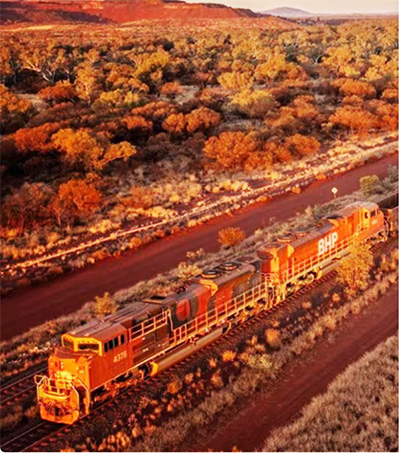
The train image shows two (of the four) locomotives hauling iron ore on a 24,000 tonne 2.4 kilometre long train with one of these loads leaving every hour of every day.
That locomotive is an SD70ACe. It’s engine is a V12 of 16.6Litres (1,010 cubic inches) running at 1000RPM and producing 4600HP. (3.4MW) One locomotive consumes around 8.3 litres of diesel every kilometre, so one trip hauling iron from the mine site to Port Headland sees an overall consumption (for the four locomotives) of diesel of around 14,000 litres and 22 of them a day, and 365 days a year.
Umm, as I said ….. Electrify that!!
Oh, and, you know, just in passing here. That’s four locomotives each train, and 22 trips, so 88 locomotives a day. And BHP was aiming to get, umm, how many battery trains? FOUR of them!!
Tony.
160
Bit of a correction there Tony, that’s, ummm, 16.6 litres PER CYLINDER, not the whole engine.
You’re not getting 4600hp out of a mere 16 litres of total displacement.
As a 4th generation railway brat, I can tell you those motors are *huge*, the crankshaft is 5 metres long…
120
Nigel W.
Thank you. I stand corrected.
So for that V12 engine that’s an overall capacity of just under 200 litres.
See, I told you all that I wasn’t a train spotter!
Thanks again.
Tony.
80
Have seen the photos of the recovery staff retrieving one of those locos that had derailed and gone down an embankment, and putting it back on the line. Another impressive operation.
40
Pilbara Mines, umm, oooookay! (Mines to go green!)
All requiring rail networks. (Locomotives to go green!)
Look at the map at this link.
Yeah yeah! Lines on a page.
Look at the lower left for the ‘legend’.
They are, all of them, private rail networks run by the companies mining iron ore in the Pilbara, and here I’ll just (as per Joanne’s Post) look at the BHP line, and that’s the red one there.
On that line. BHP has (around) 22 departures each day, hence one an hour. Each Iron ore ‘train’ has four locomotives (as in the the two at the front in the image) and can haul 24,000 tonnes of iron, with each ‘train’ being 2.4 Kilometres in length.
Umm, and that’s just BHP.
All down to Port Headland and off to China eh!
In the Pilbara, there are 2800Km of those private railways for iron or haulage.
Just the one comment here to stay on topic with Joanne’s Post ….. Umm! Electrify that!!
Tony.
200
Great map. Have spent the day at one of those minesites. Very impressive.
20
In reading some comments about electrification of haulage and industry a few days ago I was left wondering:
https://www.joannenova.com.au/2025/09/tuesday-125/#comment-2868343
Does anyone have any idea if this electrification is cheaper than direct use of diesel or gas for the equipment.
Intuitively it would seem that introducing an extra stage to the system would make it more expensive.
40
Found eng Ian’s outline at 1.1 really useful. Thanks.
20
Why are we in the OECD countries wasting trillions of $ for a ZERO return on our so called investment?
Just look at the co2 emissions graph for the world since 1945 and there has been little change in the angle of trajectory over the last 80 years.
And China emits about 0.6 billion tons more co2 per year in 2023 than all of the wealthiest OECD countries combined. Just look at the OWI Data link.
So why can’t our silly donkeys spend just a few minutes online and check the evidence for themselves from OWI Data?
https://ourworldindata.org/grapher/annual-co2-emissions-per-country?country=OWID_WRL~AUS~Non-OECD+%28GCP%29~OECD+%28GCP%29~CHN
40
Great move by BHP only sensible thing to do . .
They make profits by digging stuff out of the ground, not by thowing profits back into the hole !!
100
Well if Airbus Albo and Blackout Bowen gave Australians super cheap electricity. Like we did have before the LOONY GREENS showed up.Maybe BHP and a the like could build and process all the minerals the mining industry digs up in Australia, on selling pure pig iron ect to the world at a premium. But that would take vision and guts, 2 things ALBO, BOWEN haven’t got.So enjoy Expensive energy expensive everything Australia.
110
Here’s the co2 levels graph from NASA since 1958 to 2024.
This is from Mauna Loa and no change in trajectory since 1990 and after wasting TRILLIONs of $ trying to cut our co2 emissions.
But Humans have flourished over that time period and are much wealthier and healthier today and a huge drop in deaths from extreme weather events all around the world.
So how come we have 5.2 billion more Humans at risk today and yet a big drop in deaths rates over the last 65 years?
IOW we are living in the safest period in Human history and yet the liars and con merchants ignore the facts? Why is it so?
https://climate.nasa.gov/vital-signs/carbon-dioxide/?intent=121
70
Common sense finally caught up with BHP.
40
Try to imagine heavy transport vehicles crossing from Melbourne to Perth using batteries
70
Or the freight trains that run non-stop from Sydney to Perth. And the 2km-long iron ore trains up north that never stop.
30
Here’s the death rates from extreme weather events since 1900 and a huge drop since the 1920s.
Just run your mouse over each disaster and that will be highlighted.
We live in the safest period in Human history and we should save our money and only invest in safe BASELOAD energy.
https://ourworldindata.org/grapher/natural-disaster-death-rates?country=Wildfire~Flood~Extreme+weather~Extreme+temperature~Drought
30
So why doesn’t BHP and other mining companies just look up the data for our so called warmer, and more dangerous world and save their money and wake up?
Again, here’s the death rates from fires and burns for the World and all countries since 1980.
There’s been a big drop in all countries and Aussies and NZ have very low death rates today compared to 45 years ago.
Certainly we live in the safest period in 300,000 years and yet we have many billions more people at risk in 2025.
https://ourworldindata.org/grapher/fire-death-rates?tab=line&country=OWID_WRL~OWID_LIC~OWID_HIC~OWID_UMC~OWID_LMC~NZL~AUS~African+Region+%28WHO%29
40
~1970 I ahad a bit to do with a retired US railway engingeer who had quite a bit to do with the design of the lines in the Pilbera.
They were (still are?) a constant grade down from mine to port so no engine power mine to port. The engines are to get the wagons back to the mine.
IIRC wagons were 100 ton empty and the load 70 ton.
70
BHP’s only intention was to keep the green howler monkeys out of their ear holes for a couple of years or so. Then either the whole scam would have collapsed or some other bright shiny thing could be waved at them.
They do have a history of really dumb decisions, but if they couldn’t make the numbers work on a haul fleet, they would have gone belly up decades ago.
30
When visiting a RTIO minesite, it was brought home to me how the site logistics are finely tuned. When asked how long it took to load a 270 tonne dump truck, one RTIO staffer said 2 mins 45 secs. The other stated that he thought it was 2 mins 35 secs.
60
The head of my small mining company told me they planned to place solar panels on their HQ building and erect a wind turbine in the yard, to appease the greenies who had taken control of the local government. I told him it was a waste of money because the green nut jobs don’t care about such things, all they care about is getting the mine shut down, that’s their goal. The company placed solar panels on the roof but declined the wind turbine, and eventually the greens were successful getting the mine shut down.
BP learned the same lesson that the mining company learned: Greenwashing does not work.
80
BHP finally decided they didn’t want to be renamed to “Broke Hill Proprietary”.
30
Well, it looks like they have realised better than Bowen and Albo that renewables just don’t cut the mustard.
What’s the bet that is our ridiculous ban on nuclear energy were to be repealed, BHP would be one of the first to utilise AMRs at their mine sites?
That would allow them 24/7 energy to power the site and electrify their mining equipmen,t which would enable them to decarbonise the sites extensively.
20