|
|
||||||||||||||||||||||||||||||||||||||||||||||||||||||||||||||||||||||||||||||||||||||||||||||||||||||||||||||||||||||||||||||||||||||||||||||||||||||||||||||||||||||||||||||||||||||||||||||||||||||||
|
The great thing about these events is meeting the people who come. It includes food and drinks so anyone who can make it will need to register and pay $33 today so they know the numbers. Mount Hawthorn Main Hall, Perth, WA from 3pm -7:30pm Tomorrow.
By Jo Nova Antarctica would have been unrecognizableThe worst global warming nightmares all came true 130,000 years ago, done by mother nature all by herself. Most of the time the media ignores all this inconvenient catastrophe that lasted an astonishing ten thousand years. New research suggests almost all the Ross Ice Shelf melted and large parts of the West Antarctic Ice Sheet disappeared too, yet somehow Emperor penguins survived. So did the seals and the whales, and there was no tipping point that broke the planet. But the Hunter-gatherer beach clubs of 131,000 years ago were all washed away. A new study looked at dust in Antarctic ice cores and noticed there was an ominous shift 120,000 years ago. In other periods the ice core had a layer of fine dust that seems to have traveled all the way from South American volcanoes. But when the Earth last warmed out of the depths of the ice age 130,000 years ago, a different type of coarse grainy dust appeared in the ice core they dug out. Normally big grains don’t travel far on the wind, so this implied that it was coming from a close volcanic source. And while there are plenty of volcanoes on Antarctica, they are normally buried under ice and their dust doesn’t spread. This meant the icesheets must have melted so far that the volcanoes were exposed. The isotopic fingerprint of the fine dust matched dust from volcanoes in South America. But the large grained dust matched rocks in McMurdo Sound in the West Antarctic Rift area. We already knew things must have been dramatic in Antarctica at the time because sea levels were so much higher. There are remnants of corals up to 9 meters higher near Kalbarri in Western Australia, a stable part of very old crustal plate.
The map dramatically changed:
The Eemian period was hotter than our current Holocene.
Lest we forget, every hottest ever record today is nothing compared what has already happened.Seas are rising at 1 to 3mm a year. Yet humanity saw the seas rise by 125 meters (twice) — children used to play on the continental shelf until all their beaches disappeared, their homes washed away, and their favourite reefs were destroyed. Humans saw ice caps a mile thick roll over Manhattan and humans saw the wall of ice melt away too. Things were so bad, at some point our ancestors waved good-bye to an entire species of hominid which had brains bigger than our own, and the vast forests of the Sahara desert turned to dust, the fish died, the rivers stopped flowing and the communities that existed for thousands of years were wiped out. Teach the children what real climate change is. The more they know about prehistoric times and geology, the less vulnerable they’ll be to the scaremongering. But sometime, some day, the ice sheets will return. We do need to talk about that. REFERENCEAustin J. Carter et al, Diminished Ross Ice Shelf and West Antarctic Ice Sheet during Last Interglacial warming, Nature Geoscience (2026). DOI: 10.1038/s41561-026-01988-1
May 29th, 2026 | Tags: Antarctica, Eemian, Ice Cores | Category: Global Warming |  Print This Post | | Print This Post | |
By Jo Nova The EU Free Trade agreement would Weaponize the Paris AgreementThe Labor Party want to sign a deal with the EU which means that future Australian governments won’t be able to drop the Paris Agreement without being bludgeoned in trade by the EU. If we revise our Net Zero goals downwards or delay them the EU can cut access for our farmers to their markets. And the EU will be able to say they are not bullying us, or interfering with our sovereign rights, they are just enforcing a trade agreement we signed up for. In the Labor Governments own words: For the first time in a free trade agreement, Australia (and the EU) has made a binding commitment to implement obligations under the Paris Agreement on climate change. — Australian Government, Department of Foreign Affairs and Trade Effectively Australian farmers or exporters to the EU will be held hostage by the EU to make sure we meet our Paris targets, even if we vote against Net Zero commitments. The deal has meaningless words like “Australia maintains the right to regulate in pursuit of its own public policy objectives” but if we actually do that, there will be a price. Once farmers have adapted to the new EU market, and supply lines are established to advertise, package, transport and distribute the goods, there will be real pain if those markets are abruptly cut off because Australia didn’t meet it’s absurd impossible Net Zero targets. This suits the Labor Party, they can sell out the regions without worrying about a voter backlash from country folk who don’t vote Labor much anyway. The Labor inner-city voters will be happy because they can buy their French cheese and European electric cars slightly cheaper, along with their discounted Dutch ham. But the farmers and the Coalition will be caught in a no win situation where they will pay if they try to get rid of the Paris agreement. This is a pincer move that’s intricate and clever in the same way Ebola is
Labor hid its plans to raise our Paris Agreement commitment from the voters in the last election, only to, by golly, suddenly raise our commitment from a 42% to a 62 – 70% reduction a few months later. Lies and deception is the only way to “pass” a climate tax isn’t it? If Labor had told Australians what it was going to do, would it have still won? And if this Trade Agreement goes through, the farmers won’t have much choice. They could choose not to sell to the EU to stop themselves from being held hostage. But the trade deal means new meat and dairy products from the EU will be arriving to take some of the Australian market away, so they will be, de facto, forced to find some new market. Labor have thrown the regions under the bus in order to trap the Coalition into keeping the Paris Agreement, and the Paris Agreement is a ratchet that can only move in one direction. Commitments can only increase… The good news is that the Coalition appear to be aware of this now and have vowed to oppose it: EU free-trade deal in danger amid Coalition warnings it ‘locks in climate agenda’The Coalition says it could oppose the Albanese government’s $10bn-a-year free-trade agreement with the EU, arguing it would lock future governments into Labor’s “partisan climate agenda” by making Australia’s emissions reduction pledges legally binding. The position means the government could have to rely on the Greens – which has opposed recent free-trade deals – to ratify the agreement that took nearly eight years to conclude. The bad news is that only last week the Opposition was saying they won’t drop the Paris Agreement because it won’t change anything they do, and “it’s just a piece of paper”. That didn’t age well. Didn’t they see this coming? The true danger of Paris framework is coming into focusIt is the legal bomb that can be weaponized through other domestic legislation. If Labor can do a deal with the Greens to sign this, Australia effectively becomes a quasi satellite state of the EU at least on climate and energy. And the new ludicrous targets that Labor snuck in last September become an excuse for the EU to punish any particular industry in Australia that exports to the EU. And we can be sure the EU will pick the most politically leveraged industry to target. It’s not like they will block the Great Fashion Houses of Warringah, because the Teal politicians will squeal for free. This is the elegance of the trap: the voters least enthusiastic about Labor’s climate agenda become the collateral for enforcing it. If a future government tries to loosen the Paris ratchet, it is not the inner-city teal voter who gets threatened with lost market access; it is the farmer, processor and regional exporter. The irony is, it was a lousy inept trade deal for farmers anyhowThe incompetence of this offering made it easier for the Opposition to turn it down. EU free trade more about climate policy than free marketsTed O’Brien, The Opposition foreign affairs spokesman, in The Australian: For the first time, Australia faces legally binding climate commitments in an FTA, including enforceable obligations and the prospect of sanctions. Yet the Albanese government has said remarkably little about this. Instead, debate has centred on agriculture, where Australia was out-negotiated by Europe – securing access for just an extra 30,600 tonnes of beef while Canada won 50,000 tonnes, and forcing Australian cheese producers to compete against government-subsidised European imports at home. Imagine if Albanese had managed to arrange an EU deal which seemed appealing? His incompetence is the best thing he’s got going for him. Ocean Monster Image by Alana Jordan from Pixabay Maze Image by gugacurado from Pixabay *** I’ll be speaking at 3pm Saturday afternoon near I’ll have more details tomorrow. h/t to Dennis and Ms Smith
May 28th, 2026 | Tags: EU, Paris | Category: AGW socio-political, Australia, Big-Government, Global Warming, Politics, Renewable | Print This Post | | I’ll be speaking at an event this Saturday afternoon near If you are in the area and interested I’ll have more details tomorrow.
By Jo Nova Australia is supposed to be going hell for leather to install renewables in order to pretend it has a chance of making Labor’s 82% reduction in emissions target by 2030. Instead investors are running away: Investors desert Australia’s renewable rollout at ‘critical juncture’Mike Foley and Nick Toscano, Sydney Morning Herald Investment in renewable projects collapsed by 50 per cent over the past year, wiping out $4 billion in spending on the rollout, compromising the Albanese government’s clean energy targets and spurring industry warnings that the delays could raise electricity bills. It’s always a critical juncture for renewables isn’t it? It’s like that for things that serve no useful purpose and levitate on subsidies. Investors must bet on which way the political wind will blow, and last year, after the Trump win, renewable energy took a hit. Financial commitments for new renewable generation projects fell to a 10-year low in 2025 of $4.4 billion, half the value of projects that reached financial close in 2024, according to the Clean Energy Council’s annual report, published on Tuesday. Investors are fleeing because of all the usual reasons not to invest — there’s a glut of solar power at noon that curtails every kind of generator and makes prices so low they go negative. Manufacturing and transportation costs are lifting off. Added to that, all the new areas for wind and solar plants have no transmission lines built to them yet, and the farmers hate the proposed high voltage lines. Community resistance is organized and growing. Around the world skeptical governments are winning elections and the golden subsidy deals might vanish any day now. Cue the next crazy plan where our Energy Minister thinks data centers will rescue his ludicrous target: Energy Minister banks on data-centre boom to prop up flagging investment in renewablesBy Perry Williams and Elizabeth Pike, The Australian Energy Minister Chris Bowen has bet that Australia’s booming data-centre industry can reverse the slower-than-expected rollout of wind farms amid fears a slump in financing projects will result in Labor failing to hit its 2030 renewables target. Data centres could help wind farm projects get off the ground as part of a proposed edict for operators to underwrite new renewable power supply and pay their full share of new grid connectivity, so costs are not passed on to consumers or businesses. As if AI data centres would want to jump through all those Australian hoops and regressive taxes to make it happen here, when they can set up in the US where electricity is half the price? The kind of dumb datacenters that serve up Netflix need to be near their customers because the lag times matter, but AI datacenters don’t because no one cares if their answer comes 500 milliseconds later. Australia could have been a master hub of AI development for the world if we wanted to burn our coal, gas, or uranium, instead, we pray to the Eco-Lords to attract datacentres for gaming or watching reruns of the Hunger Games so they might install a few more industrial wind parks, kill off some excess koalas, and cool us by zero degrees by 2100. May 27th, 2026 | Tags: Artificial Intelligence (AI), Renewable Energy | Category: Global Warming | Print This Post | |
By Jo Nova The ABC and the Guardian think they are onto some hot scandalous leak, but they don’t seem to realize the awful truth they are accidentally revealing. This is not the story of an evil miner failing to make commitments, it’s the story of their technology fantasy busting. If wind and solar power were cheap, the profit hungry miners would be doing it wouldn’t they? Instead all their ambitious plans are coming undone.
The truth is that the big electric haul trucks are not even close to being ready, and without the batteries to soak up the unreliable power, there was no point in spending a billion dollars on the wind and solar projects either yet. Everything hinged on the electric trucks being ready but they weren’t: World’s biggest miner BHP backtracks on climate action with key projects put on ice, leaked documents revealBy Christopher Knaus and Adam Morton, The Guardian In a statement, BHP said its progress towards net zero emissions was dependant on technological shifts in trucks, trains and bulldozers, which were not yet ready to be deployed. “For example, no Australian mining operation is currently utilising critical 240-ton battery-electric haul trucks as the technology is not advanced enough to scale to an operational fleet,” a spokesperson said. The company is trialling battery electric trucks… “The technology simply does not exist:” The Chamber of Minerals and Energy of Western Australia, an industry group, said the shift to electrified haulage was incredibly complex and required a whole-of-sector effort to pioneer technological change. “There is currently no mining operation anywhere in the world with the scale, complexity and operating conditions of the Pilbara running a fully electrified haulage fleet, because the technology to do so simply does not exist,” said its chief executive, Aaron Morey. The ABC make out that BHP is being deceptive, saying it would cut emissions, while “locking in fossil fuels” yet the ABC has been deceptively telling us that wind and solar was the cheapest form of energy, while pretending they are real journalists, and not bothering to find out the real cost, something ten thousand engineers could have told them. In their news stories the ABC didn’t have the honesty to mention that the failure of the “urgent” BHP plans shows that wind and solar obviously weren’t cheaper or more useful than diesel.
BHP put in a sincere effort, but the ABC was deceptive all alongThe only thing that the ABC “caught” BHP doing was plotting how to manage the reputational hit from making realistic business decisions. In a normal world they shouldn’t need to do that. But when the media-commentariat is fixated with trying to control the weather, then sensible companies make plans to put out those reputational fires. The fact that reporting is so irrational reflects badly on the ABC and The Guardian, not on BHP. It doesn’t appear to have even crossed the minds of the ABC-Guardian team that their story puts renewable energy in a dismal light. They seem to believe that the higher costs are irrelevant and companies should spend the extra dollars out of charity for the planet, even though they’d be depriving their shareholders to do it. How about those ethics, eh? The ABC reports that another thing that foiled the BHP plan was that diesel trucks got cheaper (the tragedy!): Leaked documents expose how BHP shelved its ‘urgent’ plans to cut WA emissionsABC News They were working to a tight deadline — about 80 per cent of BHP’s Pilbara trucks were due to finish their operational life between 2024 and 2027. A temporary fix was hit upon. BHP would overhaul its current fleet of diesel trucks to extend their life by a few years. This would buy the company time so it could start going electric in the late 2020s. But once again, the company had a change of heart. And once again, cost was a factor. In 2023, diesel trucks from its main supplier Caterpillar suddenly became cheaper. The internal documents show rather than $5 million each, the price had fallen to $3 million. So BHP went back on its plan. It purchased 62 new diesel trucks for its Jimblebar mine, locking in diesel use at one of its biggest mines until at least the late 2030s and potentially to 2041. When diesel trucks became $2 million dollars cheaper each, should BHP have bought the expensive electric trucks anyway, and thus reduced their profits, providing less money for mums and dads superannuation accounts, and charged more for the ore, eventually depriving Mum and Dad of cheaper steel too? The ABC reports on companies as if they are a failed wing of a government department, not a mass of independently organized people working together to serve millions of other people who willingly pay for these goods and services. Thanks to Vic. Photos from BHP Australia.
May 26th, 2026 | Tags: ABC, BHP, Electric Cars (EV), Renewable Energy | Category: Big-Government, Global Warming | Print This Post | |
By Jo Nova The Seismic Rift continues as conservative politics fractures over Net Zero and mass immigration.Astonishing polls in the AFR today point to a wipe-out of the old centre-rightThe message is clear, the voters on the right side of politics don’t want to pander to the climate police and they don’t want mass immigration (which is also true of some voters on the left). It ought to be a snap for the Liberals and the Nationals to figure this out and win them back, but they are not even trying. One Nation could win a blockbuster tally of between 46 and 59 seats in the Australian Parliament. The Liberal Party would be reduced to between 7 to 21 seats and the Nationals to zero. It’s the Blob versus The People, but the Liberals are on the Blob’s side. One Nation voters know this is a fight for the country against corruption and globalist power, and they’re hardly going to be won over by a team that says they’ll stick with the UN because they’re a bit busy to just say “No”. What is Angus Taylor thinking?The Coalition’s half-pregnant policy position is that Net Zero absolutely has to go, but the Paris Agreement absolutely has to stay. This leaves Angus Taylor, the head of the Coalition telling us he won’t pull out of the Paris Agreement because it’s… irrelevant? How is he going to sell that — We’re sticking to all the international agreements that don’t mean anything? If a law achieves nothing, we will leave it on the books? There is no principle here except something else is going on and the Liberals don’t want to tell us what it is. Does he think anyone will be fooled by this? “We will get rid of net zero,” Mr Taylor told Sky News host Paul Murray. “We’re not proposing to get out of the Paris Agreement because frankly, it’s not going to change anything we’re going to do. Taylor doesn’t even try to explain any miniscule theoretical benefit. Like maybe we get to sell more cheese to the French? He’s so unconvincing the only point he mentioned was: “I’m not a big believer in being dictated to by any international organisation…” he said, lamely giving us a reason to get out of it. And poor Matt Canavan looks like a turkey, because he has to eat his own words. In the past he’s said we should get out of the Paris Agreement but now suddenly, it’s just a piece of paper: “‘Net Zero is not in the Paris Agreement at all. We signed up to the Paris Agreement in 2015. Net Zero didn’t come along until years later … it’s just a piece of paper.’ — Matt Canavan to Lee Hanson from One Nation. Senator Malcolm Roberts of One Nation explains that “No, Angus Taylor & Matt Canavan, it is not just ‘a piece of paper'”. That’s just a word game, and it’s clear the spirit and intent of Net Zero lives in there. The monstrous reach of the Paris AgreementBy Senator Malcolm Roberts The phrase ‘Net Zero’ was deliberately left out of the Paris Agreement, as it was deemed too politically charged. Instead, they inserted the legal definition of Net Zero into Article 4.1: Parties aim to reach global peaking of greenhouse gas emissions as soon as possible … so as to achieve a balance between anthropogenic emissions by sources and removals by sinks of greenhouse gases in the second half of this century… According to Onassis, Farhana Yamin is credited with ‘getting the goal of Net Zero emissions by 2050 into the 2015 Paris Agreement’ and was a key IPCC architect. She later joined Extinction Rebellion. Even Wikipedia says, ‘Net Zero was basic to the goals of the Paris Agreement’ with the IPCC’s follow-up to Paris, the Special Report on Global Warming of 1.5*C, popularising Net Zero as a short-hand for the phrase already used in the original document. This is not in dispute by anyone except, perhaps, the Coalition, who are afraid that admitting the Paris Agreement’s role in tying Australia to Net Zero weakens their political chances against One Nation. It’s a legal weaponThe Paris Agreement is a legal tool to pave the way to cement the intent in domestic legislation. As we already know, groups of malcontents and foreign interests use these international agreements in lawfare as a weapon to wring out more money from the hapless taxpayer, or delay useful projects. If we have signed The Paris Agreement, they will say, and we are not living up to our own agreements, somehow, somewhere there will be an aggrieved party who will sue to win millions for their favourite island charity or grifting business. Leaving dud legal bombs set in our legislation is inviting foreign adversaries to use them to their own advantage. China was caught funding eco-lawfare suits in the USA to sabotage American energy dominance. Do we want to make it easier? The UN has told Australia (but not China) that digging up our own gas might be a breach of “international law”. In another instance, a Blobocrat Court has ruled that perfect weather is a “human right”. That court was the Inter-American Court of Human Rights (IACHR), whatever that is — it’s more legal noise and propaganda to wade through. But each quasi legal statement gets used in a higher court, or in parliament, as a precedent, and thus the nonsense ratchets its way up to arenas that matter. Even if the UN hasn’t succeeded yet in legally bombing a nation back to the stone age, we know it wants to. Is any One Nation voter going to be converted by this (below)? If the Liberals keep pushing these contradictory messages which are obviously hiding their true intent, they look weak. If they are just doing this so the Liberals in Teal seats have a safety line, it isn’t worth it. Give the Teal voters the full force of the UN quagmire and failures and the fence sitters will be all yours. This is the sort of Uniparty waffle that will lose even more voters to One Nation. Image by Julius H. from Pixabay May 23rd, 2026 | Tags: Liberal Party, Paris, United Nations (UN) | Category: Global Warming | Print This Post | |  Image by Cortex Zone from Pixabay By Jo Nova Interest Rate Climate Porn attacks AustraliaHenceforth and verily, a witless economic model stacked on top of a skillless scientific one says that eating beef steaks makes the interest rate rise. But, don’t worry, if you spend thousands buying heat pumps, windmills and EVs from Matt Kean’s friends, you’ll pay less on the mortgage (trust us) and Wollemi Capital, who Matt Kean works for, will make more money. Right now, interest rates are a hot topic, so bingo, Climate Change causes that too: Inaction to force up rates, says Climate Change Authority’s Matt KeanBy Rosie Lewis, The Australian Natural disasters fuelled by a failure to curb global warming will make higher interest rates a permanent feature of Australia’s economy, the government’s climate change tsar Matt Kean has claimed, as analysis shows the extent to which climate inaction will harm the nation – in particular in NSW and Queensland – and reduce households’ income. The Australian Prudential Regulatory Authority has relied on economic modelling by Oxford Economics Australia to inform its first stress test of how a changing climate could affect home insurance, with the data showing the economy fares better – albeit still with challenges – when strong climate action is delayed and taken in the 2030s rather than not at all. Mr Kean said Australia’s prudential supervisor had put a scenario estimate on the cost of climate inaction that dwarfed the cost of acting. “We’re talking about household incomes potentially 20 per cent lower than the status quo, persistent inflation, and rising interest rates driven not by policy mistakes but by floods, fires and other disasters made worse by climate change,” Mr Kean said. Not only are climate models unable to predict wind, rain, drought, clouds, cyclones, and El Ninos, they also can’t predict the climate in the short run, the long run, or the past either. Therefore the economic modeling is mere fortune-telling or worse, it’s just advertising. The data, The dataWe already know both types of models are wrong. Despite humans emitting a trillion tons of CO2, Australian climate disasters aren’t costing us any more than they were 60 years ago*. This is despite rampant population growth from 11 million to 27 million people at the same time, with so many extra houses to burn, and a lot more cars to wash away. Globally, the more CO2 we emit, the less we spend on weather disasters. Professor Roger Pielke Jnr has the data. (References below).  Source: ICA. Note that 2025 is through September. Just one big happy Vested InterestMatt Kean is the “fundraiser” for a team dedicated to profiting from Climate subsidies — it’s his job to try to scare you out of your cash. How else will Wollemi Capital make money? Now he’s paired up with APRA, which is a statuary authority supposedly regulating the bankers, but which really works for Minister Jim Chalmers and is totally dependent on the largess of Big Government for it’s 844 salaries. It’s a pure Blob machine, and we can assume their lives are easier if they do things that make Jim Chalmers happier, and also do things that make voters think that Big Spending Governments are worth voting for. (ie, The Labor kind). As for their ability to predict the economy, let’s just say APRA didn’t see the GFC coming. It was the biggest event in APRA’s economic lifetime, and they didn’t warn us. The thing that makes interest rates rise is Big-Spending Governments with fantasies that they can change the global weather. Jim Chalmers not only has an interest in selling his renewable policy, he has an interest in blaming the rises on someone else. Modeling is the legerdemain by which con artists separate you from your money. An obedient model will find whatever the modeler wants it to find.
*To be exact global anthropogenic emissions since 1967 add up to 1.4 trillion tons of CO2. REFERENCESMcAneney, J., Sandercock, B., Crompton, R., Mortlock, T., Musulin, R., Pielke Jr, R., & Gissing, A. (2019). Normalised insurance losses from Australian natural disasters: 1966–2017. Environmental Hazards, 18(5), 414-433. Pielke, Jr. R. (2019). Tracking progress on the economic costs of disasters under the indicators of the sustainable development goals. Environmental Hazards, 18(1), 1-6.
By Jo Nova The big solar storms of 1201-1204 might be oldest historical records of extreme space weather. It turns out the Sun was far more active than we thought during the warm late Medieval era — which is jolly awkward for the climate modelers who need to believe the sun is just a irrelevant ball of light that has no effect on Earth’s weather. If high solar activity correlates with warming on Earth (which it seems to) the modelers can’t keep ignoring the sun. The crux of the matter, is if they add in more solar factors, the models might accidentally actually work without needing CO2. That would be a disaster (for the modelers). On February 21 and 23 of 1201 AD, a Japanese poet wrote of seeing striking red auroras near Kyoto Japan. Someone nearby described the same thing on Feb 22, which makes it an intense three day solar storm. So researchers started looking for carbon 14 in buried wood in Northern Japan, and, voila, they found a huge spike in carbon 14 that suggest a “sub extreme solar proton event”. They rate this is “about 20% of the Miyake event in 774/775, a legendary solar storm. The carbon 14 data was so detailed they were able to piece together three solar cycles from 1190 – 12:20. Which means the solar cycles then were only 7 – 8 years long, and were extremely active. In modern times we know that longer cycles are slower quieter ones. During the Little Ice Age the cycles were as long as 16 years and there were long periods with no sunspots at all.  Variation of the solar modulation parameter for the past millennium obtained based on carbon-14 data (Brehm et al., 2021).1) The team found a whole new solar cycle peaking in 1204 that we didn’t know about. 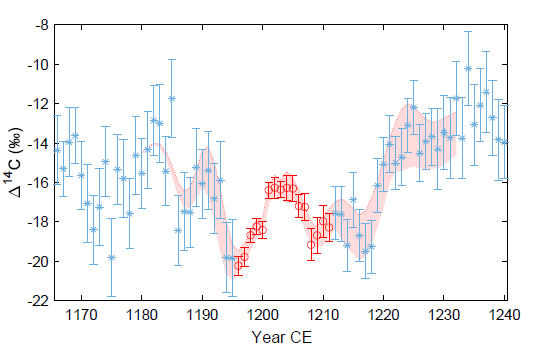 https://www.jstage.jst.go.jp/article/pjab/102/4/102_pjab.102.011/_html/-char/en From the paper come the descriptions of many solar observations recorded from 800 years ago: For example, in Meigetsuki, the diary of Fujiwara no Sadaie, a Japanese courtier famous for his poetry, there are descriptions indicating the occurrence of low-latitude red aurorae in Kyoto on February 21 and 23, 1204.6) The sighting of a red aurora is also recorded for February 22 in another historical document, Omuro Soshoki, which remains in Kyoto, suggesting that the intense magnetic storm continued for three consecutive days, making it one of the oldest extreme space weather events documented in historical records. During these three days, red and white stripes were observed toward the north and northeast. This event may be associated with the appearance of a large sunspot with the size of a date palm, as recorded in a Chinese document on February 21, 1204.3) There are also recordings of the sighting of aurorae in the following month in Meigetsuki as well as in a Chinese document2) and a French document.8) In Meigetsuki, there is a description that aurorae were seen over three nights,7) although it was hearsay within the imperial court. This suggests that solar activity was higher for longer than we thought during the Medieval Warm Period (MWP). It’s more evidence that solar activity correlates with the global temperatures. It’s remarkable to see how many space weather events are recorded:
‡Heresay within the imperial court. REFERENCEHiroko MIYAHARA, Ryuho KATAOKA, Kazuaki YAMAMOTO, Fuyuki TOKANAI, Toru MORIYA, Mirei TAKEYAMA, Hirohisa SAKURAI, Motonari OHYAMA, Kazuho HORIUCHI, Hideyuki HOTTA. Extremely active Sun from 1190 to 1220 in the Medieval Period: Intercomparison of historical records and tree-ring carbon-14. Proceedings of the Japan Academy, Series B, 2026; 102 (4): 156 DOI: 10.2183/pjab.102.011 May 20th, 2026 | Tags: Medieval Warm Period, Space-weather | Category: Global Warming | Print This Post | |
The WHO is itching to trigger the climate and health “Emergency” Powers Act or whatever legalistic bomb our patsy governments signed on our behalf. Apparently millions of people will die if we don’t have a UN rubber stamp called “Emergency” to save them — because, obviously the big rich countries would never think to send boatloads of fuel, food and clothes all by themselves. (And if they did, Lordy! Without being a conduit for millions of our dollars, how could the UN run its own grift and graft machine?) WHO Commission says alert would trigger coordinated international response that could help avoid millions dyingAnna Bawden Health and social affairs correspondent, The Guardian The climate crisis should be declared a global public health emergency by the World Health Organization, or millions more people will die unnecessarily, leading international experts have said. Presumably the “Emergency” declaration gives them the tools to declare mandatory vaccination, or ban drugs they don’t like, or to funnel lots of cash. So the WHO set up a committee to tell the WHO to declare an emergency, eh? The independent pan-European commission on climate and health, which was convened by the WHO, concluded the climate crisis was such a worldwide threat to health that the WHO should declare it “a public health emergency of international concern” (Pheic). So not independent at all. And the thing that makes this year so awful is a The international spread of vector-borne disease, such as dengue and chikungunya, as well as the health impacts of extreme weather events, global heating, food insecurity and air pollution make a Pheic necessary, said the commission’s report, which will be presented to European ministers on Sunday before the WHO’s world health assembly starts on Monday. Don’t miss the lingo — a Pheic is a “public health emergency of international concern”. Thats the highest level of health alert. So when Ebola goes global or an asteroid lands in Nevada, that’s it, they get the same rating as chikungunya. Let’s all just call it a Pheic Emergency…
The committee includes former health and science ministers — so they’re complete Blob-devotees who know what side of the bread their organic-dairy-free-nut-margarine goes on. It says something about them that they have to tell their fans that a rubber stamp can’t actually reverse climate change: Pheics are the highest level of health alert. Previous declarations include infectious diseases such as Covid and Mpox. While declaring one would not on its own reverse climate change, it would trigger the kind of coordinated international response that the scale of the health crisis demands but has not yet materialised. This is pure stone-age sorcery: [Sir Andrew Haines] added: “If we carry on emitting at current rates, that will accelerate the risks to health for both current and future generations including: more people suffering and dying from excess heat, floods and infectious diseases, air pollution from wildfires, more preterm births and more food insecurity.” Hello? Our wild increases in emissions in the last century have left us safer than we’ve ever been. The more CO2 we emit, the less people die of heat, floods, cold and frostbite. There is no saving the WHO. Nothing it does couldn’t be done better by us directly. The demands it puts out are dangerous unaccountable, and infringements on our rights. It should be disbanded for even suggesting these reckless proposals.
May 19th, 2026 | Tags: Onehealth, United Nations (UN), WHO (World Health Organisation) | Category: Big-Government, Global Warming, Psy-Ops | Print This Post | | |
Jo appreciates your support to help her keep doing what she does. This blog is funded by donations. Thanks!
 Follow Jo's Tweets
   
 
|
|||||||||||||||||||||||||||||||||||||||||||||||||||||||||||||||||||||||||||||||||||||||||||||||||||||||||||||||||||||||||||||||||||||||||||||||||||||||||||||||||||||||||||||||||||||||||||||||||||||||
|
Copyright © 2026 JoNova - All Rights Reserved |
||||||||||||||||||||||||||||||||||||||||||||||||||||||||||||||||||||||||||||||||||||||||||||||||||||||||||||||||||||||||||||||||||||||||||||||||||||||||||||||||||||||||||||||||||||||||||||||||||||||||












.jpg)
Recent Comments