Donald Trump pays no lip service to the tender heart of the Eco-Blob bureaucrat. Old coal plants are going to be kept running. Plants that have stopped will be reopened and modernized. New coal plants will be built. It’s all there. Some plants will be converted so they can switch between different fuels seamlessly.
It’s almost like the US is in a race to claw back industry and manufacturing, and wants to be world leaders in a breakthrough new technology that burns energy for breakfast.
This is what a true leader does — they make the right choice while all the minions are aghast, then years later everyone copies them.
WASHINGTON (AP) — The Trump administration said Monday it will open 13 million acres of federal lands for coal mining and provide $625 million to recommission or modernize coal-fired power plants as President Donald Trump continues his efforts to reverse the years-long decline in the U.S. coal industry.
Actions by the Energy and Interior departments and the Environmental Protection Agency follow executive orders Trump issued in April to revive coal, a reliable but polluting energy source that’s long been shrinking amid environmental regulations and competition from cheaper natural gas.
Under Trump’s orders, the Energy Department has required fossil-fueled power plants in Michigan and Pennsylvania to keep operating past their retirement dates to meet rising U.S. power demand amid growth in data centers, artificial intelligence and electric cars. The latest announcement would allow those efforts to expand as a precaution against possible electricity shortfalls.
Trump also has directed federal agencies to identify coal resources on federal lands, lift barriers to coal mining and prioritize coal leasing on U.S. lands. A sweeping tax bill approved by Republicans and signed by Trump reduces royalty rates for coal mining from 12.5% to 7%,
Coal once provided more than half of U.S. electricity production, but its share dropped to about 15% in 2024, down from about 45% as recently as 2010. Natural gas provides about 43% of U.S. electricity, with the remainder from nuclear energy and renewables such as wind, solar and hydropower.
No one wants to lose the AI race, except maybe Australia
Imagine there was hot potential new technology, maybe as transformative as the printing press, and your nation said “No” because the PM wanted to earn Green Victory points at the U.N. assembly?
Australia could do this too and say hello to cheap electricity, jobs, smelters, patents and technological advances. Instead, the more renewables we add, the less industry we keep. Alcoa has just closed an alumina refinery in WA that has been open for 60 years. Alcoa is tactfully blaming several causes, but everyone knows that electricity prices are rising, and the country is in the grip of the meddling bureaucratic Blob.
Firstly, all that money we spent — it’s done nothing (shh!)
It turns out Australia’s economy has been decarbonising at the same rate for decades regardless of how many windmills and solar panels we install, or how many UN speeches we give. Carbon taxes can come and go, coal plants can close, and we can fill up the roof with pink batts. But in the end, the Australian economy, our GDP, is decarbonising at about 2% a year, and has been since 1992. All the frequent flyer carbon schemes, carbon certificates, waste management plans and electric cars amount to a cake decoration.
Roger Pielke Jnr, graphs 30 years of government failure.
For all of the sound and fury of Australian climate politics, which have claimed the careers of a few prime ministers, there is no evidence that Australia’s emissions reduction policies have done anything to meaningfully accelerate the rate of decarbonization over many decades.
We see how Labor, Liberal, makes no difference. The dinosaur era where we used mostly coal power had nearly the same reduction as the Rudd renewable era where we started out quest for “renewables”, and the “Decade of Denial” that followed that was as successful as anything the Labor Greens ever managed.
At it’s peak, our Australia emissions reduction per unit of GDP reached nearly 3%. But if we are to reach even the lower end of the new 2035 goals Pielke calculates we need to double the reduction to nearly 6%.
Not only are the implied rates of decarbonization far in excess of anything ever accomplished in Australia, they are also far in excess of any annual rate of decarbonization achieved by any country — ever.
We know they can’t do it, they know they can’t do it, and they know we know.
Pielke Jnr calculates we should be rushing to install 25 nuclear reactors, if we were serious.
And we are serious, of course, just not about carbon dioxide. We are serious about converting the free market to a socialist paradise.
When every business is dependent on the State, none of them will criticize the Party. Hallalujah.
When energy is unaffordable here, Australia will be the perfect quarry for China, and happy clapper for the UN. …Almost there!
In terms of The Blob, the deepest darkest forces of power, the ones that scare even The Bankers, are surely the spies with guns, especially if they are unaccountable, politically biased spies with guns.
For four years since the January 6 Capitol Hill riots, the FBI has refused to say how many agents it had in the crowd, even to Congress, or even to the US President. Now we find, after the denials, there were 274 plain clothes agents there on the day. Donald Trump says “Wow: A radical Left Democrat Scam.”
It puts a whole new meaning to the term “insurrection”. Hundreds of paid agents, armed, and pretending to be protesting the same government that paid them to be there?
Let’s not forget that the main outcome of the Capitol Hill riots was to draw attention away from a critical Senate debates about irregularities with the 2020 election. (Many Republican senators who has promised to object to the certification of Joe Biden withdrew their objections after the riot). It would also be a useful (if awful) tool to imprison nearly 1,000 protestors and thus terrorize and deter people on one side of politics from protesting.
And then there were people who yelled and incited others like Ray Epps, — “We need to go IN to the Capitol” — were never arrested, and never jailed. And we still don’t know why.
The FBI secretly deployed more than 250 plainclothes agents to the U.S. Capitol during the Jan. 6, 2021 riot, an operation so disorganized it unleashed searing frustrations among many of the FBI’s rank-and-file that the bureau had lost its core competencies to “wokeness” and allowed its employees to become “pawns in a political war,” according to an after-action report kept from the public for more than four years.
Not surprisingly, doing something so politically biased, so unAmerican, was bound to test the more patriotic FBI staff, who protested in anonymous complaints to the “after action” team. That 50 page report has just been turned over to the House Judiciary Committee:
Scores of FBI agents and personnel – many from the bureau’s premier Washington field office (WFO) – sent anonymous complaints to the after-action team detailing how agents were sent into an unsafe scenario without proper safety equipment or the ability to identify themselves readily as armed officers to other police agencies, the report obtained by Just the News shows.
“The FBI should make clear to its personnel and the public that, despite its obvious political bias, it ultimately still takes its mission and priorities seriously,” one employee wrote in a stinging review. “It should equally and aggressively investigate criminal activity regardless of the offenders’ perceived race, political affiliations, or motivations; and it should equally and aggressively protect all Americans regardless of perceived race, political affiliations, or motivations.”
That agent urged FBI leaders “to identify viable exit options for FBI personnel who no longer feel it is legally or morally acceptable to support a federal law enforcement and intelligence agency motivated by political bias.”
These agents were deployed in plain clothes and with guns, yet they had no way to identify themselves to the police and no safety gear to protect themselves. What were they doing there, and why was this a secret for so long?
And the bigger question is just how close the most powerful democracy on Earth is to being a sham in the control of an unaccountable shadow government? Purely hypothetically, if the FBI chiefs had compromat which gave them control over one presidential candidate (like say, his son’s lap top) — they might feel inclined to boost his chances of getting elected, and to cover up any illegal boosting they might have done. The question is not whether this scenario is possible, because it self-evidently is possible, but to ask if it happened, “What would stop that?” The media? The Watchdogs?
Like — PBS News December 2024?“No undercover agents on the scene” says report from the Justice Department, knocking down yet another fringe conspiracy which turned out to be true.
The US Justice Department was the watchdog which took three years to not-find 274 agents. What kind of justice is that? The Blob kind…
Experts are wrong: After 58 years of emissions — disaster losses in Australia stay the same
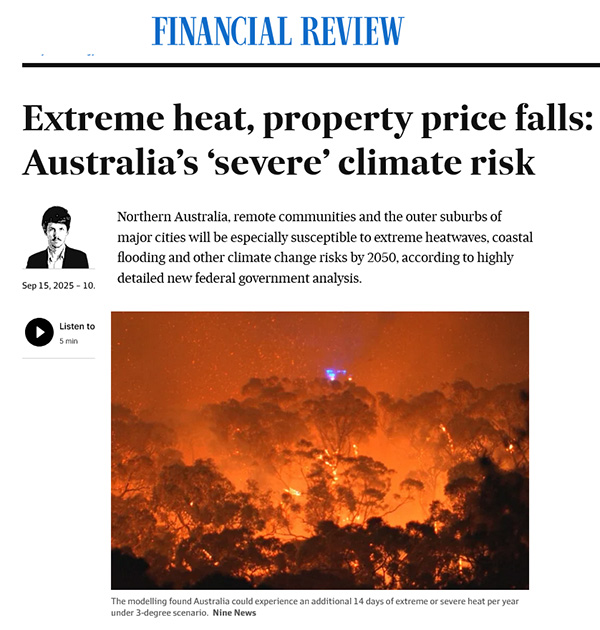
Australia’s National Climate Risk Assessment dropped on us last week like the perfect propaganda-bomb — inducing headlines about our horrifying climate future, starring photos of flooded houses. But the data shows the only horror-show is the state of Australian science at the CSIRO.
The report predicts that climate change will cause $40 billion in disaster losses each year by 2050. But Professor Roger Pielke Jnr points out that the numbers come from the Colvin Review which “says no such thing”. The Colvin Review merely projects disaster costs will increase due to population growth, not “climate change”. As Pielke says “For a formal government assessment this is, at best, incredibly sloppy.” (He doesn’t add, especially when hundreds of billions of dollars depends upon it.) He expects that people relying on this report might “feel hoodwinked”. (We do).
Climate Change is not increasing disaster losses in Australia
Despite every fire, flood and spring tide being blamed on climate change, insurance costs for disasters haven’t increased in nearly 60 years, apart from what we’d expect due to inflation and population growth. Pielke got the data from the Insurance Council of Australia, and adjusted it using GDP data from the Australian Bureau of Statistics to produce this graph (below). He finds there is “no trend”.
Where is the crisis?
Humanity produced eighty percent of all the emission we’ve ever produced in the last 58 years, (1,400 billion tons of carbon dioxide) yet in Australia losses due to natural disasters haven’t changed as a proportion of our economy. Here in the land of droughts and flooding rains, it is business as usual.
Our population has grown from 11 million to 27 million, with more homes, farms and factories just waiting to be burned, blown away or flooded. But once the extra targets are taken into account there is no sign of any extra effect from “climate change”. All those extra buildings, bridges and cars are sitting-ducks for storms, floods, and hailstones, yet the “climate crisis” downunder is the same as it ever was.
Back in 1967 (when the graph starts) global carbon dioxide stood at an idyllic 320ppm, now it’s 425ppm, and there is nothing to show for it. How much more are we supposed to spend to prevent a crisis that isn’t happening?
The CSIRO and the BoM and climate academics serve themselves and not the taxpayers who fund them.
The CSIRO and the BOM have reduced themselves and science to nothing more than a publicity exercise to promote government power and spending. Even the half-decent scientists left at both institutions don’t speak up when colleagues shamelessly abuse the scientific method, or lie by omission.
They still collect their salaries and their super while plumbers, farmers and truckies pay more for electricity than they should and jobs at factories and plants close down.
Shame on all the academic incompetent snobs: they are letting the country down to line their own pockets with comfortable careers.
A Chinese group has invented a James Bond style ejector for EVs to solve those embarrassing moments when the battery reaches thermal runaway, and there are no handy swimming pools to park the car in.
It seems like a great idea for all the times the EV starts to smoke while you idle next to a pit of fire retardant foam. Otherwise, it seems a bit tough on pedestrians. This could not only kill school children walking down the road, but take out their bus too.
Imagine if a hostile power had remote control over 500 kilogram covert bomb launchers, and they infiltrated our cities?
In case of thermal runaway, this proposed EV battery ejection system is designed to send a flaming, venting one-tonne battery pack several meters to the right of the vehicle … and may the gods help anything in its path.
(h/t https://t.co/QpsFvjruwZ) pic.twitter.com/Wyu5NIsuKM
Simon who wrote Australian Climate Madness for years, first spotted the ejector battery and explains the crazy on youtube (at least as much as he can):
People would certainly learn never to park beside one.
If heavy vehicles need to beep when reversing what kind of noise should an EV make before launching?
Trump just went full Climate Blasphemy at the UN, saying the things we wish someone had said for the last twenty years. It’s a scam, a hoax, and a fraud, he said, and the schmucks at the United Nations have to listen to every word.
In 1982, the executive director of the U.N. environmental program predicted that by the year 2000, climate change would cause a global catastrophe “irreversible as any nuclear holocaust”… these predictions were WRONG. They were made by stupid people that have cost their countries fortunes.
Trump warned world leaders that if you don’t get away from this green energy scam (and mass immigration) your countries are going to fail.
From 39:00 minutes in he mocks the UN predictions from 1982.
“Your countries are going to hell”.
Despite him being the highest ranking speaker of the day, the UN escalator stopped working and then the teleprompter didn’t work, making it just that much harder for him to connect with the cameras and the audience for the newsworthy grabs, or making it more likely he would misspeak. What are the odds?
When we were in Bali at the UN all those years ago, there were a string of odd accidents that always worked in the UN’s favour. They’d finally relent, and offer us a big venue after days of saying there were none, then they forgot to put a notice on the public ticker-timetable. Petty. Petty. Petty.
“It’s the greatest con job ever perpetrated on the world in my opinion.”
Another UN official stated in 1989 that within a decade entire nations could be wiped off the map by global warming. Not happening. You know, it used to be global cooling. If you look back years ago in the 1920s and the 1930s, they said global cooling will kill the world. We have to do something. Then they said global warming will kill the world. But then it started getting cooler. So now they could just call it climate change because that way they can’t miss. It’s climate change because if it goes higher or lower, whatever the hell happens, there’s climate change.
“Predictions made by stupid people that have cost their countries fortunes…”
Climate change, no matter what happens, you’re involved in that. No more global warming, no more global cooling. All of these predictions made by the United Nations and many others, often for bad reasons, were wrong. They were made by stupid people that have cost their countries fortunes and given those same countries no chance for success. If you don’t get away from this green scam, your country is going to fail.
They must take control strongly and immediately of the unmititigated immigration disaster and the fake energy catastrophe before it’s too late.
“… by people with evil intentions…(he names Obama)”
The carbon footprint is a hoax made up by people with evil intentions and they’re heading down a path of total destruction. You know, the carbon footprint, it was a big big thing a few years ago. I remember hearing about the carbon footprint and then President Obama would get into Air Force One, a massive Boeing 747, and not a new one, an old one with old engines that spew everything into the atmosphere. He’d talk about the carbon footprint. We must do something. Then he’d get in and he’d fly from Washington to Hawaii to play a round of golf. And then he’d get back onto that big beautiful plane and he’d fly back and he talk about again global warming and the carbon footprint. It’s a con job.
Europe cut emissions 37%, and for what…”
At extreme cost and expense, Europe reduced its own carbon footprint by 37%. Think of that. Congratulations, Europe. Great job. You cost yourself a lot of jobs, a lot of factories closed, but you reduce the carbon footprint by 37%. However, for all of that sacrifice and much more, it’s been totally wiped out and then some by a global increase of 54%. much of it coming from China and other countries that are thriving around China which now produces more CO2 than all the other developed nations in the world. So all of these countries are working so hard on the carbon footprint which is nonsense by the way. It’s nonsense.
***[For the record I tried to link to the short 6 minute version of Trump’s speech about climate change, that Marc Morano posted on X, and it is breaking the website every time. “You are blocked!” . Hmm. Is it X, or Trump, or just bad luck? – Jo]
Finally, twenty years too late, some Greens admit that wind farms and renewables damage the wilderness they wanted to save, but they’ve stayed silent because they are afraid they’ll be called a climate denier.
People may have missed this significant turning point in The Australian ten days ago. Because climate change is essentially a grossly exaggerated scam, it levitates on billions of dollars and a layer-cake of coercion and intimidation. And so it goes that the economic craziness is tearing the Liberals apart, but the environmental destruction is tearing the Greens apart too.
Never underestimate the power of petty put-downs. Many on both sides didn’t speak up because they didn’t want to sound stupid, or selfish or “far right”.
If the Greens had spoken up against the dehumanizing petty names, instead of staying silent or joining in the namecalling bonfire, we wouldn’t be killing so many eagles and whales and cutting down trees “to save the planet”. Let’s not forget, saving the animals and trees is supposed to be the driving force of The Greens, yet they were willing to look the other way, or ignore something if the social cost was too high.
Wait til they find out they’ve been helping the bankers….
By Matthew Denhold, The Australian, September 12th 2025
Major fault lines have emerged in the environment movement over the renewables rollout, with peak groups accused of turning a blind eye to “biodiversity-destroying” projects, while a senior campaigner likens its impacts on nature to the industrial revolution.
Veteran conservationist and former federal Greens leader Christine Milne told The Australian peak environmental non-government organisations were too “frightened” to oppose renewables projects.
If only the horrible people on The Right hadn’t already opposed wind farms, it wouldn’t have been so hard for the Greens to protest:
“The reason that the larger groups have got to this point is because the right in Australia oppose renewable energy.
“And so the environment movement have been reluctant to stand up and say ‘well, actually, on this particular wind farm or this particular transmission line it’s not appropriate’. They are frightened of being categorised in climate denier (terms) …”
Not quite at the state of accepting personal responsibility then…
Bullying is such a widespread problem — even the campaign director of the Wilderness Society has quit recently because of the bad behaviour and the dire threat of industrial renewables:
Ms Milne’s intervention comes as Wilderness Society national campaigns director Amelia Young quits the group after almost 20 years, citing “intolerable … attitudes and behaviours” – and warning of a dire threat to nature posed by the renewables rollout.
“The renewables revolution threatens nature in many of the same extractive and colonial ways that the industrial revolution did,” Ms Young told colleagues in a farewell email, obtained by The Australian.
It’s amazing the effect namecalling has. It’s not just a schoolyard thing, social mockery and ostracism keeps adults in line very effectively.
Christine Milne talks about the city versus country divide within the Greens. Often it’s the rural locals who are opposing the destruction and the city based NGO’s wont help. The the traditional Greens find themselves on the nasty end of their own activist inner city Green forms of bullying:
“To denigrate those people as just Nimbys or anti-global action on climate is just wrong, and it just alienates people.”
Perhaps if the Greens didn’t teach their underlings to smear and attack everyone for fantasies like “fossil fueled funding” they might foster a healthier community of their own?
It’s interesting, isn’t it, that the climate denier insult worked even better on the Greens (and for longer) than it did on the skeptics
If the Greens had spoken against the bullies, they wouldn’t have just helped skeptics, they’d have set themselves free. Everyone would have been able to speak, and we’d all have figured out unreliable low density generators were not going to stop the storms or cancel the floods, or save the spotted quoll. And most importantly, we’d have realized that it isn’t about left and right, but about the people versus the parasitic Blob.
And that’s the thing the Blob is most afraid of — the left and the right talking to each other. (Vale Charlie, eh?!)
Nearly all the “climate action” we’ve paid for in Australia has only reduced emissions by 3.9% in 20 years
Anthony Albanese is proud that Australia has reduced emissions by 28% since 2005, but doesn’t tell Australians that 24% of that was in land use, mostly because we let scrub and forests grow back. And now he’s talking of reducing emissions by 62% by 2035?
The elephant in the emissions kitchen is that only one kind of “carbon reduction” has achieved anything meaningful in Australia — and it’s not wind, solar, tidal, geothermal, fugitive emissions, EVs, batteries, pink batts, LED globes, cloth shopping bags, FOGO bins, paper straws, insulation, carbon taxes, carbon capture schemes, bug burgers, or feeding seaweed to cows to reduce their farts. The only thing that has reduced our emissions in any meaningful way is land use and forestry change (which officially goes by the delightfully-bureaucratic name, “land use, land-use change and forestry,” LULUCF).
We can see why they don’t want to talk about LULUCF!
Compare these two graphs below. Not only has all the money poured into emissions reduction been trivially effective, the second graph shows why all our efforts in reducing emissions in agriculture, industry, transport and electricity are like climbing Mount Impossible.
This first graph makes it look like our obsession with solar panels and windmills has achieved something because emissions from electricity are falling. But note the net effect of emissions-cuts across seven major areas is barely 3.9%. It’s an illusion.
Australia has reduced emissions since 2005 by 28.1%, but almost all of it comes through LULUCF. Below, we see just how many billions of dollars have been “invested” into achieving nothing, but making President Xi very happy. All the flat lines on the graph are where we spent most of the money. Thus and verily, every dollar spent reducing emissions in every other area outside land use change is almost irrelevant.
Like squeezing blood from an iPhone — our cars, heaters, food and electricity systems are already efficient, finely-tuned ecosystems. It takes massive spending to eke out every tiny further reduction. But biology evolved to “reduce carbon emissions,” and removing a few bottlenecks lets the natural carbon-reduction-bio-machine rip. Five hundred million years of evolution has made chloroplast motors that can suck carbon out of the sky. If only we have 7 million square kilometers of space to suck with — oh, we do. But most of those millions of square kilometers need water and fertilizer.
Dr David Evans was the leading carbon modeler for The Australian Greenhouse Office / Dept of the Environment 1999 – 2005 and also did some contract work for them in 2007-2009 (and I happen to be married to him, both then and now). He explains that Australia leads the world in using satellite data to estimate carbon in trees, shrubs, crops, bark, mulch, roots, and soil — because it matters more to us than nearly any other nation. The FullCAM model he created takes Landsat data down to the very small resolution of 25m2 plots across our 7.7 million square kilometer continent. It’s so detailed we can identify when a large tree grows or is cut down anywhere in Australia. We can see when a firebreak is carved through forest, and when the forest reclaims the firebreak.
From Dr David Evans, Australia’s former Kyoto carbon modeler at the Australian Greenhouse Office:
Australia had to fight to get LULUCF included in the national accounts. It was important to our accounts, but it was not useful for Europe, where forests were long since cut down.
LULUCF is responsible for almost all our reductions in carbon emissions, mostly just by ending land clearing. Between 1990 and 2008, land clearing almost completely stopped in all the Australian states except Queensland and northern NSW. It has since mostly stopped everywhere. Just ending land clearing allowed Australia’s emissions in other sectors to grow as the Australian economy grew, while still allowing Australia to meet its Kyoto Protocol commitment of less than an 8% increase in net carbon emissions between 1990 and 2008. The LULUCF contribution over this period was about -23%, as I recall (as calculated by FullCAM).
But the LULUCF emission reduction graph flattens out after 2020. There is a natural limit to carbon emission reduction in the LULUCF sector. There is only so much land not-to-clear, forest to plant, and soil whose carbon we can increase by optimal management. There probably isn’t much more arable land that isn’t already farmed or used for housing, that we can reclaim. We have millions of square kilometers of arid land, but it won’t hold much carbon in vegetation or the soil without extra rainfall and fertilizer.
Once a forest has fully matured, the carbon content per square kilometer reaches doesn’t change, because the forest is in equilibrium. Old growth forests aren’t removing much carbon from the atmosphere, just storing it where it can’t interfere with infrared radiation leaving the planet. It’s only a growing forest that acts as a carbon sink. By the way, about 96% of carbon exchanges to and from the atmosphere are not anthropogenic, and are mostly not well understood. Does global warming (by any cause, e.g. space weather) increase bacterial decay, releasing more carbon dioxide as mulch etc. is broken down quicker? How much is this raising the atmospheric carbon dioxide level?
If a bushfire destroys a forest, in the world of international carbon accounting that’s considered “an act of God” and the emissions released are not counted on our national accounts. The national accounts are only for man-made (anthropogenic) carbon emissions. (Amusing side note: when a forest burns down, about 1% of its carbon is converted to charcoal and becomes chemically inert, thereby removing it from the carbon cycle and rendering it unable to find its way back to the atmosphere. So, in the long run, to reduce atmospheric carbon via forestry, we should be burning down forests and replanting them! Which is sort of what happens anyway in Australia — which has a remarkably high charcoal content in the soil. By the way, burning the wood in low oxygen conditions creates “char,” which is a potent fertilizer for crops. But burning down all our forests and letting them regrow just to add 1% of the emissions to the soil layer seems a bit extreme, even for today’s Greens.)
— David Evans: PhD, M.S. (E.E.), M.S. (Stats) [Stanford Uni], B.Eng, M.A., B.Sc., University Medal, [Syd Uni]
We are only a tenth of the way to our 2035 target
The Albanese government rides for free silently and deceptively on the regrowth of previously cleared land, but that has probably run out. We’ve spent billions of dollars on wind, solar and batteries, and LED globes, and insulation, and all we’ve done is reduce our emissions by 4% or so. Nothing.
The LULUCF graph plateaus at 2020. Let’s assume LULUCF has done most of what it can, and remove it from the picture. Effectively then we are aiming for 43% reduction minus the 24% already achieved by LULUCF, which we’ll assume will probably stay constant from now on. That leaves a 19% reduction left to achieve from everything else. The devastating maths is that we have barely made 3.9% of the 19% we still need to achieve by 2030, and now fatuously, we’re aiming for a 38% reduction in emissions from ever sector apart from land use and forestry by 2035.
These people are so bad with numbers, we have to ask if they are innumerate dupes or lying hacks (or both)? The 2035 target is effectively twice as high as the 2030 target, which we are already failing to achieve. We are at the point of surreal absurdity in national energy policy, and yet the suits are still smiling solemnly, as if it is not a trillion dollar fairy tale.
The Labor Government is being deceptive in hiding how brutal and expensive it is going to be to meet any of these targets. Every time they mention the 28% figure, they are lying by omission, because they won’t say that most of that reduction has nothing to do with all their renewable, recycling, battery storage, or Snowy 2.0 schemes, or school indoctrination programs and therapy sessions for climate angst.
What’s the aim of fantasy targets?
Obviously, the Labor-Green Blob doesn’t really care about carbon dioxide, or they’d be acting differently. The aim here is not to reduce carbon emissions as cheaply and realistically as possible, or they’d be honest about what works and what doesn’t.
The immediate goal of obscenely impossible targets may be as petty as impressing the UN and WEF, and winning the game to host the next COP super-junket in Adelaide in 2026 (with inevitable failure cynically hidden 4 to 9 years further down the track, when this government is long gone). But we can’t overlook the true big winners in this deal — the Blob, the Bankers, the Bureaucrats, and China, China, China.
To all intents and purposes, ridiculous targets feed dependent corporate interests who farm the subsidies, while crushing any industries that don’t need government help. It converts once-independent industries like aluminum smelting to ones dependent on big government, who have to beg for handouts just to survive, and now have a driving need to grovel before politicians, or at least, not say something that might offend them. This cripples the free market and free speech. It slowly converts the country to a communist or globalist paradise, by taking the strength away from independent industry and converting all the players into vassals dependent on government rules and decrees.
This is an existential battle for The West. Without cheap energy, we become voiceless slaves to the Blob.
*UPDATE: Sky News is quoting a 27% reduction and 3%, but those figures are from the December 2024 Quarter. My figures above are the latest from March 2025.
We use cookies to ensure that we give you the best experience on our website. If you continue to use this site we will assume that you are happy with it.











Recent Comments