 By Jo Nova
Experts are wrong: After 58 years of emissions — disaster losses in Australia stay the same
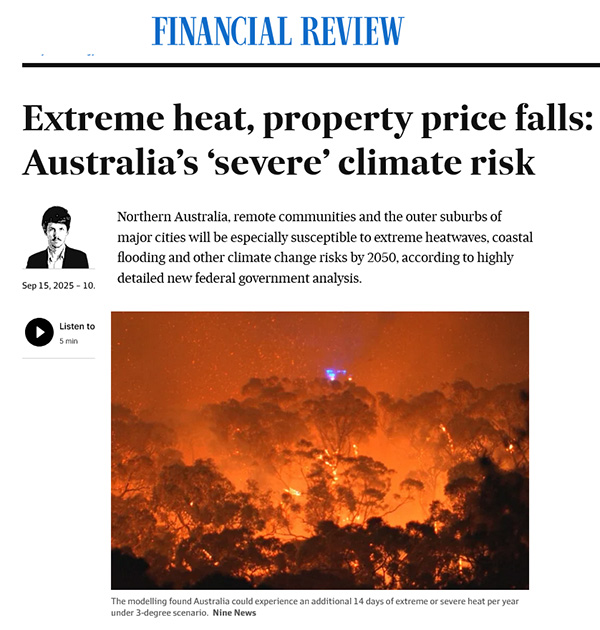
Australia’s National Climate Risk Assessment dropped on us last week like the perfect propaganda-bomb — inducing headlines about our horrifying climate future, starring photos of flooded houses. But the data shows the only horror-show is the state of Australian science at the CSIRO.
The report predicts that climate change will cause $40 billion in disaster losses each year by 2050. But Professor Roger Pielke Jnr points out that the numbers come from the Colvin Review which “says no such thing”. The Colvin Review merely projects disaster costs will increase due to population growth, not “climate change”. As Pielke says “For a formal government assessment this is, at best, incredibly sloppy.” (He doesn’t add, especially when hundreds of billions of dollars depends upon it.) He expects that people relying on this report might “feel hoodwinked”. (We do).
Climate Change is not increasing disaster losses in Australia
Despite every fire, flood and spring tide being blamed on climate change, insurance costs for disasters haven’t increased in nearly 60 years, apart from what we’d expect due to inflation and population growth. Pielke got the data from the Insurance Council of Australia, and adjusted it using GDP data from the Australian Bureau of Statistics to produce this graph (below). He finds there is “no trend”.
Where is the crisis?
Humanity produced eighty percent of all the emission we’ve ever produced in the last 58 years, (1,400 billion tons of carbon dioxide) yet in Australia losses due to natural disasters haven’t changed as a proportion of our economy. Here in the land of droughts and flooding rains, it is business as usual.

Source: Roger Pielke Jnr, using ICA and ABS data. Note that 2025 is through September. (See McAneney et al. 2019 for the details.)
Our population has grown from 11 million to 27 million, with more homes, farms and factories just waiting to be burned, blown away or flooded. But once the extra targets are taken into account there is no sign of any extra effect from “climate change”. All those extra buildings, bridges and cars are sitting-ducks for storms, floods, and hailstones, yet the “climate crisis” downunder is the same as it ever was.
Back in 1967 (when the graph starts) global carbon dioxide stood at an idyllic 320ppm, now it’s 425ppm, and there is nothing to show for it. How much more are we supposed to spend to prevent a crisis that isn’t happening?
The CSIRO and the BoM and climate academics serve themselves and not the taxpayers who fund them.
Professor Andy Pitman admits climate models can’t predict extreme events, El Nino, tipping points, rain or river flows, yet he (and all the others) rarely stand up to say so when our Minister for Changing the Weather, or our news media misleads the people.
The secret in plain view is that Climate modelers have no idea what really controls out climate. Arctic sea ice was supposed to disappear but it’s stayed the same for twenty years. Antarctic sea ice inexplicably grew for decades, and the modelers didn’t know why, then it suddenly declined, and the modelers didn’t see that coming either. Cyclones have declined in the Australian region and the Indian ocean. Australian sea levels have been falling for 7000 years. Deserts are not growing. Pacific Islands are not sinking. And 178 years of CO2 emissions have no measurable effect on rainfall in Australia.
The CSIRO and the BOM have reduced themselves and science to nothing more than a publicity exercise to promote government power and spending. Even the half-decent scientists left at both institutions don’t speak up when colleagues shamelessly abuse the scientific method, or lie by omission.
They still collect their salaries and their super while plumbers, farmers and truckies pay more for electricity than they should and jobs at factories and plants close down.
Shame on all the academic incompetent snobs: they are letting the country down to line their own pockets with comfortable careers.
Related posts:
- Minister Bowen says costs of inaction absolutely definitely higher even though we don’t know the cost of doing something
- Expert modeler admits they can’t predict extreme events, El Nino, tipping points, rain or river flows
- Climate Change to cost $38 gazillion dollars every ten minutes, right after I retire say all The Experts
REFERENCES
- McAneney, J., Sandercock, B., Crompton, R., Mortlock, T., Musulin, R., Pielke Jr, R., & Gissing, A. (2019). Normalised insurance losses from Australian natural disasters: 1966–2017. Environmental Hazards, 18(5), 414-433.
- ICA: Insurance Council of Australia data.
- OWID: Cumulative CO₂ emissions 1967 – 2025
- OWID: Australian population growth.
- CO2 levels: NASA
- Australian Bureau of Statistics
Image from the AFR article: “Extreme heat, property price falls: Australia’s ‘severe’ climate risk”