
…
By Jo Nova
Don’t mention that capacity factor…
The media and wind industry always sells the biggest, best new generators at their full imaginary capacity. The newest largest wind farms are said to be “1 GW”, even though they will almost never supply that. The real percentage they supply of the advertised “capacity” is called the “capacity factor” and it rarely gets a mention. The average reader, not paying attention, won’t notice that the $2b cost doesn’t stack up at all. It’s like buying a brand new car without knowing it only gets 7 miles per gallon (and only when the wind blows).
We need to know ‘the mileage’
The latest GenCost report uses the term “capacity factor” literally 100 times (I counted), so obviously it’s central in calculating the value of a generator, yet it is that which shall-not-be-named in public discussions. And when they do say it, it’s often worse than they say, and that bad number is also shrinking.
In 2019 the CSIRO Blob Experts bravely assumed that the modeled average capacity factor of onshore wind would be 44.4%. Years later, in the latest GenCOST report they assume, like an addict, that it would between 29% “and 48%” — still fantasizing that a miracle is about to come. So their modeled prediction of the cost of onshore wind power is ridiculously generous. Even after reality doggedly stayed around 30% for six years, a google search shows the NSW government “fact sheet” says it’s around 35% and the Google AI overview says it’s 30% “to 45%“.
How imaginary homes are powered by imaginary capacity factors
Anton Lang, also known as TonyfromOz is yet another volunteer creating the graphs that the CSIRO, AEMO, ARENA, ABC, and AER get billions of dollars to provide, but don’t want us to see. For years Tony noticed that the paperwork advertising wind “farms” didn’t mention the capacity factor. It seemed like a strange gap in the documentation. Tony noticed they usually converted their output to the fantasy fairy-thousand-homes it would supply which is a pure marketing ploy. They pretend, deceptively, that wind turbines are capable of powering any homes at all. When Tony back-converted the number of homes, he realized all the companies marketing wind turbines were assuming a capacity factor of 38% to create the imaginary homes value.
So he used his collected data to calculate the capacity factor of all Australian wind plants, and discovered, that averaged over the last seven years, it is just under 30%. It started out at about 31% in 2019 but has declined, and over the last year, the rolling 12 month weekly average capacity factor has often been close to 27%.
Thanks to Angus McFarlane for the graph where we can see the slide in wind turbine capacity:
During this time the total nameplate capacity grew from 5.3GW to 13.5GW. Despite improvements in design, and the young age of this fleet, the capacity factor is getting slightly worse, not better.

As Angus McFarlane points out GenCost uses the highest possible capacity factor on the upside, but calculates the “low option” a different way to hide how low it really is:
If only we had a scientific institution paid by taxpayers that gave unbiased scientific advice, eh?!
Three reasons the weekly capacity factor is headed downwards
- One: the best sites for wind plants are already taken. All the windiest spots near transmission towers with spare space are built on. Thus new wind installations either have less wind, or are further from population centers.
- Two: no matter how many new turbines are installed, the high pressure cells still cover the whole country, and thus the extra generation comes mostly when we don’t need it. More turbines, means more curtailment. More solar means more curtailment at lunchtime.
- Three: The equipment is always degrading. High wind zones are tough places to put any infrastructure. The wind, flying sand, dust, ice and salt are continuously degrading the trailing edges of the blades which increases turbulence and reduces efficiency. And the stop-start nature of wind is awful on gears and bearings. The blades are so heavy that even when the wind doesn’t blow, the rotor has to turn slowly, or the bearings will flatten.
Why the lowest of the low points matter
The figures in the graph above are weekly average values, but what also matters are the capacity factor on the worst days, and the worst half hour, because that tells us how much back up power we have to have. In those moments the capacity factor of a whole country full of wind turbines can be as low as 0.7%. On a bad day $20 billion dollars of wind power across Australia can only guarantee as much power as two diesel generators.
How much back-up do we need for a 13.5 gigawatt wind system? The awful truth is, about 13.4 gigawatts. The entire wind industry is effectively a superfluous add on to a full reliable grid. It’s main productive benefit (allegedly) is the hope of changing storms and floods in 100 years. It can not possibly be cheaper than our current system unless fuel costs were the largest share of electricity costs, which they aren’t.
Those high pressure cells just won’t go away:
Look at how big these horrible high pressure cells are which stop the wind across the whole continent. Make them stop!
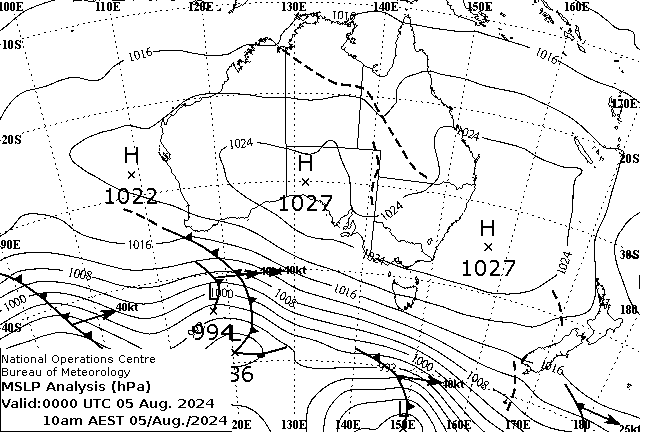
As TonyfromOz says, without isobars, there is no wind…
Depressingly, Paul Miskelly did the calculations back in 2012 and the capacity factors were around 31% even then. The AEMO, CSIRO, and AER have known all along, surely, that it wasn’t 35%, 40% or 48%. They were either living off false hope or doing false advertising.
It’s time the Australian people knew.
REFERENCES
Paul Miskelly, (2012) Wind Farms in Eastern Australia-Recent Lessons, Energy & Environment 23(8):1233-1260, DOI:10.1260/0958-305X.23.8.1233
Anton Lang publishes his work at PaPundits.
— More coming soon from Angus McFarlane on the exaggerations and fantasies of CSIRO’s GenCost. —






The capacity of turbines inland in the UK (normally on hilly ground) is reckoned to be 22% and off shore around 33%.
Our solar panels are reckoned to be around 11% efficient. Normally here in Devon we would reckon on around 1750 hours of sun a year and would be considered one of the sunniest spots in the country.
I would imagine OZ could do very much better than that
200
All that need happen is the requirement for a minimum renewable capacity of 38% as used by CSIRO.
If the wind farms do not reach this they would have to include batteries.
100
I recon that wind farms should provide some backup supply for when there is no wind, full stop. The capacity factor matters nothing. If they promise to produce a megawatt in the capacity auction and don’t, they should be penalized heavily.
40
My off-grid solar system achieves a CF of 3.8%. That figure gave the overall lowest system cost to supply the daily demand when the cost of batteries were taken into the overall cost.
My on-grid system achieved 12.6% over the first few years before neighbours started installing solar panels and the high street voltage caused my system to reduce output through the middle of the day. Last year it achieved 11.4%. It should get back up this year now that I have a battery. Since the battery was turned on in early July, I have only exported on 4 days and not till late afternoon.
CFs for off-grid systems in Australia could get as high as 8% or even 9% if the panels were favourably aligned for the lowest sun days. Tracking arrays working off-grid could achieve 15% with lithium battery firming.
The 22GW of rooftop solar in Australia averages 2.4GW output so CF a little over 10% for all rooftops.
110
And for the Industrial Solar Power plants across the whole AEMO, their total Nameplate is 10,714MW. (so 10.7GW)
They operate at a Capacity Factor of 16.97%, but that’s really irrelevant, because, umm, evidently, they supply 63 million homes, or so I’m reliably told anyway!!
Stop doing that Tony.
310
If anyone tells you this then the reply is quite simple – almost half the homes supply themselves. And that number is increasing each year. So why are they building grid wind and solar to supply homes that are quite capable of supplying themselves. The only way new grid and and solar will get built is if the government (tax payers) takes all the risk as they do with the distribution and transmission system. Only an investment moron would invest in grid assets when households and business own the demand and are quite capable of supplying themselves..
It is quite clear that homes and businesses will eventually be the largest generator in Australia. Any energy intensive industry in Australia will need to make their own electricity because grid costs are in an upward vortex with falling demand and ever increasing grid costs. Industry either shuts down or leaves the grid. The electricity prices are too high for them to survive as economic entities.
I have been making the point that the grid was stuffed for over a decade now. I think there are more now seeing how it plays out.
110
65 million homes? In Australia?
The population is approx. 26 million.
So everybody owns 2.5 homes?
No wonder the unions think we no longer need to work.
20
The big question is, Where does Australia go from here to restore energy security and affordability ?. It’s going to be difficult to unravel what’s done and we’ve baked in billions of dollars of costs for decades to come, especially with the expensive transmission and storage projects. All of these projects are underwritten by the taxpayer, so we’re all on the hook.
I was thinking how we can fix the problem?. One of the two biggest problems going forward is domestic rooftop solar and battery installations, which divert billions of dollars away from the grid operators and forces up grid unit cost prices to cover the lost revenue, smashing business and killing our productivity in the process. The other problem is the massive cost of transmission and storage, which has been deliberately under costed and will push up prices way beyond what a business could ever afford to remain competitive. We need to get all households back onto the grid for all of their energy needs ASAP and make the grid affordable, but how ???.
The only solution I’ve been able to come up with is to end all subsidies for RE, including domestic rooftop solar and impose a high price on rooftop solar exports. This will stop more rooftop solar and RE projects in general. At the same time we need a massive gas production ramp up with a gas reservation policy to provide cheap local gas, including in Victoria and to dramatically increase export earnings in both gas and coal production. This extra revenue created by the exports in royalties and other taxes would need to be used to subsidise our energy costs to bring prices back down and also help to fund new nuclear or coal plants in existing locations that could restore the grid back to what is was prior to the RE vandalism that’s followed. Basically we need to create a huge FF export industry to pay for the fix.
Of course this fix won’t be easy for any future conservative government to implement and every left wing nut case will oppose any move to ramp up FF production, but there is simply no other way to pay the massive costs needed to fix the situation. The alternative outcome of continuing on the current path is too horrible to consider.
100
Stop all investment in new electricity infrastructure apart from gas plants and new coal plants.
Move to daily bidding at rated capacity. If the generator fails to meet capacity when scheduled then no payment for the day.
That eliminates the semi-scheduled category and means every wind and solar farm has to be paired with gas plant at the rated capacity.
Households not permitted to export power. As soon as the meter counts backward, the solar inverter winds down.
80
Households not permitted to export power. As soon as the meter counts backward, the solar inverter winds down.
Shutting the inverter down in that situation could have disastrous effects. Just shut down the export function and continue to use whatever power that is being consumed locally.
31
You are rep[eating what I stated. Did not say shut the inverter down. It winds down to match the internal demand. They all do that now when the street voltage goes above 254V.
40
Inverters are configured to shut down based on voltage and ramp down base on frequency, but both of those triggers come from the grid, not the residential side. If you run in off-grid mode and you have two inverters, solar PV + hybrid (for battery), the hybrid inverter incrementally increases its frequency when the battery approaches full charge to reduce the current out of the solar PV inverter until it switches off completely when the battery reaches full charge. To completely stop the export of power with the grid connected is not something many inverters would be able to do outside of the over-voltage protection and over-frequency de-rating functions.
20
The inverters do not shut down on high voltage. They simply back off until the voltage is below the preset limit of 254V. It is not a hard shutdown. The inverter will deliver up the limit of the solar panels unless the street voltage is at the limit and then the inverter output rediuces current so the street voltage does not exceed the 254V. I have seen the voltage sit at 254V from around 11am till 2pm on sunny days in spring and early summer.
My off-grid system is completely isolated from the grid. It has a dedicated load that is not connected to the grid supply. That inverter has its own clock. The PV controllers are separate from the inverter and charge the battery directly. They just back off when the preset DC voltage is reached. Again their shutdown is progressive due to the internal resistance of the battery. In good sunlight they can pump in 3kW into 5kWh battery so the battery has to be quite low to take the full solar output. Most of the time in summer, the charge controllers are throttling the current with the battery just sitting at rated voltage.
50
Here is the UK energy dash board. Its 7.45 so the sun will be gone in an hour or so.
https://www.energydashboard.co.uk/live
110
How far we have fallen.
Novocastria was once a thriving iron and steelmaking city: but that was fifty five years ago.
On the razed island location in the city’s port there is now a stack of monstrous wind turbine blades. The pile has been there for more than a year but has increased in size in the last month.
Ironically the “pile” is directly across the river from the ever busy coal loaders..
While it’s true that pollution from the steelworks was a problem it could have been minimised with available technology.
The eventual fate of these stored blades is that in fifteen years they will be sitting on a huge, ugly steel post, broken and dysfunctional and awaiting decommissioning.
Fat chance. Remember those fourteen thousand derelict wind turbines sitting on a hill in the USA?
340
I read an estimate that removal costs for wind turbines, depending on location and access, ranges from $500,000 to $700,000 per unit cost.
100
I try to look at that one nearly every day to see how things are going, the amount of import is staggering.
120
Interesting to see, in the graph, how much of these weekly readings are in the 22-32% range.
Less than a third nameplate, over a week.
Or less.
Auto
110
Capacity factor also impacts transmission line extensions, switch gear, substations, etc, that serve intermittent generation. Everything has to be constructed for full rated output that the component parts never actually see. So, you might have a 500 MW substation that only ever sees 150 MW, on average. The transmission line extension is underutilized, but has to be constructed for 500 MW. All of this impacts the economic analysis of the project. Simplistically, but only barely so, everything in the system is 300% overbuilt for the average throughput.
Compare that utilization rate to a nuclear plant with a capacity factor of 92% + .
410
A solution would be for EACH windmill facility to build their OWN battery storage and they be required to dispatch their power to match the demand curve.
If the wind is not blowing today, then the battery provides the output. If the wind has not blown for 7 days, then the battery continues to supply the demand. When the wind blows, the battery is charged.
Under this system, the transmission lines would be sized to match the required demand, not the peak generation. This would be sensible and cost effective.
Then again, under this plan, no one would build a windmill, they’d all be too expensive because they would be required to be RELIABLE. And that is the true cost of windpower to the modern world. Too damned expensive, this backup cost should be shown in their LCOE.
270
All wind and solar facilities should be required to be 24/7 dispatchable at the same reliability as fossil-fueled generation before they’re allowed to connect to the grid, despite whatever shortage of wind or sun may occur.
210
It looks like Texas is introducing legislation to make this a requirement for future wind systems.
A Swedish wind system company went broke trying to offer this reliability.
150
A battery is not a generator. The only way to firm would be gas generation. It is only limited by line pack and the gas compressors feeding the line.
30
The CF effect on transmission lines was finally mentioned in The Australian yesterday. A lot of folks commented that they hadn’t realised this effect exists.
160
“They were either living off false hope or doing false advertising.”
You are far too kind, Jo.
These people are liars.
430
And here is King Island, Australia, this morning. I have yet to see this battery do anything positive at all.
Not much wind in ‘Windy Bass Strait – LOL –
https://www.hydro.com.au/clean-energy/hybrid-energy-solutions/success-stories/king-island
150
I don’t know if it my iPad or what, but every time I look at that web site diesel is 60%. It never changes. There must be something wrong, either at my end or theirs?
60
Peter,
when the site opens, it shows an immediate screen where Diesel shows at 60%, and then after a few seconds the real time kicks in.
So, right now 9.12AM Thursday, it’s showing me Diesel at 31%.
Hmm! First time I’ve ever looked at this site.
The real time thing shows a change every three seconds.
What puzzles me is that in real time, the output of that diesel generator also swings (pretty much) wildly, also every three seconds and as I’m watching, it’s varying between 21% and 41%, and changes every three seconds by anything up to 40KW to 50KW ….. every three seconds. I sorta thought that a diesel generator, well, every one I ever worked on anyway, delivered a constant output ….. ALL the time it was operating.
Tony.
160
The diesel engine does produce a constant torque output as dictated by the governor and spinning inertia. The coupled alternator produces a varying Active and Reative power output. The potential transformers and current transformers that provide the signals for the RMS power output signal can vary a great deal from second to second depending on load demands. It can depend a great deal upon whether the sensors are providing RMS or instantaneous outputs. Depends upon what you want to measure. IMHO, RMS is the only thing worth reporting on that interval. The electronic governor on the diesel engine is not capable of such swings as the inertia of the engine wouldn’t allow it.
120
Lance,
A diesel engine can maintain near perfect inertia, (ie it never slows down or speeds up). It can do this at 5% output or 100% output and of course anywhere in between.
The torque output of the engine is NOT constant. The revolution count IS constant. Very big difference to what you wrote.
The load dictates the frequency, the frequency dictates the fuel supply rate. All with the goal of keeping the output revolutions constant. To do this, the torque has to vary.
With regard to reporting, you can use any metric you like, RMS is only a means of showing a simple number to represent the power or voltage delivered. It has nothing to do with power factor. The normal method of calculating the power delivered from a sinusoidal, (or any shape for that matter), output is to take instantaneous measurements of voltage and current, multiply them together and have a running mean of this number, calculated over a specific number of waves/cycles. It doesn’t have to be one, nor does it have to be a second, it all depends on what time interval you want the response to vary at.
Hope this helps.
70
Thanks Tony. However, mine just sticks at 60% with no variation. It may be an iPad issue and it could be different on a computer. I’ll try it one day, maybe!
20
I’m seeing the same on my iPad Peter. I also have some issues with the AEMO WA display on my iPad.
10
Peter,
I check this site every day.
I find that it shows 374 MW for wind which does not move until I do a reset of the page.
Then everything clicks into gear.
30
Thanks, JT. I can refresh the page ad finitum, but it makes to difference. I can’t say I am particularly worried, but thank you.
20
Very complicated. Lots of moving parts and the potential for failure is high. A gas plant would be better.
20
It should be illegal to quote the power output of a wind plantation as its theoretical nameplate rating.
Imagine if such false ratings were applied to other things, there would be lawsuits for false advertising and misrepresentation.
The only legal way to quote power output of a wind plsntation should be is its actual dispatchable output which is ZERO unless combined with a battery to give it a certain deliverable on-demand power output (MW) and capacity (MWh).
And it is remarkable and frustrating when you hear a Leftist, politician, Elite, wokester or subsidy-harvester say some new wind plantation will power “x thousand homes”. It’s a lie. It will never power those homes unless it’s backed up by its own battery or invisibly depends on the reliable power from an actual real.coal, gas, hydro or (in proper countries) nuclear power plant.
The whole renewables fiasco relies on numerous lies and misrepresentations and inappropriate and bad engineering design, as well as economy-destroying subsidies in a wide variety of forms including forced purchase of a fundamentally expensive and defective product.
320
Those same quotes come out for solar factories too. (Nice phrase there, I think you may be to ‘blame’ for that).
All the politicians announcements come to…. “This will power N houses”.
And no one in the press gang ever asks, “How many will it power at night?”.
And that is where the problem lies. We have a useless media, who are either too thick or are told not to ask questions that would tie Bowen in knots. There, I’d set them a, (simple), challenge, let’s see if the press gang are capable of this feat.
220
I think that was Whitlam’s doing.
Back in the day journalism was something learned “on the job” as an apprentice and being hard workers, they tended to be conservative and rational.
Whitlam knew that to achieve his glorious socialist revolution he needed to get control of the media.
So he poured money into the universities and established new ones which created all sorts of Leftist/Communist arts faculties including those for “media studies”.
The one at what is now known as University of Technology Sydney was considered the premium course for this and very hard to get into. The media studies course was explicitly based on Marxist-Leninist lines and this was explained to students on their first lecture and they were told to leave if they didn’t like it. This led to some students departing in tears. This was all documented in The Bulletin magazine at the time.
This is the source of many of our “journalists” today. They are not investigators but communist propagandists.
The same applies to most other media studies courses in other Looniversities.
220
They’ve all been colonized.
The green left just love the idea of colonization.
Including their ABC.
00
And it is remarkable and frustrating when you hear a Leftist, politician, Elite, wokester or subsidy-harvester say some new wind plantation will power “x thousand homes”. It’s a lie.
Not a lie, just incomplete.
add “…sometimes” to the end and it is closer to the truth
60
Imagine buying a car to tow a caravan – only to find that most days the car generated only enough power to tow a trailer – and sometimes none at all.
You’ve basically bought a lemon incapable of performing the task you were promised it could do.
The manufacturer of the car would be sued into oblivion for false claims.
Unreliables are a lemon.
Unable to perform the very basic requirements of an electricity generator.
120
Note to our US friends, a “caravan” is what you would call a “travel trailer” or “camper trailer” while a “trailer” is also something towed behind a car but for carrying things that won’t fit in a car.
81
It’s similar to accepting that the speedometer in my car is a true measure of the capability of the car. I see it has a maximum speed of 240 km/hr yet I have never driven the car at that speed and, if I did, then the vehicle would be impounded and crushed. The reality is that the vehicle is incapable of the stated maximum speed.
10
I have sent this to my local member and Senator Canavan. May I suggest you all send it to your senators and members as well. Talking among ourselves gets nowhere. Tell everyone.
190
Something everyone needs to read about is the difference between LCOE, levelized cost of electricity, and LFSCOE or levelized full system cost of electricity. It is the difference between salesmanship and reality. LFSCOE places costs where they belong: On the generating unit.
LFSCOE, by Robert Idel
https://www.sciencedirect.com/science/article/abs/pii/S0360544222018035?via%3Dihub
LCOE “used to work” because Planning Engineers needed a tool to compare the cost of either a Gas/Coal/Nuclear plant at a node in a grid. The node was defined by the connected loads and the load flow analysis that indicated a mathematical solution was necessary at that node to stabilize the grid loads. The connection point was singular in that it was already known where Active and Reactive power was needed.
Wind/Solar/Battery generators have perverted LCOE by ignoring the costs of distributed, multiple, transmission lines as compared to the single connection point that LCOE was meant to model. A 2 GW nuclear plant at one location connecting to one transmission line is one thing, but dozens of smaller solar/wind/battery generators over a large area attempting to connect to the original single transmission line is a different story. A Utility deciding on whether Gas/Coal/Nuclear is preferable at a single point is not the same as many distributed entities asking to have transmission lines run to dozens of locations without including those costs into their cost of generation.
140
Someone should tell Blackout Bowen a few home truths.
One being that the sun and wind may be free but to capture that free stuff and deliver it as electricity to the end user is costing a bomb.
Whereas, the Electricity Grid designed by Electrical Engineers eons ago gave Australia some of the cheapest elctricity in the World.
Just saw on Sky News where it was stated that between 1990 and 2004, electricity prices in Australia declined by 19%. The Good Old Days…………………………………
All Blackout Bowen is waffling on about is ‘Electrickery’ and ‘mumbo jumbo’.
81
That would be a waste of time,…as he is deaf as well as dumb and obviously totally unable to peocess factual data into sensible decisions.
40
Research in Finland has shown that as the number of wind factories increases the losses as a result of the wake effect reduces the output of other wind factories. The wake effect is significant even at distances in excess of 50 km.
120
So, basically, wind plants are politicians?
80
“Those high pressure cells just won’t go away:
Look at how big these horrible high pressure cells are which stop the wind across the whole continent. Make them stop!”
It puts the lie to the slogan that “it’s always blowing somewhere”.
No, it’s not.
130
Then there is the corresponding lie, that “The sun is always shining somewhere”.
True in a trite sense, but the sun is NOT always shining somewhere in Australia, unless the longest period of darkness, summer or winter, is under three hours.
80
It puts the lie to the slogan that “it’s always blowing somewhere”.
No, it’s not.
Well strictly speaking it is probably true.
However it may not being blowing fast enough to turn a windmill.
10
” The entire wind industry is effectively a superfluous add on to a full reliable grid.”
Who said we needed a grid? Why? Where was the business case?
A ‘grid’ does not generate any power at all.
A quick look at the population map of Australia says we don’t. And the cost of creating this massive ‘grid’ is critical, the towers, interconnectors, wiring, manufacture, installation, maintenance.
The only reason for a ‘grid’ is tied to the demand that we use electricity for everything, so that Canberra controls everything.
What we had were state based supply to the major cities with small coal processing plants and we have hundreds of years of coal. But coal is controlled by the states, like all mineral resources, so Canberra has no say.
The creation of a grid has nothing to do with Climate Change, economics or need. And everything to do with power. In Canberra.
220
State capitals alone..
Sydney 5,557,233
Melbourne 5,350,705
Brisbane 2,780,063
Perth 2,384,371
Adelaide 1,469,163
Canberra 471,855
Hobart 254,930
Darwin 152,489
18,422,809
Plus a few regional centres
For example Queensland’s top nine cities add 1.6 Million, in a line up the coast.
Add a few coastal centres and you get 90% of Australians who do not need a grid.
For others we could use coal, gas anyway.
So why are we spending so much time and resources building a grid? Is the vast cost of this grid so we can add a huge network of windfarms and solar farms at vast distances from anyone and transmitting over the heads of those people who do live there? Or are they just money pumps?
Are we building the grid so we can be a wind and solar superppower? Whose dream is this? the lifespan of the solar farms and wind farms is less than twenty years, so we are building nothing and in reality relying on fifty year old coal power stations forever.
In Australia coal and gas is free. So we are now importing our own gas? It is far cheaper with zero energy loss and infinite lifespan to build gas pipe lines than transmission lines.
The less you build, the less you have to maintain endlessly and the less environmental damage you do.
What is the lifespan of a multibillion HVDC interconnector anyway? Or a grid. Does no one care? Someone else’s future problem.
We do not need a grid.
180
Snowy II is an example of an idea which was never costed, already at 10x the cost and 3-4x the completion date and will likely never be used.
Why is it no one costs these things? All is done by our political masters, not electrical engineers like Anton. When will the Great Barrier Reef be saved? And how? More make believe projects for politicians. And always our money.
200
Created by ….
https://stopthesethings.com/2017/03/13/born-lucky-stars-align-perfectly-for-pms-son-with-mammoth-bet-on-wind-power-outfit-infigen/
70
What a coincidence. Methinks the current government are doing the same thing to support their friends in the Super industry. By doing so they are also filling the Labor coffers. At least Labor benefit many whereas Turnbull benefitted one and possibly himself.
30
The purpose of the Grid is not solely to generate power, it is to distribute properly generated power that matches the connected load.
The purpose of generators within a grid is to provide the necessary Active, Reactive, and Apparent power vectors that satisfy the Real, Inductive, and Total loads within an AC power system.
Of necessity, and according to the connected loads at changing times of day, and types of loads, there absolutely must be some dispatchable generator of reactive power or the overall grid faces voltage or frequency decay which spirals into total power system collapse.
In a stable grid, dispatchable generators provide Active or Real power where the voltage and current are in phase. One or more generating units at each plant provide Reactive or Inductive power to satisfy the magnetic field requirements in inductive loads. Somewhere in the system is almost always a “Designated Swing Unit” or a generator who’s sole purpose is to dispatch Reactive power into the grid to stabilize voltage and the immediate reactive power needs. The ‘swing unit’ can shift within the grid throughout the day as connected inductive loads vary. That is why there are distributed generating plants and interconnectors, in order to service the changing loads on the grid. The Grid Operators project where, when, and how much reactive power is needed a day in advance. They advise the generator accordingly; ie: 20 MW reactive power needed between 1400 and 1700 hrs at node X. The Techs tweak the exciter winding in the alternator and provide it, as scheduled.
Inverter based generators (Wind/Solar/Battery) have limited reactive power capability and are not dispatchable at the scale needed for grid scale needs. Older inverters have no reactive power capabilities at all or nearly none.
The idea that controllable inverter based reactive power can satisfy grid scale loads, reliably and cost effectively, has never been proved. Inertia is far more reliable than power electronics. Inertia in a turbine and coupled alternator are robust, dispatchable, controllable , known, and simple. Scattered small inverters of dubious capabilities are unreliable at grid scale for serving changing inductive loads.
Just because some claim it can be done in theory is no reason to bet a national economy on the unproven beliefs of people who bear no responsibility for the chaos that ensues when they are wrong.
200
Thanks Jo and the other heroes who’ve been working for years to try and tell the truth and the real capacity factors for years.
But how will we pay for the horrendous cost of their fictional net zero while China and the rest of the NON OECD countries build BASELOAD Coal, Nuclear and Gas etc until 2050 at least?
And even Matt Ridley has estimated that the net zero lunacy would cost the world 100 TRILLION $ a year.
Does anyone really think that their net zero fantasies will come true?
170
The ones listed missed the two most important – curtailment because of line capacity constraints and economic offloading. . Rooftops get priority access tp demand. Even if their export is being curtailed, they are still supplying the household or business and charging the battery if installed.
Rooftops are the only generation that is growing. It does not matter how much grid wind and solar gets installed, the demand will continue to decline because rooftops are first in line to serve the demand. No heavy industry is viable using weather dependent generation so it will all eventually shut down unless they make their own electricity using a captive gas or coal resource.
https://drive.google.com/file/d/1n1So3r1Ef0pSoRf3ftaVx96SJVW_eeTR/view?usp=sharing
Rooftops have come from almost nothing a decade ago to 13% of the demand in the year to 1st Aug. The wholesale market peaked in 2008 and has been in steady decline since. BUT there has been an increase in the dispatchable generation needed because the guaranteed output of WDGs is ZERO and batteries delay the need for useful generation by a few minutes..
70
Are the numbers of rooftop solar systems really growing? Is there any evidence for this? I thought that the percentages had stabilised.
30
Rooftops are the only source of generation growing. The wholesale market is in decline so no matter how much grid wind and solar gets installed, it just pushes out other grid wind and solar. It is obvious in the chart I linked to. Installed rooftop solar is going up at about 3.3GW per year. That means the average output is 330MW addition from rooftops every year. This link has the capacity installed over past year and a trend forecast for 2025:
https://naturalsolar.com.au/wp-content/uploads/2021/11/Picture-1.png
The CF of my on-grid solar system will increase this year because it will never be curtailed. The battery does not get fully charged till after lunch. Ever other household and business battery will do the same for their solar.
Anyone who can do primary school maths could understand that the grid is stuffed if they cared to look. Why should anyone with a roof be subsidising those making stupid investments in grid scale wind and solar when they can get the same subsidies to make their own electricity and still hang off the grid for the other services and back-up..
Still August and I have already logged a few days when I have not pulled any energy from the grid.
Anyone hoping for a Trump style dose of sanity in Australia has a long wait.
80
True, but that extra 330 MW annual increase is only about 1.5% of of Australia’s average total electricity demand. ..Whilst the population growth alone is greater than that !
20
You are forgetting that industry has to shut down or abandon the grid. So the wholesale demand is in terminal decline. The only source of generation that is increasing is rooftops. And 1.5% annual increase is enough to meet the rising domestic demand.
Households without rooftop solar are making sacrifices to save energy.
I expect the two Rio controlled smelters will free up almost 2GW when they close down. I won’t be surprised if that happens this summer.
50
Thanks for the graph Rick. However, I don’t see much increase in solar home systems after 2020 – seems to be levelling off, which was what I thought was happening.
10
Looking at that graph almost always makes me smile.
Why? Because it shows me seven or eight things.
Notice when wind has fabulously great weeks where the closeness of those isobars are pumping the wind, and the total generated power is really high ….. for the whole week!!
Count ’em.
There’s seven or eight bullet points on that graph (the seven things I notice) where the wind generation Capacity Factor is really and truly high, at, or just so slightly above ….. 50%.
Umm, that’s seven or eight weekly points in almost seven YEARS.
Wind generation has a huge WEEK, and it’s still only delivering at 50%!!
That’s an average of once a year, at half rat power!
Tony.
250
Yep. Wind power really shouldn’t be rated on Capacity Factor alone. Each wind plant should also be rated on % of time when NOT producing electricity. Or certainly below a dispatch-able amount.
120
The anti-energy lobby think that if you have enough wind plantations distributed over a wide enough area, there will always be sonewhere where the wind is blowing.
But even over a continental.land mass such as Australia, the wind tends to be either all blowing everywhere or all not blowing.
Thus, the randomness problem is not fundamentally soluble no matter how many of the hideous Civilisation-destroying things you have.
But don’t forget, this has nothing whatever to do with good engineering design.
They are not INTENDED to replace power plants. Their purpose is to destroy Western economies and ultimately Western Civilisation by the removal of a fundamental input into our Civilisation, plentiful cheap, reliable on-demand electricity and replacing it with an expensive, random trickle which gives the illusion – to the ignorant and uneducated – of providing electricity in the same manner as a power station.
220
“… from almost nothing a decade ago to 13% of the demand”
— demand –?
Did you mean supply, installed solar, or …?
20
Meanwhile the co2 levels continue to increase from 1959 to 2024 and Statistica shows a slight uptick in the curve since 1990.
Each year is active so you can see that 2024 was now over 424 ppm.
Anyway fossil fuels still generate about 80% of global BASELOAD energy and after WASTING TRILLIONs of $ on the toxic, unreliable W & S lunacy.
W & S also destroys the environment in eastern Australia and all around the world and for a ZERO return.
https://www.statista.com/statistics/1091926/atmospheric-concentration-of-co2-historic/
40
Matt Ridley, aka 5th Viscount Ridley, opened my eyes to the wind turbine scam and low Capacity Factors over a decade ago. Back then, I naively thought those massive turbines churning around near my home in Central Victoria meant big energy. Surely, they helped farmers with extra cash on marginal land, right? Wrong. Ridley’s articles exposed the con: wind turbines are a sham. The “wind blob” outsmarted our governments—not a tough feat. Ridley, through the Global Warming Policy Forum and his journalism, also highlighted the Betz Limit: wind turbines max out at ~59% efficiency. You can’t improve them, only make them bigger. Insane, when thermal energy keeps getting denser. If man-made climate change is a scam, wind power—along with tidal, pumped hydro, hydrogen, methane digesters, and big batteries—is an even bigger one.
150
FWIW – for the covid record
Today’s Coffee and Covid newsletter
“The post-pandemic legal cleanup is turning into a bonanza of court rulings and settlements, and almost every story contains the word million. There are simply too many for me to keep up with. Here, for your enjoyment, is a buffet of headlines just from the last week. First, headline from Reuters, two days ago.”
https://www.coffeeandcovid.com/p/moral-holidays-wednesday-august-20?triedRedirect=true
40
And other pieces of “Oh what a tangled web we weave”
10
Mods – wrong thread, please axe
00
It’s like buying a brand new car without knowing it only gets 7 miles per gallon
Isn’t this the real situation with EVs?
Charge between 20-80%, tow a trailer/caravan, let the kids drive with a heavy foot, live in hilly country all equal range reduction.
https://www.whichcar.com.au/news/new-ev-range-testing-reveals-gaps-australian-automobile-association
60
Taking account of the average capacity factor is nowhere near the heart of the problem which is nights with little or no wind when obviously there is little or no wind and solar power even if you overbuild by absurd factors.
A chain is only as strong as the weakest link, as everyone knows, likewise the lowest part of a flood levee or a fence or the wall of a dam.
Did someone say STORAGE?
When our Prime Minister and the energy minister are asked how we will get through periods of low sun and wind, they scornfully reply “We store water don’t we!”
Not so fast Ministers. There is a fundamental difference between wind farming and dirt farming to grow crops and pastures.
Dirt farmers have the benefit of natural water storage in the soil.
The amount of water in man-made storage is a minute fragment of one per cent of the water stored in the soil!
Think about the impact of rain droughts without natural storage. Plants would need continuous rainfall to survive because short periods without rain on sunny days would be devastating.
Electricity grids need a continuous input of power and the capacity of storage systems is negligible compared with the amount of power required to ride through a windless night.
160
The engineering and scientific illiteracy of a typical politician and the senior public serpents and highly overpaid “consultants” that tell them what to think is staggering.
Electricity cannot be stored like water because:
1) Water just needs physical space. Electricity needs complex electrochemical and electrical/electronic systems (or water as in the case of pumped storage which has limited use in Australia).
2) Water storage systems do not tend to degrade. Batteries do.
3) Providing there are no leaks, water can be stored indefinitely, battery storage self-discharges.
4) Water storage is relatively cheap, electrochemical storage is not.
5) Etc..
70
Note also that unlike water, there are significant losses with electrochemical storage both during charging and discharging and even for pumped hydro, hence Snowy Hydro 2 will be a net energy consumer.
60
MY dams which fill (mostly) during the winter seem to have their content disappear by the end of summer. Can you say evaporation?
So please be careful when building your water storage.
10
In many parts of Australia the evaporation rate is double that of rainfall. The Murray River lakes for example evaporate about 50% of the water allocated to South Australia. The daily rate gets up to 5mm per day.
Under the Ramsar agreement, Australia promised to retain the ecological
condition of the Coorong and Lower Lakes at least at the same level as prevailed
in 1985. This commitment followed a crisis in1981 when the Murray Mouth
closed for the first time in 8,000 years.
I would be interested to know which Aboriginal book or paper stated that the Murray Mouth was open 8000 years ago. Maybe if the barrages which artificially maintain the freshness of the lower lakes were removed the Murray would once again flow unimpeded to the sea.
10
I’m still trying to understand the full cost of toxic, unr
eliable W & S and the jump from 30 GW to 3000 GW required in the near future.
Anyone have any ideas about the true cost of a grid that’s 100 times the present size?
And is the true cost 7 to 9 TRILLION $ or even higher? Here’s their quote…..
“Australia will need nearly three terrawatts, or 3,000 gigawatts, of wind and solar if it is to meet its goal of a net zero economy by 2030, a plan that could cost up to $9 trillion, according to a new study.
The astonishing numbers are revealed in a new report – Net Zero Australia – put together by Melbourne University, the University of Queensland, and the Nous Group, and released on Wednesday.
To put the 3,000 gigawatts of wind and solar in some context, Australia currently only has about 30GW of large scale wind and solar across the country. So it has a lot to do.
The report underlines the scale, complexity and cost of the net zero challenge, which it describes as a “once-in-a-generation, globally significant and nation-building opportunity” that will transform the domestic economy, and Australia a key player in global decarbonisation efforts thanks to the exports of green energy and metals.
But it won’t be easy.
First off, Australia will need to triple the power capacity in the National Electricity Market’s by 2030 to be on track for net zero by 2050, and it will ultimately need to increase the size of the NEM 40 times over to meet that economy wide and clean export target”.
40
Here’s the link to Renew Economy net zero article.
https://reneweconomy.com.au/net-zero-study-finds-australia-needs-nearly-three-terawatts-of-wind-and-solar/
20
Whoever wrote that document is innumerate, technically and historically and economically illiterate.
First, it has taken AU 100 years to get the grid they now have. It has taken 30 years to get the wind/solar that is presently in use. The time window is 5 years to construct 100 times what it has already taken 30 years to install.
Second, the time to construct transmission lines, from concept to completion, is about 10 years. That is for right-of-way purchase, environmental studies, engineering studies, permitting, bidding, and actual construction. Add to that the likely litigation.
Third, the number of construction workers required, and the supply of concrete, gravel, equipment, conductors, steel, etc, do not exist to execute such a project by 2030 or 2050. Impossible.
“reneweconomy” seems to be the wet dream of a group of idiots.
If we all flap our arms fast enough, we can fly.
120
Thanks again Lance and the cost would be endless TRILLIONs of $ forever and certainly way beyond 2100 and the environment would be destroyed.
And the entire rotten mess would have to be replaced every 15 to 20 years and zero change to the climate.
30
I love that statement that there would be the ‘export of green energy’.
We already have green energy here and it is way too expensive. So what stupid Country would buy this expensive green energy?
They would rather buy our reasonably priced Coal, Gas and Uranium as they are not stooooopid like Albo and Blackout Bowen.
As for green metals, try the copper on top of the QVB in Sydney’s CBD. Lol.
00
50
70
‘Those high pressure cells just won’t go away.’
Does anybody know the cause of large blocking high pressure?
21
See:
https://www.bom.gov.au/climate/about/australian-climate-influences.shtml?bookmark=blockinghigh
30
Thanks Lance, very informative on the impact but not direct cause. I thought it might have been the result of orbital forcing, dunno.
Its happening in both hemispheres.
22
Fluid dynamics and jet streams.
‘Rossby waves are a natural phenomenon that form as a result of the rotation of the Earth. As they are a feature of rotating fluids, they are also observed in the oceans and in other planets, such as gas giants Jupiter and Saturn.
‘Blocking weather patterns can occur when Rossby waves “become amplified and/or break”, says Woollings. Amplified Rossby waves can be seen in a “wavy” jet stream. This tends to slow the east-to-west progression of weather systems, making conditions more persistent and, potentially, allowing blocks to form.’ (Carbon Brief)
21
In a warming world its not unprecedented.
‘The 1990–2010 rise in jet stream waviness, previously tied to Arctic amplification, had frequent precedent earlier in the 20th century.
‘The polar jet stream was wavier in the 1940s, 1960s, and 1980s than during the modern 1990–2010 period of enhanced waviness.
‘Two-thirds of the U.S. winter warming hole (spanning 1958–1988) can be attributed to an increase in polar jet stream troughing.’ (Chalif et al 2025)
11
Its a global cooling signal.
‘Here, we show that the LIA was preceded by an exceptional intrusion of warm Atlantic water into the Nordic Seas in the late 1300s. The intrusion was a consequence of persistent atmospheric blocking over the North Atlantic, linked to unusually high solar activity.
‘The warmer water led to the breakup of sea ice and calving of tidewater glaciers; weakening of the blocking anomaly in the late 1300s allowed the large volume of ice that had accumulated to be exported into the North Atlantic. This led to a weakening of the SPG, setting the stage for the subsequent LIA.’ (Lapointe et al 2021)
11
For WA, just a moment ago (9:20AM WST), according to the NEM dashboard, wind is supplying just 2.5% to the grid, compared to Coal + Gas, 75%. A partly cloudy with a few showers this morning in Perth, solar is contributing 20.8%.
60
70
This needs to be explained to Australians who have been led to believe that wind and solar installations can replace power station generators;
50
They just want some of Blackouts handouts. He will give the capital up front for any wind generator with a proven site. Just as long as the proponent agrees to keeping the gift secret.
30
Only if the ‘company’ is a stand-alone outfit, so it can, unfortunately, go belly-up.
Sadly, unable to decommission – let alone remediate – sites where it has been living high on the hog for a decade.
At tax- and bill-payer expense.
But no matter.
Auto
10
Has anyone ever paused to think about the possibility that everyone in AU is being played for fools?
It is kind of like AU elected officials have planned and executed the foundational collapse of AU energy, jobs, and financials in such ways that can only be explained as a concerted effort to de-industrialize the entirety of AU? How else does a modern society commit economic, cultural, energy, and industrial suicide?
Just asking.
100
This might answer some questions Lance, I was searching for something else and discovered this link recently;
https://dlp.org.au/dlp-calls-for-review-of-the-1975-lima-declaration/
50
>Has anyone ever…
Yes, and it’s apparently been in operation for 26 years at least with the enthusiastic co-operation of Australia’s political leaders and others.
Relevant: https://archive.org/details/unrestricted-warfare
Ask DeepSeek the following question and all will be revealed:
What did Sun Tzu and Macchiavelli say about conquering without fighting, by crippling the enemy’s resources, will to fight, and ability to resist?
30
On Tuesday I explained exactly this info to a work colleague who has previously been a fan of wind and solar, but who now after several forthright dissertations from me, and also his own subsequent readings on the topic, has begrudgingly thrown off the shackles of the renewables cult and emerged blinking into the light.
Science FTW.
140
I just love this picture “meme” https://www.plus613.net/image/84602. Lets twist and distort the “facts” to suit our biases.
But yeah the truth is somewhat more painful, wind farms:
http://artpictures.club/autumn-2023.html
https://www.bbc.com/news/uk-england-cumbria-45424559
https://skkynet.com/media/2016/04/Wind-turbine-farm.jpg
https://en.sungrowpower.com/newsDetail/1979/sungrow-powers-the-largest-pv-wind-storage-complex-in-south-korea
Seems most coal/gas power stations are build in industrial areas, not in the pristine wilderness or in the ocean
https://www.dreamstime.com/aerial-view-electricity-grid-power-station-coal-fired-drax-yorkshire-england-image275416969
https://static.independent.co.uk/2024/09/30/11/GettyImages-1922613920.jpg
https://www.utilities-me.com/2021/07/Coal-power-plant.jpg
All that lovely steam,/water vapour from the cooling towers
Admittedly, there is a lot of land that is dug up for the coal, but that has to be returned to a natural environment instead of just being abandoned.
10
Wind turbines and solar panels may be fine for some, but give me my red ironbark any day, wouldn’t be without it . .
20
It’s also the assumption that it is the moral duty of everyone else to make this work. Like electric cars. We should pay for the charging stations, the road repairs, all the car taxes, registration. Our taxes were never used to pay to build petrol stations. But they were used to pay for roads being trashed by superheavy electric cars whose owners pay nothing.
And it is presumed we taxpayers should pay for the distribution lines to all remote wind farms, solar farms, the lines, the step up and down connectors, the land, everything and of course the ecological damage. But the people who own the windmills pay nothing.
Consider that Snowy II is being built solely in an attempt to make windfarms viable, even if half the power is lost on the way up. And ordered by Malcolm Turnbull without justification, I read his son is a major investor in wind power.
Everyone else should stop cooking and living so electric car owners can charge their cars on the domestic distribution system.
I am sure the full cost of replaceables has not been calculated. The only part which is free is the wind. From then on it costs far too much and by definition, it is always thousands of kilometers from the the right place. So taxpayers we have to pay for a high technology very expensive low loss grid? Why?
80
Maybe we can use wind farms to sequester CO2, combine with Green hydrogen and manufacture Green coal which we put in rail cars and export and become a Green Coal superpower. We already have the power stations.
We have reached a point in peak stupidity where that makes sense. Nett Zero coal. You have to love it.
70
Or make ethane and use that now useless $1Billion pipeline to Gladstone and Green hydrogen. It’s a wonderful world with other people’s money and no accountability to the public. And you don’t have to worry about the voters because they know nothing about it. It’s all ‘off budget’ so parliament never gets a say. What Albanese would see as a new sort of democracy. Much like Communism.
70
As Bob Dylan famously wrote;
🎶 The answer, my friend, isn’t Bowen and the wind. 🎶
90
Crookwell NSW, surrounded by wind farms, regularly finds itself power less due to there being only a single 66Kv power line connecting them to Goulburn, the cowfans are connected to a 330Kv network so it’s too much bother to connect them to it.
30
A wind turbine can only harvest a maximum of 45% of the total power contained in the moving air’s projected area of the rotating blades. That’s physics.
From that point onwards its all down the drain. 27% of 45% is 12%
30
I don’t think it’s 27% of 45%, it’s just 27%.
And a monocrystalline solar cell has an even lower starting efficiency, based on the Schockley-Queisser Limit of only 33%. In practice, commercial solar cells achieve a maximum of only 25%.
20
The theoretical maximum efficiency of a wind turbine is about 59.3%, known as the Betz Limit, which states that a turbine cannot extract more than this perceThe theoretical maximum efficiency of a wind turbine is about 59.3%, known as the Betz Limit, which states that a turbine cannot extract more than this percentage of the wind’s kinetic energy. Modern commercial turbines achieve efficiencies in the range of 40% to 50% of the wind’s available energy, accounting for aerodynamic, mechanical, and electrical losses that reduce the overall power output below the theoretical limit ißwà of the wind’s kinetic energy. Modern commercial turbines achieve efficiencies in the range of 40% to 50% of the wind’s available energy, accounting for aerodynamic, mechanical, and electrical losses that reduce the overall power output below the theoretical limit.
The boiler plate nominal power rating of a wind turbine is bases on is measured at a good wind speed àpprx.12m/s
10
Tony Abbott on this topic:
https://www.youtube.com/watch?v=OJpEkzIh7UU
20
Its almost as if there was an engineering principle involved. Something like a Pollack limit.
00
The world is full of inefficiency factors, it’s a fact of life.
We cannot escape it . .
00
1026MW = 1,026,000kW
1,026,000kW / 700,000 (alleged number of homes) = 1.5kw each.
And that is IF the stupid subsidy farm is producing at 100% CF.
My induction cooktop has a 7.5KW feed to it. I guess I’m stuffed!
Not only is the ‘number of homes’ metric misleading, but math also shows that it is laughable.
It matters little what the maximum output is, but rather the minimum output that matters most.
20
GRIDWATCH
AT 6.30 PM eastern time THE WIND IS CONTRIBUTING 13% OF DEMAND IN THE EAST AND 2.5% IN THE WEST OH DEAR!!
https://www.nem-watch.info/widgets/RenewEconomy/
WHAT ABOUT TEXAS?
https://www.gridstatus.io/live/ercot
3 AM WIND 4% SOLAR 0
JUST AS WELL ITS NOT A DARK AND STORMY NIGHT WITH SUBZERO TEMPERATURE
BRITAIN?
https://grid.iamkate.com/
9.20 AM WIND 9 SOLAR 0 LOL
00