 By Jo Nova
A little piece of the third world has just arrived in Australia
What bad luck eh? Electricity prices are rising again in the Renewable Superpower known as South Australia. But it’s not the fault of renewable energy, it’s your fault see, for “demanding the highest standards of reliability.” — you unreasonable perfectionist, you.
If the unwashed masses can just let go of that extravagant notion and live with a few blackouts, the experts can make electricity prices slightly lower. (But not actually cheap, just at nosebleed level, not the full ischemic stroke grade power bill, right?)
For the last twenty years they’ve been beating us over the head with the message that renewables are the cheapest form of energy there is, bar none. But now that has categorically failed, they are not just moving the goal posts, they’re trying to change the game.
Make no mistake, this is a big pivot. They are admitting (quietly, and without the honesty to actually say so) that it’s more expensive to run a renewables grid.
I must have missed their apology?
But it could be cheaper, they say, if we could just be reasonable serfs and put up with a few blackouts. As the expert Daniel Rossetto says, slightly exasperated, ““Nobody in Australia, with the exception of maybe a few rural communities and so forth, is prepared to tolerate any downtime.””
Indeed, Mr Rossetto, no one wants to plan their day around the electricity schedule, or lose their data, or get stuck with wet hair, unwashed clothes or an uncharged phone in a crisis. We’re not keen on screaming kids in a cold bath, or half cooked dinners, or not being able to study the night before an exam. And a dose of salmonella can ruin your whole day. We like our fridges to stay on.
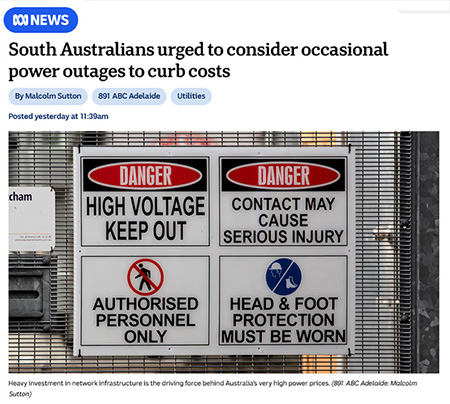
South Australians urged to consider occasional power outages to curb costs
— By Malcolm Sutton, the ABC
With yet another power price hike in the works this year, an energy technology expert warns South Australians may need to consider tolerating the occasional blackout for the sake of cheaper power.
Daniel Rossetto is an expert in global environmental and energy commodity markets at Adelaide University.
He called upon Australians to have a conversation about accepting less reliable energy, or making concessions elsewhere, if it wants to bring down utility prices with any meaningful impact.
People have unrealistic expectations of having electricity working all the time, just say, like we used to for most of the last century. The problem is that it will cost a fortune to have reliable back up power to cover every last contingency. (Because giant infrastructure will be sitting around all year doing nothing, just waiting for that half-hour when it’s needed. Who thought that would be cheap?).
Watch the pea here in the paragraph below — we used to have two of the three major priorities, then we added number three, and now we have none:
He said there were “basically three major policy priorities” when it came to energy, and it was currently impossible to achieve all three for electricity.
“One is affordability, another is sustainability and third is security, or reliability,” he said.
Righto. So it’s possible to have affordable electricity and reliable electricity but not (gasp) renewable energy at the same time? Well, why didn’t you just say so, and fifteen years ago would have been handy.
This is Olympic level spin:
“We end up prioritising reliability by default, and sometimes also sustainability with renewables and things like that, without necessarily thinking about affordability,” Dr Rossetto said.
“But are we prepared to tolerate a slightly slower pace of decarbonisation on electricity in the name of less expensive energy? Or are we prepared to take little more outage time in exchange for lower prices?”
In the end, you must remember how you are always the problem. But forget how you used to have affordable and reliable electricity…
Thus the great renewable-energy transition continues: first electricity becomes more expensive, then reliability becomes an optional luxury, and finally the public is blamed for expecting the power system to do what power systems used to do.
h/t David from Cooyal in Oz.






Typical Communist rationalisation.
The ideology is perfect, and therefore any problems encountered must be the result of the non-believers.
30
Its Electrickery people.
Get used to it.
Emissions Impossible
20