By Jo Nova
If someone wanted to sabotage Western science, this would be a useful technique
A research team has used AI to analyze 2.6 million cancer papers and found a quarter of a million have used suspicious tortured phrases, incorrect reagents, fabricated data and altered or reused figures — all hallmarks of fakery at the industrial paper-mill. A dumb AI will change “energy use” to vitality utilization or convert “raw data” to crude information.
The commentariat is blaming profit and greed for the flood of fake papers, but what if this is no accident? If I were an enemy of The West, and I wanted to sabotage scientific research, this would work like a DDOS on science. Researchers would spend hours running meta-analyses of dud results. They might change their own experiments, scurrying down pointless rabbit holes in search of an effect that doesn’t exist. Or, they might drop a useful approach if they thought someone had tried it and failed. And it can’t be too good for the cancer patients either, can it?
Even businesses might find it appealing to slow down or confuse the competition. Or perhaps they’d like to quote a paper to get their government grant but they can’t find one? So many people can benefit from fake science, (heck, our whole government does) it’s hard to see where it ends.
Fake cancer research from China and Iran flood scientific journals, study reveals
By Natasha Bita, The Australian
Chinese and Iranian academics are flooding research journals with fake science, an Australian government-funded investigation has revealed.
At least 250,000 published papers on cancer research have been flagged as potentially false, in the analysis of 2.6 million cancer studies between 1999 and 2024.
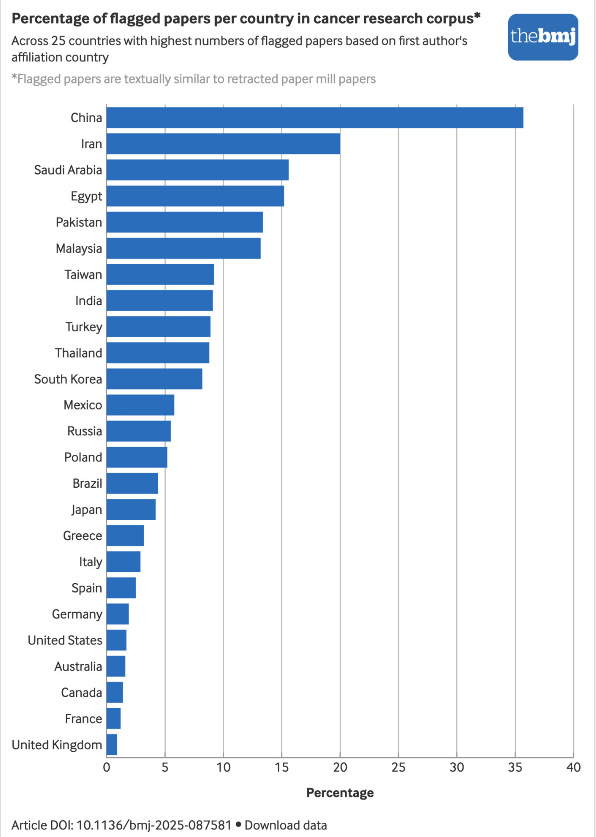
One in three of the flagged research papers came from China, 20 per cent from Iran, 16 per cent from Saudi Arabia, 15 per cent from Egypt and 15 per cent from Pakistan.
The rot is endemic, right to the top:
While smaller scientific publishers were most likely to publish questionable studies, the QUT filter flagged as fake 10 per cent of papers from the mainstream John Wiley & Sons and nearly 7 per cent of SAGE Publications.
The problem *might* be getting worse… you think?
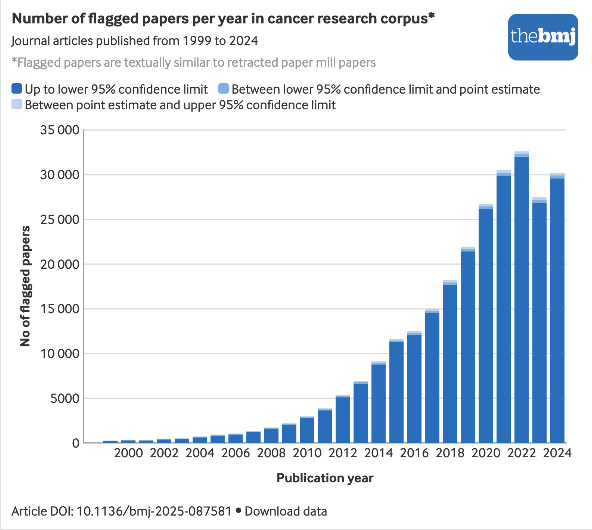
Most of the fake papers studied here were done without the help of AI wizardry (at least those before 2022). Presumably, as AI helps in fake paper creation, it will be much harder to spot the fake ones…
Fake papers are contaminating the world’s scientific literature, fueling a corrupt industry and slowing legitimate lifesaving medical research
The Con-versation.
The problem reflects a worldwide commodification of science. Universities, and their research funders, have long used regular publication in academic journals as requirements for promotions and job security, spawning the mantra “publish or perish.”
But now, fraudsters have infiltrated the academic publishing industry to prioritize profits over scholarship. Equipped with technological prowess, agility and vast networks of corrupt researchers, they are churning out papers on everything from obscure genes to artificial intelligence in medicine.
These papers are absorbed into the worldwide library of research faster than they can be weeded out. About 119,000 scholarly journal articles and conference papers are published globally every week, or more than 6 million a year. Publishers estimate that, at most journals, about 2% of the papers submitted – but not necessarily published – are likely fake, although this number can be much higher at some publications.
We already knew peer reviewed papers were biased, one sided, barely checked, and lacking in transparency, but now increasingly, they’re just fake.
The largest scientific experiment in history was Peer Review itself and it failed
Peer Review has been a sixty year experiment with no control group. It’s pretty lousy for science, but essential for freeloaders.






Amateurs.
They should get some tips from Michael Mann.
420
Governments will NEVER allow investigations into the sources or origins of the Climate hoax “SCIENCE “. Can you even begin to imagine what fraud will be uncovered.
Maybe some USA INVESTIGATIONS need to proceed based on this medical fraud.
240
Oh my gosh, the first graph looks eerily akin to Mr Nature Trick’s infamous Hokey Shtick, ie. up, up, and away…
Surely this would never happen in the royal and holy halls of ©️climate science™️ where ModelTruth rules for the sake of the children’s children.
220
Yes. However there’s not so much as a mention of climate “science’ in any of it that I could see.
I wonder why?
Interestingly, in the link provided to “The Conversation” by Jo there’s a little dig at a favourite of many here, under the heading:
That’s not how it works, buddy
Ivermectin, a drug used to treat parasites in animals and humans, is a case in point. When some studies showed that it was effective against COVID-19, ivermectin was hailed as a “miracle drug” early in the pandemic. Prescriptions surged…………
……… As it turned out, nearly all of the research that showed a positive effect on COVID-19 had indications of fakery, the BBC and others reported – including a now-withdrawn Egyptian study. With no apparent benefit, patients were left with just side effects.
https://theconversation.com/fake-papers-are-contaminating-the-worlds-scientific-literature-fueling-a-corrupt-industry-and-slowing-legitimate-lifesaving-medical-research-246224
00
I understand that hockey sticks are now made in China
sarc
10
How come there are no consequences for publishing fake science.
Retraction watch publishes a list of retracted papers but a name and shame list could be more appropriate.
230
Yes, Peer Review appears to be not much of a review.
But the view from the Pier is usually quite nice.
Fake Science. Not very Safe but quite Effective it would seem.
190
But how does a fake intelligence determine that some other piece of intelligence is fake?
181
Is AI fake or is the information it scans fake? If you ensure the quality of the input can’t you trust the output?
GIGO rules!
80
Computers aren’t intelligent. They only think they are.
70
Or –
“Computers aren’t intelligent. WE only think they are.”
Err – maybe. Some of us [us/them …]
Auto
10
Science cheerleaders aren’t going to like this.
A potential solution is to submit papers on actual paper, mailed to the publication.
10
You could require that all submissions be handwritten and submitted with a certified copy their driver’s license and it would still be faked in some scammer-centre in Nigeria.
00
In theory it should be self-correcting.
Fake authors and those who publish them should lose reputation. Genuine authors and publishers should ostracize the fakers and those who publish them.
It looks like flooding the field is overwhelming the self-correction mechanism. Or at least is draining the resources of the genuine.
And as Jo has already said the self-correction mechanism wasn’t functioning very well. Mainly I suspect because it drains the resources of the genuine.
190
Peer review have gone the way of MSM.
Once trust is lost, it’s very hard to get it back.
270
One could draw an analogy with cheap drones on the battlefield: You can take out a few very efficiently with expensive missiles, but not a swarm.
Are there too many papers being submitted and too few peers to allow effective review? These peers have their own work to do after all.
130
My sister, a PhD in her field, gave up doing peer reviews ten to twelve years ago because too time consuming and difficult to verify, especially overseas contributors. Loss of trust.
50
I assume advanced shotgun technology has been tried, on a much lower scale than rapid fire machine guns for ships to combat missiles and aircraft attacks?
By the way, one technology I have heard nothing about for over a decade is US Rail Gun technology that is like a very big electronic shotgun and claimed to have been deployed into space during the POTUS Reagan period.
00
Trump’s 47 class ships will have the generating capacity for rail guns. Never say never.
00
I wonder if there is a true analogy here with ‘the clipping of the coinage’ in Europe – certainly in England – in the late medieval, and early proto-modern era?
Auto
AI tells me – trust it if you will –
“Coin clipping is the illegal practice of shaving small amounts of precious metal (gold or silver) from the edges of coins, collecting the shavings for profit, and then spending the lighter, less valuable coin as if it were full weight, a crime that undermined currency trust until milled (ridged) edges were introduced. This widespread fraud, common in ancient times through the Middle Ages, “
00
Peer review has been broken at both ends.
By China and Muslim countries flooding it with fake studies, and by western countries turning into a guild protection racket that scuttles any study that threatens the lucrative sinecures/grants of the prevailing academic/scientific establishment. Peer review crushes disruptive science the same way the Catholic church used to back in the middle ages.
270
Some three thousand years have passed since a Hebrew speaker and writer wrote: “Vanity of vanities, said the Preacher, vanity of vanities; all is vanity” (Ecclesiastes 1:2). Quite so.
80
Only learned about that peer review fact quite recently. That, peer review is only a relatively recent requirement in scientific research.
Before the imposition of peer review you conducted your “science”, analysed the data, wrote up the paper and presented it for publication with your chosen journal. Maybe, you gave your draft paper to some work colleagues to critique/ edit and that was that. Now I view the term “peer review” a bit like “safe and effective”.
It seems peer review was introduced to stifle creativity, impede breakthroughs, make researchers conform and create powerful gatekeepers. Also, no doubt to benefit corporations with deep pockets and profit motivation. It’s actually the antithesis of science.
200
The problem with peer review is that it promotes mediocrity.
The drones that are winning in Ukraine are not subject to peer review. Thery are winning because they are in a competitive environment when winning means taking out the enemy.
Apparently Zelensky stated that something like 800,000 out of 1M Russian confirmed kills (either personnel or assets) in 2025 was done with drones. Ukraine aims to kill 50,000 Russian soldiers a month through 2026. Russia must be running out of young men!
The Ukranian drone builders are not publishing peer reviewed papers on their weaponry and tactics.
82
Not sure I would take anything sourced to Zelenskyy at face value.
50
What do Russian drones do?
10
Fly in communes?
10
Ross,
A scientific paper should not be published unless it clearly has the potential to advance science.
Peer review is a way to manage this desirable objective, but it is not now used that way.
Maybe there is scope for an international journal or two to live by that objective.
I used to say “Surely there is a wealthy person who could start such a publishing house” but now I realise how annoyed I would be to be pestered that way. Geoff S
50
Drawing conclusions, even from known facts, can be dangerous. We all know the Hemingway quote “How did you go bankrupt?” “Two ways. Gradually and then suddenly.”
This left me wondering how Hemingway could go bankrupt ’til one day I looked it up to get the correct wording to find it was a character Mike Campbell in the 1926 novel “The Sun Also Rises” who went broke.
Even such august journals as this contain much misinformation which goes unchallenged. Quote: We all know from shopping the real inflation is 25 – 30%. [from a prolific, highly regarded contributor]
140
And yet I provided an example of my own product, which showed that a 25-30% increase in price due to inflation over the “Covid” years was clearly indicated.
You missed it.
But I agree that the quote you used is a bit ambiguous.
31
We have zero inflation because petrol has remained stable. My factoid cancels yours.
So what? I use little of one and none of the other.
10
The Reserve says we have inflation because too many people are being gainfully employed.
Then there is also the stupid idea of giving young people a leg up to get into the property market. Prices kept on rising and interest rates are going up.
81
In a post below I did mention Gov. policy.
10
One factor only, record-high immigration intake is economic stimulus for a while but per capital recession remains lurking below the line.
Government spending of taxes and debt is another major factor
00
Petrol $1.17 in March 2021, $1.73 today at the same place. It would have been cheaper in 2019, but I randomly saved that 2021 price for some reason.
48% inflation since then…
20
The Rule of 72 says that 30% inflation will double prices in 2.4 yrs [72/30=2.4]so since pre-covid we might show a 300% price rise. I saw a sharp rise in ’21 ’22 but some things [1kg block cheese] have dropped back since.
I could buy the 2026 version of my 15 yr old Camry for about 25% more than I paid then. I just bought a big [too big] TV for less than a married couple’s weekly pension. When I was first married a TV cost about three months of a tradesman’s pay. My power has dropped from [by memory] 30.5c/kWh to 29.5c/kWh. [connection fee has risen] Cheer up!
WE ARE CHERRY PICKING The things that have risen most are those affected, directly or indirectly, by Gov. policy.
60
The 30% increase in price I quoted was over 5 years , using the government announced rates of inflation.
Nobody is talking about a 30% annual inflation rate, (expect perhaps you).
10
Tap out accepted.
If you use the words “We are experiencing 30% inflation” that MEANS per annum. If you mean otherwise it must be stated.
00
Hanrahan,
If that unnamed contributor was not me, then I second the statement about underinflated real national inflation.
Wife and I have had rather constant patterns of income, expenditure and keeping accounts for a neat 20 years. We have useful data for items such as a loaf of bread bought on credit card, same baker and body corporate fees on the Unit, mostly insurance, plus like the price of petrol for the same happy supercharged Statesman running 98+. Now and then I run an item, usually comparing to ABS CPI as well. Geoff S
30
Geoff, nowhere have I denied what you say. I guess I’m saying that the difference is sometimes [grossly?] overstated.
I have been aware of John Williams’ Shadow Stats [US] for a loong time.
00
The trouble is, when I saw it was “an Australian government-funded investigation”, my immediate reaction was; “I don’t believe it”.
Or, maybe, there’s another agenda, along the lines of; “They are all fake. Only trust the official science from your government”.
Reinforcement for the BBC & their Twisted News Initiative perhaps.
150
Nobody should trust the BBC, off their bat.
Trust and verify – as a minimum.
After their treatments – two programmes and two different edits, but both ‘amending’ the sense of his speech – “inadvertent” and “accidental” … but each [obviously purely by chance] pandering to their [required?] visceral hatred of the POTUS …
Their long spiels about Epstein [unpleasant felon] and his houses, pals, tastes … aimed at Trump and our Royal Family it appears. Ulterior motives … Oh of course not! – We are the BBC …
Auto
20
It’s tough when you have a binary choice: Trust the government or trust the science [as it is being peddled].
Reply to #10
60
Fake science journals, fake cancer research, AI generated people: all are a form of gaslighting. The intent? Psychological warfare on a global scale. Will the fakery PSYOP get to the extent where you arrive home from work and find that your family, including the dog are all AI generated?
60
Meanwhile, we in the west slowly become the third world by tolerating this rubbish. And one would think that all papers from the top contenders should be used in the toilet.
70
Well, at least we know why global warming is happening because the science says so, and why the vax was safe and effective, why butter was bad for you and margarine good, why GMO foods are as safe as real food, why fluoride is toxic but good in your water supply, why meat is bad but grains good…
Its all been wrong because The Enemy has been subverting our science. Really, Govts should not be involved in science at all, its a hobby for private interests who are willing to invest now for future gain, and while its a lovely dream that Govt will use science to protect us, the results would suggest exactly the opposite.
Lets see how NASA science goes if the 4 astronauts survive their trip around the moon next weekend. I’m sure I’d rather fly with Musk Spacelines than NASA’s Boeing-Northrop Grumman-Aerojet Rocketdyn combine, their science has a tint of Woke about it.
120
How can peer review be effective, or even possible when there are tens of thousands of papers published per year in just one field?
More than 33000 Astronomy related “refereed” papers published in 2025… around 90 a day.
While new technology has undoubtably lead to new discoveries, and new theories, there really are not that many astronomers in the world.
180
If I were an enemy of The West, and I wanted to sabotage scientific research, this would work like a DDOS on science. Researchers would spend hours running meta-analyses of dud results. They might change their own experiments, scurrying down pointless rabbit holes in search of an effect that doesn’t exist. Or, they might drop a useful approach if they thought someone had tried it and failed.
It may be more even strategic than that.
Anyone observing the West will notice the uncritical rush to embrace AI in all areas. Given that AI essentially gains its ‘intelligence’ by trawling the garbage bin of the internet, how better to confound the West than to fill the bin with legitimate-sounding misleading rubbish.
If your own AI engines are able to access a database identifying the deliberate rubbish you have posted, and then screen said rubbish from its processing (and also screen Western papers that cite said rubbish) your AI becomes ‘smarter’ (or less deluded) than Western AI.
Leveraged dumbing down of your opponents.
Win win.
160
Its broken.
‘Take the field of climate research, for example. For at least a couple of decades now, the scientific consensus has been that anthropogenic climate change poses an existential threat to humanity. Anyone who challenges that orthodoxy, regardless of the quality of his research or the logic of his arguments, finds it very difficult to publish his findings in leading journals. The gatekeepers (read: reviewers) simply won’t allow it.’ (Martin Centre)
91
FWIW
“For at least a couple of decades now, the scientific consensus has been that” –
Don’t quit yet!
That is about how long Ancel Keys ruled human nutrition and yet the food pyramid has just inverted
20
Elements of
“Stone Face”
https://accordingtohoyt.com/2026/01/27/stone-face/
00
My apologies for hijacking the thread, I know this thread is about the thousands of fake science papers but it appears the UN is in financial trouble without US money according to Guterres, although he doesn’t mention the US specifically. He’s talking about imminent financial collapse.
https://www.asiaone.com/world/guterres-warns-uns-imminent-financial-collapse
.
100
If true , that has to be the best news ever.
150
I agree.
70
farmer,
More than a decade ago I started writing on blogs that the United Nations should be terminated because it failed its primary purpose and let mission creep involve it it unchartered and uncharted territories, some quite harmful.
They cost my employer company possibly a billion dollars in the 1980s and evermore by stopping uranium development in the Ranger or Jabiru region with sterile world heritage processes over very ordinary terrain. Geoff S
110
Geoff
Re visiting – Kakadu or Kakadont
30
Remember the first term as President for Donald Trump when he addressed the United Nations in New York for the first time as POTUS?
Of his many words of advice he included the growth of UN organisations and cost of funding them all as well as the original UN, and therefore exceeding the Charter created at the time of establishment just after WW2. He advised the executives to downsize, and to stop interfering in the affairs of member sovereign nations, and failure to do so could result in US Government cutting back funding to the UN in future.
He even joked as DJT does saying the cost to US citizens to support the UN is too much, that maybe the UN HQ in New York could have the lease cancelled and the premises turned into a casino for profit to US citizens.
DJT has been concerned about many UN organisation activities, the tariff impositions against unfair trading or dumping from UN designated developing economies another example that began in his mind long before he got involved directly in politics. UN Lima Agreement/Protocol 1975, Agenda 21 now 30 Sustainability and others, including transfer of manufacturing industry and related wealth creation from developed countries to developing countries and free trade agreements exploited by at least some developing nations using low operating costs and even government subsidies to dump goods into economies notably the USA, and others. The dumping of course boosts production and developing economies, it delivers valuable foreign currency, and so on.
10
Each academic job application form should have an additional question: how many papers have you had retracted.
Those who say zero can quickly be checked.
30
Have any of the Authors of these fake papers been reference checked? Who do they work for? Do the Authors even exist? Do they claim authorship, or have their identities been hijacked? Who are the peer reviewers? These are questions the publishers should be asking. The answers to these questions should also identify whether this is a deliberate strategy by State actors or just desperate academics on the publish or perish treadmill using AI to meet their publishing quotas.
20
Peer review is a bit like democracy – it’s the worst system apart from all the others.
Just wait till AI solves a mathematics research problem…
01
This is going to backfire on non-elite institutions. Nobody will take their researchers seriously.
Peer review might need to be better paid…
Today we have the arXiv, an internet repository for preprints in mathematics and physics. You write your paper, lodge it – publish it – on the arXiv, and then you submit it to a journal for peer review. If it gets accepted for publication, you add the journal reference to its arXiv page, which also gives the date you first lodged the paper there and establishes your priority. This procedure allows other scientists to read it sooner, for peer review can be slow. Scientific publishing houses tried to refuse publishing any paper already lodged on the arXiv, but its advantages to scientists were so great that publishers had to give way.
Scientific journals originally had two useful functions: dissemination and quality control. The internet solved the first. It could solve the second if scientists re-organise peer review, or drop it in favour of the arXiv. That hasn’t happened, because peer-reviewed papers are needed to get academic jobs. Scientific publishers make scientists typeset their own work, get peer review for free, seize copyright, then charge large sums – either in journal subscriptions or page charges – for the research community to view its own work. Large subscriptions deter private individuals whose taxes pay collectively for much of the research, and deter libraries of universities in developing countries. Page charges, conversely, deter retired scientists from submitting, and motivate publishers to accept poor-quality (AI generated?) research. Scientific publishing has twice the turnover of the recorded music business! Professional institutes of physics, chemistry etc have developed publishing arms that are part of this rip-off. Their paid staff argue for the rip-off to continue, in a conflict of interest with their members.
Online-only journals are appearing today. They work in various ways, and one option is an arXiv-overlay journal. You lodge your paper on the arXiv, and inform the journal’s Managing Editor that you are submitting it to their journal. They then arrange peer-review. If it passes, it goes onto the journal’s website, with a link to its arXiv page, which you update with its journal link. I hope to see more journals of this sort in other parts of science soon, and see the rip-off wither. There will need to be plenty of mirror sites and maybe even a blockchain to prevent journal editors taking down controversial papers (yes it has happened re the GMVH – look it up!) but that can happen.
10
Propaganda and misinformation is an age old tactic of course
00
That second bar-graph could be interpreted as a country-level “dishonesty and mistrust” index. As education levels have risen in the countries at the top of that graph, the volume of published papers has also increased. To me, this supports a logical progression from minor questionable practices (“shonkiness”) to outright fraud. There is something about the prevailing mindset of the medical profession that allows this to happen—and it is not new. Go back to Francis Crick et al, his noble prize was essentially based on an assertion. Barry Marshall got a nobel for his work on helicobacter pylori (mentioned here a number of times recently). He took Cimetidine to suppress hydrochloric acid, drank a brew of bacteria and said he had an upset stomach. Gastroscopy day 10 saw inflammatory changes, another day 14 saw no abnormality. Then he took the antibiotic for five days and said he felt better. No blinding, n of 1, it hasn’t been replicated, he didn’t take the null hypothesis and there were no control experiments. (H/T Sam Bailey). That got a nobel prize. And I daren’t mention viruses other than to say, do you remember Fan Wu et al; the “discoverers” of the covid genome. This is not new—it reflects a natural progression of practices that have long existed within the medical profession. Nevertheless, I agree that there may be something more sinister at play.
10
I will mention Fan Wu after all.
The sequencing of the novel coronavirus was first reported in humans by Fan Wu et al., Nature 2020. These sequences came from crude patient samples containing a mix of human, microbial, and environmental genetic material, not from isolated viruses. From tens of millions of fragments, hundreds of thousands of contigs were assembled, and the longest was selected as the reference genome for RT-PCR testing — even though the virus itself had not been directly demonstrated to exist. Put simply, the claim of infection rests on a shaky foundation: the “evidence” came from a complex mix of genetic material rather than from a confirmed, isolated virus.
And then there is Peng Zhou et al., whose early coronavirus work also relied on cell cultures to infer infection. These cultures used abnormal or cancer-derived cells—monkey kidney cells, liver cancer cells, and HeLa cells—stressed and exposed to toxic substances like antibiotics and enzymes. The resulting cell death was inevitable, making any viral RNA in the mix essentially meaningless. The claim of infection here, as with Fan Wu, rests on unstable evidence.
The story continues with Na Zhu et al., NEJM 2020, who studied lung samples from four pneumonia patients linked to Wuhan’s Huanan Seafood Market. They claimed to have “isolated” the virus, but in reality, the samples were grown in cancerous human epithelial cells, which naturally produce extracellular vesicles that can easily be mistaken for virus particles. While the authors included images labeled as “2019-nCoV particles,” there was no verification of their composition, infectiousness, or whether they even contained the SARS-CoV-2 genome.
This is another example of medical profession relying on inference and implication rather than definitive proof — arrowheads on unknown vesicles become “virus,” and uncertainty is accepted, even by major funders like the Bill and Melinda Gates Foundation. (H/T Mark Baily)
00