By Jo Nova
If someone wanted to sabotage Western science, this would be a useful technique
A research team has used AI to analyze 2.6 million cancer papers and found a quarter of a million have used suspicious tortured phrases, incorrect reagents, fabricated data and altered or reused figures — all hallmarks of fakery at the industrial paper-mill. A dumb AI will change “energy use” to vitality utilization or convert “raw data” to crude information.
The commentariat is blaming profit and greed for the flood of fake papers, but what if this is no accident? If I were an enemy of The West, and I wanted to sabotage scientific research, this would work like a DDOS on science. Researchers would spend hours running meta-analyses of dud results. They might change their own experiments, scurrying down pointless rabbit holes in search of an effect that doesn’t exist. Or, they might drop a useful approach if they thought someone had tried it and failed. And it can’t be too good for the cancer patients either, can it?
Even businesses might find it appealing to slow down or confuse the competition. Or perhaps they’d like to quote a paper to get their government grant but they can’t find one? So many people can benefit from fake science, (heck, our whole government does) it’s hard to see where it ends.
Fake cancer research from China and Iran flood scientific journals, study reveals
By Natasha Bita, The Australian
Chinese and Iranian academics are flooding research journals with fake science, an Australian government-funded investigation has revealed.
At least 250,000 published papers on cancer research have been flagged as potentially false, in the analysis of 2.6 million cancer studies between 1999 and 2024.
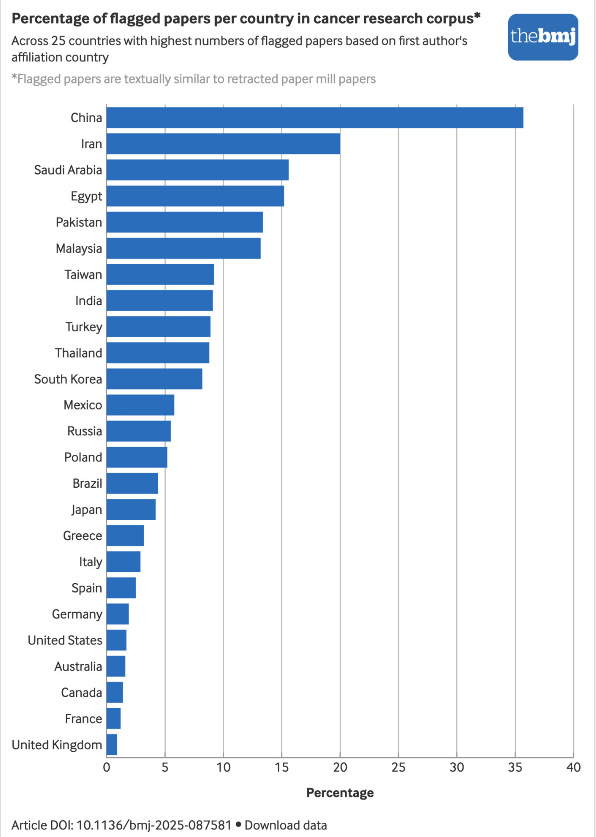
One in three of the flagged research papers came from China, 20 per cent from Iran, 16 per cent from Saudi Arabia, 15 per cent from Egypt and 15 per cent from Pakistan.
The rot is endemic, right to the top:
While smaller scientific publishers were most likely to publish questionable studies, the QUT filter flagged as fake 10 per cent of papers from the mainstream John Wiley & Sons and nearly 7 per cent of SAGE Publications.
The problem *might* be getting worse… you think?
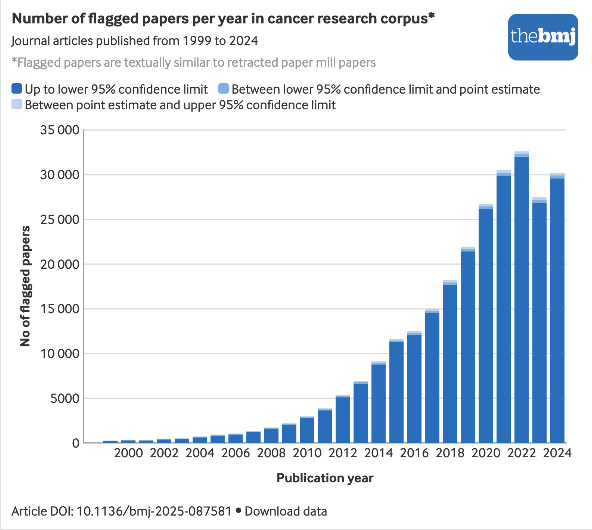
Most of the fake papers studied here were done without the help of AI wizardry (at least those before 2022). Presumably, as AI helps in fake paper creation, it will be much harder to spot the fake ones…
Fake papers are contaminating the world’s scientific literature, fueling a corrupt industry and slowing legitimate lifesaving medical research
The Con-versation.
The problem reflects a worldwide commodification of science. Universities, and their research funders, have long used regular publication in academic journals as requirements for promotions and job security, spawning the mantra “publish or perish.”
But now, fraudsters have infiltrated the academic publishing industry to prioritize profits over scholarship. Equipped with technological prowess, agility and vast networks of corrupt researchers, they are churning out papers on everything from obscure genes to artificial intelligence in medicine.
These papers are absorbed into the worldwide library of research faster than they can be weeded out. About 119,000 scholarly journal articles and conference papers are published globally every week, or more than 6 million a year. Publishers estimate that, at most journals, about 2% of the papers submitted – but not necessarily published – are likely fake, although this number can be much higher at some publications.
We already knew peer reviewed papers were biased, one sided, barely checked, and lacking in transparency, but now increasingly, they’re just fake.
The largest scientific experiment in history was Peer Review itself and it failed
Peer Review has been a sixty year experiment with no control group. It’s pretty lousy for science, but essential for freeloaders.