By Jo Nova
Will anything be salvageable?
*UPDATED: No — After drifting abandoned and on fire for three weeks, The MorningMidas has sunk.
The latest update shows the fires still burning and (wow) extensive damage to the hull.
A week after fire broke out on the Morning Midas, the salvage crew have finally reached the boat. The bulk car carrier was abandoned last Tuesday and has been adrift 300 miles south of Alaska. The ship only had 68 full EVs on board, with 681 hybrid cars, among a total load of 3,000 cars. But apparently that was quite enough to turn it into a 47,000 ton slow burning barbecue.
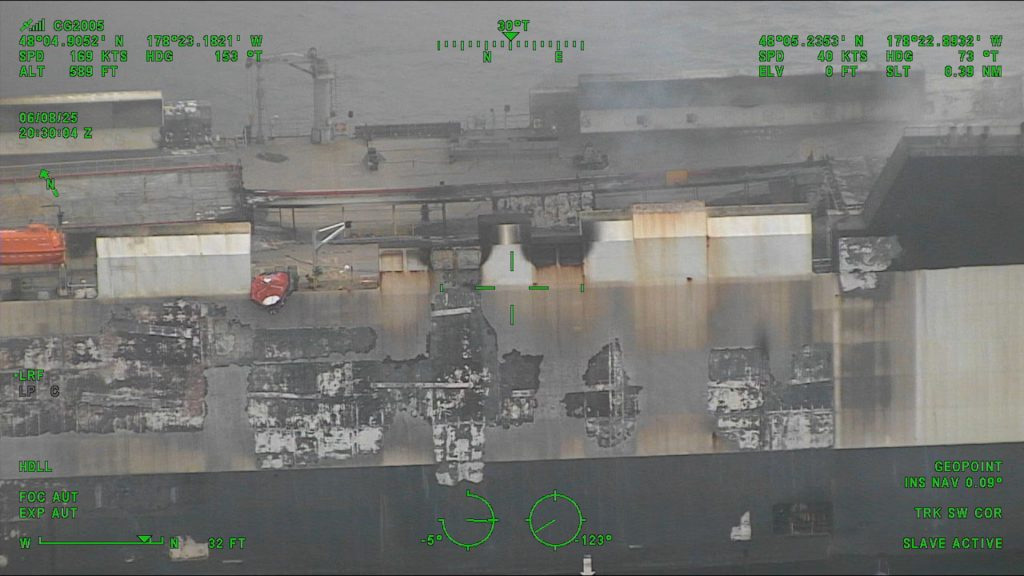
But alas, a week later, the photos show the slow burn has consumed much of the ship. Even though the hull appears intact and the ship is not listing, the damage is extensive. How much of the cargo on board would have survived a week of smoke and heat?
The Morning Midas is a bulk carrier which was headed from China to Mexico. The fire broke out last Tuesday Alaskan time, so it is said, from the deck where the electric cars were. After the crew sealed the doors and unleashed the carbon dioxide bottles, there wasn’t much else they could do. All 22 sailors abandoned ship and were rescued by a Costco carrier.
The 46,800-ton ship itself was built in 2006 and is worth about $14 million. With 3,000 new cars at $30,000 each that would be a loss of $90 million. If the ship and cargo is lost, as happened to the Felicity Ace in 2022, the total loss could be around $100 million.
Without any realistic way to put out these fires, perhaps EV’s will have to be parked on the top deck next to an ejector hatch, with a catapault? It would save so much money if they can be dumped at sea at the first sign of smoke?
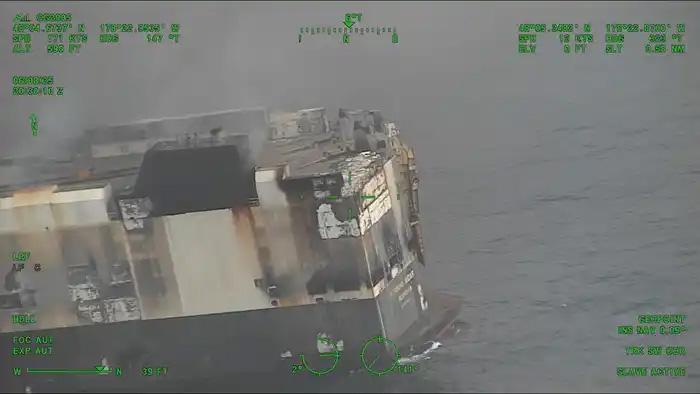
Sal Mercogliano, a specialist on shipping news points out that on these ships, the cars are packed bumper to bumper and tied down with straps over the wheels. As the fire burns through the straps, he says the cars can start to roll on the seas. (His youtube on this is here).
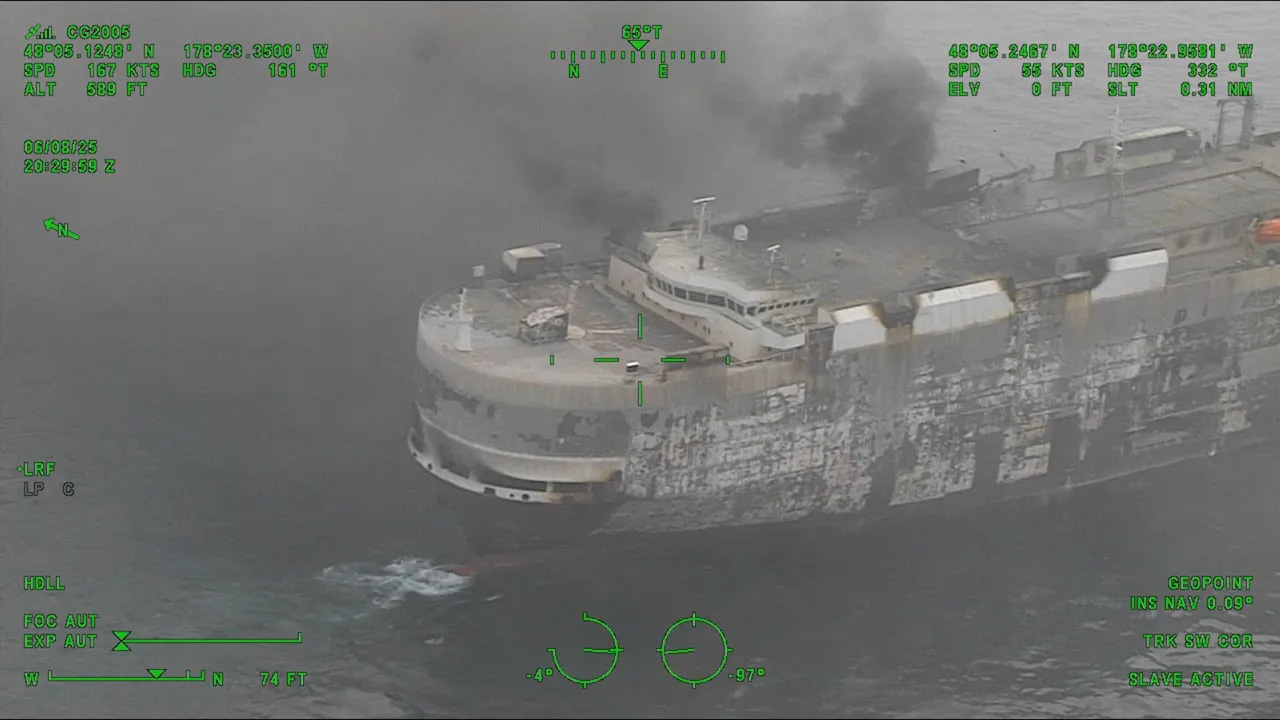
He also points out the crew have to get off early in a situation like this. They are 10 to 12 decks high above the water, or 100 – 120 feet above water. The lifeboats must be lowered into the water, and if they wait too long, they might be unable to do that. At that point they are left jumping 30-40 meters into the cold Pacific Ocean.
What the ship looked like last week as the fires started.
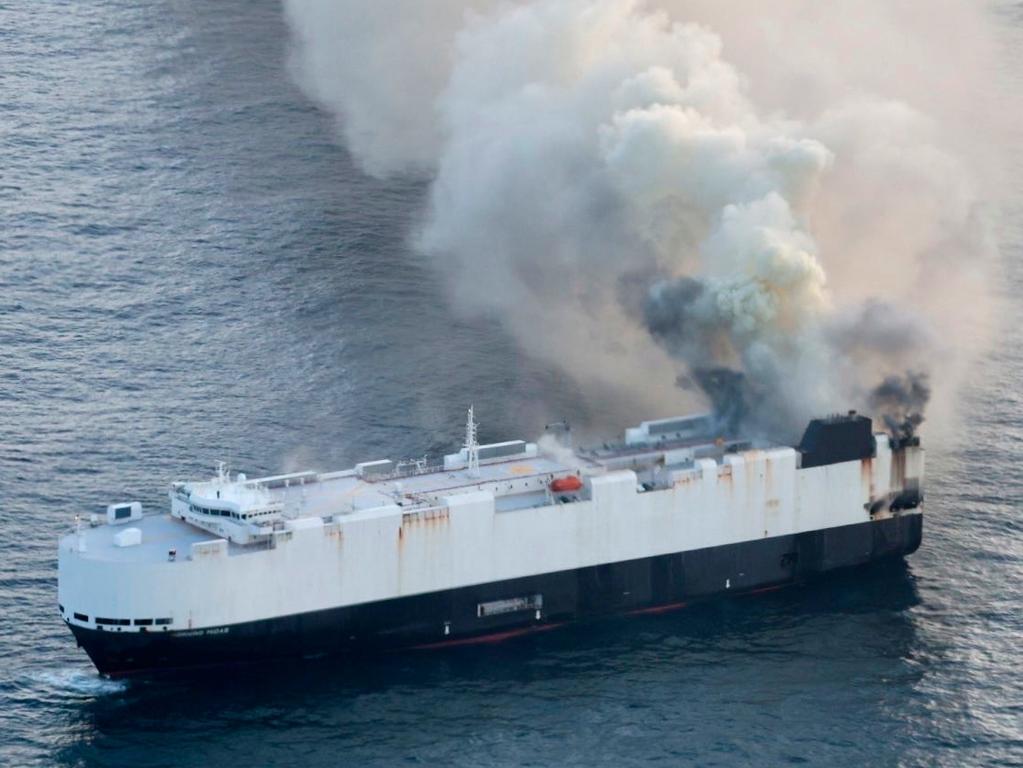
Imagine if this was a ferry with 300 passengers?






BC ferries put “dangerous cargo” where it can be pushed off in case of fire. Trucks carrying hay bales get this treatment. Gas tanks bigger than BBQ size are banned unless empty.
Needless to say, electric cars are not considered dangerous
230
Seems one possible solution would be to ship the 68 EVs on a towed barge while the rest of the 3000 cars are on the big ship. If the EVs ignite, you either cut the barge loose or continue to tow it into port.
Though I am also partial to the car catapult idea.
330
Skeet shooting at BIG “clay pigeons”?
PULL
21
Seems to me standard procedure needs to change as it relates to EVs. Either ship them separately on a towed barge or pack them into containers that can be easily dumped overboard at the first sign of trouble without sacrificing the ship or the rest of the cargo.
200
Yes, but what is the plan if an EV bursts into flame on a ferry or in a tunnel?
290
Don’t allow them in confined spaces. If it is OK to make smokers smoke outside then it should be OK to make EVs stay away from people who don’t want to be exposed to immolation.
200
Is there such a thing as hazardous pay for crews of EV toting ships?
120
Easily sorted. Buy a new EV, go in a draw for a special cruise.
10
Come on John,
This is a Chinese ship. The crew are handpicked – they do it for the ‘fatherland’ no reward needed, like the satanists wrecking The Angels City.
10
Not sure if using Carbon dioxide on such a fire is a good idea. There is a lot of very hot aluminium around, both of the cars and of the ships superstructure, and it will burnin Carbon dioxide when hot enough.
70
Clean, green, 100% pure, renewable, net zero, safe & effective, moving forward, at the end of the day, while the band played on, up in smoke and down she goes…
Nope, haven’t heard a thing about this toxic ocean-destroying calamity on the ‘regular broadcasting’ outlets: either it’s not real or Jo & friends are among a minority brave enough to raise their heads above the parapet, ie. flak! flak! flak!
340
Lloyds of London, or whoever, will not be amused?
110
It’s definitely been reported on mainstream media. But not overly repeated. Usually if there’s a story or narrative the MSM want to push, the news item gets repeated ad nauseum then picked up by other outlets. Different angles in new stories are presented and then they are also repeated. Sadly, it would appear that a story doesn’t get “big” until it appears in the left leaning newspapers/ outlets. There’s so many spin off stories from this event that could be produced , yet it doesn’t fit the narrative. That narrative at present is that EV’s are really cool and saving the planet from global warming, or something. (should have been a reply to Greg NZ, those damn bots)
150
The press in Australia is wall-to-wall with anti-Trump riots. Miostly images of national guard protecting government buildings.
40
Thanks Ross, though I did read Gertie the Grumpy was put on a (shocking!) plane back to Europe – in an aisle seat back down by the toilets? Welcome to the real world, kid, economy class.
80
TheirABC actually responded with an article “proving” that it is a myth that EVs can ignite, and that it is conspiracy theorists who are to blame for the misinformation out there about EVs. (Replies off on that article, of course)
80
The ship was worth $14M.
Now think this through, in Oz, a ship like this would be built by a unionised crew. All demanding well in excess of $150k per year to work a 36 hour week. So you could easily say that it would be $200k per year, per worker when you add OT.
If the ship took 1 year to build, (in Oz…. stop laughing), and had a work crew of 50 doing all the work, (again… stop laughing), then the wages bill alone would be $10M.
Somehow I don’t think that building ships will ever come back to Oz. So now we’ll we get another rise in the minimum wage. The only work left in Oz will be the government sponsored, NDIS. Nothing else can compete.
Glad I didn’t vote for this.
410
36 hours per week? That was the first laugh. I watched a NSW Railways crew doing the regular maintenance on a level crossing near my farm. 20 men turned up in a small bus- 10 stayed on the bus and drove to another crossing where they spent the day reading the Sunday paper. The 10 that stayed worked (euphanism) steadily all day and when finished were collected by the relaxation bus and went home. A year later railway maintenance had been outsourced to contractors so for the next maintenance two young guys turned up in a ute with a small Hyab and finished the task in about 6 hours. 50 people building a ship like this would be required just to make coffee if it was a union job. Productivity? Joke.
221
nothing Lawrie. Over here in Britainstan, all the train drivers are working from home.
50
The USD14M would be residual value. A high duty cargo carrier has about a 20 year life. A car carrier might be good for 25 years. So Morning Midas was already near end of life. Not sure what it will be worth as scrap value. May well just scuttle it.
Current shipbuilding costs appear to be around USD1.5M per 1000 gross tomes. That would put the cost of replacement around $75M. Korea is still competitive with China for shipbuilding.
For comparison, Australia is spending AUD2bn for 18 off 90 tonne carrying capacity landing barges. Let’s say a gross tonnage of 3,600 for AUD2bn or USD354M/1000GT.
30
Looks like I was on the money. No sensible ship building in Oz. US$354M/1000GT Not good when the world is around US$1.5M/1000GT.
How could anyone afford to do manufacturing/business here?
I suppose the ultimate goal of the high wages is to make the nett zero functional. No industry, no need for electrical power. Bowen endorses this plan.
Employment…. nett zero.
50
Another nail in the coffin for BEV exports. Insurers simply will not insure vessels transporting BEVs. That ends their export with the battery installed.
160
And yet the Tasmanian ferry operators say its safe for them to transport EVs because special precautions. Sooner or later the numbers game they are playing will backfire.
Last night I saw an item on a large mixed residential commercial devlopment , where delays and replanning were required when the risk of basement car park recharging was considered to high. Insurance may turn out to be a big EV barrier, at least with the current technology set.
161
I don’t know about that. I suspect the risk of a conflagration on a ferry is significantly smaller than on a freighter. Spending a few hours on a ferry is a lot different than spending a month traversing the Pacific Ocean on a freighter.
10
12 hours on a ferry, in the dark, crossing Bass Strait? I was on edge about it, knowing there were BEVs on board.
40
If your BEV has any sort of electrical fault displaying you will not be permitted to board with it.
The preferred charge for new BEVs on ship transport is 30 to 40%.
00
Imagine a battery car fire not on a short ferry route such as Dover-Calais but on a long overnight route such as Portsmouth-Bilbao and in the middle of the Bay of Biscay?
30
I haven’t got time to research it now, but my recollection on most of the freighter fires involving EVs is that they happen weeks into the shipping route, not just a few hours. I suspect ferry rides measured in hours rather than days/weeks are probably relatively safe.
20
And some start in stationary cars on land, and away from earthquakes too.
40
Like the Bass Strait crossing overnight from Geelong to Devonport (and vice versa). A good 12 hours in the nightmarish dark of night.
50
I’m surprised that the EV evangelists haven’t blamed Trump for the fire.
He gets the blame for everything else.
130
I think this one is down to Brexit.
Auto
10
I got some money in my pocket, I got the car keys in my hand
I got myself a couple of tickets, to see a rock’n rollin’ band
……
EV, EV, EV let your … battery burn
.
(apologies to Stevie Wright ….. and everyone else 😉 )
100
EV, EV,
EV make your ferry burn down
30
Maybe we don’t need batteries that cannot catch fire but batteries that can be extinguished fairly easily if they catch fire? Flood the pack with appropriate chemical.
There are currently several sailplanes offered by the German and South African manufacturers with 8 to 9 Kw lithium ion battery packs for the electric motor that can get the thing into the air.
Fortunately sailplane pilots wear personal parachutes but the thought of 60+ kilograms of flaming batteries falling out of the sky leaves me cold.
20
This stuff shows some promise:
https://fireicesolutions.com/wp-content/uploads/2016/01/FireIce-Battery-Test-Report_2015-010-026.pdf
00
It does – on small batteries – flashlight size, I suggest.
Do we know if the ‘Fireice’ powder continues effective if it is kept ready for weeks, or months, or does it have to be made up with [fresh?] water immediately before use?
And – obviously – it must not give off any ‘GHG’ … or it will be outlawed by woke bureaucracies, even if it could save lives.
Created by slave labour, or child workers, less of a problem it appears!
Auto
00
Out of 14 fires onboard car carriers since 2015 seven have been total losses which will fully occupy the minds (via their pockets) of Marine Underwriters. So as the risk of fire is increasing and loss mitigation is impossible, those Underwriters will either ramp up the rates or – more likely – avoid that risk altogether. My gut feeling is they will do us all a favour such that the cost will become so prohibitive, the Virtue Signallers’won’t be able to afford their climate saving do-gooder vehicles – hopefully the market will self immolate.
110
I guess as they aren’t in containers, they won’t count as containers lost at sea….
2023 was the best year since they surveyed – only 221 containers lost with a 33% recovery rate. Compared with 2013 where around 5000 containers were lost at sea.
https://static1.squarespace.com/static/5ff6c5336c885a268148bdcc/t/66828a26c1ec3a2fca7fd299/1719831078480/CCC+10-11-1+-+Estimate+of+containers+lost+at+sea+-+2024+update+%28World+Shipping+Council+%28W…%29%5B4%5D.pdf
10
Here is a pic of a ship that lost c. 1800 in one storm –
https://www.reddit.com/r/pics/comments/17qp82w/cargo_ship_apus_one_after_losing_1800_shipping/
Auto
00
The lifeboats are launched down chutes from the crew areas. Crew just climb in and press a button.
10
Have you got a link for that? I’m curious where those chutes open and how far above the waterline they are?
40
Jo, there are ‘Marine Evacuation Systems’ – these are like tubes a person can go down, bouncing left-to-right and back again, to slow descent.
Most [newish] passenger ships, cruise liners, etc., have them – and the idea is they let you out, shaken but not stirred [!] onto a raft.
There have been casualties using these, too – one, at a drill in IIRC the UK caused the death of a volunteer who was trapped and asphyxiated, sadly.
I am mighty glad not to try these [or free-fall lifeboats – but I’m not an Amusement Park aficionado!].
Just inspecting/surveying was enough!!
Auto
10
https://www.gov.uk/maib-reports/positional-asphyxia-during-a-vertical-chute-evacuation-drill-from-ro-ro-passenger-ferry-p-osl-aquitaine-alongside-at-the-port-of-dover-england-with-loss-of-1-life
Accident report – it was in Dover.
Published in 2003 – presumably better systems are in use [with or without lifejackets …]
Auto
10
Sal Mercogliano said the lifeboats on the container ship that had explosions off Cochin are over 100′ above the water. He shows the one they were not able to launch. The Indian Coast Guard dropped more for them.
I suspect you enter before launch and then lower them.
NB wonder what was in those containers.
10
Wouldn’t want to be dogmatic, but the ‘Wan Hai 503’ looks about 10,000 teu – big, but not that big.
Merchant ships are – by law – required to have falls [the wires that allow controlled lowering of lifeboats] that can reach the water in the ship’s lightest draft, and also IIRC, heeled 15 degrees and trimmed 5 degrees.
Some rigs and specialised service ships might have boats 100 feet out of the water; Supertankers, VLCCs AND ULCCs, probably did – certainly the largest – when in ballast; see the pictures of Shell’s Batillus [550,000 deadweight tonnes] in this link –
https://www.helderline.com/tanker/batillus
Auto
20
Not on this ship – it has a standard [‘old-fashioned] davit launched [orange-coloured] lifeboat – see one pic at the top.
Tankers – oil and some gas – do now have boats on the after end that are gravity launched – so called ‘free fall lifeboats’.
They are stowed, on runners, at an angle of about 45 degrees – so boarding them needs some dexterity, even for an inspection.
The reason is so that they can be dropped [from inside the fully crewed boat], and their momentum carries them – briefly under water – away from any [potentially burning] cargo oil – or freezing cargo gas [LNG is carried at about -157 C, but rapidly evaporates when in contact with warmer seas]; you hope there is a decent breeze to mix the methane with air to below the Lower Flammable Limit.
Auto
00
Which EV holds the record for taking the most ICE cars with it when it self immolated.
30
In free fall lifeboats the crew sit in seats facing aft and wearing seat belts. You don’t wear your lifebelt. The seats have headrests.Lifeboat prototypes are extensively tested in a pool of burning oil before production. They are the safest way of leaving a vessel in distress, bearing in mind the best way is to keep your vessel afloat.
Car carriers have conventional lifeboats because the stern area is occupied by the cargo ramp that typically weighs about 250 tonnes
00