|
|
||||
|
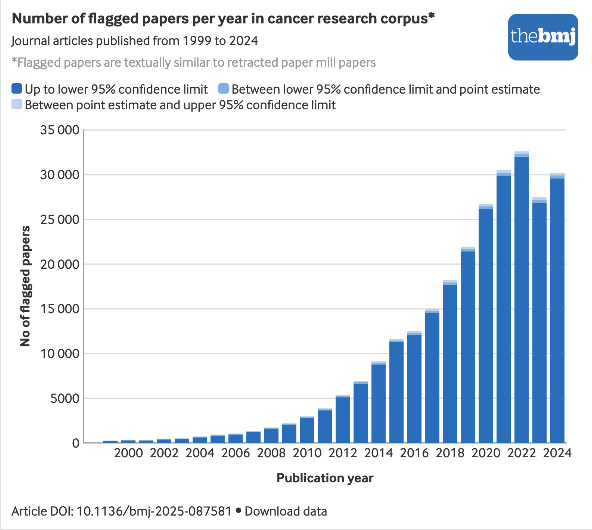
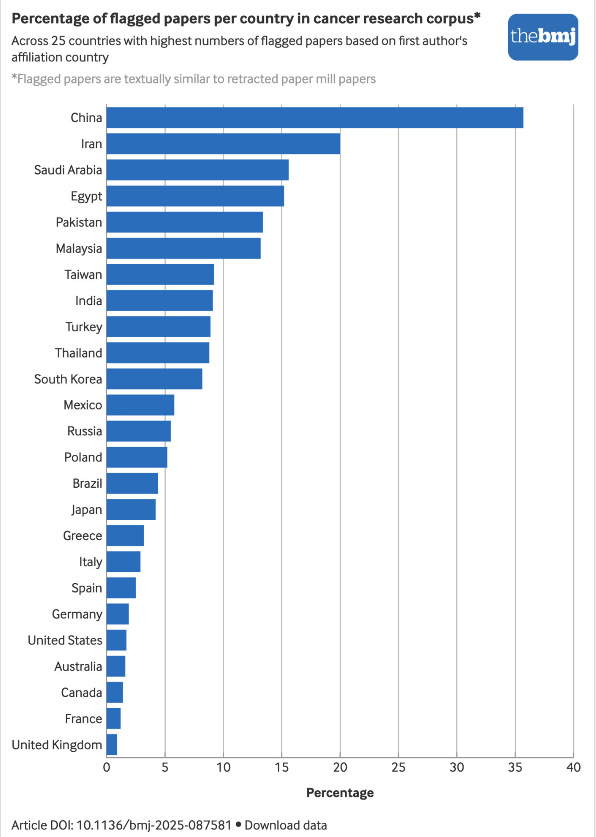
By Jo Nova If someone wanted to sabotage Western science, this would be a useful techniqueA research team has used AI to analyze 2.6 million cancer papers and found a quarter of a million have used suspicious tortured phrases, incorrect reagents, fabricated data and altered or reused figures — all hallmarks of fakery at the industrial paper-mill. A dumb AI will change “energy use” to vitality utilization or convert “raw data” to crude information. The commentariat is blaming profit and greed for the flood of fake papers, but what if this is no accident? If I were an enemy of The West, and I wanted to sabotage scientific research, this would work like a DDOS on science. Researchers would spend hours running meta-analyses of dud results. They might change their own experiments, scurrying down pointless rabbit holes in search of an effect that doesn’t exist. Or, they might drop a useful approach if they thought someone had tried it and failed. And it can’t be too good for the cancer patients either, can it? Even businesses might find it appealing to slow down or confuse the competition. Or perhaps they’d like to quote a paper to get their government grant but they can’t find one? So many people can benefit from fake science, (heck, our whole government does) it’s hard to see where it ends. Fake cancer research from China and Iran flood scientific journals, study revealsBy Natasha Bita, The Australian Chinese and Iranian academics are flooding research journals with fake science, an Australian government-funded investigation has revealed. At least 250,000 published papers on cancer research have been flagged as potentially false, in the analysis of 2.6 million cancer studies between 1999 and 2024. One in three of the flagged research papers came from China, 20 per cent from Iran, 16 per cent from Saudi Arabia, 15 per cent from Egypt and 15 per cent from Pakistan. The rot is endemic, right to the top: While smaller scientific publishers were most likely to publish questionable studies, the QUT filter flagged as fake 10 per cent of papers from the mainstream John Wiley & Sons and nearly 7 per cent of SAGE Publications. The problem *might* be getting worse… you think?Most of the fake papers studied here were done without the help of AI wizardry (at least those before 2022). Presumably, as AI helps in fake paper creation, it will be much harder to spot the fake ones… Fake papers are contaminating the world’s scientific literature, fueling a corrupt industry and slowing legitimate lifesaving medical researchThe Con-versation. The problem reflects a worldwide commodification of science. Universities, and their research funders, have long used regular publication in academic journals as requirements for promotions and job security, spawning the mantra “publish or perish.” But now, fraudsters have infiltrated the academic publishing industry to prioritize profits over scholarship. Equipped with technological prowess, agility and vast networks of corrupt researchers, they are churning out papers on everything from obscure genes to artificial intelligence in medicine. These papers are absorbed into the worldwide library of research faster than they can be weeded out. About 119,000 scholarly journal articles and conference papers are published globally every week, or more than 6 million a year. Publishers estimate that, at most journals, about 2% of the papers submitted – but not necessarily published – are likely fake, although this number can be much higher at some publications. We already knew peer reviewed papers were biased, one sided, barely checked, and lacking in transparency, but now increasingly, they’re just fake. The largest scientific experiment in history was Peer Review itself and it failedPeer Review has been a sixty year experiment with no control group. It’s pretty lousy for science, but essential for freeloaders.
January 31st, 2026 | Tags: Cancer, Corruption (science), Middle East, Peer Review | Category: Global Warming |  Print This Post | | Print This Post | |  … By Jo Nova Surprise! The Blob wants to track your car, limit your travel, get more of your money (but only so they can fix the weather!)How could they resist? The 15-minute city is the fantasy idea that the unwashed masses can get everything they need within 15 minutes of home. But of course, their family may live somewhere else, as might their favourite dentist. How many old folks in nursing homes will miss out on visits because someone doesn’t want to fill out a permission slip or get a fine? The UK government has said it will let councils use official databases of drivers licences in order to fine people driving outside their “permitted area”. Oxford has divided up its city into six areas and is set to start fining people later this year. The head of the Alliance of British Drivers said it was “A page out of the East German playbook.” If this gets off the ground in the UK, we know it’ll end up here. Labour opens door to ‘Stalinist’ 15-minute cities across BritainBy Camilla Turner, The Telegraph UK The most high-profile example of such a plan is in Oxford, where the council put forward proposals to divide the city into six “15-minute neighbourhoods”. Under the scheme, drivers would need a residents’ permit that allows 100 days of free travel per year through six traffic filters during operating hours. Meanwhile, a separate permit allows 25 days of free travel per year through six congestion charge locations during charging hours, and after this, drivers face fines if they travel without the relevant permission. Greg Smith, shadow transport minister, said: “This is the blueprint for a national rollout. Labour has given the green light for draconian councils like Oxfordshire to police how people live, move and drive, using cameras and fines backed by DVLA data. “Oxford is the test case… Australians would be wise to prepare the ground for mass protests. The Blob will take as much as they can get until the people scream, so if you’re going to have to protest sooner or later, better to just say “No” now. How many degrees cooler will our world be with 15 minute cities?
January 30th, 2026 | Tags: 15 Minute Cities, Royal Society (UK) | Category: Global Warming | Print This Post | |
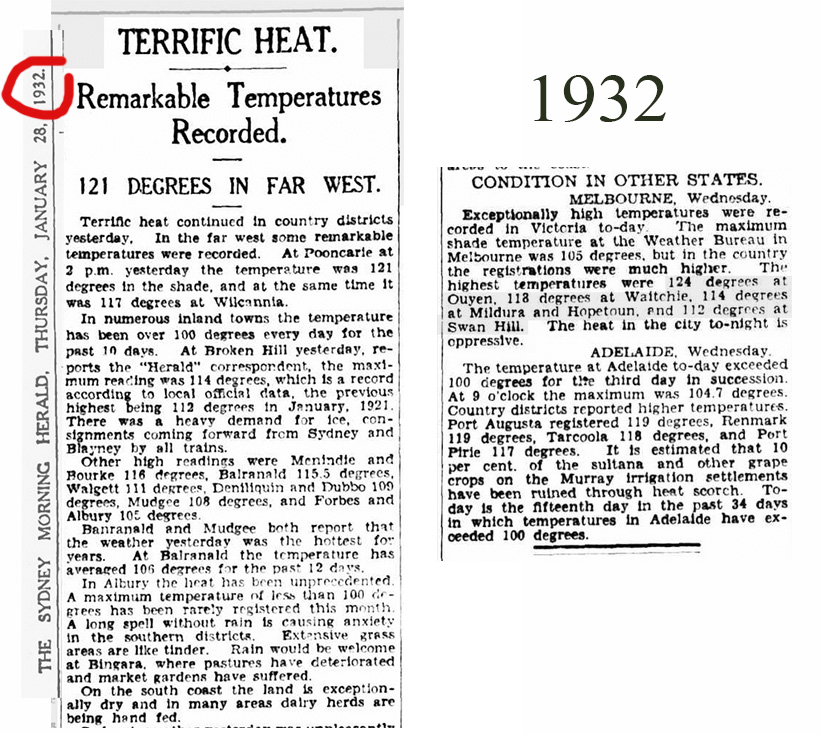
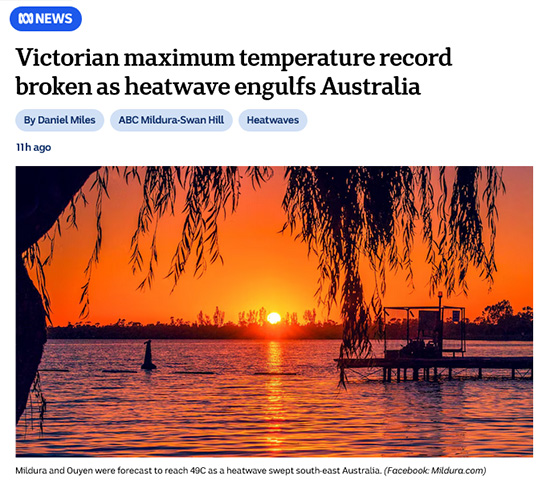
By Jo Nova Despite the news headlines about the hottest ever heatwave in Victoria this week — old Australian newspapers are mysteriously full of reports of hotter temperatures. Consider, for example January 1932. 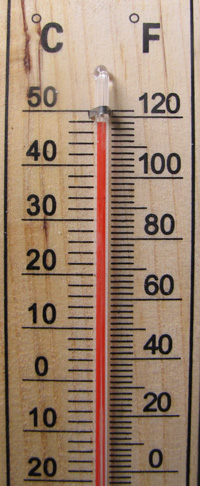 Photo: Jo Nova The town called Ouyen reached 47.5 °C this week — the “hottest temperature ever recorded” we’re told, but 94 years ago it was reported to be 124 °F (51.1 °C). Not far away Mildura reached 123 °F (50.6 °C) and to the south, Hopetoun reached 114 °F (45.6 °C). You might wonder if these local stations were inaccurate or badly managed, but in New South Wales, Pooncarie recorded 121 °F (49.4 °C) in the shade at 2 pm, Wilcannia – 117 °F (47.2 °C) at the same time, Broken Hill reached 114 °F (45.6 °C), Menindee was 116 °F (46.7 °C), and Bourke – 116 °F (46.7 °C). The heat stretched across to Port Augusta which recorded – 119 °F (48.3 °C). Were they all crazy, or was it really hot? You might also wonder if they were using non-standard thermometers or the wrong screens, or enclosures which might bias the measurements. Except the Bureau of Meteorology standardized official thermometers to Stevenson Screens around the turn of last century, and it was mostly finalized twenty years before these temperatures were recorded. And not only were blisteringly high temperatures recorded across vast distances– but then there are the birds. Lordy but the parrots and zebra finches fell from the skies in mass deaths due to the heat. As a kind of macabre proxy thermometer, we know the temperature crossed some kind of terrible threshhold when there were piles of dead birds “two feet high”, and stories of people hauling out thousands of dead birds from dams, including in one case, as many as 60,000 dead parrots. Credit for this goes to Lance Pidgeon, (Siliggy) the volunteer who dug out all these old temperature recordings from National Archives 15 years ago and found stories about the mass bird deaths during that heat wave which he and Warwick Hughes published. Unlike the BOM, none of us is paid by taxpayers and yet we managed to find these old records. But the BOM is paid nearly a million dollars a day to give Australians the truth the whole truth, and nothing but the truth and yet they don’t seem to be able to do a basic internet search? And even if we do the search for them, they still can’t find it. It’s time the BOM stopped hiding Australia’s climatic history from Australians. In 1909, the town of Bourke had a Stephenson screen and they recorded 125F or 51.7°C.But the BOM deleted that record because it was measured on a Sunday. Given that modern thermometers are electronic, and prone to picking up one-second records, and interference from airport radar, in new small 60L screens, placed near hot tarmac, and then corrected with thermometers up to 1,500 kilometers away, it’s hard to imagine how thermometers in 1932 needed adjustment to correct anything, when they were probably far more accurate than todays errant batch. In this case even if Victoria is somehow a tenth of a degree hotter now that it was in 1932 before China built 1,000 coal plants, it’s a big So What? Is this what we’re turning our economy inside out to change? Australia has always had extremely hot days. The ABC receives a billion dollars a year to tell Australians the truth, the whole truth, and nothing but the truth. Yet they serve up biased stories which are poorly researched and which coincidentally favor the political team most ABC journalists vote for. Below, the sad story of the mass death of thousands of birds, where dams and wells for hundreds of miles were piled with dead birds… A heatwave kills thousands of birds — this was climate change in 1932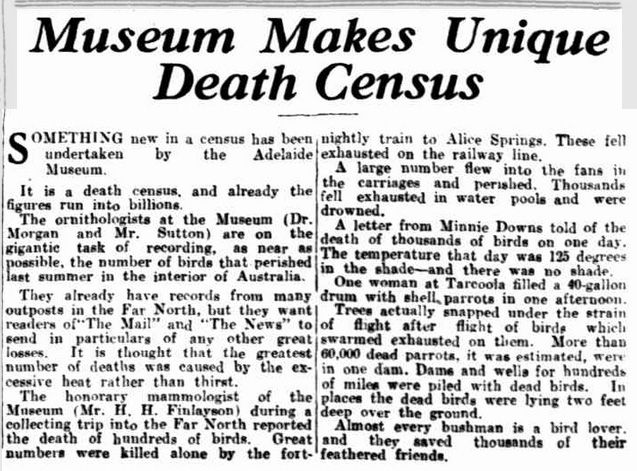 https://trove.nla.gov.au/newspaper/article/59308062 So much for 94 years of climate change.Related stories
The site was hit yesterday morning with yet another DDOS (Denial of Service attack)If you had trouble accessing the posts, you weren’t imagining it. Yesterday morning tens of thousands of “people” in Brazil all wanted to read this site in the same hour, which crowded out the usual traffic. So we can add that to the previous attacks from Singapore, USA, Vietnam and China. Someone with control over thousands of computers spread across the world doesn’t like what we discuss here. Thanks for your patience!
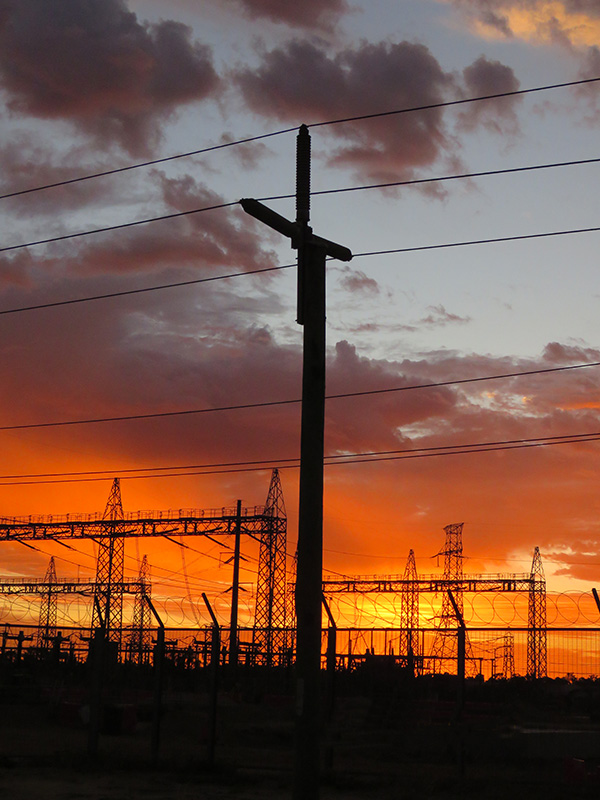 © Jo Nova By Jo Nova “It’s just a matter of time” says Frontier Economics chief Danny PriceEven though it was a public holiday, there was a raging bonfire in prices in South Australia on the evening of Australia Day. The spike in prices hit a blistering $20,000 peak and stayed there for three long hours…
Expert Danny Price warns of ‘catastrophic’ national grid failure after SA price surgeBy Patrick Starick, The Advertiser The average price for every hour of the 24 hour period in South Australia was $2,457 per megawatthour. Frontier Economics chief Danny Price, a key architect of energy policy for state and federal governments, warns renewables cannot meet high electricity demand and predicts significant outages and high prices.
Wholesale electricity spot prices spiked in SA to near the $20,000 per megawatt hour limit on a still Monday night, when household batteries drained and wind generation dipped, prompting the Australian Energy Market Operator to issue a low-reserve warning at 8.42pm.
“It is only a matter of time. It will happen. There’s no doubt that it will happen. Year by year the system becomes more fragile and that’s because people are spending less on coal.”
Dan Lee at WattClarity tracked the big batteries in South Australia and says they were run almost flat by 8:30pm. The 1.5GWh battery was down to 66MWh — empty. This outcome is perhaps unsurprising given that much of the region’s battery fleet contains around two hours of duration, while the period of sustained high prices extended for more than three hours, pushing many batteries toward their energy limits as the evening wore on. Danny Price thought it was “very, very lucky” that so far, heatwaves have basically hit Australia on weekends and holidays. The state was running on an LOR1 — lack of reserve, Level 1. for hours. So any unexpected unit failure or break in a line could bring down the system. To shore up Australia’s electricity grid, obviously then, we need more public holidays and weekends? Do it for the nation, eh?! Shame if you run a business… January 28th, 2026 | Tags: Blackouts, SA (South Australia) | Category: Global Warming, Renewable | Print This Post | | By Jo Nova On Monday for Australia Day, don’t forget to March For Australia. 12:00 noon – 2pm January 26th. The globalist unaccountable Blob wants us to forget what makes The West great. They want to erase our heritage, our customs, our history, and even the names of places in the land we grew up in. The gradual character assassination of every early hero is not an accident. Their stories of success can be turned into woke-fairy tales to scare little children. When we become a lost people, apologizing for every tiny imperfection, we are easy to rule. But when we stand on the shoulders of the world’s greatest civilization we expect to be treated as equals. For we are the children of people who built a nation. And it’s a nation worth defending. March For Australia locations Monday Melbourne: Flinders St Station Sydney: Prince Alfred Park, Cleveland St Gold Coast: Macintosh Island Park, Surfers Paradise Adelaide: Wigley Reserve, Corner of Anzac Highway and Adelphi Terrace Perth: Wellington Square, Hill Street Entrance Canberra: Parliament House Lawns. Hobart: St David’s Park Davey St. Australia Day is a test. If we don’t celebrate it, they will take it away. Plus, we meet great people.
By Jo Nova The Biggest Banker in the world has flippedWay back in his 2021 annual CEO letter, Larry Fink, CEO of BlackRock, wrote: “No issue ranks higher than climate change.” It will reshape global capital flows, he said, and declared “…anyone can see the impact of climate change in the natural disasters in California or Florida.” Now though, nevermind about global extinctions and flash floods. Fink just spoke at the Davos ski club for billionaires, and declared that we need “trillions of dollars” of investment for AI. Data centres, he said, are rapidly expanding — one technology company he spoke to said that “its data centres currently use about 5 gigawatts, but by 2030 it expects to need 30 gigawatts.” But like a true banker, he doesn’t see a backflip, he sees only investment opportunities — the world is short of power he says. (He doesn’t say that this is in large part because BlackRock leaned on companies and countries all over the world to abandon fossil fuels.) Fink helped create the energy shortage that he now calls an investment opportunity. BlackRock is the largest asset manager in the world, controlling $10 Trillion dollars in assets, or five times Australia’s GDP. When that much money talks, everyone listens. Now Larry Fink throws wind and solar under the busHe’s matter-of-fact, with a straight face, almost like he never pushed intermittent generators: Fink: “At the same time, this represents a huge investment opportunity. The world is going to be short of power. And to supply these data centres, you cannot rely solely on intermittent sources like wind and solar. You need dispatchable power, because these data centres cannot simply turn on and off.” Larry Fink slides the bomb in after 45 mins 30 seconds: This man probably did more than any single person to pump up the Great Renewables Bubble that peaked in 2022. He presumably has taken his profits long before this speech — leaving mums and dads and pension funds holding the bag with investments in unreliable, expensive generators. Transcript of Larry Fink at the WEF: “AI is fundamentally a large-capitalisation business. At the moment, if you look at the S&P 500, the ten largest companies account for about 38% of the index. If AI develops the way many expect, and if you look at the scale of reinvestment these companies are already making, that share could rise to 50%. We may end up with an “S&P 10” and an “S&P 490”. That alone shows the power of what is coming. Keep reading → January 23rd, 2026 | Tags: Bankers, BlackRock | Category: Big-Government, Global Warming | Print This Post | | By Jo Nova Humans used more coal in 2025 than at any point in human history.The International Energy Agency (IEA) solemnly announced that global coal demand reached another all time record high in 2025. “However, it is expected to decline by 2030 amid competition from other energy sources” they say, just like they say every year when coal hits a new record. The IEA are a fully paid up part of The Blob– their funding comes from taxpayers in rich nations — so their role is to manage the narrative on energy to keep that funding flowing. Every year that coal hits a record high, the IEA also projects that coal use will plateau or fall. Back in 2019, they said “Over the next five years, global coal demand is forecast to remain stable.” Which it didn’t. In 2020 they said “Coal’s partial recovery is set to fade after 2021”. And it didn’t do that either. In 2022 they said “Global coal demand is set to plateau through 2025”. Yet again, demand for coal keeps rising. Every year they do some version of the plateau graph (below) which includes their wish-list forecast of coal trending flat or down. This is this years version:  https://www.iea.org/reports/coal-2025/executive-summary This fictitious faded out extension on the right (after 2026) distracts the eye from drawing a rising line. It feeds the expectation that coal use will start to decline soon, and hides the relentless rise in coal use in the last twenty years. No doubt China is happy if other countries don’t feel any urgency to ramp up their coal generators. And the UN is happy because they told us coal was a stranded asset for twenty years and they don’t want to look too stupid. And the renewables industry, and all the bureaucrats that feed in that trough, don’t want the taxpayers to know other countries are feeding on coal. It’s all part of the Psy-Op. The growth of renewables might be fast, but it’s not even quick enough to reduce the growth of coal use.
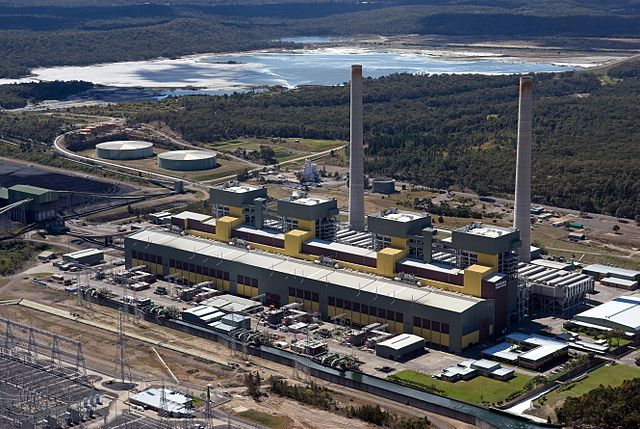
January 22nd, 2026 | Tags: Blob (The), Coal, IEA, Psy-Ops | Category: Global Warming | Print This Post | | By Jo Nova The Zombie coal plant lives againEraring coal plant is Australia’s largest coal power station. Obviously it’s a polluting monstrosity that kills koalas and is more expensive than solar panels. It’s also old and yet, for some reason, when it was supposed to shut down in August last year, the government dished out nearly half a billion dollars to keep it running for another two years until 2027. Now, in a second round of baffling electrical fever, the NSW government has twisted the arm of Origin Energy to make sure they don’t shut the coal plant until 2029. All four coal units will be kept running. Eraring supplies nearly a quarter of the electricity used in our largest industrial state, but apparently the wonderland new renewables grid isn’t quite ready, even though it’s 2026 and we are supposed to be aiming for 82% unreliable energy by 2030. But cruelly, the renewables revolution hit a wall and the Snowy Hydro Scheme hit an unmodeled rock. Only three new wind farms have been built in Australia last year, and everyone hates the interconnector transmission lines. If the renewables grid was utterly failing, and the targets were all going to be missed, this is exactly what the early stages of a big backflip would look like. They can just keep extending the coal plants. Ministers say Eraring will be used less and less and exists only as “insurance”. Which is like buying a truck to sit on the lawn, just in case your bike, roller skates and e-scooter can’t get you to work. Origin Energy’s Eraring coal power station gets 2-year extensionBy Colin Packham, The Australian NSW Energy Minister Penny Sharpe said the extension will help keep power bills down. “My number one job is keeping the lights on and putting downward pressure on power prices. NSW is making real progress replacing ageing coal-fired power stations. Since the election, we have increased the amount of renewable energy capacity in operation by almost 70 per cent. That’s equivalent to Eraring’s capacity,” said Ms Sharpe. The longer lifespan would not impact Origin’s own emissions reduction targets and taxpayers will not at this stage be called upon to provide any financial support, underscoring the profitability of the coal power station near Lake Macquarie. Shares in Origin rose 2.6 per cent to $11.34 as the market cheered the prospect of additional returns from Eraring. Green groups are calling this a disaster. They believe that renewables are cheaper than coal, yet say that keeping an old coal plant going will “crowd out” cheaper investments — though they don’t explain why people will choose the coal…. The CEO of the Nature Conservation Council of NSW, Jacqui Mumford, said “far from supporting the transition, Origin’s decision will crowd out investment in the clean, modern sources of generation we need to be switching to”. Meanwhile The Blob speaks its own language — this decision has obviously increased real “certainty”, but the Blob says it has been undermined. Johanna Bowyer of the Institute for Energy Economics and Financial Analysis said extending Eraring “undermines certainty right when investors in new replacement generation need clarity” Just substitute the phrase “certainty” with “certain income”, or “subsidies” and it all makes sense. And do the same for “clarity” which is another Green word for “money”. |
Jo appreciates your support to help her keep doing what she does. This blog is funded by donations. Thanks!
 Follow Jo's Tweets
   
 
|
|||
|
Copyright © 2026 JoNova - All Rights Reserved |
||||








Recent Comments