By Jo Nova
The Command Economy Fails Again…
Only 6% of government backed wind farms have made it to a committed financial sign off. The “Capacity Investment Scheme” (CIS) was supposed to deliver 40 gigawatts by 2030. Less than a single gigawatt has been finalized. There’s another nearly 13 gigawatts sitting there on the sidelines “in the pipeline” waiting for a cash downpour or a physics miracle.
Anthony Albanese has played whack-a-mole with the free market, but nothing can make this hydra work. Every time he drops a sugar bomb on one part of the market another part gets diabetic. His genius plan to gift rich people with expensive batteries seemed like a great success — smoothing out some of the nightly wild price spikes (and for just $8 billion dollars!). But who could have guessed that the industrial wind plants were counting on making money from those price spikes themselves, and now are struggling to see how to make a profit? (Say, weren’t they the cheapest energy on Earth, and now they can’t compete..?)
Apparently the teams that bid to build wind parks for the CIS didn’t realize wars would drive up the cost of fossil fuels (which they need to build renewables) and they didn’t know inflation would ramp up (even though it was no secret that governments printed billions during covid.) And they didn’t realize that the AI wave would suck the spare electrical hardware out of the room, and leave everyone else scrambling for the last gas turbine on Earth.
Thus and verily, the price of building onshore wind has doubled since they put their bids in, and now no can afford to fulfill those bids.
If only Australia had 1000 years of cheap coal, and its own steel and electronics industry…?!
Renewable energy investment plunges to decade low as major projects stall
By Perry Williams, The Australian
The CIS has the lowest financial close success rate of any major renewable underwriting mechanism in Australia at just 17 per cent, according to Rystad. “Many of the early winners were bid on yesterday’s economics and may never reach financial close without greater flexibility,” said Gero Farruggio, Rystad’s head of Australia.
The combination of high capital spending and subdued spot wholesale electricity prices has also kept the volume of overall power purchase agreements low, on par with two of the worst years on record in the early 2010s.
“Once the backbone of Australia’s energy transition, onshore wind is now being squeezed from every direction,” Mr Farruggio said. “Batteries have eroded the price premium that once underpinned wind economics, while construction costs have more than doubled and power purchase agreements have dried up.”
Nexa Advisory chief executive Stephanie Bashir, a former AGL Energy executive, said the CIS was designed primarily to reduce merchant revenue risk. However, it was not structured to solve the practical barriers stopping projects from reaching final investment decisions.
These include “transmission delays, access to renewable energy zone capacity, network connection processes, planning and environmental approvals, construction cost escalation, community benefit obligations, and the lack of long-term PPAs,” Ms Bashir said.
It’s a multifunctional fail. Somehow, the profits are not there for developers, the power is not there for industry, the cheap electricity is not there for families, and the certainty is not there for investors — unless they get a guaranteed government handout. There’s no winner here except the Chinese Communist Party for selling us solar panels, batteries and turbines, and stealing our factories, and for the Chief Bureaucrat Sponges who fly to beachside resorts on UN holiday plans, (not mentioning any names, Chris Bowen!)
Worst of all, there’s no productivity bounce coming, not even in 80 years time. There’s no payoff to the nation if we reduce our sacred CO2 emissions. No tourism win when we become 0.0001°C degrees cooler. No steel factories waiting to move back here and make the Green Steel no one wants to buy.
Mr Bowen’s *big hope* now is that AI data centres will still want to build something in Australia with our high electricity prices, while being forced to build wind and solar projects as a penance for the “right to do business here”.
If only wind and solar power were cheap, like they told us every day for the last 7,000 days, it might have worked.
h/t Bally
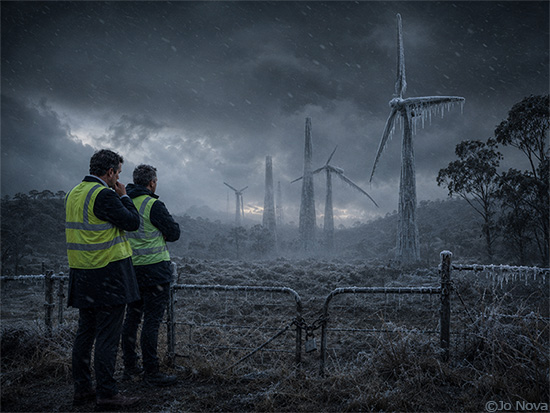
Image: Ai generated. ©JoNova






The data centre buildout is just crazy, have they done their homework or is the govt going to guarantee their supply of electrons at our expense.
Time will tell, they are causing chaos in the US.
120
Chaos? I would contest that at least in that it has a negative connotation. There is a working market. Unfortunately, most of the working press thinks electricity comes from the socket in the wall, and AI is a robot in every pot. We’ve had data centers for a couple of decades, and have over 5,000. We have a vast number of mature businesses in “the Cloud”, which that incurious newsbabe reading about possible AI calamities has no idea lives in a “data center. Our 600-800 million phones and laptops are backed up, our cars navigate, or phone is VOIP when it’s not cell, and our date needs have been growing. Will some amount of data be too much? Sure. When the market reaches that point, the last few won’t get built out, and some will be bankrupt and be bargain storage for the patient. We did fibre the same way, and coax before that, and gas stations and drive-ins, and even boomlets like hula hoops and lava lites.
The raw materials: shell buildings, chips, cooling hardware, and transport infrastructure are pretty fungable; the dedicated power generation will not go unused as the replacement of
renewables with real power has begun here. There is some market movement, well within the normal range for cycles, and far more asset bases that the .Com debacle. The chaos of a free market at work may be disturbing to some, but then, there are the tens of thousands of Nvidia millionaires who had a 100 shares of a little game video card company a decade ago.
A lot of the world wishes they could participate in the “chaos” but alas, they are far too green.
130
Ideology meets Reality and guess who wins?
Electrickery from the Feral Guv’ment.
Emissions Impossible.
Who would have thought!
140
New wind generation is uneconomic because the real price of electricity has decreased. That’s a win for the consumer.
133
The real price is way higher than it was before Ruinables came on the scene.
And where did that reduction of $275 go?
Electrickery!
320
We keep hearing from the Left how “cheap” ruinables are, Simon, but getting back to REALITY, the more we have, the more expensive electricity has become, dramatically so. That happens in every country that has wind and solar ruinables. Every time.
In fact, electricity is so expensive in Australia that it has been a major factor in the deindustrialisation of Australia, apart from feral unions, over-regulation and over-taxing. All part of the plan to destroy the West. If it wasn’t, advanced economies like China wouldn’t be exempt from CO2 emissions limits would they?
Australia used to have some of the cheapest electricity in the world, now some of the most expensive. And back in the day, energy intensive industries like aluminium smelting didn’t need taxpayer subsidies to survive.
(Hydro is frequently counted among ruinables for the purpose of propaganda of the Left but those are properly engineered systems (not politician-design SH2) that long pre-date modern wind and solar and shouldn’t be counted.)
300
Renewables ‘Can’t Keep Up’ With Data Center Pace. As Usual, The Left Wants Government To Step In…
The political left is worried that the rapid expansion of data centres across the U.S. – a controversial but necessary development considering our competition with China – is increasingly accompanied by the corresponding construction of stand-alone natural gas plants to provide the power demands of the centres
Across the nation, similar stories are playing out region by region, with dedicated gas plants often backed by tech giants who once swore off fossil fuels before reality set in
Natural gas plants can be stood up relatively quickly and deliver the massive power required to keep the U.S. ahead of its adversaries in the AI/data centre race.
While data centres have resulted in controversies in some local communities – an unsurprising NIMBY reaction – other places have welcomed the developments.
As stated before, artificial intelligence is here, like it or not. The only question is who will make the rules, the U.S. or China? Soldiers in the anti-fossil fuel brigade are once again coming face-to-face with their biggest enemy: reality. And as usual, rather than seeking to engage fairly in the free market, backers of renewables are demanding that government write regulations requiring their use.
But in the fantasyland of far-left (and socialist) idealism, government regulations keep them afloat or even put them in preferred positions – at least until their deficiencies become too obvious and too dangerous to pretend anymore.
(For example, see the massive 2025 power outage in Spain, Portugal and parts of France, where alternatives failed and natural gas came to the rescue to restore power.)
10
Gas turbine deliveries are effectively booked out and stretching into the early 2030s highlights one of the most acute bottlenecks in the global energy transition.
The heavy-duty gas turbine market—dominated globally by a tight oligopoly of manufacturers like GE Vernova, Siemens Energy, and Mitsubishi Power—is experiencing an unprecedented supply-demand crunch.
1. Why Gas Turbine Deliveries Are Pushed Out to the 2030s
– The Explosive Surge in Demand: Global orders for gas turbines skyrocketed due to a simultaneous collision of power demands.
Chief among these is the massive, rapid build-out of artificial intelligence data centres requiring guaranteed, 24/7 baseload power, compounded by traditional utilities seeking flexible bridging power as coal plants retire.
– Severe Manufacturing Backlogs: Major manufacturers are reporting multi-gigawatt backlogs (with GE Vernova’s combined backlog and slot reservations climbing well over 100 GW).
Global production capacity is operating near peak utilizsation (around 90%), and annual orders have routinely outpaced total global factory output.
– Extended Lead Times and “Slot Reservations”: Buyers are no longer just ordering equipment; they are paying hefty non-refundable fees simply to lock in manufacturing slots for 2030, 2031, and 2032. Standard lead times for large, heavy-duty combined-cycle gas turbines have stretched out to roughly 4 to 6 years depending on the model.
2. Market Implications
– Procurement Over Economics: Project viability is increasingly driven by whether you can secure a turbine rather than standard fuel-cost economics. Developers are being forced to plan half a decade or more in advance.
– Surging Equipment Costs: With demand vastly outstripping supply, turbine prices have surged dramatically—climbing sharply from historical baselines as manufacturers wield immense pricing power.
– The “Bridge” Strategy: To bypass the multi-year wait for massive heavy-duty turbines, some developers are turning to smaller aeroderivative turbines (which use modified jet engine technology). While more expensive per kilowatt, they can be manufactured and commissioned much faster to provide immediate blocks of power while heavy-duty plants remain backlogged for the early 2030s.
20
And Simon, many on the Left are highly overpaid public serpents or others dependent upon taxpayer funding. They are among the wealthy Elites and don’t notice the struggle normal people go through who work hard to pay the taxes that support them. That’s why you never hear Leftists complain about electricity prices, or even notice they’re expensive.
240
So if electricity is so cheap who is making all the money from the high consumer prices?
220
I do believe Simon I real life is the PM. Exact fit when it comes to thought patterns!
110
I think more likely Chrissy Bowen (when he’s in Australia).
70
I don’t know how you can say that. Compromised by inefficient wind power that stands down reliable coal based units while wind carries on in its usual erratic fashion adds to market distortion via the spot price bid. As the article says wind power generation is hollow and subsidy driven.
30
This is from AI
Average Australian residential electricity costs grew from roughly 12–15 cents per kWh in 2000 to an average peak range of 28 to 44 cents per kWh by 2025.
Between 2000 and 2025 daily supply charge rates grew significantly from historical averages of around 20 to 50 cents per day to over $1.00 to $1.60+ per day by 2025, driven by rising network and infrastructure costs.
Anybody who has to pay an electrickery bill knows that prices have soared with the intervention of unreliables.
The “message” that unreliables are cheap has long been drowned out by reality.
90
In a neo-communist-dictatorship* like Australia, if people won’t voluntarily “invest” in ruinables, Emperor Albo will force them.
Recall what Albo-sleazy said about superannuation (retirement savings like US 401(k)) savings recently?
It’s scary that he considers all that hard-earned money a “national asset”, not a private one. We’re obviously being primed for that to be interfered with or taken as well.
*Yes, our Emperor PM is a genuine life-long communist as documented by Trevor Loudon in Comrade Prime Minister: Anthony Albanese’s 40-Year Alliance with Australian Communism
240
The friction surrounding Australia’s $4.5 trillion superannuation pool centers on a fundamental ideological clash:
whether retirement savings belong strictly to the individual worker for their post-work life, or if they can—and should—be leveraged by Canberra to solve macro-economic problems like housing shortages and the clean energy transition.
The Core Debate
The Government’s View:
Labor Prime Minister Anthony Albanese and his senior ministers have repeatedly pointed to the massive scale of the super pool, describing it as an “extraordinary national asset”.
The government argues that directing a portion of these funds toward long-term domestic infrastructure, business lending, and social housing is entirely consistent with building a stable economy—and that it can generate solid, long-term returns for members simultaneously.
The Pushback:
Critics, financial commentators, and industry leaders (such as banking executives who have pushed back at high-level roundtables) argue that government encouragement risks morphing into government direction.
Under Australian law, super fund trustees are bound by a strict “best financial interests duty” to maximise returns for their members, not to act as a funding arm for government policy objectives.
The “Hands Off” Sentiment
The public pushback—often echoed by consumer advocates and financial commentators in the vein of the “hands off super” sentiment—stems from a deep-seated fear of mission creep.
Private Property vs. Public Policy: Superannuation is accumulated via compulsory contributions taken directly from employees’ wages; critics argue it is private wealth, not a government slush fund.
Conflict of Objectives: If fund managers are forced to balance member retirement returns with broader societal goals (like nation-building or political priorities), performance can be diluted.
The Slippery Slope: Once a government begins defining private retirement savings as a “national asset,” it opens the door to shifting regulatory mandates, tax changes, and forced domestic allocations that may not align with what is best for an individual’s financial future.
00
Amazing that people still want to vote for these Labor ,Greens and Teals traitors and further flush the Aussie economy and environment down the drain.
Surely Victorians will wake up by November and the rest of us by 2028 at the next federal election?
Or is that too much to hope for as we kill more Koalas and Eagles etc as a sacrifice to toxic, unreliable W & S + batteries.?
140
“Amazing that people still want to vote for these Labor ,Greens and Teals traitors”
It’s the “Cargo Cult” mentality, keep promising people free stuff and they keep voting for “Free Stuff”. As can already be heard by both state and federal governments, don’t vote for conservatives, all they will do is slash, slash, slash spending. Apparently “Spending” is easy, paying for the spending is never spoken of.
90
Leith Van Onselen has another interesting post that shows the mess we are in if we continue to support the blackout Bowen loony and Labor down the plug hole.
Interesting data and graphs to support his opinion. Let’s hope the NT and Qld govts can win the day.
https://www.macrobusiness.com.au/2026/07/data-centres-are-incompatible-with-renewable-energy-targets/
80
What’s the exit plan from ruinables insanity?
(Assuming a genuine conservative pro-energy Government like One Nation can be elected.)
Unlike the Liberals, One Nation has promised to withdraw from the Paris Agreement.
60
John Anderson and his guest tell us in 6 minutes why we can’t rely on unreliable W & S to power our country.
For 60% to 70% of the year W & S are missing, but coal, gas or nuclear are reliable 24/7/365 days of every year.
https://www.youtube.com/watch?v=H4SOeJCJJWY
50
Unreliable monuments to mammon.
Jo’s image at the top of today’s article describes perfectly the sh!tuatiion parts of New Zealand have been ‘suffering’ this month: record overnight (dawn) low temperatures, frosts even in the so-called ‘winterless’ Far North, ice & snow on alpine passes & ski areas, and if it’s not blowing a gale it’s dead calm. Thankfully our hydro lakes are FULL so city dwellers of the green variety don’t even notice how USELESS their planet-saving Chinese-made carbon-heavy bird-chopping windmills are.
-7 C in Waiouru this morning (North Island) while The Hermitage dipped to -8 (South Island) on the weekend, with lots of -4 recorded on both islands accompanied by frost and black ice on roads. For some unknown reason carbon pollution doesn’t seem to work in the dark, cold depths of winter.
Re the video, Neville, are subtitles necessary for 2 Aussie blokes speaking English? Or is it a new-and-improved useless AI bug that Youtube has now inserted into clips? Searching for The Simpsons’ version of Homer’s Odyssey yesterday resulted in badly translated subtitles on all bar one – is there a button I can push to eliminate such useless visual pollution from my theatrical enjoyment?
00
Climate has always changed and always will. Contributors to planet warming include increase in solar output (grand solar maximum), increase in water vapor due to increase in human population and increase in irrigation, and, decline in cloud cover. CO2 has no significant net effect on climate. Fig 3.5 and fig 0.2 in the analysis at http://globalclimatedrivers2.blogspot.com
A consequence of the mistake of thinking that climate change is being primarily caused by burning fossil fuels and that climate change can be stopped by curtailing the use of fossil fuels, is that humanity is neglecting to adequately prepare itself for natural climate change. A universal protection from the negative effects of climate change is increased availability of reliable energy at fair cost.
61
We have the MT Challenger project up here in the Whitsunday region. Alinta Energy wishes to erect huge wind towers along the ridge line which would entail the destruction of forest habitat and contribute to run off siltation. Public opinion is largely against it, but unfortunately we have a lot of NIMBY types who say that they’re not against renewables but not here. Public meeting in Bowen on Thursday to discuss the issue.
50
Make a placard – “Stop the Climate Change hoax – vote One Nation”.
50
😀
00
The proponents of the CIS contracts get a taxpayer guaranteed return on the estimated cost. Double the actual cost compared with estimate and the return looks AWFUL.
Blackout wants the big super funds to finance these AWFUL projects but the fund administrators have a duty to their investors.
The “renewables” target is dead. No responsible investor would accept the sovereign risk of Blackout still throwing taxpayer money at their projects while One Nation loom ever larger.
Can you imagine a “renewables” proponent sitting down with Malcolm Roberts and Barnaby Joyce to extract taxpayer money from them.
40
Can anyone tell us where this so called climate crisis is hiding and how to find it?
And where is the data to support their claims?
Is it: Unusual or dangerous Sea level rise? No, see 2025 Dutch Engineers study of 200 tide gauges around the world, showing no acceleration in SLR since the 1850s etc. So where is this dangerous warming since the end of the little ice age?
Or Polar Bears, NO, there are much higher numbers since the 1950s.
Or deaths from extreme weather events, NO, but down by 99% over the last 100 years. See Dr Pielke jr, Lomborg, co2 Coalition Scientists, Clintel group etc.
Is it life expectancy? No, global Life Exp has boomed since 1900. 32 years then and 73 + years today. See UN, World bank data etc.
Is it Human calories per person? No , much higher today, see OWI Data, UN, World bank etc.
The data clearly shows that the world depends on fossil fuels for Humans to flourish and thousands of products are made from FFs and these products cannot be quickly replaced.
30
The Climate Crisis is headquartered in New York. Australia has its own Climate Crisis promotion team labelled ACCESS. This from their website:
https://www.access-nri.org.au/impact/case-studies/
AND let me tell you – Australia’s future climate is ALL BAD. There is no good news. Oceans will boil; coral will die; rain will either be flooding or non-extent; snow will disappear; Antarctica will melt and sea level rise will flood all the capital cities.
Their earlier climate models have now been proven wrong but they were old atmospheric models that did not have all the bells and whistles of the latest ACCESS coupled model running on a supercomputer. ACCESS climate simulator is definitely spot on now.
The perfect Climate Simulator is one that produces data for a future that is beyond the programmers retirement payout.
00
Adding insult to injury, the commie cruds who brought this nightmare upon us will slink away to comfy taxpayer funded boltholes and leave the huge mess resulting from their renewables boondoggle for us, our kids and grandkids to clean up.
10
By their nature, AI data centres and cloud storage can be built anywhere to service the demand. They are naturally going to follow the lowest electricity prices.
In energy-poor South Australia we have the govt hyperventilating about new data centres in rural towns, it’s the latest thing that’s going to put us “on the map”.
And wait until they work out that AI is not intelligence at all, but a simulation of intelligence (as Turing clearly said back when he coined the phrase ‘machine intelligence’). Like the child who realises that his teddy bear will never talk, and is just stuffed cloth. AI can never be more than an extremely powerful search engine and calculating machine.
10