By Jo Nova
Rich nations protect the Earth
Despite the UN blaming the rich nations for destroying the planet, the data shows that wealthy nations have cleaner air and water and less deforestation.
A team at Yale compile a score called the Environmental Performance Indicator. It tracks 58 factors like biodiversity, species protection, particulates in air, pollution in water, forest integrity and fish stocks. It also, sadly, considers “climate change mitigation” measures — which no doubt adds some pointless noise to the line. But the underlying trend is clear. The only countries in the highest ranks of Environmental Performance are the ones with a GDP per capita higher than $30,000 US.
Possibly the best thing we could do for the environment is help poor nations grow their own economy. And the stupidest thing we could do is push unreliable energy onto the third world and deprive them of coal plants “for the sake of the environment”.
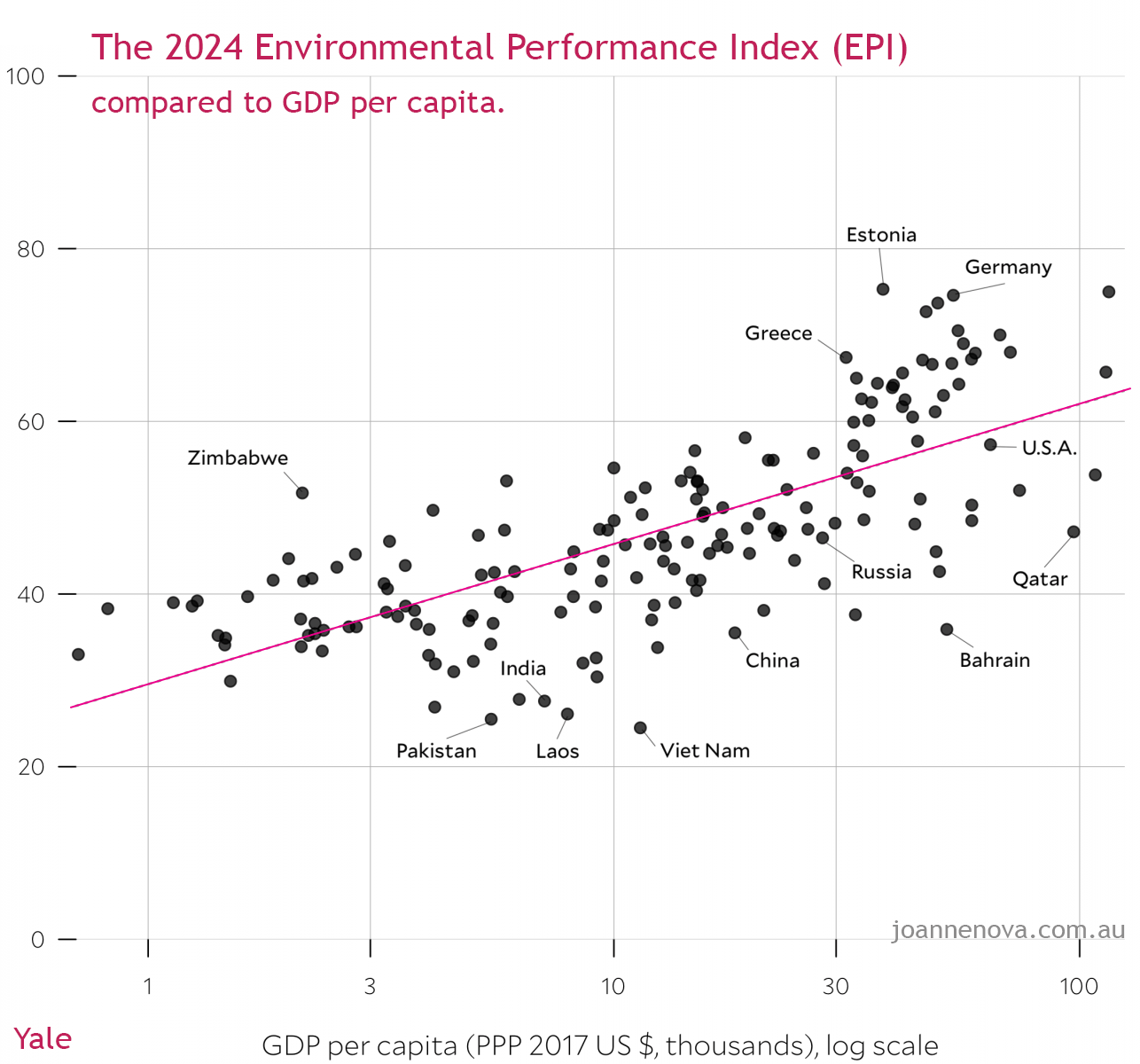
https://epi.yale.edu/
Obviously, anyone can raze a forest, and throw rubbish in the river, but it costs money to protect trees and plants, clean up waste, and filter factory chimneys. People who are hungry understandably, don’t care much about setting up national parks.
The Yale dataset itself, is updated every year. This article, discussed below, came out in 2021:
Study Finds Economic Prosperity is Associated With a Cleaner Environment
By Ethan Yang, Human Progress
The study finds that higher levels of income per capita are associated with lower levels of air pollution and deforestation.
The Environmental Performance Index
The Environmental Performance Index (EPI) is a joint project of the Yale Center for Environmental Policy and Law and the Center for International Earth Science Information Network at Columbia University. The index has been a leading resource on accessing environmental protection in individual countries for over 20 years.
The latest 2020 edition ranks 180 countries based on metrics, such as air quality, ecosystem vitality, environmental health, drinking water, CO2 emissions, etc. However, what stands out about the 2020 edition is its conclusion:
Good policy results are associated with wealth (GDP per capita), meaning that economic prosperity makes it possible for nations to invest in policies and programs that lead to desirable outcomes. This trend is especially true for issue categories under the umbrella of environmental health, as building the necessary infrastructure to provide clean drinking water and sanitation, reduce ambient air pollution, control hazardous waste, and respond to public health crises yields large returns for human well-being.
For some reason Yale researchers even admit free speech and private property rights help the environment. Perhaps priorities become clear when people look closely at environmental stewardship in Zimbabwe?
Furthermore, the report notes that although urbanization and industrialization can lead to increased pollution (especially in developing countries), tradeoffs between environmental protection and economic growth can be greatly mitigated by sound policy. For example, “commitment to the rule of law, a vibrant press, and even-handed enforcement of regulations – have strong relationships with top-tier EPI scores.” That’s because open governments allow for greater public scrutiny, whereas dictatorial governments, like the former Soviet Union, can silence their critics and continue destroying the environment unimpeded.
Undermining of private property rights, for example, can incentivize poor ecological stewardship – as it did most recently in Zimbabwe and Venezuela.
Economic growth is painted as a bad, bad bogeyman. Growth is supposedly synonymous with greed, and yet wealth saves the day.
Giving up wealth to protect the environment is not the trade-off they want us to think it is. But it might be the excuse for keeping people poorer.
REFERENCES
Block, S., Emerson, J. W., Esty, D. C., de Sherbinin, A., Wendling, Z. A., et al. (2024). 2024 Environmental Performance Index. New Haven, CT: Yale Center for Environmental Law & Policy. epi.yale.edu
Graph by the Yale Center for Environmental Law & Policy – CC BY 4.0, https://commons.wikimedia.org/w/index.php?curid=154237043
Thanks to Peter Ridd for asking the right question.






I don’t think it’s anti-economic growthism.
Pretty sure it’s anti-Westernism.
281
Accidental red, sorry Honk.
60
The Greens and United Nations use the phrase “economic growth” as a toxic thing in and of itself.
It’s anti-Western and anti-economic-growth too.
160
Annie … darn.
I’m disappointed in myself if I don’t get under at least one craw.
🙂
20
Which dot on the chart is Australia?
100
Oz is almost the same as Spain or Slovenia, 23 on a scale of 1 to 180, so pretty good.
50
“Pretty good at the moment.” What happens when Bowen and Grim Jim turn us into a poor country, which is exactly what they are doing at the moment.
110
The correlation between national wealth and environmental protection has been known for decades. The transition to post industrial technological economies particularly so. People in affluent societies have more inclination towards a cleaner environment.
220
People who can afford washing machines and vacuum cleaners usually keep their houses clean and their clothes washed. Keeping the country clean is just an extension of lots of clean houses.
190
So after trashing the environment for a century, rich countries exported their polluting industries to the global south, and now smugly bask in a cleaner environment.
Take rare earths as an example. China processes 90 percent of all rare earths, which is a particularly dirty job.
932
Unfortunately the exporting of polluting industries to poorer countries is fact and that is the double edge I’m afraid. A failure too of legislative will in some of these poorly run places no doubt desperate for economic development and kickbacks for despots.
110
See comment #1.
60
Industry has been exported from the West partly because Leftist anti-energy policies have made them unviable.
Thus, industry goes to advanced industrial countries like China who for inexplicable reasons is exempt from the anti-energy policies of the West.
212
So Peter what is your solution to fix your so called problem and why doesn’t China, India and the NON OECD countries embrace your unreliable, toxic W & S disasters?
160
BUT,BUT,BUT PETER…WHOS GOING TO MAKE YOUR CHEAP IPHONE IF CHINA AND 3RD WORLD IS NO MORE?…BWAHAHA. There’s a good reason why a fridge is cheaper today than it was 49 years ago…bwahaha
80
The reason China processes “rare” earth’s is that it is an extremely environmentally toxic process and the Chicomms don’t care for the environment.
171
Unregulated rare earth mining in Myanmar is causing pollution downstream.
‘Over the past year, rivers in this region, such as the Ruak, Sai and Kok – all tributaries of the Mekong – have shown abnormal levels of arsenic, lead, nickel and manganese, according to Thailand’s Pollution Control Department.’ (Aljazeera)
52
Peter, please cease being such a hypocrite.
China is the World Leader in toxic mining practices in China, Africa, and anyplace else they dominate mineral extraction.
Zambia: https://www.mining.com/acid-spill-from-chinese-owned-copper-mine-contaminates-vital-waterway-in-zambia/
China: https://e360.yale.edu/features/china-wrestles-with-the-toxic-aftermath-of-rare-earth-mining
The process is to drill bore holes, inject nitric or sulfuric acid, and leach out the metals, then abandon the sites. This leaves the mined areas uninhabitable, from toxic runoff, to debilitating health issues. But cheap extraction without rules is their choice.
Western countries don’t allow this kind of scorched earth violation of the environment. But China does, in China and any country they can exploit.
Prove me wrong.
190
you make my point, China is doing the dirty work, not the west.
As to your pollution claims, look at the tailings dam failures in Brazil, all caused by multinational companies
010
Please discuss the idea that the current technology relating to mining and processing of these rare earth elements are so polluting that they are in fact banned (or so restricted to be uneconomic) in western countries but not in China?
40
Please check the facts WRT multinational companies causing dam collapses. The Brumadinho operation is a Vale project. The Marianos operation is Samarco, a joint venture between Vale and BHP. Vale is a Brazilian company with many operations in countries other than Brazil. So the term “multinational “ does apply to both Vale and BHP, but what is your point? Both tailings dam disasters in Brazil were mainly in operations governed by Brazilian engineers. It’s not like colonial masters taking short cuts as in Victorian times.
00
China was more than happy to help Indonesia process nickel by building coal powered plants. There is probably 14 coal powered plants on 3 nickel processing sites by now as this article was written a few years ago.
https://dialogue.earth/en/energy/coal-powered-industrial-parks-test-indonesias-climate-pledges-and-chinas-too/
If CO2 was such a danger to the planet, this type of activity would be universally condemned, but it’s not. It also highlights that EV drivers shouldn’t be smug about their choice of car because it’s more than likely that the battery contains dirty nickel. Australia can produce cleaner, higher quality nickel but no one is prepared to pay for it- they just buy the cheap polluting kind.
100
China, as a Developing Nation (/sarc), is already doing it with Mining, etc, in Africa and Nickel processing in Indonesia for example.
And who is forcing China and India to build all those Coal fired Power Stations?
Not the Rich West, that’s for sure.
50
Extractives are, and always have been, messy.
The Net Zero push drives increasing, new extractive industry onto previously unextracted sites. So more mess.
Although it is certainly not the Chinese that started the mess in Zambia – they just picked up where Glencore and others left off.
Interesting fact – two of the top five destinations for export of Zambian copper in 2012 were Switzerland and British Virgin Islands. Funny, I cannot find anywhere that these places process copper…
Extraction with no benefit (and no growth) to local people then just piles on to the levels environmental degradation. But I think it is a good idea to worry about the poor people first – they will then be able to make their own environment better. Unless the extractives have destroyed it already – I don’t think people should have been living and drinking the water in Kitwe before the Sino-Metals leach, but now, definitely a no go area.
30
Surprisingly, I agree with Peter F here, the West are post-manufacturing economies, their wages are too high to support menial jobs and they have become service economies.
The manufacturing has been exported to the cheap second and third world, and all manufacturing is dirty. They make a lot of noise about rare earth extraction, but any metallic industry, or anything involving oil and plastic generates filthy waste. You only have to look at the Youtube videos of Pakistan to see how to completely ruin your environment.
However, that is the only way they will become first world, so how can we complain, they are just doing what we did 150years ago.
00
Prior to the coal revolution in the UK, trees were cut down in large numbers for the production of charcoal. This raw ingredient was used for the production of iron, (amongst a lot of other tasks).
It doesn’t take a genius to realise that trees grow slower than their consumption rate when they are located near to a smelter. By adopting coal, the UK was able to allow trees to grow.
If the modern rules were applied back then, limiting coal extraction, etc, then would the UK have had an industrial revolution? I doubt it.
Green tape is possibly destroying the next revolution. We’ll probably never know what we missed out on and what could have been.
270
Apparently before the Industrial Revolution when wooden sailing ships were the norm, the U.K. had so depleted her forests that ship building was in decline.
120
Background reading:
https://www.chesterfieldhistoricalsociety-nh.org/kings-board-arrow-acts
The Crown, starting in 1691, restricted the cutting of white pines in the New England colonies. Three slashes on a tree meant the colonists could not harvest it for their use. That went over well.
60
Thanks for that link John, fascinating stuff, particularly getting trees to fall ‘softly” onto the ground. In my area of Victoria Mountain ash used to be harvested (before a complete ban on native timber harvesting) These very large trees, straight trunked with the head sometimes not starting for 30 or 40 metres were very much appreciated by millers throughout the ranges. The trick in the old days was to drop these giants without them hitting any rocks, fallen trees or previously cut butts. If a log hit these obstacles it was deemed as being “stumped” and often written off as little value. The damage caused by falling on these obstacles wasn’t always apparent but it certainly reduced the strength of milled timber to the point of it not being fit for purpose.
90
A whole forest was knocked over to build The Mary Rose for King Henry viii that, served the British Navy for 34 years 1511-1545, before unceremoniously and incongruously sinking off Portsmouth
50
I remember when we were a rich nation. Happy days.
171
We still rely on poorer nations to get the things we want oblivious to the damage we indirectly wreak on these countries that burn coal and oil and gas despite the damage they cause to human health and the damage they cause to the environment.
05
Just look up OWI Data for Human flourishing since the start of the Industrial Revolution and today the wealthiest countries have the best and safest environments.
But the Labor and Greens are trying to destroy the Aussie environment using toxic, unreliable W & S and we’ll have to clean up that toxic mess every 15 to 20 years.
They’ve reached peak stupid and soon we’ll have a severe shortage of energy and a serious shortage of funds to fix up their entire net zero lunacy.
And all for no measurable change to the weather or climate and at a cost of trillions of $.
171
Rather than Leftists promote the destruction of Western economies by fake claims that anthropogenic CO2 is a “pollutant” and causes “climate change” I would like to see them do some genuine volunteer work for once in their lives.
Leftists should go to Third World countries and personally pick up rubbish and also teach the locals not to litter.
They could start by going to Nepal where I have trekked and start cleaning up there. It is appalling to see the amount of litter discarded in the Himalayas on the ground and in the rivers. The locals simply don’t care.
Also, convenience products like supermarket plastic bags, straws and plastic picnic ware should be reinstated to the woke countries like Australia. Ocean plastics do not come from places like Australia and other Western countries. They come from Third World countries where they frequently throw their rubbish into rivers.
In the following list they are either Third World, under-developed or advanced countries, China, Russia and Thailand, who simply don’t care.
202
Sort of, pretty common sense isn’t it? But as my grandma used to say, common sense ain’t so common.
130
We should never forget that the rich countries have become rich by using fossil fuels and today fossil fuels still supply 80% of the world’s energy and many poorer countries will want to join us ASAP.
110
We should ask the Venezuelan zoo animals what they think about this important question.
70
There was a report of a survey this morning that found that 49% 0f Australians want to keep Net Zero and only 30% that want to scrap it. This was a call to the Liberals to keep their Net Zero policy. We were not told the wording of the question. What needs to happen is the education of the public of what Net Zero is costing them and will cost them with an alternative plan for reliable power. Education, the wrong sort, got us to this position so good education will correct it.
140
Yes, the fake conservative Liberals need to become a conservative pro-science, pro-reason party, stop being woke and start believing in something rather than basing their policies on what the ignorant masses believe. They need to start educating because the Sheeple will not learn the truth from the Lamestream Media or the education/indoctrination system as those are already captured by the Left.
130
Fake, flake or fakir pretty much amounts to the same thing “taking our money under false representation”
70
There’s a little glimmer of hope in Vicdanistan with MP Sarah Henderson. She’s calling for a halt to renewables, advocating for better treatment of farmers and asking for more affordable and secure energy.
https://www.skynews.com.au/opinion/chris-kenny/these-schemes-need-to-stop-farmers-facing-huge-distress-amid-labors-renewables-rollout/video/b4396b17e240bf969df3ae93185c1710
It would be encouraging if some of her fellow party members backed her up.
30
The Industrial Revolution has only existed for about 250 years and Human life expectancy was just 28.5 years then and about 32 years by 1900. See Dr Koonin, the UN, Dr Pielke and the co2 Coalition scientists etc.
But today the average global life Exp is about 73.5 years and much higher in wealthy countries. See the UN ,World Bank, Macrotrends etc.
So why was Human life exp unchanged at 28.5 years for 99.9% of the last 300 K years and yet we’ve seen our life exp today boom to 73.5 years during the last 0.1% of our existence?
Our population in 1800 was about 1 billion and 8.2 billion today. So does anyone not fully understand the UN etc data now?
100
8 billion people @ average 70 kg each, weigh about the same as the water in Sydney Harbour. That leaves an awful lot of the world untouched.
20
This was mostly true until western leaders and corporations realised they could bypass strict and “difficult” environmental protection laws by moving dirty industry to China and other Asian countries and then lost their minds over the “green utopia” dream of Net Zero and climate alarmism.
Proclaiming they’re “saving” the environment and atmosphere by shutting down hydrocarbon based industry and electricity generation in their own countries while ignoring the ramping up of the same things for the mining, mineral processing and manufacture for toxic “green dream’ products of Wind turbines, Solar panels, inverters and industrial sized battery banks.
100
Been to Vietnam quite a lot, and while they are no environmental leaders I struggle to believe they would be the lowest ranked out of all countries. India and China are above them in these rankings?
40
River ecologists could quickly point you to a large visible issue.
25
Can anyone of our silly blog donkeys explain the co2 emissions data at the link from OWI Data?
I’ve linked to the up to date annual emissions of co2 for the World and the NON OECD and the OECD. And that horizontal biro mark at the bottom is Australia.
The World graph upward trajectory seems to be basically unchanged since 1945, so has any blogger have any ideas?
https://ourworldindata.org/grapher/annual-co2-emissions-per-country?country=OECD+%28GCP%29~Non-OECD+%28GCP%29~OWID_WRL~AUS
40
No, under the Socialist Far Left Albanese government, we’re destroying our natural beauty and native animals and replacing those priceless assets with so-called clean energy factories in order to save the planet. That’s a wealth of wanton vandalism at the hands of oafish tyrants.
190
There has been a big global fall in death rates from fires and burns since 1980 and Aussies are now one of the lowest in the world.
Just another benefit of a wealthier world and the use of fossil fuels and machinery, planes etc to fight the fires.
IOW our global environment is much safer today. Think about it.
https://ourworldindata.org/grapher/fire-death-rates?tab=line&country=OWID_WRL~OWID_LIC~OWID_HIC~OWID_UMC~OWID_LMC~NZL~AUS~African+Region+%28WHO%29
60
An oft noted thing by early explorers was the many natives with obvious burns and burn scars from sleeping to close to fires. I hope the descendants of these people are grateful for having electricity connected to their Mia Mias
60
Our global environment is a much safer place today than 100 years ago and a big drop in death rates since 1960.
And today 8.2 billion are at risk and only 2 billion in the 1920s and 3 billion in the 1960s.
When will we wake up and think?
https://ourworldindata.org/grapher/natural-disaster-death-rates
50
Poor nations worry about a meal tomorrow. Rich nations worry about OLED televisions at discount prices.
The Chinese are adept at providing the OLED televisions on the backs of the poor nations without regard to any environmental concerns.
It isn’t personal, it is simply business. If it wasn’t profitable, they wouldn’t do it.
Amusing how CO2 has “externality” costs, but rare earths don’t, in the Environmentalist Bible.
150
Spot on Lance. Whether it’s an OLED TV, an EV or white goods, Westerners need a bargain without knowing the environmental or human slavery repercussions behind their purchase.
00
In fact Droughts and floods were the big killers up to 1960 and a massive reduction in deaths over the last 65 years.
Only 3 billion Humans at risk in 1960 and 8.2 billion at risk today, just hold your mouse on the particular disaster and that will be highlighted for you.
The data tells us the truth so why do our blog donkeys and stupid pollies or so called scientists or MSM etc refuse to understand?
Are they really that ignorant and why are the OECD countries wasting trillions of $ for nothing?
https://ourworldindata.org/grapher/decadal-average-death-rates-from-natural-disasters
80
The data tells us the truth so why do our blog donkeys and stupid pollies or so called scientists or MSM etc refuse to understand?
Are they really that ignorant and why are the OECD countries wasting trillions of $ for nothing?
Because, for the ‘stupid pollies or so called scientists or MSM etc who refuse to understand?’, it’s not their money being wasted.
A lot actually profit from the Taxpayer and Borrowed money being wasted.
As for the blog donkeys, they are being led by a carrot on a stick.
70
80
How many Australians understand Installed Capacity and Capacity Factor for so called renewables, and that wind and solar must have full controllable generators back up as well as other “firming” equipment?
If they understood would 49% say that they support net zero emissions and renewables?
90
Not many. In fact I don’t think most of the media or politicians do either. Seriously.
100
The ‘capacity’ is just straight up lies. You really have to question how they get away with it.
I have solar hallway lights (cheaper and easier than a skylight).
To run a 24w light you need a 32w solar panel. Why? Because the solar panels ‘capacity’ is measured at 15 degrees.
After 35 degree the capacity nose dives. Remember, this is the surface temperature of a dark energy absorbing object in full sun.
All solar panel in the Australian summer are operating at about 50% of name plate.
00
Would Peter Fitzroy be happy to do without everything that relies on rare earth processing? I doubt it.
No more solar cells, wind turbines, mobile phones, no more computers, no more television, and much more.
He could lead by example, dumping his phone and computer. It would improve the level of discourse here.
50
Heh heh- gold.
20
So how did the prawns get exposed to Cs-137, which were caught by Indonesian ‘PT Bikini Shrimp Holdings Co.’ ?
20
For those who think this is an open door. Those who don’t or who can’t will never get it.
00
How dare you! – Greta Thunberg…
30
Exactly
Rich nation’s are leading the way in clean energy
Poor countries are still burning coal
02