Recent Posts
-
Snowy 2.0 is the Trillion dollar Black Hole of Australia — sucking in energy, money, land, industrial relations, the dollar, our lifestyle
-
Tuesday
-
Monday
-
Winter Solstice
-
Saturday
-
We were throwing-renewable-energy away at record levels in 2025
-
Friday
-
Pauline Hanson, the centrist, just wants a free market in electricity, and an end to the renewable energy bribery
-
Thursday
-
Blame the Climate Yeti again for making your life more expensive! (It’s a smokescreen)
-
Wednesday
-
The Sunrise Project funneled $343 million from overseas to push net zero
-
Tuesday
-
Monday
-
Sunday
-
The US government has been secretly funding 120 dangerous biolabs around the world
-
Saturday
-
New report shows renewables are a drag on our national productivity
-
Friday
-
Thursday
-
Well, how convenient. AI data centers have arrived to be the fall guy for the Energy Minister
-
Wednesday
-
Billionaires are leaving the room with excuses — Bezos says “AI will solve climate crisis”
-
Tuesday
-
Monday
-
Sunday
-
The Craziest eco laws against Farmers. Let’s check that science…
-
Saturday
-
China cooks the carbon accounting books by 400 million tons
-
Friday
-
The Wind Power Puzzle (add more wind turbines and get the same output)
-
Thursday
-
To save the world, Cement Australia stops burning coal and burns trees instead
-
Wednesday
-
On Fire! US hunger for gas power so large, wait time for turbines blows out to 5+ years
-
Tuesday
-
Monday
-
Sunday
-
Saturday
-
Perth event Saturday May 30th: Green Greed and the Grid
-
Catastrophic warming already happened in Antarctica 130,000 years ago
-
Friday
-
Suddenly the Paris Agreement grows teeth
-
Thursday
-
Australian renewable investments evaporate in 2025: reaching a ten year low
-
Wednesday
-
The Bubble Pops: Big Miner BHP quietly backs away from decarbonization
-
Tuesday
-
Monday
-
Sunday
-
Conservatives are tearing themselves apart over “The Paris Agreement”
-
Saturday
|

By Jo Nova
This week, newspapers in the UK appear to be full of Carmageddon headlines.
Thanks to NetZeroWatch and Ballyb, for the compilation of EV warning signs on the road to West Debacle.
The big advantage of an EV used to be the cheap fill but that’s all changed in the least year with the energy crisis. If the workers can’t afford to turn on the oven to cook a Sunday Roast, they can hardly afford to power up a car.
 In a bit of a bombshell last week, Volkswagon admitted that people weren’t buying their electric cars, quaintly referring to this phenomenon as “strong consumer reluctance”. Sales were so bad though, 30% down on forecasts, that they have closed the factory at Emden, Germany for six weeks and are sacking 300 out of 1,500 staff. In a bit of a bombshell last week, Volkswagon admitted that people weren’t buying their electric cars, quaintly referring to this phenomenon as “strong consumer reluctance”. Sales were so bad though, 30% down on forecasts, that they have closed the factory at Emden, Germany for six weeks and are sacking 300 out of 1,500 staff.
Meanwhile, the UK is speeding towards the 2030 EV mandate five years faster than the rest of the world, and the backlash is growing. A Daily Mail poll finds only 1 in 4 people think it’s a good idea to ban sales of petrol and diesel cars by 2030. Fully 53% of people don’t like it. Is the UK a democracy or not? Manufacturing and industry leaders are using words like “ruinous” and talking of “the end of UK car production.” They’re warning that 800,000 UK jobs are at risk. Nothing about this makes sense. EV’s are a lousy way to change the weather. No one even knows if EV’s will reduce carbon dioxide.
At the moment in the UK 36 cars are fighting over every public charging site. Electricity demand is expected to double in the UK due to EV’s yet there is no plan to provide the extra capacity. Perhaps the real plan is to get half the country onto electric buses…?
Politicians are forcing electric cars on a public that doesn’t want them
Ben Marlow, The Telegraph
The electric car revolution is stalling, of that there can no longer be any doubt. It has left the big global carmakers floundering…
But it’s the setback at VW that stands out, raising serious questions about whether politicians are making the catastrophic mistake of forcing electric cars on a public that doesn’t want them.
Think about it for a second: an entire industry not only forced to abandon a product that the vast majority of people still want and use, but also bullied into channelling all its resources into making something on a colossal level that there simply isn’t the market for – at least not within the horrendously short timeframe that is being imposed on car manufacturers.
It’s industrial self-sabotage and a commercial, economic and social catastrophe in the making.
Mandating EVs is an “assault on the working class” says Joel Kotkin.
EV owners are wealthier, the cars are more expensive, and mandates will put owning a car out of reach of the unwashed masses…
Spiked Online
Replacing the massive $3 trillion global car industry is an extremely high-risk economic gamble, particularly for the West.
In simple terms, the push for EVs represents an assault on the working class. Two-thirds of all EV owners have incomes in excess of $100,000.
EV mandates are also likely to force up the price of now restricted traditional cars. In the meantime, greens will demand higher fuel prices to reduce drivers’ consumption of the demon petrol. Ultimately, as even the Washington Post recently admitted, electric vehicles are hastening a return to conditions not seen since the early 20th century, when the automobile was a luxury item. ‘New cars, once part of the American Dream, [are] now out of reach for many’, it notes.
Just to repeat… None of this makes sense. Even if people have a religious fixation on climate change, this isn’t the path to salvation:
Economist Bjorn Lomborg calculates that a wholesale shift to EVs will lead to a reduction of global temperatures of no more than 0.0002 degrees Fahrenheit by 2100.
Kotkin asks “who benefits”:
 So, who wins here? Certainly not middle- or working-class families for whom climate change barely registers as a primary concern. So, who wins here? Certainly not middle- or working-class families for whom climate change barely registers as a primary concern.
…the biggest winner is China.
Today, China produces twice as many EVs as the US and the EU combined. Its leading EV maker, BYD, is now the world’s largest. Its electric-car exports are expected to almost double this year, helping it to overtake Japan as the biggest car exporter worldwide, according to the South China Morning Post.
China has control of much of the worlds rare metals. Giving up an industry with a century of expertise and mass public support for a new high risk industry that depends on foreign supply lines needs some explanation. No one believes we’re doing it to fix the weather.
——————-
Joel Kotkin is a spiked columnist, the presidential fellow in urban futures at Chapman University and executive director of the Urban Reform Institute. His latest book, The Coming of Neo-Feudalism, is out now. Follow him on Twitter: @joelkotkin
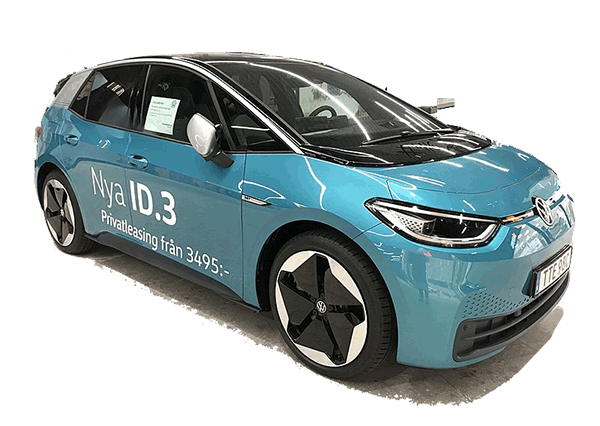
Image by OpenIcons from Pixabay | Das Logo der Marke Volkswagen Nutzfahrzeuge | VW EV Photo by Vogler,
There was a young climate-change tzar,
Bought a brand new all E.V. car,
Found that very few joints,
Had quick charging points,
Means this car can’t venture too far.
–Ruairi
9.8 out of 10 based on 99 ratings
9.2 out of 10 based on 18 ratings
By Jo Nova
UN Human Rights commissioner turns into a hellfire prophet
Volker Turk has looked into his crystal bowl and sees five or ten plagues coming — there will be famine, flood, and fire, and the Earth is melting — it may cease to exist or perhaps even evaporate? Luckily, the UN knows how to save the world, we just have to do what they say and be nice to their friends at BlackRock, Microsoft and the Chinese Communist Party. That means buying lots of windmills and solar panels because climate change is a human rights issue, but slave labor camps in Xingjiang are not.
And who cares about child cobalt miners in the Congo?
Simon Kent Breitbart
 Volker Turk Volker Turk, the U.N. High Commissioner for Human Rights, declared Monday the planet is “[…] burning. It’s melting. It’s flooding. It’s depleting. It’s drying. It’s dying,” as he evoked a “dystopian future” for all unless “climate change” is addressed.
The Austrian lawyer turned U.N. official said the time has come for everyone to heed the unelected body and address the long list of concerns it sees as threatening the very existence of the planet.
Essentially, some lawyer appointed to a UN committee says extreme, preposterous, provably wrong things about climate science, global food, makes some end-of-world prophesies and some newspapers think it’s worth reporting.
 Turk says crops have been wiped out and 80 million more people will starve Turk says crops have been wiped out and 80 million more people will starve
France24
Turk told a UN Human Rights Council debate on the right to food that extreme weather events were wiping out crops, herds and ecosystems, making it impossible for communities to rebuild and support themselves.
“More than 828 million people faced hunger in 2021. And climate change is projected to place up to 80 million more people at risk of hunger by the middle of this century,” said Turk.
This is the catastrophe that climate change inflicts on global agriculture. Far from being wiped out, there has never been more food on Earth.
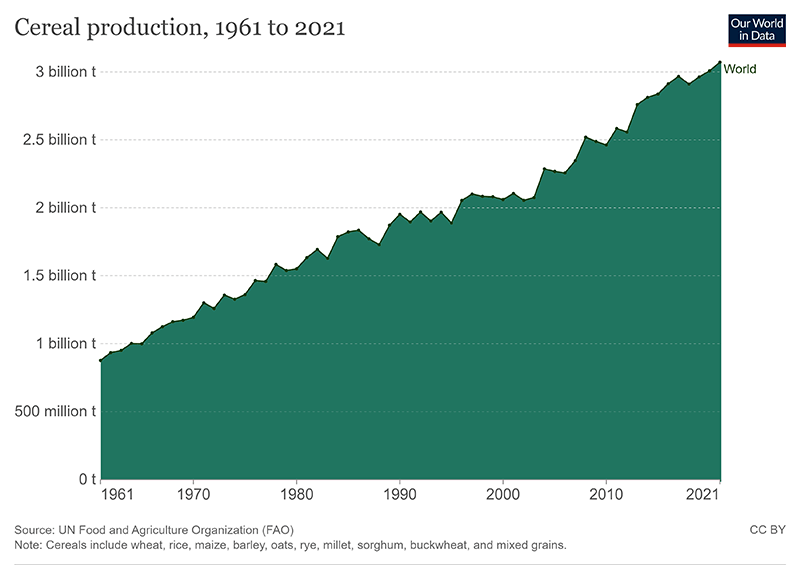
The dystopia he warns about is here, but it’s where career bureaucrats can work 30 years at the UN, and get taken seriously when they are 100% wrong.
The UN is the dystopia Orwell warned us about. Time to end it and give us our money back.
REFERENCE
Hannah Ritchie, Pablo Rosado and Max Roser (2023) – “Agricultural Production“. Published online at OurWorldInData.org.
Earth image by Bela Geletneky
Wizard Artwork: pendleburyannette
9.7 out of 10 based on 108 ratings
8.6 out of 10 based on 18 ratings
By Jo Nova
Perhaps Africa could use some global warming?
Thanks and credit to Kenneth Richard at NoTricksZone:
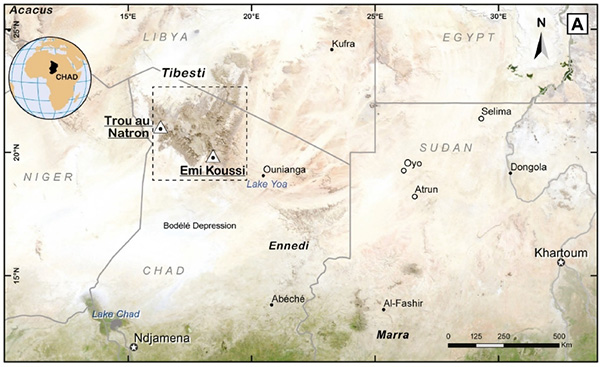
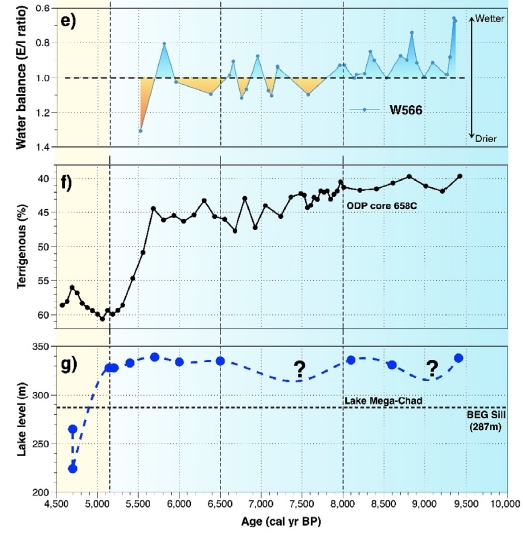
During the hottest part of the Holocene, for thousands of years, there were deep lakes filled with water in the middle of the Sahara Desert. From 9,500 years ago to 6,000 years ago the monsoons rained on the Sahara, freshwater plankton frolicked in the lakes, and greenery grew far and wide. The wetter conditions made it possible for “widespread human occupation and the development of agriculture across North Africa”. Amazingly, that last quote comes from Kuper and Kropelin fully seventeen years ago. Strangely the UN experts don’t mention very often that in the warmer world not that long ago, the hyperarid Sahara desert was rich, green and filled with water? We wouldn’t want people to start wondering if climate change might mean Chad and Libya could be nicer places for Africans to live? Instead we’re told that global warming will turn into our whole world into the Saharan desert, only to find out that in a warmer world even the Sahara didn’t turn into the Saharan Desert.
There once was a lake here…
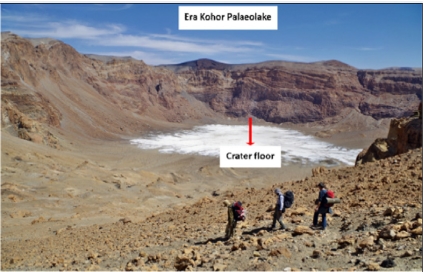 Era Kohor, northern Chad. The new study by Yacoub et al shows how the water came and went in more detail, in the Tibesti Volcanic Massif (TVM) of northern Chad, but they cite twenty years of other studies that show a lost rich Saharan wilderness. The period is quietly known in academic circles as the African Humid Period (AHP).
So yet again we find that the climate on Earth has always changed, that lakes, forests, and rainfall came and went without any input from coal fired plants or SUV’s and that solar panels probably would not have saved the once great green Sahara from turning into a hyperarid desert. We claim to have expert climate models, but we don’t really know why these big shifts happen, or how fast they occurred or what caused them — they are vaguely “linked” to the changes in sunshine that happen due to our orbit.
But if we are still debating whether it ended quickly or gradually, then obviously we haven’t got a good grip on the driving forces.
 …. 7,020 years ago freshwater plankton lived and died leaving behind their silica skeltons.
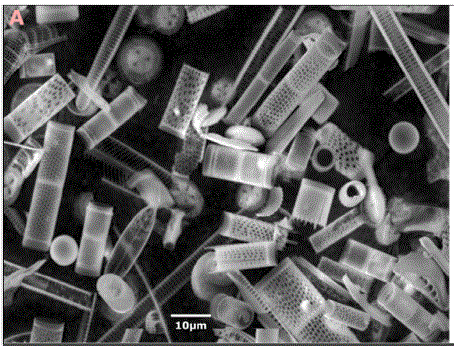 Diatoms. Photographed by a Scanning Electron Microscope Things started to dry out about 5,500 years ago.
The introduction to Yacoub et al is eye-opening. It is a literature review of scores of papers showing just how wet and green the Sahara was, and then wasn’t — in the blink of a geologic eye. There is still debate about how fast the green era disappeared.
Yacoub et al., 2023,
An extensive array of palaeoclimatic records (Shanahan et al., 2015; Holmes and Hoelzmann, 2017) and archaeological investigations (Cremaschi et al., 2014; Manning and Timpson, 2014) have shown that during this humid period, large parts of the present-day hyperarid Sahara and the semi-arid Sahel regions were much wetter and “greener” than today, and thus characterized by grasslands with tropical trees (Hély and Lézine, 2014), hosting numerous lakes (Hoelzmann et al., 2004; Drake et al., 2011) and incised by vast fluvial networks (Skonieczny et al., 2015). This early-to-mid Holocene period of greening of the Sahara, named the Green Sahara period (Claussen et al., 2017), was linked to the low precession in Earth’s orbit associated with high boreal summer insolation that induced the northward extension of the Intertropical Convergence Zone (ITCZ) and the intensification of the associated African monsoonal rainfall belt (Kutzbach and Liu, 1997; deMenocal, 2015; Dallmeyer et al., 2020). These wetter conditions enabled widespread human occupation and the development of agriculture across North Africa (Kuper and Kröpelin, 2006; Manning and Timpson, 2014). After the mid-Holocene, the southward retreat of the monsoonal rainfall belt led to drier conditions that provoked the desiccation of most lakes (Gasse, 2000) and critical demographic shifts (Manning and Timpson, 2014), sealing the end of the AHHP. Throughout the African continent, the timing and magnitude of the termination of the AHHP were probably variable in space and time (Shanahan et al., 2015) and there is a long-standing and on-going debate about whether the end of the AHHP and the subsequent drying of the Sahara was abrupt or gradual (deMenocal et al., 2000; Holmes, 2008; Kröpelin et al., 2008; Bard, 2013; Collins et al., 2017; Ménot et al., 2020; Chase et al., 2022).
REFERENCES
Yacoub et al., (2023), The African Holocene Humid Period in the Tibesti mountains (central Sahara, Chad): Climate reconstruction inferred from fossil diatoms and their oxygen isotope composition
Kuper and Kropelin, (2006): Climate-controlled holocene occupation in the Sahara: motor of africa’s evolution. Science 313, 803e807. https://doi.org/10.1126/ science.1130989
10 out of 10 based on 85 ratings
…
8.6 out of 10 based on 19 ratings
9 out of 10 based on 22 ratings
By Jo Nova
Thirteen remarkable minutes everyone needs to see.
Remarkably, despite the aura of modern space-age medicine — not one childhood vaccine of the 72 that are recommended in the US — has ever been subject to a long term pre-licensing placebo controlled safety trial. Kennedy knows, because he took legal action to get Anthony Fauci to supply one study. After a year of litigation, they admitted they could not provide a single study.
As Kennedy says, he’s not anti-vaccination, he just wants good safety studies — something everyone wants, except maybe certain shareholders.
“Calling people “anti-vaxxers” is a way of silencing them.”
So, for decades, our highly trained doctors have been injecting babies and children with medicines that we didn’t test properly.
The four big companies that make vaccines … Merck, Sanofi, Glaxo and Pfizer, have paid over $35 billion dollars in criminal penalties in the last decade, for lying to doctors, falsifying science, for defrauding regulators…
RF Kennedy Junior’s site is Children’s Health Defense. They have a list of safety studies and controlled trials that use active ingredients in the comparison arm instead of inert placebos like sugar pills. Putting active compounds in both arms of the trial is more likely to produce similar side effects in both sides of the trial, effectively disguising any effect those ingredients have.
Kennedy is such an old hand at the vaccine debate, watch how deftly he uses Elizabeth Vargas’s poorly thought out questions to turn the tables. He’s quite the lawyer, getting her to clarify what she means, fencing her into admitting that no one is suggesting vaccines never cause any harm. At one point she is just gob-smacked, struck dumb. She has not done her research, she just assumed he was the loopy-kooky guy she thinks all “anti-vaxxers” are. (See how name-calling works?) Her spontaneous interruptions, her absolute declaration of faith in the studies that don’t exist, is the perfect foil for RFK.
When Vargus resorts to reciting attacks from his own family, he doesn’t even mention them, just asks her if her family agrees with everything she says.

All the medical organizations and doctors trust and rely on the FDA and the CDC. But these are the same agencies that get more funding from Big Pharma than they do from the taxpayer. In 1969, one former FDA commissioner himself warned us that the FDA protects the drug companies, not the people, and yet here we are 54 years later, and most people have no idea. Perhaps the $15 billion a year Big Pharma spends on seemingly pointless media advertising has a point? It’s a forcefield against bad news…
h/t John Connor II, Kevin a.
Image by Peter Lomas from Pixabay
9.6 out of 10 based on 101 ratings
8.5 out of 10 based on 22 ratings
By Jo Nova
Hail destroyed most of the three year old Scottsbluff community solar project in Nebraska this week. Solar energy might be free but collecting it requires vast acreages of fragile and expensive infrastructure.
Imagine if a three year old coal plant was “destroyed by hail?”
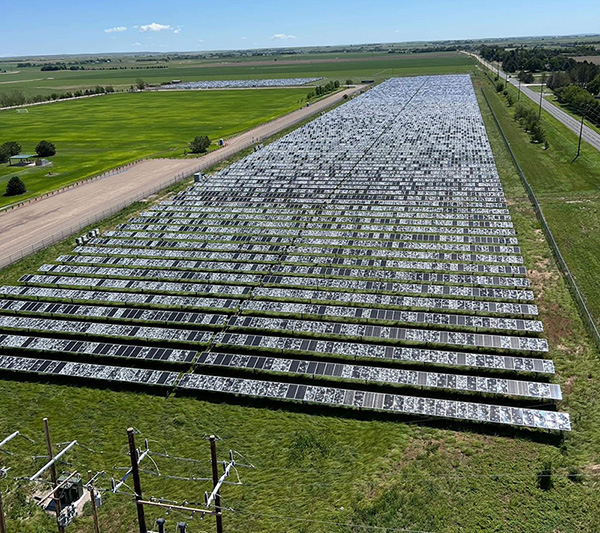
Scottscliffe was a 5.2MW plant with 14,000 panels that started operating in the Spring of 2020. In theory it was going to reduce the “carbon footprint and stabilize city costs for the next 25 years”. Instead it will increase the toxic metal in landfill.
There were tornadoes in the area at the time, but there doesn’t appear to be damage to the fences, trees or poles surrounding the plant.
About a quarter of the panels may have survived, or at least don’t have damage visible from 100 meters away…
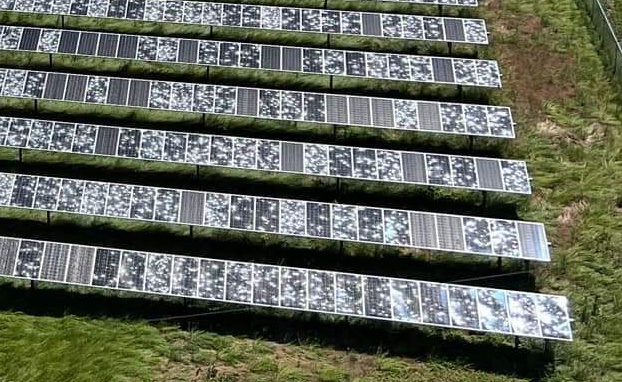
We hope they had insurance.
Kevin Killough, Cowboy State Daily
[Don Day, Cowboy State Daily meteorologist] said that the region around southeast Wyoming has some of the highest frequencies of hailstorms in the country. “It’s ground zero,” Day said.
The average is seven to nine hailstorms per year. That includes everything from pea-sized to baseball-sized hail. “Scottsbluff last Friday night was just absolutely pummeled,” Day said.
Day said that the storms are covering a sparsely populated area with little development, so they don’t always cause a lot of damage. As more solar farms are built, he said there will likely be more shattered panels.
Sometimes the places with the most sun also have the most hailstones…
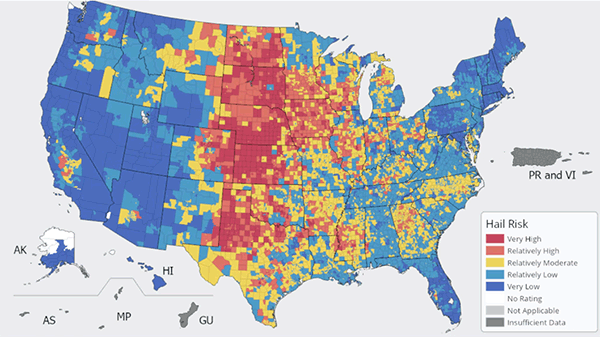
Thanks to Bill in AZ for the tip, and Matt Larsen for the photo.
10 out of 10 based on 94 ratings
9.1 out of 10 based on 23 ratings
By Jo Nova
Wrecking the roads to save the nation from 0.01 degree C?
Electric cars may cause twice as much damage to roads as normal petrol driven cars.
EV’s are heavier, and heavier cars may break bridges and car parks, they wear out tyres 50% faster, increasing pollution, they will cause more road deaths (of other people in smaller cars), and now, they probably wear out roads faster too.
Did anyone think about the carbon emissions of new asphalt and new road surfaces?
Major roads are built to take heavier trucks, but suburban streets were only designed to cope with the occasional truck — not the truck that lives next door. When every car has 300 kilograms more “luggage” there will be consequences.
And remember underlying all this, no one even knows if EV’s will reduce carbon dioxide. An e-Golf has to be driven 100,000 kilometers just to break even with a diesel equivalent. With all these extra lifetime costs, if carbon dioxide mattered at all, EV’s might end up raising global temperatures. But who cares about that eh?
It’s not about carbon, and it’s not about the environment. It’s about control.
Jack Simpson, The Telegraph
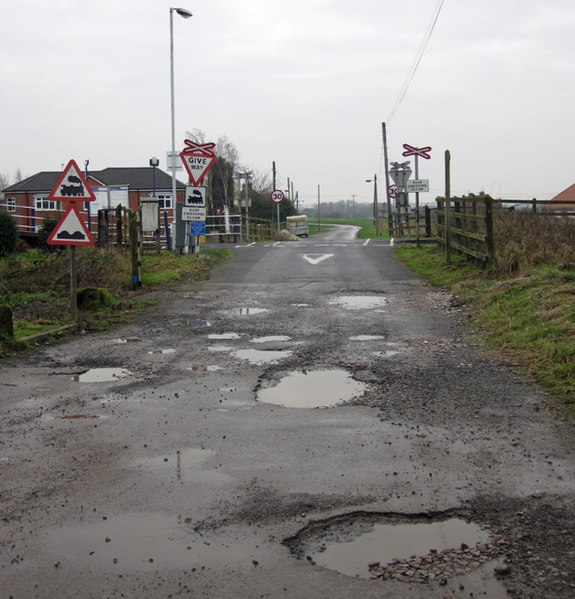
The country is suffering from a pothole crisis, with half as many filled last year compared to a decade ago amid an estimated £12 billion price tag to fill them all.
The Telegraph found that the average electric car puts 2.24 times more stress on roads than its petrol equivalent, and 1.95 more than diesel. Larger electric vehicles weighing over 2,000kg (2 tons) cause the most damage, with 2.32 times more wear applied to roads.
The AA reported last month that the number of pothole-related call-outs it had received had grown by a third in a year, with the company responding to 52,000 incidents in April alone.
A little bit of weight creates bigger better holes in the road:
Fourth power formula
The analysis uses the “fourth power formula”, which is widely used by highways engineers and researchers to assess the damage caused to road surfaces by heavier vehicles. It means that if weight on a vehicle’s axle is doubled, it does 16 times the damage to the road.
Cut the subsidies, recover fair costs, and the free market will sort this one out.
Potholes photo: David Wright Creative Commons 2.0
10 out of 10 based on 80 ratings
Oops. Yes. Where did Tuesday go?
9.9 out of 10 based on 15 ratings
By Jo Nova
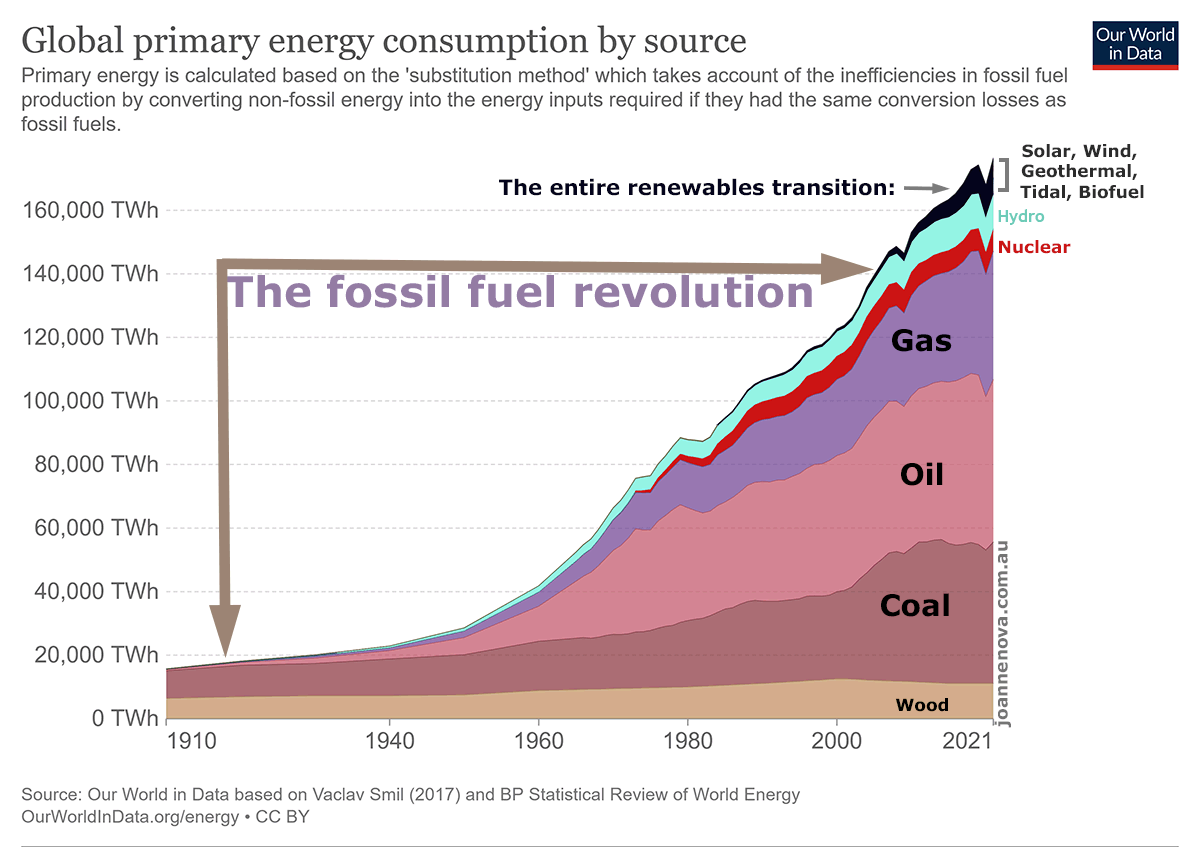
We are a fossil fueled world. Solar & wind power make up just 7.5% 6% of our energy needs.*
The world has set a new record for energy use in the last year. And even though renewables are being installed at the fastest rate they ever have been, it isn’t enough to keep up with the growing demand for energy let alone to “convert” the world to Net Zero.
Overall, despite our best efforts to wean ourselves off fossil fuels, the world remains “stuck” getting 82% of its energy from them.
The Energy Institute has released the Statistical Review of World Energy, and it shows global energy use has not only recovered from the pandemic, it is now 3% higher than it was pre-Covid in 2019. The relentless human desire for energy continues. In 2022, humans used 1% more energy than they did the year before and 70% of that growth was from China.
To put the historic size of the “Renewable Energy Transition” into focus, here’s the last century of energy transformation. The Energy Institute did not seem to want to highlight the insignificance of renewable energy, so I created this from the OWID myself.
Greenhouse gas emissions from homo sapiens reached 39.3 billion tonnes of carbon dioxide equivalent. An increase of 0.8% in the last year.
Renewables are not keeping up with the growth in demand
Indeed, if we just look at electricity — demand grew 2% around the world last year. Renewable generators grew at a blistering pace. Solar recorded a 25% growth in output. Wind power grew by 13%. But despite that extraordinary (hard to believe) increase, the gap between the supply of renewables and the total demand for electricity grew even larger.
The Energy Institute spun this the best way they could saying:
“Renewables (excluding hydro) met 84% of net electricity demand growth in 2022.”
But think how pitiful this is. Renewables met none of the normal demand at all, and could not even supply all the new demand.
Soberingly, energy use grew in every region of the world except for Europe.
This is a report written by a new team dedicated to “Net Zero” — so we know it’s as rosy as possible, but it’s still devastating.
“The Energy Institute (EI) is the chartered professional membership body for people who work across the world of energy. Our purpose is to create a better energy future for our members and society by accelerating a just global energy transition to net zero.”
REFERENCES
Statistical Review of World Energy, The Energy Institute, (formerly BP), Media Release
* Total renewables is 7.5% of “Primary Energy” but includes biomass, geothermal, and tidal etc (but not hydro). Stripping away the “other renewables” leaves wind + solar at 6.1%. Wind power now (theoretically) makes 3.75% of total global primary energy. Solar makes 2.4%.
10 out of 10 based on 77 ratings

Image by Gerd Altmann
By Jo Nova
Matt Taibbi talked in London about what he and Michael Shellenberger found in the Twitter files. He realized the free speech battle has evolved into something new — where reality is altered and people are coached into forgetting what they saw, and censoring themselves. A kind of mass digital brainwashing.
In the Twitter Files there was a sinister pattern of “deamplifying” people’s true stories, their experiences, and then deamplifying the person themselves. Running parallel with this was a program to reduce our language, our world into a polarized one-nil, good-bad, us-them division where all shades of complexity were extinguished — so people who had vaccines but didn’t like mandates were anti-vaxxers, and people who had some vaccines, the injured, the unvaccinated — were all “anti-vaxxers”. This was a dystopia George Orwell predicted — the binary existence where there are no shades of gray. There is no safe middle ground. There is only rightthink and wrongthink.

Matt Taibbi, Racket News
Michael and I are here to tell a horror story that concerns people from all countries.
What Michael and I were looking at [in The Twitter files] was something new, an Internet-age approach to political control that uses brute digital force to alter reality itself. We certainly saw plenty of examples of censorship and de-platforming and government collaboration in those efforts. However, it’s clear that the idea behind the sweeping system of digital surveillance combined with thousands or even millions of subtle rewards and punishments built into the online experience, is to condition people to censor themselves.
In fact, after enough time online, users will lose both the knowledge and the vocabulary they would need to even have politically dangerous thoughts. What Michael calls the Censorship-Industrial Complex is really just the institutionalization of orthodoxy, a vast, organized effort to narrow our intellectual horizons.
Stanford Uni operated The Virality Project, where Google, Twitter and Facebook shared notes to work to suppress any realities the elite or Deep State didn’t want people to share:
They compared notes on how to censor or deamplify certain content. The ostensible mission made sense, at least on the surface: it was to combat “misinformation” about the pandemic, and to encourage people to get vaccinated. When we read the communications to and from Stanford, we found shocking passages.
One suggested to Twitter that it should consider as “standard misinformation on your platform… stories of true vaccine side effects… true posts which could fuel hesitancy” as well as “worrisome jokes” or posts about things like “natural immunity” or “vaccinated individuals contracting Covid-19 anyway.”
The language erases the spectrum of opinions and leaves only Good and unGood labels:
A person who talks about being against vaccine passports may express support for the vaccine elsewhere, but the Virality Project believed “concerns” about vaccine passports were driving “a larger anti-vaccination narrative,” so in this way, a pro-vaccine person may be anti-vax.
This deters people from tinkering with mild “alternate opinions”. It’s been going on for years in the skeptical world. All skeptics are “climate deniers”, even if they agree with the IPCC and just think the economics of climate change is bonkers.
The Good People and The UnGood
When the binary reduction is applied to people then a person becomes the bad thing they said once — one wrong opinion means everything they say is suspect. As Taibbi says:
We saw NGOs and agencies like the FBI or the State Department increasingly targeting speakers, not speech. The Virality Project brought up the cases of people like Robert F. Kennedy, Jr. The posts of such “repeat offenders,” they said, are “almost always reportable.” They encouraged content moderators to make assumptions about people, and not to look on a case-by-case basis. In other words, they saw good and ungood people, and the ungood were “almost always reportable.”
It is cancel culture today. In the stoneage, it was ostracism. It’s very effective.
The Social Media Social-Credit-Score
A form of the Chinese Social Credit Score is already here. Social media companies were scoring people and putting some of them on blacklists, and then in some cases even blacklisting others in their networks. It is guilt by association.
Over and over we saw algorithms trying to electronically score a person’s good-or-ungoodness. We found a Twitter report that put both Wikileaks and Green Party candidate Jill Stein in a Twitter “denylist,” a blacklist that makes it harder for people to see or search for your posts. Stein was put on a denylist called is_Russian because an algorithm determined she had too many beliefs that coincided with banned people, especially Russian banned people.

“It’s more than a speech crisis, it’s a humanity crisis”
If you apply these techniques fifty million, a hundred million, a billion times, or a billion billion times, people will soon learn to feel how certain accounts are deamplified, and others are not. They will self-sort and self-homogenize.
We’re building a global mass culture that sees everything in black and white, fears difference, and abhors memory. It’s why people can’t read books anymore …
We have been complaining about censorship, and it’s important to do that. But they are taking aim at people in a way that will make censorship unnecessary, by building communities of human beings with no memory and monochrome perception. This is more than a speech crisis. It’s a humanity crisis. I hope we’re not too late to fix it.
Read it all on Matt Taibbi’s blog “Racket Media”.
h/t David E
Social Media Eye by Gerd Altmann | Photo by Mike Renpening | Icons by Arek Socha
9.9 out of 10 based on 100 ratings
By Jo Nova
It’s a bloodbath in the wind industry.
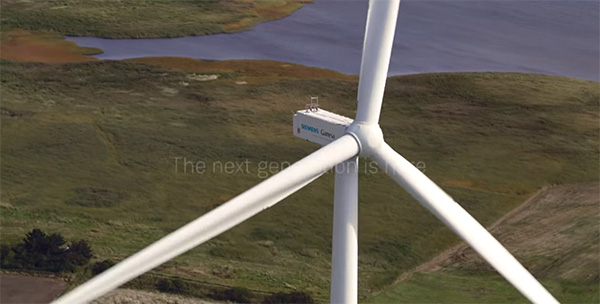
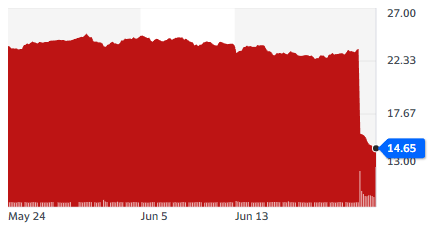
Despite the wind being free, collecting it appears to cost a fortune. Siemens Energy lost a third of its stock price on Friday. Just like that, seven billion dollars in market value disappeared.
Only a month ago they were expecting to break even, as the Wall Street Journal reports, the executives appear to have been blindsided by the rapidly escalating maintenance costs. The problem is so bad, and perhaps fundamental, that shareholders in other turbine manufacturers are selling out. Vestas Wind fell 7% Friday.
The promise was that wind turbines would keep getting cheaper as they got bigger and better. Instead, issues are appearing now even in new installations, and people are starting to wonder if they’ve made the turbines too big too fast. The bearings and blades are wearing out, and the costs to fix them are crippling.
Carol Ryan, Wall Street Journal
Shares in Siemens Energy plunged by a third after it said turbine components are degrading faster than expected
The news isn’t just a blow for the company’s shareholders, but for all investors and policy makers betting on the rapid rollout of renewable power.
The creaky components, which affect 15% to 30% of the installed onshore fleet, will be expensive to fix. Management thinks the cost could run upward of €1 billion, equivalent to $1.09 billion, effectively wiping out more than a third of the profit the company is expected to make doing maintenance on wind turbines it has already installed, according to Bernstein analyst Nicholas Green.
These are not words CEO’s ever want to use: ” it’s much worse than even what I have thought possible”:
Michelle Fitzpatrick, Barrons
In a call with reporters, Siemens Gamesa CEO Jochen Eickholt said “the quality problems go well beyond what had been known hitherto”.
“The result of the current review will be much worse than even what I would have thought possible,” he added.
In the call with reporters, Siemens Energy CEO Christian Bruch called the developments “bitter” and “a huge setback”.
The company has seen just “a handful of failures” across a fleet of several thousand turbines, he said, but it now had to assess “what to expect over the next 20 years” and which preventative measures to take.
To put it mildly – It’s either the rotor, the bearings “or the design” — could it be worse? It could — Siemens has already built 132 GW of wind plants — mostly onshore — and these new unforeseen problems may affect as many as 15 to 30% of their turbines. The maintenance costs to meet the warrantees they have already made are substantial. On top of that Siemens has “an order backlog of 34 billion euros”. This could be a very big hole…
By Nina Chestney and Christoph Steitz, Reuters
On Friday, Siemens Gamesa said that while rotor blades and bearings were partly to blame for the turbine problems, it could not be ruled out that design issues also played a role. It said the problems could affect as many as 15-30% of its turbine fleet.
The company said quality problems “go beyond what we were previously aware of, and they are directly linked to selected components and a few, but important, suppliers”.
It’s a perfect storm of rising supply costs and unexpected maintenance costs:
EnergyVoice
The company was already being hit with issues such as the rising costs of steel and other key raw materials when the news of its wind turbine failures went public.
Chief executive, Christian Bruch has told reporters “Even though it should be clear to everyone, I would like to emphasise again how bitter this is for all of us”.
h/t to J.J and NetZeroWatch
9.8 out of 10 based on 135 ratings
8 out of 10 based on 21 ratings
8.8 out of 10 based on 22 ratings
By Jo Nova
 … Sweden has thrown away the sacred renewables talisman and opened the escape valve from the Temple of WindySolar-Inc. They’ve done the obvious thing anyone who was worried about CO2 would have done in 1992 — aimed for nuclear.
They have switched their 100% “renewables” target by 2045 to a 100% fossil-free target. It’s still a pagan antipathy of the sixth element of the periodic table. But at least it’s a more pragmatic version.
Sweden topped the EU list for renewables share of energy in the last tally — albeit with mostly biomass and hydropower. It was a star of the renewables set — number 1 on the Climate Council list of the “11 countries leading the way“. Yet here they are effectively giving up on the unreliable generators. Surely this must hurt?
The team at NetZeroWatch applaud the Swedish shift, and suggest the UK follow.
Florence Jones, Power Technology
 Sweden’s parliament adopted a change to its energy targets on Tuesday, which will see it become 100% fossil fuel-free by 2045. Sweden’s parliament adopted a change to its energy targets on Tuesday, which will see it become 100% fossil fuel-free by 2045.
The change means that nuclear generation can count towards the government’s energy targets. Sweden’s Government voted to phase-out nuclear power 40 years ago, but in June 2010 parliament voted to repeal the policy. The government elected last year seeks to promote nuclear power.
Reuters:
Finance Minister Elisabeth Svantesson said in parliament. “We need more electricity production, we need clean electricity and we need a stable energy system.” State-owned utility Vattenfall is looking at building at least two small modular reactors and at extending the life of the country’s existing reactors.
It’s not such a big shift for Sweden. Thirty years ago their electricity was half hydro and half nuclear, and this is just a return to that after the intrusion of some wind and bioenergy.
This new target is just for fossil free electricity, not total “fossil free” energy use. Sweden still gets about 30% of all its energy from coal, oil and gas, and that is not about to change.
The new moderate right Swedish government was elected last September and one of the first things it did was cut EV subsidies “with immediate effect”.
As Euractiv notes, the Swedish government has also cut requirements for carbon neutral fuels in cars and also stood up for countries wanting to keep their coal plants on standby.
The coalition plans to cut the bio-fuel mix in petrol and diesel, leading to bigger CO2 emissions, a move that could mean Sweden missing 2030 emissions goals.
Proposals by Sweden to allow countries to prolong subsidies for standby coal power plants have also been met concern in the EU, while Stockholm also wanted Brussels to water-down a landmark law to restore deteriorating natural habitats.
To all intents and purposes, this is what a government would do if it didn’t believe the climate dogma but didn’t want to rock the global boat.
Swedish Flag image: wikipedia
9.9 out of 10 based on 99 ratings
9 out of 10 based on 19 ratings
|
JoNova A science presenter, writer, speaker & former TV host; author of The Skeptic's Handbook (over 200,000 copies distributed & available in 15 languages).

Jo appreciates your support to help her keep doing what she does. This blog is funded by donations. Thanks!


 Follow Jo's Tweets
 To report "lost" comments or defamatory and offensive remarks, email the moderators at: support.jonova AT proton.me
Statistics
The nerds have the numbers on precious metals investments on the ASX
|








Recent Comments