|
|
||||
Submissions close today!It’s better to say something short than nothing at all. Let it be known that we have grave concerns, and far too little time to debate and discuss such far reaching legislation. Please read submissions posted below and add your own here too. Thank you! — Jo Upload your submission here (button on the right hand side) Committee Secretariat contact: Committee Secretary Public submission regarding: Communications Legislation Amendment (Combating Misinformation and Disinformation) Bill 2024. _____________________
Misinformation is easy to correct when you own a billion dollar news agency, most academics, institutions, expert committees and 25% of the economy. The really hard thing, even with all that power and money is to defend an absurd lie and stop people pointing it out, which is surely the main purpose of the Misinformation Bill amendments. The government can already correct any misinformation that really matters, so these amendments curtail our freedom of speech for no benefit at all. Guilty until proven innocent?The amendments turn free speech on its head — instead of having the implicit right to criticize the government, everyone now needs to prove to some judge that their views are “reasonably” satire, or reasonable dissemination for an “academic, scientific or religious” purpose, and that their “motive” is honest and their behaviour is “authentic”. When it comes to reasonableness in a democracy the highest court should be the court of public opinion, but how can the people decide if they are not allowed to hear it? How is it even a democracy still if the government is allowed to take our money to force feed us the governments view on the ABC and in every captured university (dependent on government funds), but the people cannot even reply through sheer unfunded creative wit? This legislation puts a very unfree cloud over all groups, forums, blogs, and social media.The fines (and all legal fees today) are so obscenely, disproportionately harmful to Australians that few will risk going to court, instead the platforms will be preemptively second guessing what a judge might say is reasonable, and people with serious social media accounts will be second guessing the second-guesses of their platform controllers in fear that they might be thrown off, and lose years of work if they guess wrongly. Worse, the big platforms, supposedly so “independent” will become unaccountable but de facto arms of the government. The platforms will know if they don’t perform as expected and favorably to the incumbent masters, that the rules will get more onerous, the fines bigger. And thus and verily will the unholy alliance of Big-Tech and Big-Government will become Big-Brother in your conversations, and Big Bankrupter in your nightmares. The government claim they are not censoring anyone, but it’s just done at arms length with “implausible” deniability. Obviously the laws will censor all of us who are not already controlled by ACMA or the government through a public salary, a grant, or a Code of Practice written into the the Australian Broadcasting Corporation Act. Who silences the government misinformation, then?
What happens when the experts are wrong, but the people who are unconvinced can’t speak up because they might “harm… the efficacy of a preventative health measure”? These health measures may take a … lifetime… to even measure the efficacy. Does the government get a free pass for 40 years? It was estimated dietary trans fats (found in margarine) were killing 82,000 people a year in the US. (Danaei et al 2009). Should we have fined all the people who talked about this, and perhaps delayed things, and killed a half a million more? Someone speaking against hydrogenated margarine could have been deemed to be spreading “misinformation causing harm to public health in Australia”. So 20 years later, they turn out to be right — will the government compensate the families of the dead who might have chosen a different sandwich spread had they heard another opinion and been able to make up their own mind? Will Facebook and Twitter need to block the accounts of experts who were wrong? Or, are there two kinds of citizens in Australia — one sort that work for the government, who can give their opinions and get things wrong without losing their right to speak, and the Untermenschen, who cannot speak, even if they are right? Confidence has to be earned, not orderedApparently the citizens of Australia are not allowed to say anything that might harm the confidence in the banking system or the financial markets. But if our banking system is so fragile, or our currency so fake, that it needs a law to force people to “feel confident” then we are in a trouble already. Nothing damages confidence like making a law to silence critics. As adults, we filter misinformation our whole lives, it’s our jobWe are all adults in this room, and we have lived our whole lives filtering out advertising spin, ignoring political lies, and reading books telling us we can stops storms if we just ride a bike. Since the stone-age we’ve spent our lives climbing from one misinformation-swamp to another, but as adults, it’s our job to figure it out. Free will and all. How dare you treat us like children. And even the children about to enter the room have to learn how to deal with misinformation. How exactly can we teach them, if the government serves up one permitted line to protect us from accidentally hearing something “wrong”? It’s not just that this misinformation bill is egregiously wrong, it’s that we shouldn’t have one at all in the first place. REFERENCES Danaei et al (2009) The preventable causes of death in the United States: comparative risk assessment of dietary, lifestyle, and metabolic risk factors, PLoS Med, . 2009 Apr 28;6(4):e1000058. doi: 10.1371/journal.pmed.1000058. Epub 2009 Apr 28. The Bill: Communications Legislation Amendment (Combatting Misinformation and Disinformation) Bill 2024 The 69 page proposed legislation PDF form and Word doc. Submissions close on the 30 September 2024. (General advice on how to make a submission). Submissions can be uploaded here (button on the right column) or emailed to the Committee Secretariat below.
September 30th, 2024 | Tags: Free Speech, Misinformation | Category: Australia, Global Warming |  Print This Post | | Print This Post | | By Jo Nova It’s grand final day in Australia, and awkwardly the State of Victoria risks a grid overload. A truckload of solar power will arrive at lunchtime that no one needs, and which has no place to go. The largest single generator in Australia now is rooftop solar and it’s virtually uncontrollable. The geniuses running the national grid have subsidized solar panels and made electricity unaffordable at the same time, thus driving more householders into the arms of the solar industry. So they’ve created an artificial market bubble — as all good communists do. We now have a 20 gigawatt capacity generator that mostly can’t be turned off, except by clouds or possibly Chinese cyberwarfare. And where autumn and spring used to be the easy seasons, now Sunny spring days are diabolical too — hardly anyone needs their air conditioner or their heater at lunchtime, but solar watts are pouring in. This was the situation yesterday in Victoria: Again, the poor sods who built solar industrial parks (marked in red) have to curtail their production massively from 8am to 5pm. The red curve is supposed to look like the yellow curve. The missing red peak is wasted solar production. As the yellow uncontrollable peak rises towards the black line (the total demand), the whole grid has a problem — more reliable cheap generators have to shut down to prevent the toxic excess electricity building up. Without the reliable generators, with their 500 ton turbines spinning at 3,000 revolutions per minute, (or 3,600 in the USA) the grid loses frequency stability, and spinning inertia, and the ability to cope when a cloud rolls over. The problem of excess solar at lunch time is also called The Duck Curve and has been known for years. It’s not like this snuck up and surprised anyone, yet here we are — courting disaster. The ABC reported on this, but can’t bring itself to call this what is is — a “Solar Glut” dumped on the grid. Instead rooftop solar is a “juggernaut” and the grid faces a “low demand warning”, as if you personally are the problem, for not using enough electrons. Don’t blame the artificial pointless bubble of solar panels. Rooftop solar ‘juggernaut’ risks grid overload as AEMO issues first-ever low-demand warningby Daniel Mercer, ABC Rooftop solar output has reached such enormous levels that authorities have begun issuing warnings about their ability to keep the electricity system from being overloaded at times. In an extraordinary first this week, the body that runs Australia’s biggest energy market said the supply of solar power in Victoria threatened to overwhelm demand for electricity from the grid amid mild, sunny conditions. It said Friday’s oversupply of solar was so acute that demand for power from the grid would fall below a threshold critical for keeping the electricity system on an even keel. Even the AEMO (the Australian Energy Market Operator) calls it a minimum system load notice – not a solar surge, or a renewable overload. And despite the toxic excess of solar panels, and that we’ve known this day would come, in true Soviet fashion, we’re still installing as many as we can (see below). The trainwreck continues.  The relentless rise of solar PV in Australia. That would stop dead in its tracks if householders had to pay fair costs for the frequency stability, the back up power, and the storage. The solution, according to government experts, is not to have a real market and accurate prices, it’s to give more powers to some bureaucrats so they can order battery owners to discharge before lunch and be ready to soak up the dangerous excess at midday. The battery owners don’t like that, but like an anaconda, the government gradually tightens its grip until the free market is dead. The other “solution” is to add controllers to home solar panels so the government can switch them off (which is starting to happen in South Australia and Western Australia). Solar panels owners don’t like that either, but they were sold rainbows and fairy cakes that no one could deliver. The communist quislings complain that the market is failing us and needs more governance. But the truth is, the overlords destroyed the free market long ago. The people want reliable electricity, and if they were allowed to choose reliable power over renewable energy, the problem would solve itself. Meanwhile, grid managers surely pray for cloudy days. Soon, some bright spark is going to suggest cloud seeding for grid stability. UPDATE: The grid demand fell to 1817MW in Victoria, and survived but prices spiked to minus $367 today during the low minimum solar belly of the duck.
September 28th, 2024 | Tags: AEMO, Duck Curve, Solar Energy (PV) | Category: Global Warming | Print This Post | | 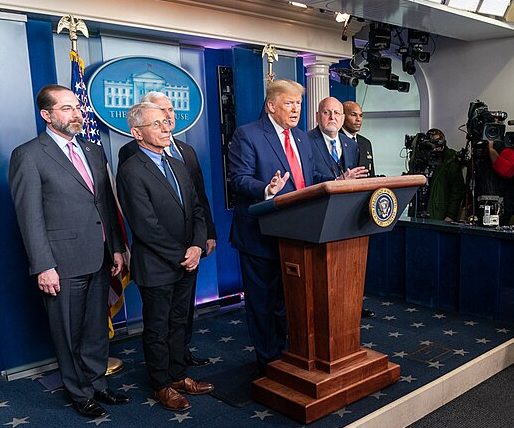 Robert Redfield stands to the right of Donald Trump on Feb 29th 2020 for The Coronavirus Taskforce. By Jo NovaThe rift in the political heliosphere continues to tearThe phase change is upon us. The most unlikely people are suddenly fans of Donald Trump and talking about cleaning up corruption. From the core command center of the US Pandemic Bureaucracy, the Former CDC director, Robert Redfield, whom Robert F Kennedy Jnr mercilessly criticized, has come out endorsing President Trump, and admitting Kennedy was right all along. Redfield was director of the CDC from 2018 – 2021, and now says that the three behemoth government health agencies — the FDA, the NIH and the CDC, have been captured by industry and the federal government must fix this problem. Furthermore, he says Trump “has chosen exactly the only person who can do this, Robert F Kennedy, Jnr.” Redfield writes in Newsweek “Donald Trump Has a Plan to Make America’s Children Healthy Again. It’s a Good One.”Across a century-plus of cozy courtship, the federal regulators have nearly married the regulated, especially in health care. Today, private industry uses its political influence to control decision-making at regulatory agencies, law enforcement entities, and legislatures. Kennedy is right: All three of the principal health agencies suffer from agency capture. A large portion of the FDA‘s budget is provided by pharmaceutical companies. NIH is cozy with biomedical and pharmaceutical companies and its scientists are allowed to collect royalties on drugs NIH licenses to pharma. And as the former director of the Centers for Disease Control and Prevention (CDC), I know the agency can be influenced by special interest groups. But it doesn’t stop in the health agencies: the U.S. Department of Agriculture is a captive of industry, too. Created to help the family farmer and to ensure a wholesome food supply, today the agency often favors large corporations over the interests of small farmers and the public’s health. To cure our children, we must reevaluate our food choices and the underlying practices of the agricultural sector. We must prioritize wholesome and nutritious food. If we do not discover the depth of our corporate capture problem and fix it, we cannot truly address chronic disease in this country. Redfield says nothing about vaccines specifically, but if the agencies are captured, and Kennedy is right about so many things, the stinking mess is sitting there on the table, unmentioned. And the question of course is, where was Robert Redfield when the nation needed him?Has he seen the light, or is he jumping from a sinking ship, and throwing himself a life-raft? Kennedy was shocked:
It’s hard to believe Redfield would be doing this if he thought Trump would lose. Redfield had years to speak up about the problems at the CDC and other agencies. He had years to improve childhood nutrition or to explain the risks with a rushed roll out of vaccines and he did nothing. But his endorsement surely adds a major dose of credibility to Kennedy’s claims, and thus to Trump. It’s hard to call Kennedy a conspiracy theorist when the head of the CDC says he was right. There are a lot of left-leaning women who are very concerned about problems with food additives and children’s health. Some of these same women were worried about vaccines even before Covid arrived. Kennedy is speaking their language, and the Democrat party establishment has nothing at all for them. The mood is shifting.  Gage Skidmore from Surprise, AZ, United States of America
September 27th, 2024 | Tags: CDC, Corruption (Medicine), Health, R.F.Kennedy Jnr, Trump (Donald) | Category: Health, Politics | Print This Post | |
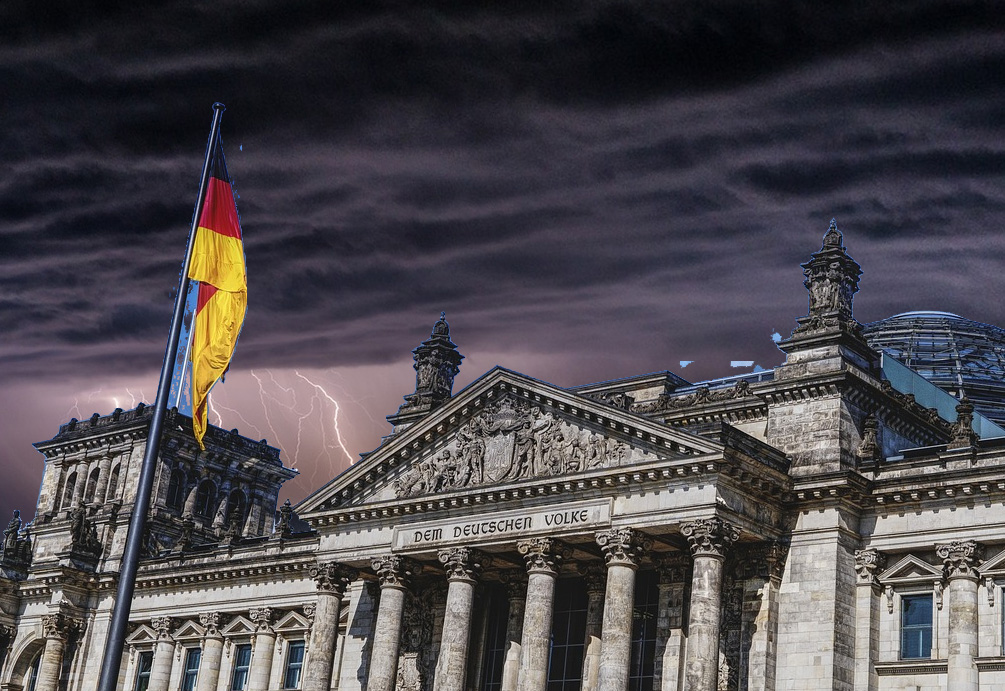
Jo Nova The Greens have become the “punching bag” of the Left and the RightThings just keep getting worse for the Greens in Germany. After two terrible performances in recent state elections the Party “crashed out of the state parliament” in the Brandenburg region of Germany (which surrounds Berlin). Results were so awful, the two current leaders of the German Greens have jointly stepped down. The Greens won a mere 4% of the vote in the region, not even reaching the minimum 5% required to win a parliamentary seat in the State election. About 70% of their voter base had abandoned them in the last five years. In Thuringia, the entire traffic light ruling coalition of three parties barely amassed 10% of the vote collectively. The right-wing AfD (Alternative for Germany) party “keeps rising despite efforts to stop the party” says Nette Nöstlinger at Politico, slightly baffled. The establishment used the nastiest names they could think of, and it didn’t work: The AfD keeps rising despite efforts to stop the partyGermany’s mainstream leaders have made a concerted effort to stop the rise of the AfD by warning voters of the party’s growing extremism, with some leaders even calling it a Nazi party. We’ve heard this before: State-level domestic intelligence authorities have classified the local branches of the party in both Saxony and Thuringia as extremist organizations aiming to undermine German democracy. The nasty names are backfiring, because no one is listening anymore: That points to a core problem that won’t be easy for centrist parties to grapple with — a growing mistrust of the centrists and the country’s institutions that has fomented anti-establishment fervor across a large swath of the country. In other words, even as many centrist leaders and institutions in Germany warn of the AfD’s extremism, many voters have simply stopped listening. In fact, the approach may be backfiring by alienating AfD voters. When the TV commentators called the AfD “extremist” the leader in Thuringia said “Please stop stigmatizing me”. “We are the number one people’s party in Thuringia. You don’t want to classify one-third of Thuringian voters as right-wing extremists, do you?” But of course, the TV commentariat probably did want to do exactly that… Bullying is brittle. When it fails, it crumbles into anti-matter, because there was nothing but nastiness to fall back on.
In the recent election campaigns, it [The Greens] often appeared to be the punchbag for parties across the spectrum. Accusations were rife that the party was trying to “dictate” the lives of ordinary Germans – from which type of heating system to use, to which car to drive – with the BSW and AfD going so far as to compare the Greens to the Communist regime of the former German Democratic Republic. There is hope. Young voters are abandoning the party faster than any other age bracket: The party has also lost a larger proportion of its younger voters at recent elections than any other party. In Sunday’s Brandenburg poll, for instance, it saw its support in the 16-to-24 age bracket drop by 24 percentage points, a bigger fall than in any other age range. — Eugyppius says — Something strange and unexpected is happening to the Greens — “Everyone hates them”.The Crisis of the Greens and the Future of the Left I have been thinking a lot about the Greens since their drubbing in the recent German elections. Something strange and unexpected is happening to them – something that even two years ago I wouldn’t have predicted. They are bleeding support; they are on the defensive and suddenly everybody hates them. In East Germany you could even say that they are in outright collapse. The party of the future, the party of the youth, the party at the cutting edge of progressivism, is now withering on the vine. And I suspect that this is not just happening in Germany. It may be happening here faster than it is in other countries, but the Greens are an international phenomenon, and Green politics are in trouble in many places beyond the Federal Republic. (Paywalled) Votes for the Greens have been stolen from both sidesThe collapse in popularity is about the climate, the heat-pumps, the cars, the energy prices — but it’s also about immigration and the war. A new leftist force has appeared from nowhere in the last few months, run by a former communist, but wanting to curb immigration: In some ways, the biggest winner of the night was the populist-left Alliance Sahra Wagenknecht (BSW), which is led by a former member of East Germany’s communist party. The BSW finished third in both states, a notable result for a party that only formed several months ago. The party, which merges traditional right-wing stances on immigration and other social issues, has repeatedly called for an end to German military aid for Ukraine and negotiations with Putin — a view for which there is much sympathy in Germany’s formerly communist East. — Politico It’s part of the Great Realignment of politics. The new force on the left attacks the Greens for being arrogant and out of touch with the workers: Is Germany’s rising superstar so far left she’s far right?James Angelos, Politico, August 26th, 2024 Sahra Wagenknecht’s brand of “left conservatism” is upending German politics ahead of critical elections in the east. Listening to Sahra Wagenknecht, Germany’s hard-left icon, you could be forgiven for coming away with the impression that the greatest threat to democracy is “lifestyle leftists” nursing lattes in reusable cups while shopping for organic kale at a Berlin farmers’ market. Such well-off, eco-friendly urban bohemians hold what they deem to be “morally impeccable” views about everything from Ukraine to climate change, she says, and then impose those beliefs over regular people with draconian zeal. Sahra Wagenknecht’s brand of “left conservatism” is very tailored to East Germany, but some of it will translate widely. Uncontrolled immigration is a hot button everywhere. She attacks the influx of asylum seekers as a threat to the welfare state, which, she says, requires a “certain degree of homogenity to function”. She attacks the gender bender transformations as something that benefits the big pharmaceutical companies. All of this will resonate across the political divide. At one point last year, the leader of the AfD in Thuringia was so impressed with her, he invited her to join the party in a speech. The pure environmental Greens are a luxury bubble that no one can afford anymore. Those days are over.
h/t Photos adapted from Image by Image by PayPal.me/FelixMittermeier from Pixabay and Presentsquare Presentsquare from Pixabay
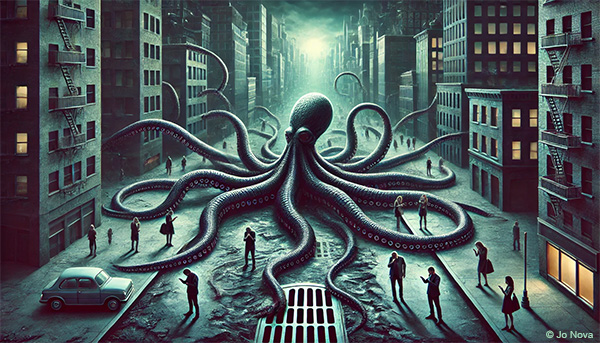 The Ministry of Truth will control your every online conversation By Jo Nova The Censors are always the bad guysThe only way to fix misinformation is with better information. Dear Australians, we only have until Monday to lodge a submission against the proposed amended Misinformation bill. It’s a bill so bad warnings are coming from the far side of the worldThe Cato Institute warns that if Tech companies take the simple route and comply with the Australian proposal Americans using mostly American companies may be effectively subject to misinformation rules set by foreign governments (and that may be the point, eh?) The great leftist global machine gets “help” with every country conquered by censorship glue. Why do the guys with galactic megaphones need to shut you up?Suppose misinformation was harming Australians, what stops the government giving us the correct information? They have the billion-dollar ABC, the billion-dollar CSIRO, the entire tamed academic sector, every school in Australia (they’re all funded and controlled by the government) — and yet somehow against this, an unfunded mum or dad writing on Facebook or a blog might harm trust in government institutions and therefore must be shut down, before any harm even occurs? Think about what this says about the Australian ABC? It must be pretty useless if it can’t save Australians from verified lies? Things could only be this absurd if it doesn’t have any truths to refute “the lies”, or it doesn’t have an audience because it’s an odious propaganda machine no one wants to watch. Or both. The Labor government claims that they won’t be censoring content, which is a lie, the media “platforms” will be forced to do it for them. If the platforms don’t comply, the government will send men with guns to their door to take away 5% of their global income. Even if the fine is never issued, the instant this law comes into effect, the threat of being savagely fined will mean platforms will be censoring Australians. How would we keep comments open on this blog? Ask everyone to write satirically? Ban anything that may be contributing to harm that might happen, maybeThe legislative bomb is a multifunctional octopus. It pretends to prevent “serious harm” but the proposed legislation defines misinformation as anything “reasonably likely to cause or contribute to serious harm”. So there are three legalistic qualifiers there for any sympathetic judge to crush dissent. What’s “reasonable” — depends on whether you can afford a QC. What’s “likely” to cause harm (but hasn’t actually done it) is anyone’s guess or the work of seers and soothsayers. And a “contribution” to serious harm might be just about anything. Did you retweet that scientific study showing that Antarctica isn’t warming? You’re harming the planet, the government energy policy, killing the spotted quoll, and damaging financial prospects for solar manufacturers. Stop that now! Thou shalt not harm the government, the economy, the bankers, or government health plansIt’s hard to believe they revealed their real intentions so obviously. This bill is not designed to protect the people, it’s designed to protect the government. What’s the worst kind of “serious harm” you can do to an Australian — harm the government, or their referendums. (The Labor Party are so hurt they lost the “Voice” vote last year.) It’s the first thing they list. Read their own words in Amendment 14:
The second thing on the list are words that harm “preventative health measures” which means vaccines — the biggest, worst and most expensive preventative measure the government ever forced on the people. The third priority is to outlaw any harmful words against their favourite protected mascot groups. So if you think women in one religion are being mistreated or harmed, you can’t say that. If you think children are being hurt by anyone in a protected mascot class, you’re not allowed to say that either. The laws will hurt those they claim to “help”. It’s revealing that the other protected class are the poor suffering bankers. You must not “harm public confidence” in banks or financial markets. Presumably pointing out that banks are technically insolvent might cause a bank run. Don’t mention that bankers make money from printing our national dollars from thin air, effectively profiting by loaning money they don’t have, which would be called counterfeiting if anyone else did it. Shh! Lastly, if you think someone is doing criminal activity don’t say so, because it might have “severe consequences for an individual”. Is that what the Labor Party meant to say — let’s protect criminals? Who decides “the truth”?Apparently it’s not God, it’s ACMA — The Australian Communications and Media Authority. Apparently, it’s the team with the most money. Only a billionaire, or a government, could afford to set up a “third party fact-checker”. The number of people up in arms about these rules grows by the day: Nick Cater, Phillip Altman. Roger Pielke Jnr. Caldron Pool. Australian Citizens Party and The Cato Institute. Please copy your submission below to inspire others. Phillip Altman has a list of Senators emails to cut and paste. REFERENCES:The Bill: Communications Legislation Amendment (Combatting Misinformation and Disinformation) Bill 2024 The 69 page proposed legislation PDF form and Word doc. Submissions close on the 30 September 2024. (General advice on how to make a submission). Submissions can be uploaded here (button on the right column) or emailed to the Committee Secretariat below. Committee Secretariat contact:Committee Secretary h/t to Andrew M, David Maddison, Stephen Neil, Nick Cater
September 25th, 2024 | Tags: Free Speech | Category: Big-Government, Free Speech, Global Warming | Print This Post | |
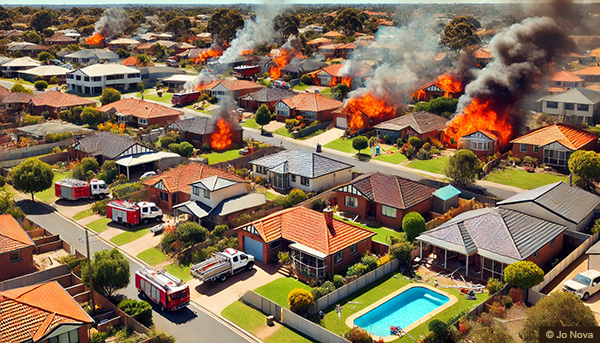 Battery bombs in the suburbs? By Jo Nova You think exploding pagers was a wicked trick….Hypothetically, suppose you were distracted while you tried to change tropospheric jet streams, and accidentally gave away your national manufacturing to a foreign adversary. Next thing you know, you’re buying the batteries they make, and installing them in essential grid infrastructure and thousands of homes. You’re patting yourself on the back for getting a cheap deal (never mind the slaves) and it all seems dandy until one sunny day, a leader who was cheesed off with a trade deal, quietly switched off the “overcharge protection” on all of them remotely. At that point, millions of solar panels are pumping excess electricity into batteries that have no safety cut off. A few houses start to go off like popcorn, and an hour later we’re all living at the Western Front. Brian Craighead – chief executive of Energy Renaissance, has come to warn us — it’s a hidden threat to national security. He says Australia has already installed 220,000 batteries that were made in potentially unfriendly places, and each home battery has roughly 7,500 times as much energy as a pager. As he remarks: “overcharge is when all hell breaks loose”. Now, he happens to sell secure battery management systems — so he has an interest in scaring the socks off Energy Ministers and hyping things up, but ask yourself this: would Anthony Albanese have seen this coming? To ask the question is to know we’re in trouble.
It would make a great movie, but a lousy life:
As Craighead says (so colorfully) — it’s like pink-batts on steroids. (A program here in Australia where a Big Government-made bubble in home insulation killed 3 poorly trained people and set fire to 200 homes.) In the end, after the bombs and the blackouts, the hit to the GDP and the death toll — it will all be deemed a dreadful accident, due to a fault in a minor part, and a hot day caused by climate change. Everyone will know what happened, but no one will want to risk the lobster-wine-coal-barley-beer-students deal, and besides the nation needs to order new fridges and solar panels. Unless, of course the home-battery-bombs were a decoy in a larger hostile plan, in which case we’ll have bigger things to worry about. Speaking of which: The US banned the Pentagon from buying batteries from six Chinese manufacturers earlier this year. September 24th, 2024 | Tags: Battery, Cybersecurity, Defence | Category: Big-Government, Global Warming | Print This Post | | And the Southern Hemisphere steals the sun …
By Jo Nova It takes a lot of money to get a Green saviour out of bed…
|
Jo appreciates your support to help her keep doing what she does. This blog is funded by donations. Thanks!
 Follow Jo's Tweets
   
 
|
|||
|
Copyright © 2026 JoNova - All Rights Reserved |
||||











.jpg)

Recent Comments