


The UK government’s strategy for tackling climate change received a major blow in May when Danish developer Ørsted announced that adverse economic developments had halted its 2.4 gigawatt (GW) Hornsea 4 wind farm in the North Sea.
|
|
||||
|
By Jo Nova The Class with No NameMartin Durkin’s latest video exposes the stealthy rise of a secret new ruling class in society. The most powerful class in society has been anonymously invisible, unnamed, and unnoticed, and this is key to its success. If the ruling class is named, the masses would be able to discuss the common motivations and interests of its members. While it has no name, it can disguise itself as separate neutral parties working to help “society”. “An entire social class that has steadily grown in size and power over the past century — whose very existence, whose jobs and income depend on depriving the rest of us of our money and freedom.” That this cloak of invisibility, it turns out, is exactly the way the Soviet bureaucrats worked. We know this, because, as Martin Durkin explains, it was described in 1957 by a man called Milovan Djilash in his book called The New Class. His book was smuggled out of Yugoslavia and printed in the US. It earnt him 15 years in jail — obviously he was speaking a dangerous truth. Djilash had become appalled by the socialist system he helped set up. He had come to realize it did not represent a victory of the working class, but of a new oppressive parasitic, bureaucratic class. And for this New Class, he said, it was vital that it must deny its own existence. This, he said, was the biggest deception it must accomplish. ” The source of power for this new class was public administration — its power to regulate and control everybody else. The new class, he said, finds itself unavoidably at war with everything which it does not administer or handle and must deliberately aspire to destroy or conquer it. “ Gorilla Science
The New Deal in the 1930s led to an explosion in alphabet agencies and regulators and planners. Understandably, the people inside the class are only human, and they like their jobs and their junkets. Thus they become “a bureaucratic solution in search of a problem to solve”, in order to grow their own power. Verily, the bureaucracy expands to fill as much of the economy as it possibly can (and then some). The New Class is at war with the free individual:The new class, by definition, is absolutely at war with laissez-faire free market capitalism. For the new class, lower taxes and less regulation are a direct challenge to its livelihood. The new class, though it does not say it outright, is implacably against the notion of private property. It ought to be up to the state, the state run by them, to determine how much of our money, our earnings, and savings we will be allowed to keep. And so for the new class, it’s axiomatic that capitalism is cruel, oppressive, inefficient, corrupt. Martin Durkin points out that the State calls itself “democratic” to soften up the awful truth of the authoritarian power. “Instead of calling something “state control” it’s called “democratic control”. This mirrors what Mike Benz talks about with the US State Department and its “Whole of society censorship framework”. When we protest and complain about a state institution we are “attacking democracy itself” which justifies calling for censorship. It is as if democracy means the Institutions of a democratic country, rather than the power of the voters. Part of the reason the New Class has stayed so well hidden is because the very academics and people who define the Classes of society are a part of the New Class, and there are no benefits to them in being exposed as a class that serves itself. And of course, in an unholy alliance, the bureaucrats align with the corporate predators who are folded into the New Class too. The Big Pharma Giants work with the regulators they capture in a symbiotic parasitic relationship. I shall continue to call this new class The Blob, for want of any better, more apt sounding name. But we must have a name, for we cannot fight a vaporous foe. Your mission, should you choose to accept it, is to help tell the world about the new ruling class. Everything they want to hide, we must expose. My draft definition: BLOB (The) — The parasitic unholy alliance of Big Corporations, Big Government, Big Bankers and their entire fan club and cheer squad of supporters. Dangerously, this also includes the watchdogs: the Spy Agencies and large parts of the media. The Blob takes money from citizens, pays other parts of the Blob (eg USAID, The UN, The BIS, The World Bank etc), pretends to “help” some token victim group or environmental cause, or even to monitor or audit The Blob, but the outcome benefits The Blob more than the victims. They line their own pockets and increase their own privileges. The Blob also includes a special category of “useful idiots” who naively assist them in looting Western Civilization. These people are paid in status or an illusory sense of purpose rather than money. They may not realize they are part of the self-serving Blob, and in the long run are not only harming the trees, birds and whales they say they want to save, but are harming their own health, wealth, national security, and worse, that of their children. From the joannenova.com.au site list of Abbreviations and Terms.
The pushback is coming. Any word that gives power to the individual will be subsumed, relabeled, distorted and misused by The Blob in an attempt to neutralize it. I’m sure I saw the ABC mention it recently…
July 19th, 2025 | Tags: Blob (The), Language, The Blob | Category: Academia, Big-Government, Global Warming, Property Rights |  Print This Post | | Print This Post | | By Jo Nova Twelve thousand years ago sea levels around Africa rose much faster than todayIt’s another totally solid, non-controversial paper that will never be mentioned in the media or by 50 shades of climate experts. In extraordinary detail, Vecchi et al look at 347 datapoints up and down the west coast of Africa and find that, like everywhere else, sea levels were a blockbuster 125m lower at the depths of the ice age 25,000 years ago. Then seas rose in rapid bursts as the vast Laurentide and Eurasian ice sheets melted, until they finally stopped rising 8,000 years ago. It must have been twelve thousand years of mayhem for corals, mangroves and beach-side cave-dwellers. In the northern Gulf of Guinea seas were recorded as rising at up to 25 mm per year about 12,000 years ago — eight times faster than anything we see today. And given the difficulty of knowing sea levels 15,000 years ago, there were probably many short episodes of faster shifts that got washed away, never to be recorded. All our panic about the current crisis of a pitiful 3mm-a-year rise allegedly “due to man-made CO2” pales to nothing compared to what Monster Nature does. This study and hundreds like it, are like a stake through the heart of the vampire. For if the children understood the seismic shifts of the past, they would know that they were being sold a lie that the world had a stable and perfect climate or that current beaches have some sacred right to exist in perpetuity. Obviously, as commenters* pointed out, the Torres Strait Islanders ought to have a cultural memory of massive inundation, reefs shifting and the beaches being washed away. Like everywhere else in the world, Australian sea levels have been falling for 7000 years. Thanks to Kenneth Richard at NoTricksZone who wrote that Africa’s Atlantic Coast Sea Levels Were Still 1 Meter Higher Than Today 2000 Years Ago.  Click to enlarge | Nature | NB: The authors must be left-handers and run their graphs right to left — so in graph C, the present is on the left. And if natural rises can be eight times faster than what we see today, then how do we know the current rise is not partially or wholly natural? All we have are climate simulations… Sea levels have fallen by 1 to 4 meters in last 5,000 yearsImagine the amount of work to collect all these data points from so many locations? There were some sharp falls in sea level in the last 2,000 years. Keep reading → 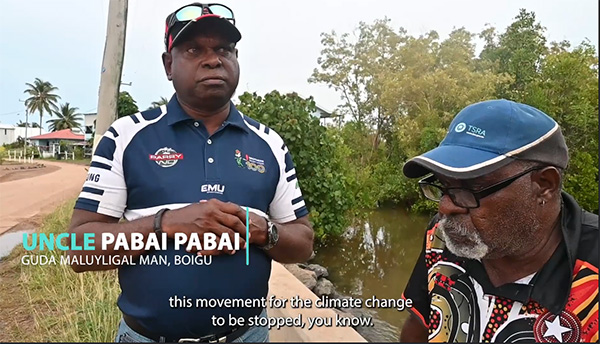 Uncle Pabai Pabai, Boigu, in their video from The Australian Climate Case By Jo Nova Two men from a Torres Strait Island spent four years trying to sue the Australian government for “its duty of care” to change the global weather. Both sides agreed climate change will be a disaster, so the science was never debated in court. Despite this, Justice Michael Andrew Wigney said he accepted “many of the factual allegations” upon which the case was based, even though the claims were never tested, no one spoke against them and they didn’t get a fair trial, or even any trial at all. Thus Justice Wigney issued his prophecies of biblical hellfire, no doubt raising anxiety levels of the Torres Strait islanders even further, but who cares about their mental health right? They are just the mascots used by The Blob: Shock result handed down in Torres Strait climate caseBy Jack Nivison, The Australian The Australian government has no duty of care over the people or the islands of the Torres Strait with regard to climate change, even though there is a “real risk” the land could disappear entirely, the Federal Court of Australia has found. I’ve accepted the scientific evidence … concerning the devastating impacts that human-induced climate change has had, and continues to have, on the Torres Strait Islands and on the traditional inhabitants … their culture and way of life,” Justice Wigney said. “Severe erosion, the salination of wetlands and previously arable land, the degradation of fragile ecosystems … has become more frequent and more severe in recent times,” he said. “There is a very real risk that the worst fears of the applicants will be realised.” The defendant*, The Australian Government — could hardly disagree with “the science”. It is spending hundreds-of-billions to protect us from the climate gorgons, after all, so it can hardly argue that climate science is skill-less, unfalsifiable and based on unverified junk simulations. So the whole legal show is mere pantomime theater, and in the end, the ABC and other junk media get to breathlessly tell the world that in a smashingly big climate case, even the Judge has found that climate change is real. Gnash! Gnash! Gnash!  Judge as Weather Prophet So the Judge is reduced to doing free advertising for The Blob. And perhaps that was the whole point of the case, since it was always ridiculous, in a democracy, that a judge should be the one to set national energy policy. The islanders have been shamelessly wound up by activists, the ABC and CSIRO lobbyists to serve their own purposes. They were set up to expect something they could never get, and thus their crushing disappointment was just the third act in a badly written play. The Guardian, with no hint of irony, or any sense of what a democracy is, asked How can governments be held to account on climate? It’s like voters are irrelevant, eh? But the other point about this case is the way the science debate gets sidestepped yet again — so the judge issues his judgment, but makes a lot of wholly unnecessary statements of climate assumptions that were not tested in his court. And not only do these become free advertising on prime time TV but they will be used in subsequent cases as if they mean something. “Quoted as fact” they may also influence policy and legislation, and help to cement the profoundly unscientific “consensus” and all the Blob institutions that feed off that. So the world just got more cluttered. Science shrank, and everyone, bar the Blob, got poorer. The Blob pretends to care about the world while it uses and abuses the mental health of the Islanders in a quest to increase their own power and income. And The Blob pretends to care about “science” even as it destroys the tenets of the Scientific Method. The antidote, as always, is to tell the world and pop that smug-bubble in public. Their case is being supported by the Grata Fund, an Australian “strategic litigation funder” and the Urgenda Foundation, a Dutch group that uses lawfare to “help” the renewables transition. Obviously if giant industrial renewables firms and bankers, or the Chinese government were donating to these groups (with the best of intentions) we probably would never know. It’s not like The ABC will ask them hard questions like that, is it? *Not the plaintiff in this case! REFERENCES
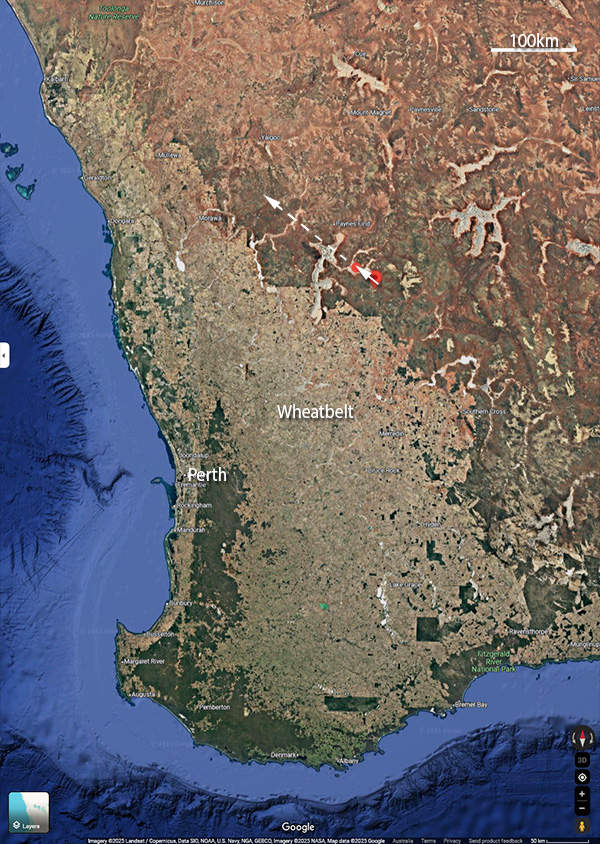
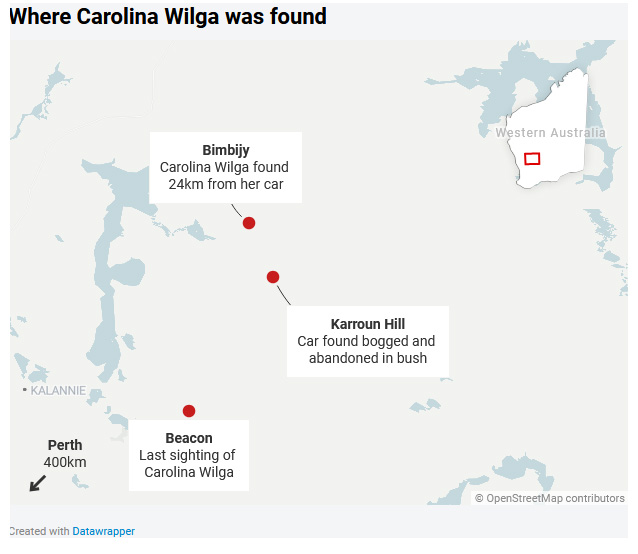
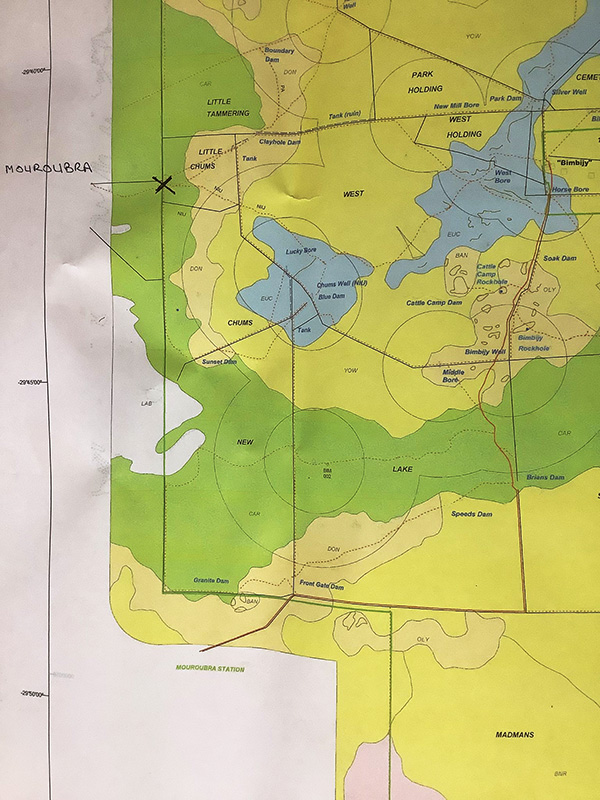
July 17th, 2025 | Tags: Lawfare | Category: Australia, Global Warming, Lawfare | Print This Post | | By Jo Nova The city kids don’t know the first thing about the skyDespite the media frenzy here, no one seems to have noticed that the lost tourist, Carolina Wilga, was walking for 11 days in the wrong direction. She said she “followed” the sun, and thought she was going west, but she was actually going north-west, away from help. See the map below to appreciate what a terrible mistake she was making (among a list). At this time of year, the sun is setting almost as far north as it ever sets. Somehow she was missing the entire Wheat Belt of Western Australia. Primitive hunter gatherers knew the cycles of the sun and the movement of stars we can’t even see. It’s the most ancient science and we seem to have lost it. Not just Ms Wilga, but all the commentators too. Neolithic Brits built Stonehenge 4,000 years ago to mark the solstice and modern phone bunnies with silicon chips have lost it. Heck, even Bogong moths can navigate by the stars.  Carolina Wilga, 26 The 26 year old German backpacker drove 35 km off the beaten track into no-mans land and had an incident where the car slid, and she hit her head and got bogged. After giving up on the car, she waited a day, then walked “west”. She drank water from puddles and bee-hives. At night, temperatures drop to around zero (32F). No surprisingly, she was convinced she would die. It would have been gruelling and very very scary. On the 12th day, somehow, through extraordinary luck, or a divine act, the one sole station owner for 50 kilometers happened to see her on a dirt track that the owner doesn’t travel on much. Tania Henley (the rescuer) called it a miracle, which I thought was the usual hype, until I saw the map. Out in the border-land surrounding the vast desert center of Australia there are thousands of empty square kilometers. The direction Carolina was headed in was almost doomed — running parallel to the northern edge of the wheat and barley fields in a largely uninhabited semi-arid zone. What the bland mass media map doesn’t show is where civilization is, and how she was headed in the wrong directionIn the satellite photo below we can see the wheat and barley farms to the south, where she had come from, and would have found safety and people. To the north and north-west is Bimbijy — which is one of the vast remote stations in Western Australia. (The red dots marking her start and end points are only approximate. The car was stuck in “Karroun Hill Reserve” which no one has ever heard of, but is 3,097 square kilometers in size. She apparently covered 24 kilometers on foot and was found west of Bimbijy, and her car was left 35km from “any established track”.) Never mind the brown snakes, the deadliest thing out there is the lack of water. Rainfall in this area is less than 300mm or 12 inches a year and all the lakes are salt-pans. Luckily June and July are the rainiest time of year. One 73 year old gold prospector went missing in the same area last December, and sadly, has still not been found. 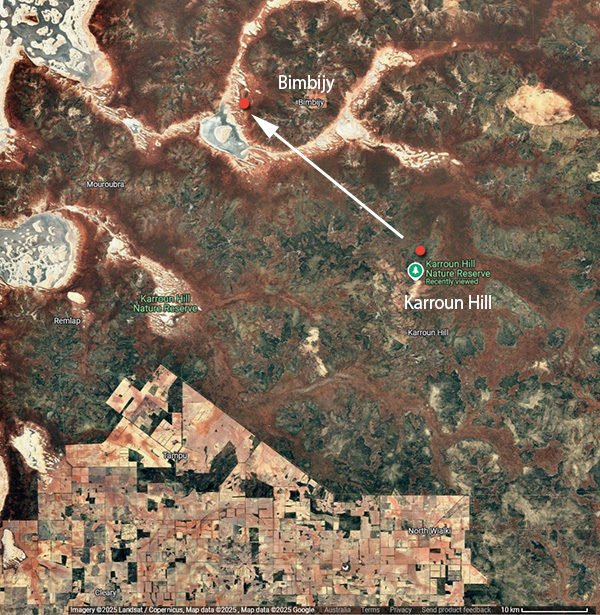 Headed NW to follow the Sun. Ponder that the one cleared pale square under the word “Bimbijy” above is the station homestead and airstrip. The only one out there. Tania Henley (the rescuer) said: “It was meant to be because no one goes up and down that road. “I don’t go to Beacon very often…” We can zoom out and see that by following the sun Carolina’s direction was one long miss. (Along the dotted white line). In midwinter at 29°S the sun is setting 23° north of west. Though obviously, she should have been going south west, not west in any case. (Don’t leave home without a paper map, eh?) Keep reading → July 16th, 2025 | Tags: Astronomy, Western Australia (WA), Wilderness | Category: Global Warming | Print This Post | |
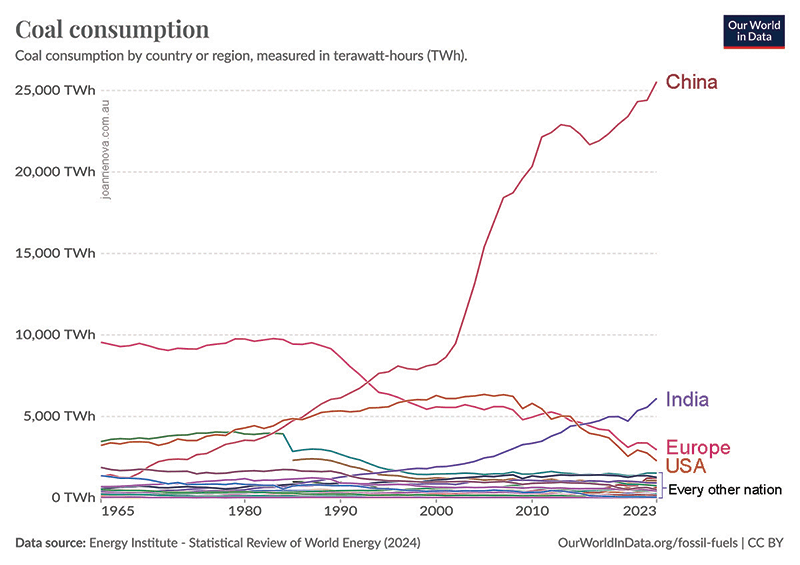
By Jo Nova Lets build an industry on a niche fashionista item where the main selling point is that it “makes the weather nicer”?No one, bar anyone, believes China gives a toss about reducing carbon dioxide emissions, not when China burns four times as much coal as the second largest coal burning nation on Earth, and they are increasing the rate they build new coal plants. China won’t be buying our sacred Green Steel to make their own cars and bridges.
Where is this imaginary market for Green Steel?The only “need” for Green Steel on earth is because it’s a fashion accessory at UN events, or because some people believe it can change the weather. There is no intrinsic benefit, it’s not shinier or stronger, it just has more social scoring points, or bragability if you go to inner-city upmarket arts parties. Technically, according to the experts, owning green steel will confer benefits like extending winter for a few more days a year (theoretically). I can’t see that catching on. This is a market that the bottom could fall out of any dayIn May, only 13% of UK Voters said Net Zero goals were more important than their cost of living. So 87% of the market is already not interested in buying Green Steel instead of normal steel. And that 13% “peak” is only maintained with bullying, censorship and non-stop propaganda by the legacy media. Imagine how fast that niche group would shrink if word spreads that Net Zero policies are killing birds and whales and hurting the poor? Or that thousands of scientists are skeptics — including men who walked on the moon and won Nobel Prizes (Vale Ivar Gievar!).
The only market for Green Steel in China is the one we make, sorry, we fake here at home, with government decrees, forced carbon markets, subsidies, and Soviet rules. In the EU there is a small premium paid for green steel, but they have a carbon market and targets. In the US where people are now more free to choose their favourite steel, the green steel market is “stagnant”. Devastatingly, Fastmarket reports that the differential paid for green steel was “$0” per short ton (per long ton too!). That’s how much people in the US are willing to pay voluntarily for green steel. Nothing. There may come a time soon, when it will be negative. Don’t give me that…
In a survey of car manufacturers, they were only ordering enough “fossil free” steel to cover 2% of the global car market by 2030. If Australia tries to make wind-solar-battery-power “Green Steel” five minutes later, China will start nuclear power green steel, and wipe out our marketIf the gormless West taxes and subsidizes the population into paying more for green steel, China will be only too happy to profit from selling niche fashionista pointless items to the West. If we delude ourselves that it is a market with “hundreds of thousands of jobs” — a moment later, China will process green steel with electric arcs powered by “low emission” nuclear plants. Our fantasia wind-powered-solar-biomass-battery made token-smelters will be out-competed in a minute. By 2030 China is aiming to be the worlds largest nuclear power. Think about that…
REFERENCESSource: coal consumption — OWID Photo by Jamie Street on Unsplash
By Jo Nova It’s so unfair, the wind is free, but who could have known we’d need metals, boats, cables, and magnets?Governments waved their magic wands to declare the renewable transition would “bling” into existence, but they didn’t bother doing the sums on whether we could mine the vast resources in time, and what would happen to the prices of everything, if every other stupid fashion-obsessed western nation tried to do the same thing at the same time. At the academic safe-space known as “The Conversion” Thomas York explains to baffled renewables fans why wind farm developers are mysteriously pulling out at the last minute. He doesn’t spell out the baby-nature of the economic reality, but we can read between the lines. The ship called The Infrastructure-Bill has arrived and it’s killing them: the price of steel, copper and aluminium has doubled and tripled; we can’t make the right boats fast enough to build the towers out at sea; everyone wants high-voltage cabling at the same time, and they all need the rare metals for the magnets, which are well, rare. Then, the delays in arranging all this mean the developers fall over their contract agreements timelines, so they start to lose subsidies. Ultimately developers have raised their prices to cover the true costs, but then the customers aren’t happy. As the University of Leicester researcher says so poignantly when faced with the brutal reality of the market: “it [wind power] is simply not profitable enough”. He even admits “renewable energy still cannot compete with oil and gas.” Sacre bleu! The UK government magic wand says it can generate 95% of energy from renewable sources by 2030. York, master of understatement, says the “target is now in jeopardy.” Lordy, but the skeptics were right all along…
By Thomas York, at The Conversion* Supply, meet demand: When everyone wants the same thing at the same time, prices rise Building a wind turbine requires significant amounts of steel, copper and aluminium, all of which doubled or tripled in price between 2020 and 2023. Turbine manufacturers have raised prices in an effort to recover recent losses… Impending national and international net zero targets also mean that developers globally are having to make earlier investments in transmission infrastructure. An exponential increase in demand for scarce high-voltage cabling has already led to high-profile cancellations of offshore wind farms in the US. … Rising demand for rare earth metals used to make magnets in turbine generators has also been snared by geopolitical issues. There are just not enough boats: Ørsted ceased work on its 2.2GW Ocean Wind development zone off the coast of New Jersey in 2023, citing a vessel delay in its decision to cancel the project. According to the advocacy group WindEurope, demand for vessels capable of installing foundations and turbines and laying cables will outstrip availability within the next five years. The gap between the two is forecast to skyrocket between 2028 and 2030…. Delays caused by these issues can result in a problem known as “contract erosion”. In their contracts, developers have a commissioning window within which turbines have to start generating. If they are not operational within this time, they lose their subsidies on a day-by-day basis. Ultimately, the market hath spoken: Rising costs mean that even one of the world’s biggest wind farms, Dogger Bank in the North Sea, will not be profitable for its developer, Equinor. As a prospect for generating financial returns, renewable energy still cannot compete with oil and gas. This is the key argument of economic geographer Brett Christophers in his recent book The Price is Wrong. Christophers argues that, if national governments continue to rely so heavily on private sector investment to build renewable energy, decarbonisation is unlikely to proceed as fast as it needs to. It is simply not profitable enough. If the government had got out of the way and let the market speak twenty years ago without hiding the truth under a bonanza-fog of subsidies, we wouldn’t have wasted twenty years and trillions of dollars to find out it was not going to work. _____________ *In 2019 The Conversation gave up conversing and banned skeptics. Thus, they became — The Conversion.
July 12th, 2025 | Tags: Renewable Energy, UK, Wind Power | Category: Global Warming, Renewable | Print This Post | | By Jo Nova Burn more oil and coal, save lives and never ever apologizeIt’s been a hot ten days in Europe and the Blob-Propaganda Machine is running full tilt. A rapid “analysis” invented a number of excess deaths faster than junk science has ever been done before. So teeth can be gnashed appropriately, never mind about peer-review, who needs that? Thus, extreme heat was said to have killed 2,305 people across 12 cities — 2,305! And with Coupled Voodoo Models we can “show” two thirds of those deaths were because of fossil fuels and “Climate ChangeTM“! This study, note, has not even been published, it can’t be using real data from the event “seven days prior” (June 23 to July 2, 2025) because that won’t be published for weeks or months. It’s all guesstimated from past deaths in other years. One *handy* thing about rapid analysis like this is that it’s also “too fast” to see if the excess deaths were followed by a lower death rebound, which often happens after heat-waves. A few hot days in a row generally take those who are about to die in the next six weeks anyway, so after the peak, comes the drop. It’s rather darkly known as harvesting future deaths. Good studies use at least a 21 day lag, but crass publicity-science-stunts don’t even wait 21 days to hit the news stands. Maybe they “guessed” that too in the assumptions? Who can tell? Maybe they’ll add it in and adjust the numbers later — after the media hype? The Grantham Institute at least has a PDF paper out for a UK heat wave they forecast would kill 570 people last month. (And at least that was called a “forecast” so everyone knew they were just guessing). Of course, if the sole purpose of junk-science-academia is to promote government tax and spending plans, then we wouldn’t want to do a careful analysis and find that 1,500 people weren’t really excess deaths we could blame on fossil fuel induced warming, or that by the same reasoning probably 15,000 Europeans were saved last winter. Shh! The complete sell out of university and legacy-media is there for all to see. All it takes is for one professor, or one journalist to do five minutes of research (or a read a blogger for free) and show what we all know — that if global warming kills anyone in summer, by the same reasoning it would save ten every winter. Around the world Global warming saves 166,000 lives a year. (Zhao et al). Where are the headlines for the people the Greens don’t care if they kill in winter each year?
New York Times Climate Change News Politico
Climate Change saves ten times as many lives every winterIt’s rare in medical science to have unequivocal research. But this is one of those moments. Studies of 74 million people show the same pattern everywhere; in terms of the climate nothing is more deadly to humans than winter. (See Gasparrini et al). For every summer heat wave death, at least 6, 10 or even 20 people die due to cold weather in winter. The largest study across 13 countries found cold deaths were twenty times more common than heat deaths. Look at the scary blue bars below, it’s moderate cold coming to get you!
In richer European cities, with gas stoves and coal fired power stations *only* ten times as many people will die of the cold. (Mazzelot et al) Even in warm sunny Brisbane, Australia, six times as many people die in mild cold weather as in the heat of summer. (Cheng et al). Remember this graph? The one on the left made it through peer-review and expanded deaths on the “warm” side. The graph on the right is the real proportion of cold deaths to warm ones. And the Lancet published the big 74 million deaths study in 2015. They knew. They knew! 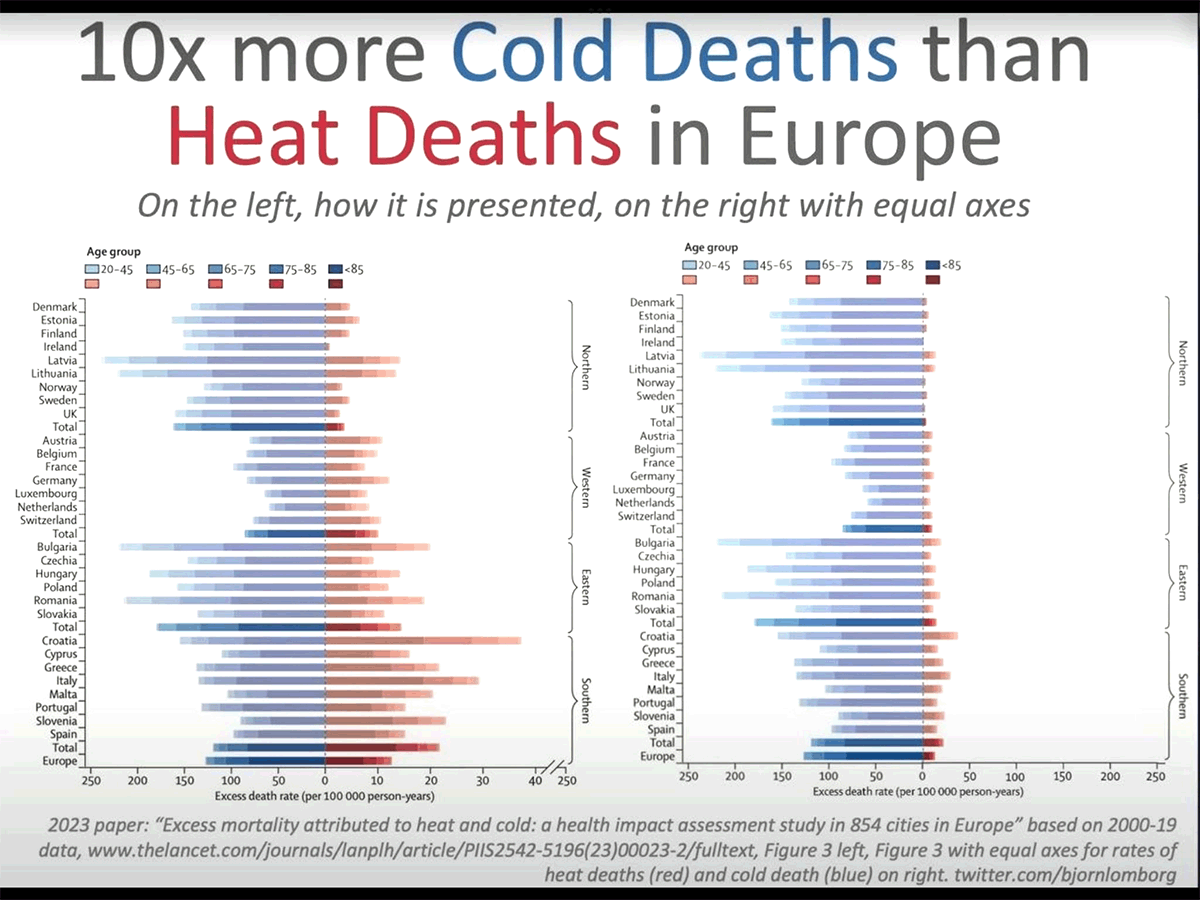 Thanks to Patrick Moore https://twitter.com/EcoSenseNow In reality, man-made climate change probably killed no one, but fossil fuels made life possible for 500 million people in Europe all year round. The icing on the cake of civilization is that airconditioners save 20,000 lives in USA each year (as long as you can afford to run them). As it got hotter in Spain last century, less people died. Thank air conditioning and electricity. Related posts
The benefits we can derive, – Ruairi
REFERENCESThe World Weather Attribution study (unpublished) … ? Grantham Institute: Konstantinoudis, G., Mistry, M., and Gasparrini. (2025). Real-time forecast of heat-related excess mortality during June 2025 heatwave. Cheng et al (2019) Impacts of heat, cold, and temperature variability on mortality in Australia, 2000–2009, Science of The Total Environment,Volume 651, Part 2, 15 February 2019, Pages 2558-2565, https://doi.org/10.1016/j.scitotenv.2018.10.186 Masselot et al (2023) Excess mortality attributed to heat and cold: a health impact assessment study in 854 cities in Europe, The Lancet, DOI:https://doi.org/10.1016/S2542-5196(23)00023-2 Gasparrini et al. (2015) Mortality risk attributable to high and low ambient temperature: a multicountry observational study. The Lancet, May 2015 DOI: 10.1016/S0140-6736(14)62114-0. Full PDF. Zhao, Qi et al. (2021) Global, regional, and national burden of mortality associated with non-optimal ambient temperatures from 2000 to 2019: a three-stage modelling study, The Lancet Planetary Health, Volume 5, Issue 7, e415 – e425, DOI:https://doi.org/10.1016/S2542-5196(21)00081-4
July 11th, 2025 | Tags: Health, Hyperbole, Junk Science, Spain, Temperature (Effect on Mortality) | Category: Global Warming, Health | Print This Post | | Really don’t know where Wednesday went. By Jo Nova Don’t panic, but the unleashed fossil spirits from The Ford 150 are about to plague us with volcanoesIf only you bought your oranges locally, instead of flying them in from California, the lava would have behaved. If ever you have doubts that we are merely 3 genes away* from being mammoth hunting tribes of prophets and bone pointing shamen, look no further than modern captive science. These nice geochemists haven’t even published a paper yet, but five minutes after giving a speech at a conference, it’s already click-bait headlines and advertising for The Blob. Not that the captive researchers seem to mind (more’s the pity). We are about to enter the doom loop where climate change melts glaciers which trigger volcanoes, which melts more glaciers. The press release even says “explosive time bombs”. Except, of course, this is really about the Great Ice Sheets melting from the last ice age, not about humans raising global temperatures by a thousandth of a degree. And we’ve known about this since 1992 when Sivaldason et al reported that a kilometer thick block of ice slowed down volcanic eruptions in Iceland during the depths of the ice cold climate. The new team have just shown this happened in Chile too.
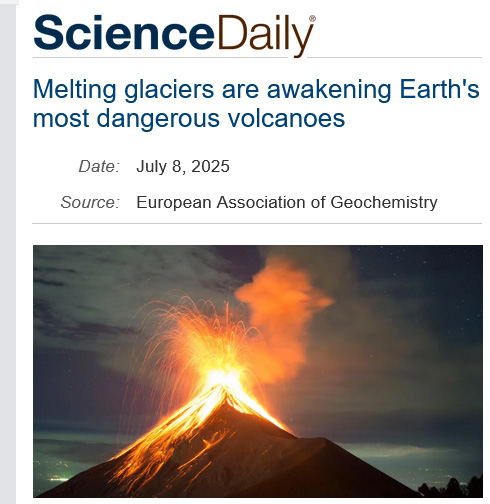
Melting glaciers are awakening Earth’s most dangerous volcanoesEuropean Association of Geochemistry Scientists have discovered that melting glaciers could unleash powerful volcanic eruptions by removing the weight that keeps magma trapped deep underground. Antarctica may hold hundreds of these explosive time bombs. Melting glaciers may be silently setting the stage for more explosive and frequent volcanic eruptions in the future, according to research on six volcanoes in the Chilean Andes.
The Guardian goes full Absurdium: “A barrage of explosions”After the Patagonian ice sheets melted 12,000 years ago, volcanoes increased two to six fold they say…. as if increasing atmospheric CO2 by 0.01% somehow compares to removing a block of ice that was 1.5 to 2 km thick and weighed 540 trillion metric tons: Melting glaciers and ice caps could unleash wave of volcanic eruptions, study saysThe melting of glaciers and ice caps by the climate crisis could unleash a barrage of explosive volcanic eruptions, a study suggests. “Previous research has shown volcanic activity increased globally by two to six times after the last ice age…” “A recent review by scientists found there had been relatively little study on how the climate crisis had been affecting volcanic activity. They said more research was “critically important” in order to be better prepared for the damage caused by volcanic eruptions to people and their livelihoods and for possible climate-volcano feedback loops that could amplify the climate crisis. For example, more extreme rainfall is also expected to increase violent explosive eruptions.” Should we toss darts at Voodoo dolls?The witchdoctors of modern science are one-variable thinkers, and every answer is “climate change”. We don’t even know how many volcanoes there are on Earth. Most volcanoes are underwater and a couple of years ago we found another 19,000 of them that the experts didn’t know about. Sometimes we only find new seamounts when we run into them in a nuclear sub, like the USS San Francisco did in 2005. We also don’t even know when underwater volcanoes erupt today, let alone whether they were more or less active in 21,000BC. It’s hard to believe, but we can see a volcano explode on Io, easier than we can see one in a deep sea trench. Eruptions under two kilometers of water can be somewhat muted. The feedback doom loops suggested here are vicarious guesses. Who knows — when the great ice sheets squashed down volcanoes on land, the magma might just have been squeezed out of undersea trenches instead. And underwater eruptions rewrite all the rules. Sudden heating of water might divert ocean currents, it might unleash nutrients that feed vast phytoplankton blooms which in turn emit benzene and toluene aerosols that rise up and increase cloud cover, cooling the world. *No disrespect intended. There probably weren’t many dumb mammoth hunters in the northern Tundra in an ice age.
|
Jo appreciates your support to help her keep doing what she does. This blog is funded by donations. Thanks!
 Follow Jo's Tweets
   
 
|
|||
|
Copyright © 2026 JoNova - All Rights Reserved |
||||








Recent Comments