The Malhotra-Dowd-Wolf-Shipman event about the Corruption of Medicine in Perth was a smashing success. The crowd of nearly 2,500 was on fire, the speakers were excellent and you can still watch it (and help cover some of the costs) by buying tickets to watch it online. Four hours of some of the best and brightest of humanity.
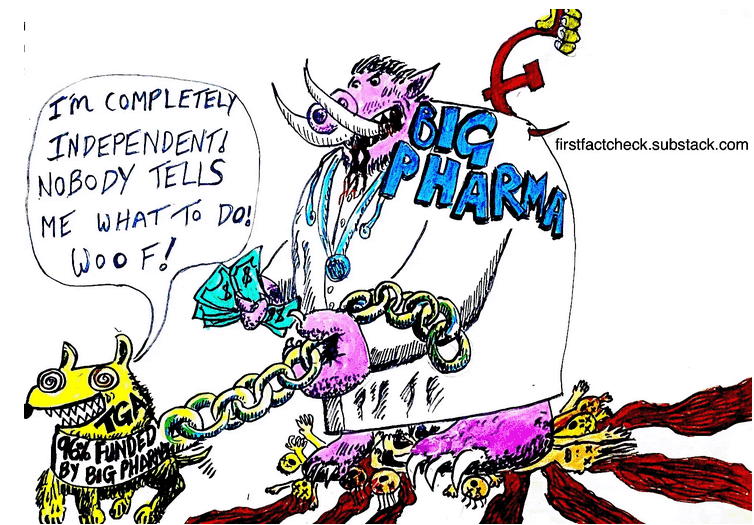
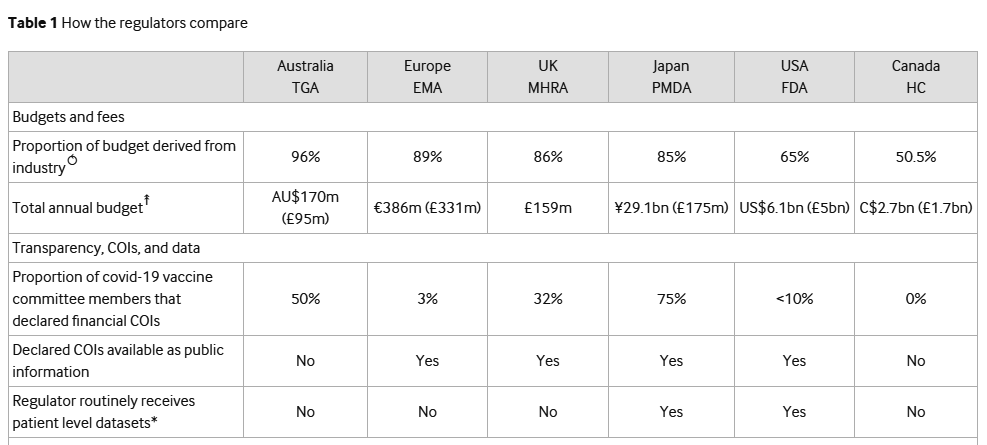
Fact-of-the-day (for me) was that the Australian TGA (drug approval agency) gets 96% of its budget from the industry it supposedly is a watchdog for. Hello? So when the TGA inexplicably banned the safe ivermectin and hydroxychloroquine options they were, it seems, just doing what any bought-and-paid corporate crony agency would, even if people died. Apparently the government agencies are not just a rubber stamp for profitable drugs, they are the iron mallet to crush the competition too.
While Australia won the prize for the agency with the Biggest Conflict of Interest, there’s little material difference in the EU, the US or the UK (or Canada). The drug industry funds 89% of the EMA budget in Europe and 86% of the UK-MHRA’s. The giant US FDA is “only” 65% industry funded. Glory be — is $800 million enough of a conflict of interest?
From the British Medical Journal (BMJ) and Australian investigator — Maryanne Demasi:
Over the past decades, regulatory agencies have seen large proportions of their budgets funded by the industry they are sworn to regulate, explains investigative journalist Maryanne Demasi.
Industry fees to the US Food and Drug Administration (FDA) have increased 30 fold – from around $29m in 1993 to $884m in 2016, while in Europe, industry fees now fund 89% of the European Medicines Agency (EMA), up from 20% in 1995.
In 2005, the UK House of Commons’ health committee evaluated the influence of the drug industry on health policy. But nearly two decades on, little has changed, and industry funding of drug regulators has become the international norm.
The BMJ asked six leading regulators, in Australia, Canada, Europe, Japan, the UK, and US, a series of questions about their funding, transparency in their decision making (and of data), and the rate at which new drugs are approved.
Of these, Australia had the highest proportion of budget from industry fees (96%) and in 2020-2021 approved more than nine of every 10 drug company applications.
Just how deep and how wide is that river of drug money…
Click to enlarge. (BMJ)
These agencies control what you are allowed to take into your own body. Hours after ivermectin was banned in Australia, a legal script from a qualified doctor was worthless at any pharmacy. Three adults with university training in medical science were suddenly unable to get what they wanted (money, work or medicine). The power of these unelected agencies reigns — where is the accountability? Nice racket you have there…
Sociologist Donald Light of Rowan University in New Jersey, US, who has spent decades studying drug regulation, says, “Like the FDA, the TGA was founded to be an independent institute. However, being largely funded by fees from the companies whose products it is charged to evaluate is a fundamental conflict of interest and a prime example of institutional corruption.”
“It’s the opposite of having a trustworthy organisation independently and rigorously assessing medicines. They’re not rigorous, they’re not independent, they are selective, and they withhold data. Doctors and patients must appreciate how deeply and extensively drug regulators can’t be trusted so long as they are captured by industry funding.”
It’s time to ask our elected members where they stand on corporate-regulatory-capture. For or against? But don’t just stop there, the media are culpable too — why aren’t they grilling the politicians, the TGA, the AMA? Do they get advertising money from BigPharma, or is it more that they lack the courage to speak the truth, or need to believe in a religious savior? Hail Mary for Big Government?
Meanwhile the GP’s, the specialists, the pharmacists didn’t ask for this test, but it is here. And if they want to keep their high status leadership roles, they need to earn it. The brave ones speaking now are the heroes.
Totally blown away after my talk to over 2000 full capacity crowd in Perth tonight. Atmosphere was electric and full of hope. Hope that speaking and fighting for the truth will redeem the world from the hell of corporate tyranny. We can do this 👊👊👊🔥🔥🔥 pic.twitter.com/OsR5oDYqE8
— Dr Aseem Malhotra (@DrAseemMalhotra) June 10, 2023
The comedian who opened was savagely good. Someone tell me his name…
Some overpaid academics think the rich nations owe $192,000,000,000,000 to poorer nations because of the “carbon pollution” they emitted.
Jo Nova says that fossil fuels built a civilization that invented cars, trains, planes, penicillin, the Haber-Bosch process, and clean water — making seven billion more lives possible. Fossil Fueled nations added free fertilizer to the atmosphere, increased crops and forests, greened the world and fed more people than ever.
The uncosted benefits owed to the West far outweigh the imaginary losses, so call off the parasites and let’s consider it all a free gift from the West to the world. What are seven billion lives worth?
The global population was resolutely stuck under 1 billion people for a hundred thousand years, then we discovered fossil fuels. | Source: OWID
It’s just another jumped up claim, not to feed the poor, but to enrich the bureaucrat class:
High carbon countries owe at least $192 trillion to low-emitting nations in compensation for their greenhouse gas pollution. That’s the conclusion of a new paper published Monday in the journal Nature Sustainability by researchers Andrew Fanning and Jason Hickel.
…they divided the carbon budgets into fair shares for every country. Each nation gets a slice of the budget according to its size and population.
And that’s retrospective back to 1960 because the science was settled then.
Next, they examined each country’s cumulative emissions since the year 1960. The world had been emitting large quantities of greenhouse gases for decades beforehand — but by 1960, they said, researchers clearly understood the science of global warming and were beginning to communicate it to the public, as well.
The countries that burn the most fossil fuels are also the ones with the cleanest air. If people are serious about clean air, they need more fossil fuels, not less.
By Jo Nova It’s great to see new media platforms blossoming Australia. I spoke to Topher Field at The Aussie Wire to explain how BlackRock, bankers and the Insurance giants use your insurance, pension and super funds against you and why the 23 states of the USA are pushing back and even winning some battles. UN NetZero cartel wants to make Insurance Firms into “Climate Police”. But the insurance fund cartel is unravelling.
Topher introduces me at 13 minutes and generously lets me talk…
Hopefully we can reach a whole new group of people who might not read blogs.
In this episode of the AussieWire Topher also discusses the Housing Affordability Crisis in Australia, the South Australian Penalties for disruptive protests, and questions about “hate speech” legislation with David Limbrick MP.
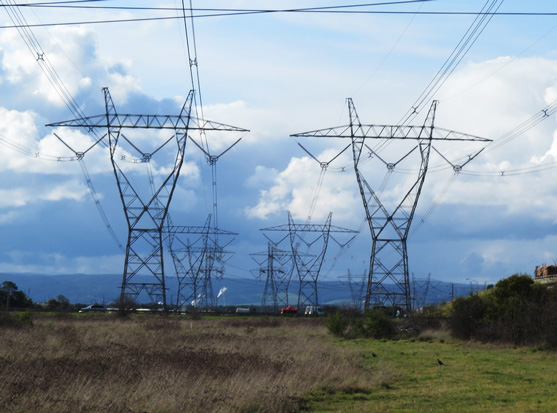
Who wouldn’t want to wake up to these beautiful towers…
By Jo Nova
Just another community horror thanks to Green fantasies
Australia’s Power Grid is full they say, and to collect all the sacred green electrons and save the world now means building thousands of kilometers of high voltage towers that will carve up farms and wilderness, damage property values, and ruin good farming land. For some reason, inner city activists think that’s a good idea.
But out in the country farmers and rural people are angry.
Few people want giant wind turbines spoiling the view and their sleep, but if the turbines are built in lonely far-flung spots, then thousands of 70m high steel towers will have to cross the land anyhow to connect their useless electrons.
In theory the Renewable Crash Test Dummy nation “needs” another 10,000km of new transmission lines and they’re supposed to be built before 2030. To get some idea of just how impossible this is, consider Humelink which is meant to be the interconnector to “Snowy 2.0” (the doomed pumped storage scheme). It is only 360km long and was supposed to cost $1.1 billion but is now projected to cost $3.3 billion. What will the other 9,600 kilometers worth cost?
…
We’re struggling to build those towers
It may have seemed like a good idea on the back of an envelope in Canberra, but out in the country, landowners are forming alliances to refuse the compensation on offer, saying they want the lines put underground, which will make building the transmission lines even slower and much more expensive. Only about 40% of the property owners affected by Humelink plans have accepted the offers, which means 60% haven’t. Given the schedule for blowing up coal plants in Australia, governments here are getting desperate, and are ramping up the offers — in NSW and Victoria landowners could get as much as $200,000 per kilometer in compensation. In Queensland the going rate is $300,000.
Farmers are not impressed. Some were arguing that they would lose an 80 m wide easement across their land. They can’t build or dig too close to the towers in case it weakens the footings.
Angela Macdonald-Smith and Colin Packham —Australian Financial Review
Katz – and others – have already rejected an offer from the NSW government of $200,000 for every kilometre of his land crossed by a major infrastructure project, a payment which was designed to put an end to a deadlock between landowners and the state.
Katz says that allowing large pylons – each as tall as those on the Sydney Harbour Bridge – would reduce the value of his property by 30 per cent and significantly change how he manages his herd of cattle.
I do not believe, … that it makes sense to build it as an overhead line with such huge risks in causing environmental destruction in the name of saving the environment. That seems to me a non sequitur of monumental portions,” Katz tells AFR Weekend.
Calabria told a business lunch in late November that the urgency and complexity of the challenge to meet the 2030 targets increases every day – as does the cost. The risk looms large of losing support for the transition from the community, which has been promised cheaper and cleaner energy from the process with little perception of the expense involved, he says.
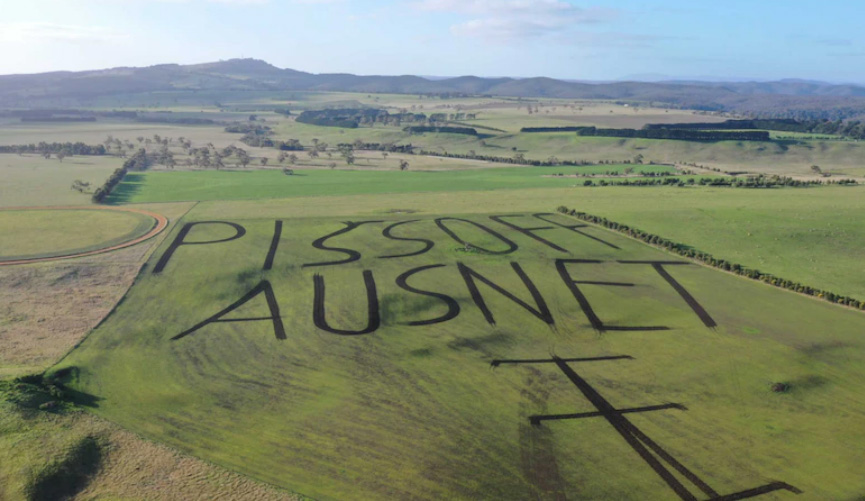
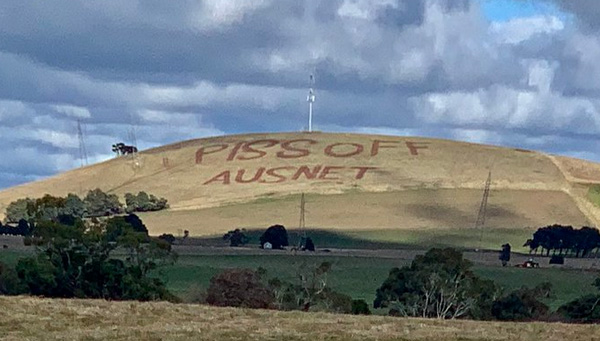
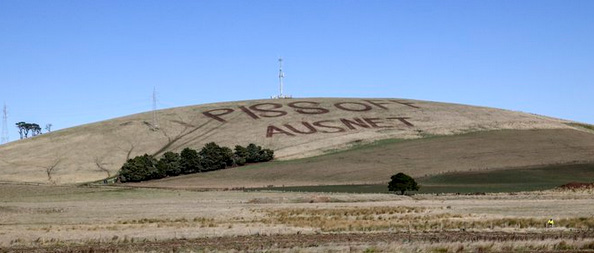
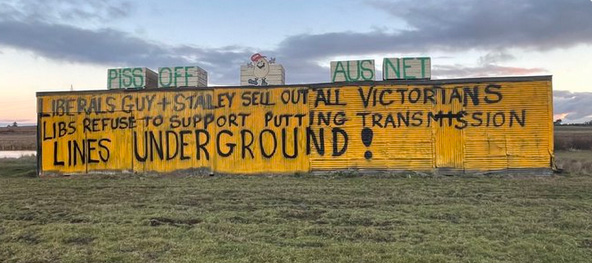
4,000 people have joined the “Piss Off Ausnet” protest group in Victoria and protests are continuing. In NSW, the HumeLink Alliance are growing and further north The Merriwa Cassilis Alliance have won concessions in the Hunter Valley. (The line will now go through public land and old mining areas which will reduce the impact on farmers). Never mind about the wilderness though…
They explained some of the ways these transmission lines affect farmers:
Height restrictions on farming machinery, interference on guidance technology and the no go areas for aerial management means crops and pastures could not be managed in a timely and cost-effective manner.
Standard farming machinery like headers and boom sprays over 4.6m will be out of action, deemed too high to drive frequently and safely under these power lines. The use of light aircraft to manage crops, spread fertiliser and control pests and diseases would also be too dangerous to carry out near the powerlines. These practices are regularly carried out when crops or pastures are too advanced to manage on the ground.
Strategic agricultural land and transmission lines don’t mix!
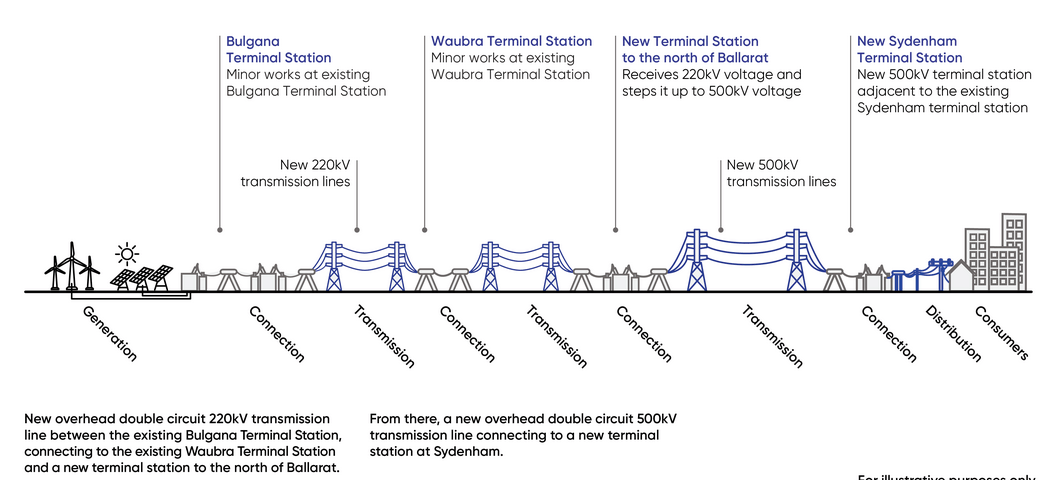
It takes a lot of infrastructure to connect up the Green Totems:
So much infrastructure, all of it expensive and completely unneccessary. — Source: (Western Renewables Link)
Australians lose either way
If the government pays for the transmission lines, and pays adequate compensation to farmers, which they should if they build them, that just means the average Australian gets screwed for a even bigger bill to build the Green religious talismans against storms a hundred years from now.
The only people who benefit are the subsidy-farmers in the city, the foreign manufacturers of unreliable generators, adversaries that want to ruin competing industries, and any potential military foe.
…
It would cost about 0.0001% of this to audit the UN science committees and find that it was all a waste of money.
The land that is the Renewable Crash Test Dummy is holding its breath
This time last year, the Australian energy market turned into a kind of Hunger Games spectacle with daily feeding-fest at dinner time where prices were so burning hot that unhedged smaller retailers begged their own customers to leave them and then the whole market was suspended. The bonfire was so big we’re still paying for it, and retail electricity prices are set to rise another 25% in a few weeks.
So it’s no surprise that as the cold weather arrives downunder, everyone involved in energy is “on edge”. Suddenly Australian corporate leaders are telling it like it is — the Alinta Gas chief says there is just no way we can build enough renewables in time — he can’t even “see a way” of building enough renewables to compensate for the coal units that are being closed.
The man who used to run the Snowy Hydro Scheme agrees (and then some) — saying we need to build a “Snowy” every year, and we are being lied to (his words) and it will take not 8 years, but 80 years to get there. The head of EnergyAustralia says shutting down the Liddell coal plant means the system is “exposed”. These are people at the top (or formerly) of our biggest energy companies.
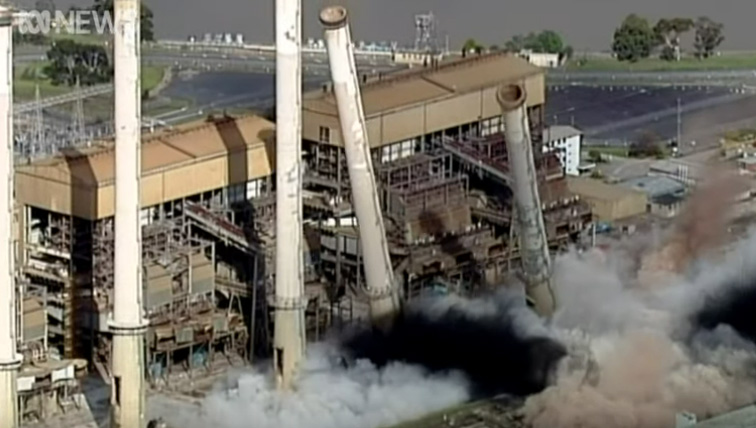
A year ago the new government won with a pledge to bring electricity prices down. Instead prices just keep rising and are set to remain high “for years”. To appreciate just how like the Starship Enterprise the nation is, going where no nation has gone before, we have a roughly 30GW grid, and in the next eight years 8GW of coal power is scheduled to be lost. But in reality the AEMO estimates that 14GW of coal power capacity will flee the rigged Australian market by 2030.
The cost of the rushed transition-we-don’t-have-to-have is estimated to be $120 billion which is $4,500 for every man, women and child or about $20,000 for a family of four, who could have gone to the Bahamas instead. As it is for $20k, they will get expensive unreliable electricity, lose jobs to China, and reduce world temperatures by 0.00 degrees C.
Alinta chief executive Jeff Dimery, head of the country’s fourth largest energy retailer, said he could not see a way of building enough renewable energy sources to compensate for the loss of coal, which still generates about two-thirds of Australia’s electricity.
“We’ve had one battery reach a final investment decision in the last quarter – one battery,” Mr Dimery said.
“Snowy 2.0 is delayed, VNI West [interconnector] is coming in 2031, three years after Yallourn comes out. The whole transition is not lining up. We are so far off track.
The transition may not happen this century…
Paul Broad, who ran Snowy Hydro until resigning shortly after Labor won office last year, said the challenge of the huge pumped hydro expansion under construction could not be overstated, adding that was just a tiny fraction of new green-energy supplies needed.
“We need a Snowy every year, but it’s extremely difficult,” Mr Broad said. “We are being lied to that this is achievable; the transition will take 80 years.”
Australia’s electricity network is precariously balanced going into a peak demand period, the head of one of the country’s biggest energy companies has warned.
Mark Collette, head of EnergyAustralia, said recent fossil fuel closures, including the shutting of AGL Energy’s Liddell coal-fired power plant, had left the national electricity system exposed… If there were outages or supply shocks – we notice them”.
The Australian Energy Regulator last month approved bill increases of about 25 per cent for households and businesses across the east coast from July 1, which it said was predominantly driven by the increased cost of generating electricity in winter 2022.
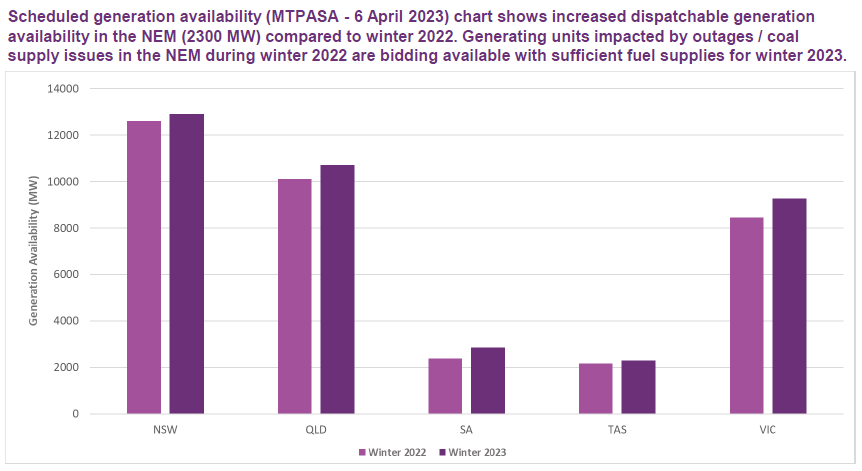
Meanwhile the resolutely green AEMO (Australian Energy Market Operator) forecasts an improved winter outlook but says “risks remain”. Translated, they’re saying that things are slightly better than the bottom of the barrel and if nothing else breaks, we might get through the winter without the same trainwreck we had last year. Maybe.
But ponder that since last winter 400,000 immigrants have moved to Australia. It’s not clear the generation has even kept up with that.
States all over the world have declared we have to change our cars to EVs and do it tomorrow so we can save the world. But as Mark Mills points out, despite the rush “No one can really say whether widespread adoption of EVs will cut carbon emissions.” I mean, does carbon dioxide matter at all?
The problem with EVs is that it takes a staggering amount of energy to dig up the 250 tons of specialty rocks required, and then crush, purify and mold them into one half-ton battery. While normal cars are naughty burners of fossil fuels for their whole lives, an EV emits a mountain of CO2 before it even gets to the saleyard.
EV emissions realities start with physics. To match the energy stored in one pound of oil requires 15 pounds of lithium battery, which in turn entails digging up about 7,000 pounds of rock and dirt to get the minerals needed—lithium, graphite, copper, nickel, aluminum, zinc, neodymium, manganese, and so on. Thus, fabricating a typical, single half-ton EV battery requires mining and processing about 250 tons of materials. (These figures hold roughly true for all lithium chemistries.) For the carbon-counters tracking such things, the global mining and minerals sector uses 40 percent of all industrial energy—dominated by oil, coal, and natural gas—and that’s before we take into consideration the massive expansion that would be required to supply all the battery factories planned for widespread EV adoption.
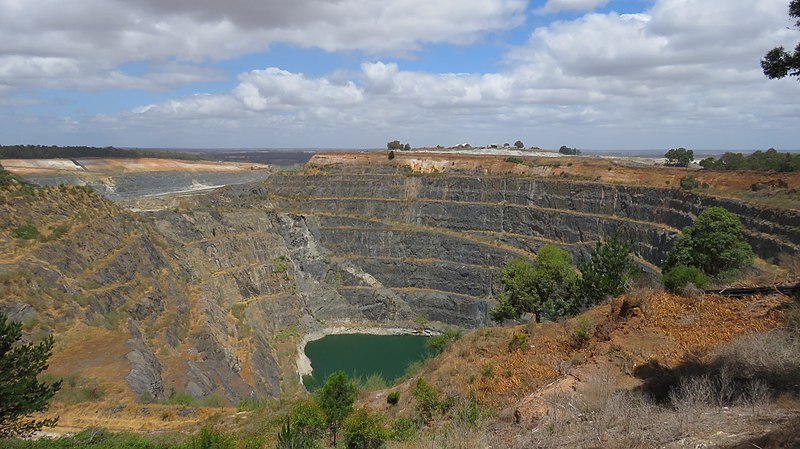
Lithium Mining makes a big hole in the ground, and we’d need about 10,000 times as many big holes to get to Net Zero. Not that I have anything against big beautiful open pits but the Greens may not have thought this through…
We don’t even know what emissions we will produce by making a billion EVs. As Mark Mills points out one review shows studies on this vary fivefold and start with the assumption the median car only uses a 30-kilowatt-hour battery. But most batteries are much larger. Indeed MyEVreview lists 344 electric cars and 327 of them have bigger batteries than 30KWh — much bigger batteries. Nearly 100 EV models are 90kWh or more — three times the size.
Ponder just how far you have to drive an EV to even get the emissions clock down to the same level as a fossil fuel powered car?
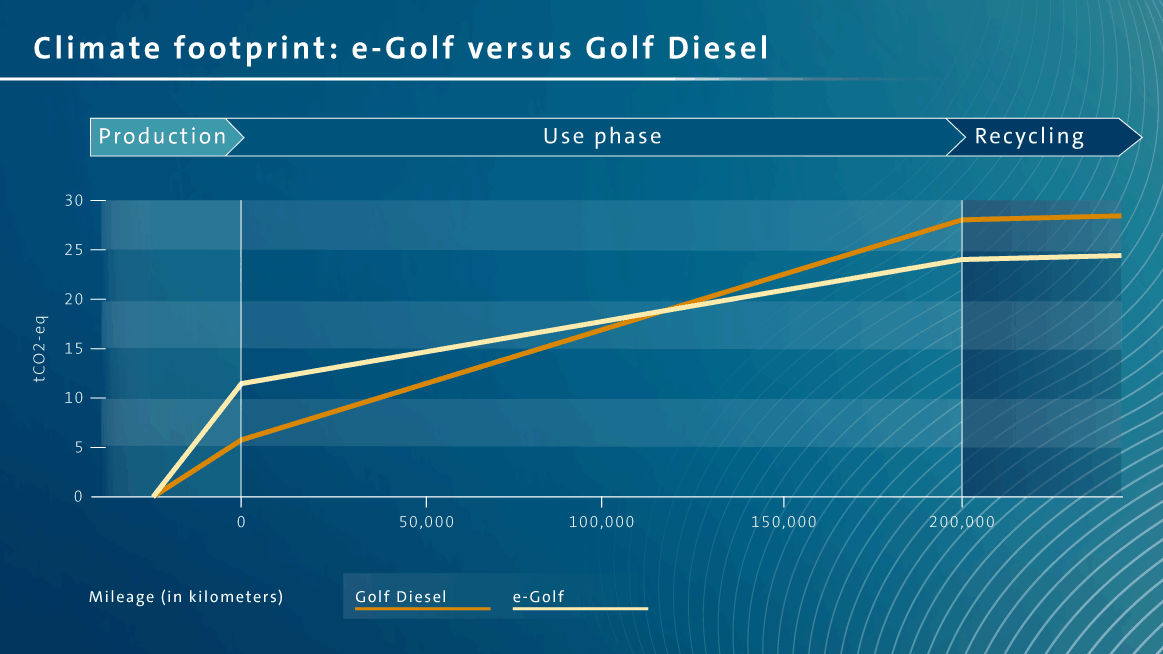
Some automakers—notably Volkswagen and Volvo—have published their own studies that take into account both upstream emissions and grid realities. Those analyses found that an EV powered on Europe’s grid creates more CO2 emissions than a conventional car until at least 50,000 miles of gasoline-free driving. After 120,000 miles, the studies estimated that total cumulative emissions reductions finally reach about 15 percent and 25 percent, respectively. Hardly “zero.”
Just to check that we understand Mills point we can visit the VW study to find that “yes”, it is that bad. The EV emits more CO2 than a fuel filled car for the first 125,000 kilometers. Only after that, there are some savings… but by the time you’ve owned that EV for years and driven 200,000 kilometers (or 120,000 miles) you’ll have saved a tiny 15% in total emissions produced by the diesel equivalent.
Comparison of the carbon footprint of the e-Golf and the Golf diesel.
But of course, if you dent the EV after one year and have to write it off because no one is sure the battery won’t catch fire, then “the planet” would have been much better off if you bought a fossil fueled guzzler instead.
And as Mills points out, this dismal assessment is the optimistic one:
Those savings shrink for cars using batteries significantly bigger than small one in the Volkswagen and medium-sized one in the Volvo. And the calculated CO2 reductions collapse, and even evaporate entirely, if one factors in the higher ranges of known values for upstream emissions in mining and processing, rather than the low, average values chosen in those studies.
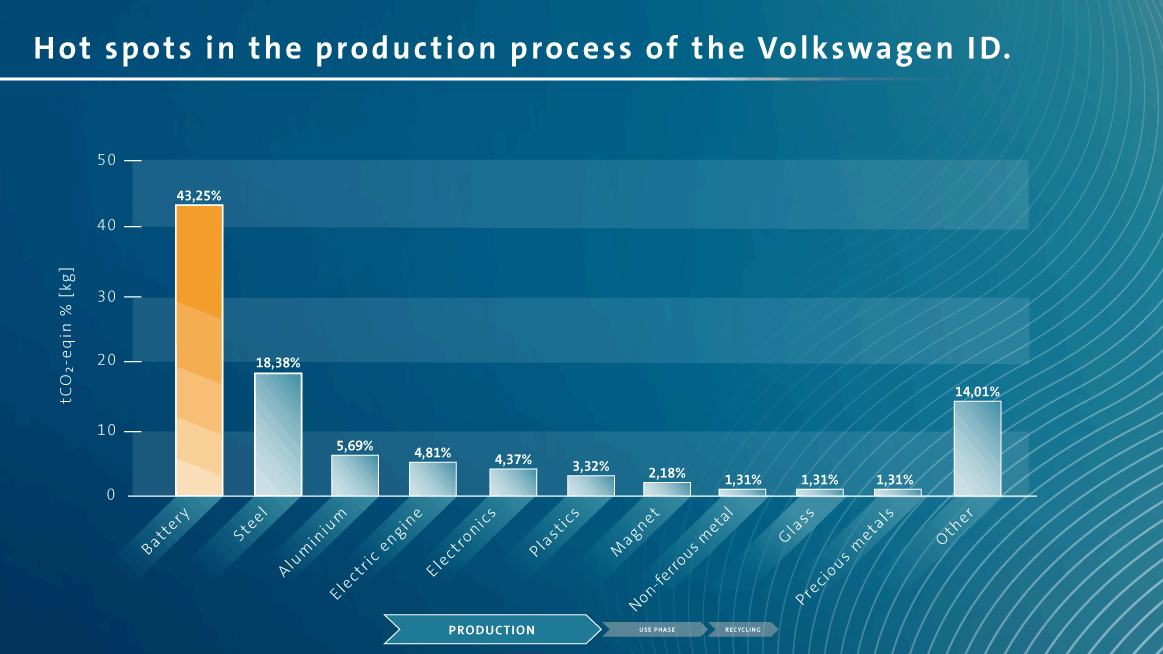
And it’s clear which part of the EV is the cause of all the emissions. If only EV’s could run without a battery…
Comparison of the carbon footprint of the e-Golf and the Golf diesel.
And things are likely to get even worse as demand rises and we seek out deeper and more difficult ore-bodies to mine:
…per the IEA, “lower-grade ores require more energy . . . greenhouse gas emissions and waste volumes.” Already, for example, over the past decade in Chile, the world’s top supplier of copper, mining-energy use has grown ten times more than the tonnage produced.
As Mills also points out, the global mining and minerals sector already uses 40 percent of all industrial energy. It’s not like we can double this on a whim.
So we are pouring money into a program to “reduce CO2” which will cost a fortune and quite possibly achieve very little, if anything of the danger it was supposedly going to save us from.
Meantime, hundreds of billions of dollars designated for wildly premature all-EV mandates will likely become stranded capital because the quantities of minerals needed won’t be available soon enough. Along the way, those stranded billions will do little or nothing to cut CO2 emissions. In the end, the rush to EVs could even increase global vehicle-related emissions.
Luckily CO2 is plant food so it doesn’t matter that EV’s are a terrible way to reduce CO2. Unluckily money doesn’t grow on trees unless you are a central banker.
Nearly every proposal from the climate activists was struck down:
How times have changed. After the energy crisis of 2022 investors at major oil and gas firms are spurning climate activism. A year ago nearly a third of investors at Chevron and Exxon voted for the draconian “Scope 3” emissions targets. These targets are ludicrous — requiring the oil and gas giants to adopt a plan to reduce third party use of their own products. It’s like a form of corporate sabotage.
This year only about 10% of the same investors voted for these measures. And apparently there’s a similar trend on the other side of the Atlantic with BP and Shell investors rejecting activism too.
By Collin Eaton and Jenny Strasburg, The Wall Street Journal
The votes were abysmal for climate activists. All but two of the 20 shareholder proposals for the two companies garnered less than 25% of investors’ vote, according to preliminary results, with some performing much worse than similar proposals put forward last year.
In recent weeks, similar climate proposals failed to win over most shareholders at annual meetings of British oil and gas giants BP and Shell in London.
It’s still bonkers that 10% of oil investors would vote for a plan to get their customers not to use their own product, but if those 10% were BlackRock and Vanguard, the giant financial asset managers themselves, then they have other ways to profit from these votes.
The ESG spell is broken:
But Wednesday’s votes demonstrated how some shareholders have backed off pushing major oil companies to embrace certain climate goals. Investors said many voices pushing ESG measures have been drowned out following Russia’s war in Ukraine, which caused oil and gas prices to skyrocket as global supplies were crimped.
Investments in fossil fuels pushed many oil companies to record profits last year, which lured back some investors who had fled after years of meager returns from the industry. Exxon Chief Executive Darren Woods said Wednesday the company had benefited from investing in fossil fuels when others pulled back.
But Woods and other industry executives have argued some climate-related proposals would backfire or leave the economy worse off. Woods said several proposals rejected Wednesday would have required the company to assume the world will cut carbon emissions at a much faster pace than observers have projected.
“Some [would] go so far as to force us to decrease oil and gas development,” he said. “This would do nothing to reduce global demand.”
This is a good sign that the free market is not dead yet.
______________________
ESG Means: environmental, social and corporate-governance issues.
It is in effect: If there is a train and it’s less than a 2.5 hour trip, in France you can’t fly — unless of course, you own your own private jet, the most “polluting” kind of plane (according to the EcoWorriers). How does that make “carbon sense”? Are we saving the planet, or just stopping the riff-raff from traveling?
It’s one rule for you, another for the Feudal overlords.
Private planes make 5 to 14 times as much CO2, but they are “good to go”?
… numerous studies demonstrate that private jets are much more impactful to the environment than other modes of transportations.
They are about “5 to 14 times more polluting than commercial planes (per passenger),” a report published by the Transport and Environment group in 2021 states.
According to a recent study, “only 1% of the population causes 50% of global aviation emissions.”
Right now there are only three routes in France that will be banned, Paris-Orly to Bordeaux, Nantes and Lyon affecting only 2.5% of all domestic flights. The original plan was to ban five more routes, but the timetables weren’t so friendly for early morning or late in the day flights.
“You were warned! This is what a climate lockdown looks like. This is what the Great Reset looks like. The climate agenda demands you give up airline travel, car travel, cheap reliable energy, and plentiful food. Net Zero goals are now dictating vehicle shortages to force more people into mass transit.
They’re going after your freedom of movement; they’re going after private car ownership, they’re going after everything it means to be a free person and turning it over to the administrative state.”
The Citizens illusion of Debate and Democracy
The BBC and others are mentioning that banning flights was first suggested at France’s Citizens Convention on Climate, as if Macron is just doing what the people wanted — but never forget that the people have been free all along to not-fly and take the train but they didn’t want to. The people of France were voting with their money and time, but now they can’t.
To create the illusion, Macron tasked a group of people to assume the world was going to end because of CO2 and come up with ideas. With enough monkeys on typewriters, how could they miss? Afterwards Macron can just pluck out the suggestions he was going to do anyway, and say “Voila — this is what the citizens suggested”.
France’s Citizens’ Convention on Climate, which was created by President Emmanuel Macron in 2019 and included 150 members of the public, had proposed scrapping plane journeys where train journeys of under four hours existed.
But this was reduced to two-and-a-half hours after objections from some regions, as well as the airline Air France-KLM.
There was no Citizens Convention on whether we can stop the storms with solar panels. No Convention on Holding Back the Sea. No one asks the citizens if it’s worth spending a trillion Euro to cool the world by one hundredth of a degree. It’s not democracy, and it’s not debate. The Bureaucrats only ask the citizens questions that make Big Government bigger.
As I said It’s the Reality TV version of “Democracy” where 150 people pretend they speak for a nation while 65 million people get sidelined. Expect to see them take off everywhere. They are the perfect tool for Big-Government.
Won’t change the weather, will kill people
Now that short flights are banned, how many people won’t take the train and will get in their cars instead?
France’s Ban on Short-Haul Flights Will Kill People
You’re 2,200 times more likely to die when traveling by car as opposed to by airplane.
A recent study out of Harvard University found that, for people traveling within the United States, Europe, and Australia, the chances of being killed while flying are 1 in 11 million, while the chances of being killed while driving are 1 in 5,000. Put differently, you’re 2,200 times more likely to be killed when traveling by car as opposed to by airplane. By diverting some travelers from the air to the roadways, the French government will almost certainly cause more travelers to die.
Political theater, it turns out, can be deadly.
Don’t mention the private jets
The BBC doesn’t want anyone to notice that the Billionaires and corporate heads can keep churning out the CO2 of ten men…
Putting private jets on the graph would blow the scale and shrink the rest to tiny lines.
Worse, it would expose that this law is not about reducing CO2 at all.
We use cookies to ensure that we give you the best experience on our website. If you continue to use this site we will assume that you are happy with it.


 Sociologist Donald Light of Rowan University in New Jersey, US, who has spent decades studying drug regulation, says, “Like the FDA, the TGA was founded to be an independent institute. However, being largely funded by fees from the companies whose products it is charged to evaluate is a fundamental conflict of interest and a prime example of institutional corruption.”








Recent Comments