|
|
||||
|
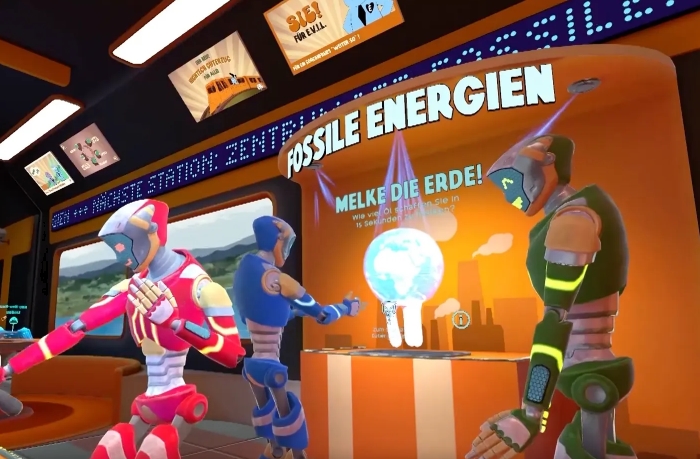
By Jo Nova If anyone made a game shooting lasers at parasitic flying climate believers they would be arrested for hate-speech. But if a government agency promotes a game that dehumanizes, mocks and kills critics of the government “Green program”, they’ll probably get another grant. A bit like the 10:10 “blow up deniers children” video, this game accidentally reveals the intellectual and moral vacuum that Big-Government funding inevitably flows to, unless there is a true Free Media to embarrass and mock it. And unfunded blogs like this are that free media. The State pays these Groomers of Hate: German state media broadcaster develops virtual reality game in which players shoot lasers at flying climate denialists, in perhaps the most eccentric effort to propagandise teenagers known to manBy Eugyppius Climatists at the German state media broadcaster Südwestrundfunk (SWR) have used the mandatory license fees they collect from all German households to produce an astounding virtual reality video game called GreenGuardiansVR. In this game, players shoot lasers at flying climate denialists to defeat disinformation and save the planet (h/t RatSays). This is literally true, this thing really exists. It will be released to the public sometime in the autumn; the Steam page is here. In the meantime, they’ve set up a whole stand to debut this lunacy at Apparently there is a fossil fueled villain from the E.V.I.L. corporation (just to make it easy for children to know who to hate). It seems he has oil running through his veins. Hypothetically, if there was a country trying to destroy Germany, to poison its youth, to teach them to hate the energy that gives them their wealth and freedom, they could not do a better job than the German government.
The arcade game in the train is called “Fossil Fuels” and players are invited to “milk the Earth” via the udders under Antarctica. Dr Evil says that fossil fuels are the future, and they are working to keep people “dependent” on them, as if the need for cheap kilojoules is just a propaganda meme, not a core need of any civilization.
Next, a freedom fighter girl-power eco warrior (of course) turns up to save the day (and emasculate German XY teenagers). She hacks into the fossil fuel game with the message “Don’t get sucked in. Join the Green Guardians.” For some reason the train has laser guns in the carriage (like this makes any sense). According to Eugyppius students are invited to break them out and shoot at things to “defeat disinformation”. Blasting away the side of the train is somehow good, and then, of course, blowing up Mr E.V.I.L. in his flying machine is a win.
In the press release, the producers say they are targeting “youth” aged 14 -25 — so they include all the university airheads who still haven’t grown up. Producers say this target market “wants to have something to do” and are put off by bad news, but they must think “youth” are childish babies if this sort of thing is supposed to appeal to them. This is the perfect example of why State Broadcasters need to be shut down in any democracy. The government already has vast funds to defend itself, and explain its actions. The only purpose of “State Broadcasters” is to defend the State from critics. Eugyppius translated the original and has all the info. Readers who haven’t seen the 10:10 “No pressure” video from 2010, follow that link. You will not believe the graphic violence that Youtube and others thought was funny, but now try to hide. The true face of evil. h/t David E, and Tonyb.
August 26th, 2024 | Tags: Big-Government, Propaganda | Category: Big-Government, Europe, Global Warming |  Print This Post | | Print This Post | | Mark the turning point: Climate activists know they have to hide “the climate” to win the electionNow that Trump is ready to make climate change an issue, the last thing the Democrats want is to put this debate out on the table. So their strategy is to say nothing about it, in case they offend the voters in the middle. As Marc Morano says “‘No one is buying their ‘climate emergency’ claptrap anymore’“. In an extraordinary headline the New York Times is letting everyone know that the new “green” thing to do is to sit back quietly and wait for her to win. They don’t want activists to complain she’s gone soft on climate change and accidentally trick her into making public commitments which Donald Trump will use against her. We’re at the point where the Climate die-hards openly admit that it will cost them votes if she talks about the climate. They know the voters don’t want it, and the only way keep the Green Gravy flowing is to hide it. And these are the same people saying Trump is destroying democracy. They don’t want a mandate for action anymore, they just want to win. They’ll claim the mandate later anyway.
Make no mistake she and Tim Walz are as deep green as any fungus. Climate groups were happy to send $55 million to the Democrats silent campaign. They know what they’re getting. Party strategists are happy to explain that lying-by-omission to voters is all for the cause. In The New York Times, the Democratic Governor of Washington openly says he “is not concerned” about Kamala’s silence on the climate: “I am totally confident that when she is in a position to effect positive change, she will,” Gov. Inslee said. Who cares what the voters want, she’ll do it anyway. Kevin Book, a manager of a Washington based research firm, pretty much explained voters don’t want what Joe Biden delivered: ““This doesn’t look accidental, it looks like a deliberate choice,” …they are worried if she takes a strong position on climate, even it fits the same position that Biden took, it will make her look too progressive,” Mr. Book said, adding, “It’s a divisive issue and they need both sides as much as possible to win Pennsylvania.” — New York Times The $55 million dollar ad campaign doesn’t mention climate change or global warming either. It sells Kamala by saying she will “strengthen the middle class” with “advanced manufacturing and clean energy”. Democrats apparently are nothing more than cliches, namecalling and a bucket of other-peoples-money to pour on the right keywords. And of course if the Green Blob doesn’t want us to talk about climate change, it’s our duty to raise hell with it (in the nicest possible way, of course). Not just with far left politicians, but with the media. Make them explain why it’s OK for Kamala to hide what she is planning to do to. Isn’t the planet at stake? Doesn’t Democracy matter?
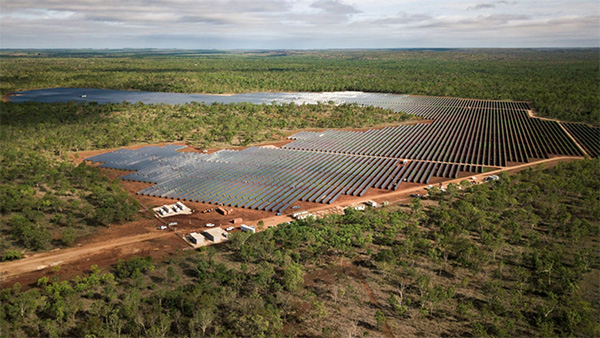
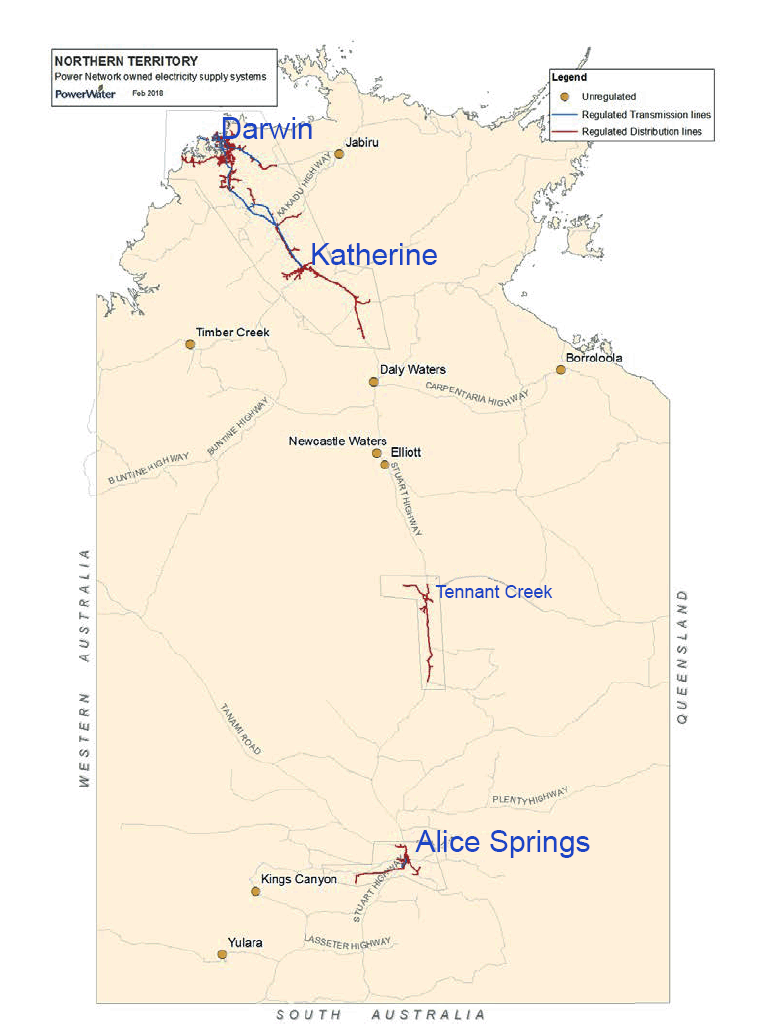
August 24th, 2024 | Tags: US Politics | Category: Global Warming, Politics, USA | Print This Post | | The Northern Territory is a test case for renewable energy and it’s a bonfireIn 2016, the new Labor Government waved a magic wand and commanded they would be 50% renewable by 2030. The experts said it was doable and would save $30 million a year. They gave out the permits for large solar installations, which began construction in 2019, but then suddenly changed the rules in 2020, and wouldn’t let the solar plants connect to the main Darwin-Katherine grid. Unbelievably, 64 megawatts of solar panels that cost $40 million dollars have sat, doing nothing, for four long years. “It’s just reflecting back into space, not being used to power the grid and to substitute for diesel and gas turbine production,” said local vet Peter Trembath, who leased his land to energy company Eni Australia for the solar project. “It’ll be some technical issue, but you’d reckon they would have sorted that out before Eni spent $40 million to erect it.” — Max Rowley, ABC News June 2022 It’s always the Grids fault…The reason they couldn’t be connected was that the Territory government suddenly rewrote the rules in February 2020 and insisted the solar generators had to operate like fully scheduled generators, not semi-scheduled ones. Cruelly, they would have to make accurate predictions of what they could supply 30 minutes ahead on a rolling 5 minute basis. This meant they would need their own battery backup with the equivalent of 80% of their capacity and storage that lasted 30 minutes. They’d also need “weather forecasting” ability to predict cloud cover. The solar owners, Eni, protested that this would cost them $20 million (at least!) making the project unviable. And to make things even worse, the government was saying they had to build the battery at the solar plant, and reserve it to back up their own panels, so they wouldn’t be able to build the battery in Darwin, and use it to help the grid at other times, which would defray the costs. It all seems quite bizarre. (Who would want to run a business in the Northern Territory?) Why didn’t the renewables industry protest these belated draconian conditions louder? Probably because they didn’t want to highlight the reason for the Territory government’s sudden flip. It suddenly makes sense when we look at the timing. The panic-attack about connecting solar power came just after the Alice Springs black startThe NT government didn’t appear to realize that there were risks in adding 64MW of solar power to a grid that was roughly 250MW in size until 13th October 2019 when the whole Alice Springs network serving 29,000 people collapsed due to a cloud. It was the third blackout in four years, and it must have terrified the management in Darwin, because Alice Springs didn’t have much solar, yet the system was so unstable. Only 13% of the town’s total electricity comes from solar panels, but one cloud was enough to knock that little grid over and it took over nine hours to get it restored. By December 2019, an inquiry was set up and both CEO’s of the Power and Water Corp and the Territory Generation lost their jobs. Presumably the new CEO’s were not going to risk the collapse of the larger Darwin-Katherine Grid, hence the sudden rule change in February 2020 which left the solar operators high and dry. The ABC and others insist the blackout had nothing to do with solar power, and was just due to incompetence, but all the new grid managers grabbed their electrical garlic and acted exactly like solar power was the vampire. How else do we explain that these perfect solar plants have been sitting there doing nothing for four years? So 64MW is too much for Darwin, but lets build 4,000?Clearly grids need their armour before anything so risky as a large solar plant can be connected, which is all the more poignant considering the Australian government just approved (again) the humongous SunCable plant, what will be the “largest plant in the world”, at 4GW, and it’s going to be in the Northern Territory. It’s 60 times bigger than the 4 Eni plants, but is supposedly going to send most of the green electrons to Singapore, a mere 5,000 kilometers away, which is lucky, because the whole Darwin-Katherine grid only uses 250MW at peak, so SunCable would eat it alive. The people will pay for the solar debacleThe new NT Generator Performance Standards were trying to make sure that the Territory’s consumers wouldn’t end up footing the bill for the backup and wouldn’t suffer a blackout. But the Territory Government has paid $45 million to build a battery in Darwin anyway, and looks like it will try to buy out the four idle solar plants from Eni. So the citizens will be whacked for the cost one way or the other for the magical wish-fairy thinking that renewables would be easy and cheap. As it happens the people of the NT get to vote tomorrow in the Territory elections. Lets hope there is some salvation. Though on the media apparently the major issue is not about keeping the lights on, or whether the NT is a basketcase for investors, but whether people can keep crocodiles as pets. No, seriously. (And they’re talking about the Saltwater kind which eat people, and grow to 6m and 1,000kg.)
There are only about 250,000 people living in the Northern Territory. There are two separate grids and several microgrids. All of these are perfect test cases to showcase renewable energy, as I keep saying, and none of them are managing to do it. When will we get the message? If a town of 30,000 can’t live off the sun and wind, why would anyone bet the whole nation on it? h/t CO2 Lover
August 23rd, 2024 | Tags: Big-Government, Electricity Grids, Microgrid, NT (Northern Territory), Renewable Energy, Solar Energy (PV) | Category: Australia, Big-Government, Global Warming, Renewable, Solar Power | Print This Post | |
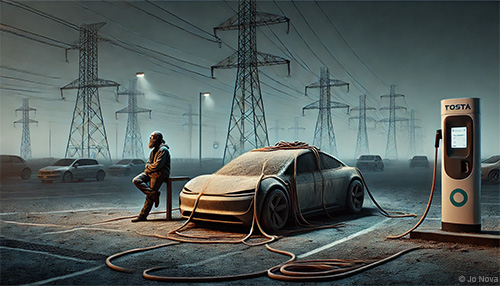
By Jo Nova No one saw this car crash coming?EV’s represent just 0.9% of all cars on the road in Australia but plans to install fast chargers are already grinding to a crawl. Last year, Ampol was planning to build 180 EV charging bays by the end of the year. Instead it’s proved difficult to even reach half that target. Eight months after they were supposed to have 180 in action they’ve reached 92. Just throw money…A mere 3 weeks ago Ampol announced that thanks to a $100 million dollar grant from the Australian government they would install more than 200 new fast chargers at Ampol’s national network of petrol stations this year. But presumably after making a few phone calls they’ve realized it’s not going to happen. (You’d think they might have made the calls before putting out the press release? Or the Minister might have phoned a friend before tossing $100 million to the wind?) Power grid foils Ampol’s big EV charger plansBen Potter and Simon Evans, Australian Financial Review Ampol, one of the country’s largest petrol retailers, has dialled back plans to triple the number of electric vehicle chargers because of power grid limitations in a blow to government hopes of pushing motorists towards cleaner cars in big numbers by 2030. The company’s chief executive, Matt Halliday, said it would not be possible to expand the number of charging bays from 92 to 300 by the end of this year because of difficulties connecting chargers to the grid which is already struggling to cope with an influx of renewable energy generation. In March, Energy Minister Chris Bowen said the government would spend $60 million helping car dealerships install chargers on sales lots. [As] much as we spend a lot of time talking about generation, firming and transmission infrastructure, the last mile distribution grid is not really built for large-scale electrification, despite the best will that the players have to try and make it happen,” Mr Halliday added. “There are a lot of constraints that need to be worked through.” These people are not good with numbers. A fast charger needs 300 kilowatts, and if there are three car charging spaces in a row, that’s a major load that our low voltage lines simply can’t bear. In order to get the local distribution networks upgraded the wait times to connect these fast chargers can be as long as two years. Not to mention that we’re supposedly aiming to make all new cars electric in a mere five years or so, while we also try to shut down our largest coal plant. At the moment most EVs charging overnight are probably burning more fossil fuels than petrol cars do. The EV revolution in Australia (should it happen) would rampantly increase our carbon dioxide emissions. But who cares, right? It was never about CO2. It’s not like engineers haven’t been warning us this was going to happen for ten years. h/t Dave of Cooyal in Oz, and CO2 Lover
By Jo Nova For some reason our long climate proxies work for hundreds of years but always seem to stop working just before the man-made catastrophe appears. It seems to me that if a coral-tree-clam-sediment thermometer worked in 1393, it should work in 2020. It’s not like Earth has run out of trees, mud, pollen or corals. So here we are again, this time with a new Fijian coral that runs 627 years continuously from 1380 to 1997. And the experts have to slap “an instrumental record” on for the last twenty years to find the catastrophe. The actual single coral core shows the water of Fiji was the same or even slightly warmer in the Medieval warm period as it was in the 1990s. There’s no sign at all, in 600 years of this coral, that man-made carbon dioxide has had any effect at all on the water around Fiji. The new data comes from a coral core drilled in 1999, which explains why it suddenly stops. It does not explain why the world is about to end, but worried scientists waited 25 years to assess the coral core. The apocalypse is upon us, but no one can find a new big coral to study it in real time? 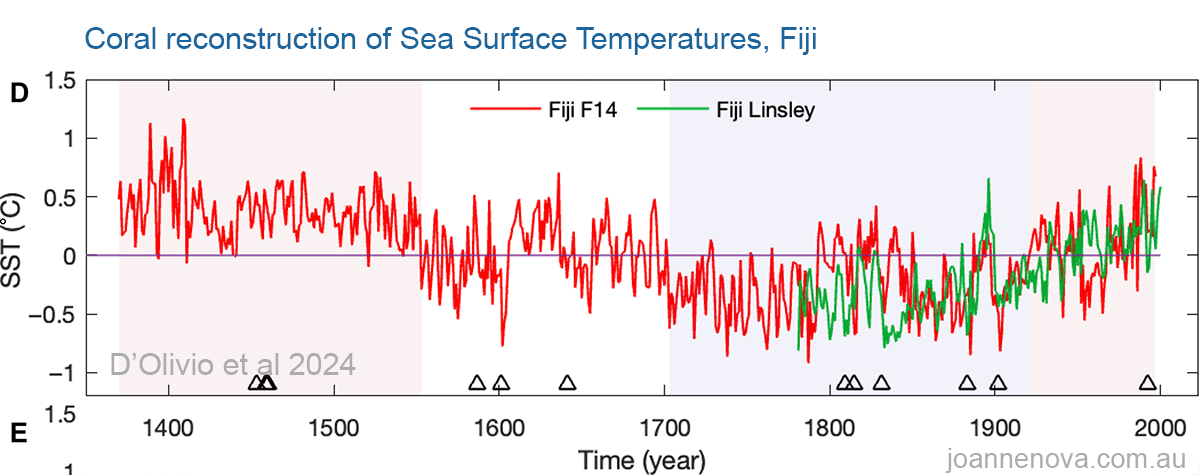 Click to enlarge Since the Pacific is a long way from Europe and Antarctica, we also confirm, yet again, that the Medieval Warm Period and the Little Ice Age were global events. Some force was warming the Earth 600+ years ago and the experts don’t know what it was. Then the Earth cooled, and the experts don’t know what caused that either, though the sun was suspiciously quiet, but we’re not supposed to mention that. The water around Fiji started warming in 1800AD, long before humans invented coal power or model T Fords. The experts tell us this is a “significant departure” from natural variability, and the hottest in 600 years. But it’s only when they superimpose ocean buoys and other instruments that the “record” hottest ever temperature appears like magic at the end. 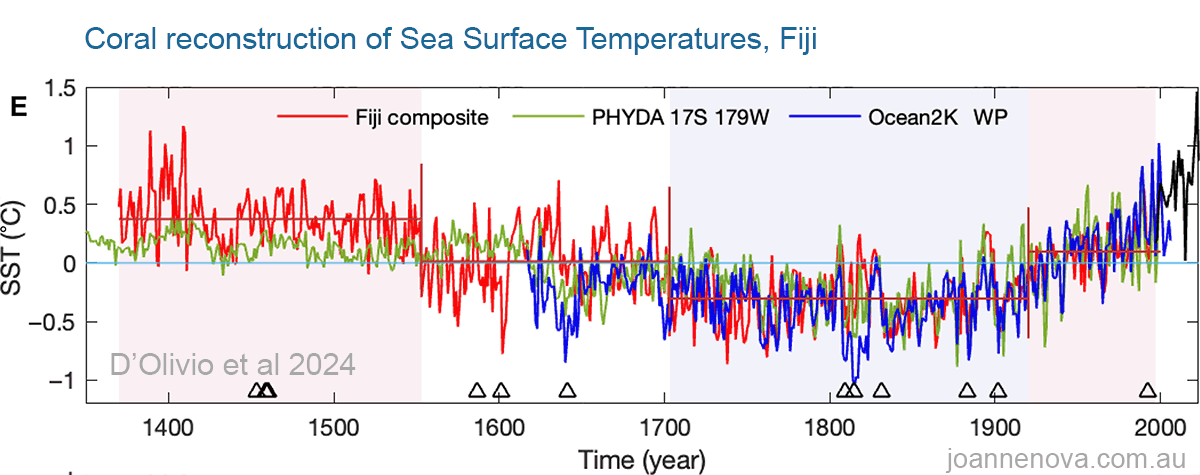 Click to enlarge Despite the authors forgetting to label the instrument data in the key on the graph, the caption contains the fine print “Also shown is the most recent SST data for Fiji from ERSSTv5 (1998 to 2021) shown in (E) (black).” So the only data for the “record” spike in the last 20 years of corals, comes from thermometers (and statistical infilling) instead. Wouldn’t you know? So yet again, even though I hear there is still coral living around Fiji, the key hottest ever record part of the graph is not from that coral. I’ve been asking for years for a long proxy to show we have a crisis. One solitary proxy that assesses temperatures in 2020 as well as it did in 1703 or 1492. Does anyone know one? If corals and clams work so well as thermometers do, surely Australia, with the worlds largest living reef, ought to have hundreds of old corals we can study? You’d think if our climate scientists cared about the climate and were given, say, $440 million dollars to spend, they could have found some? But perhaps they have to leave them in drawers for 20 years so they have room to tack on the instrumental spikes at the end? And here are lots more graphs from the paper showing that CO2 has made no difference to the climate. A is the Southwest Pacific. B is the Macassar Strait, D is from Palmyra, E is the central pacific, F is the Galapagos, and none of them show anything we should spend a trillion dollars on. Paleo Hydrodynamics Data Assimilation product (PHYDA) 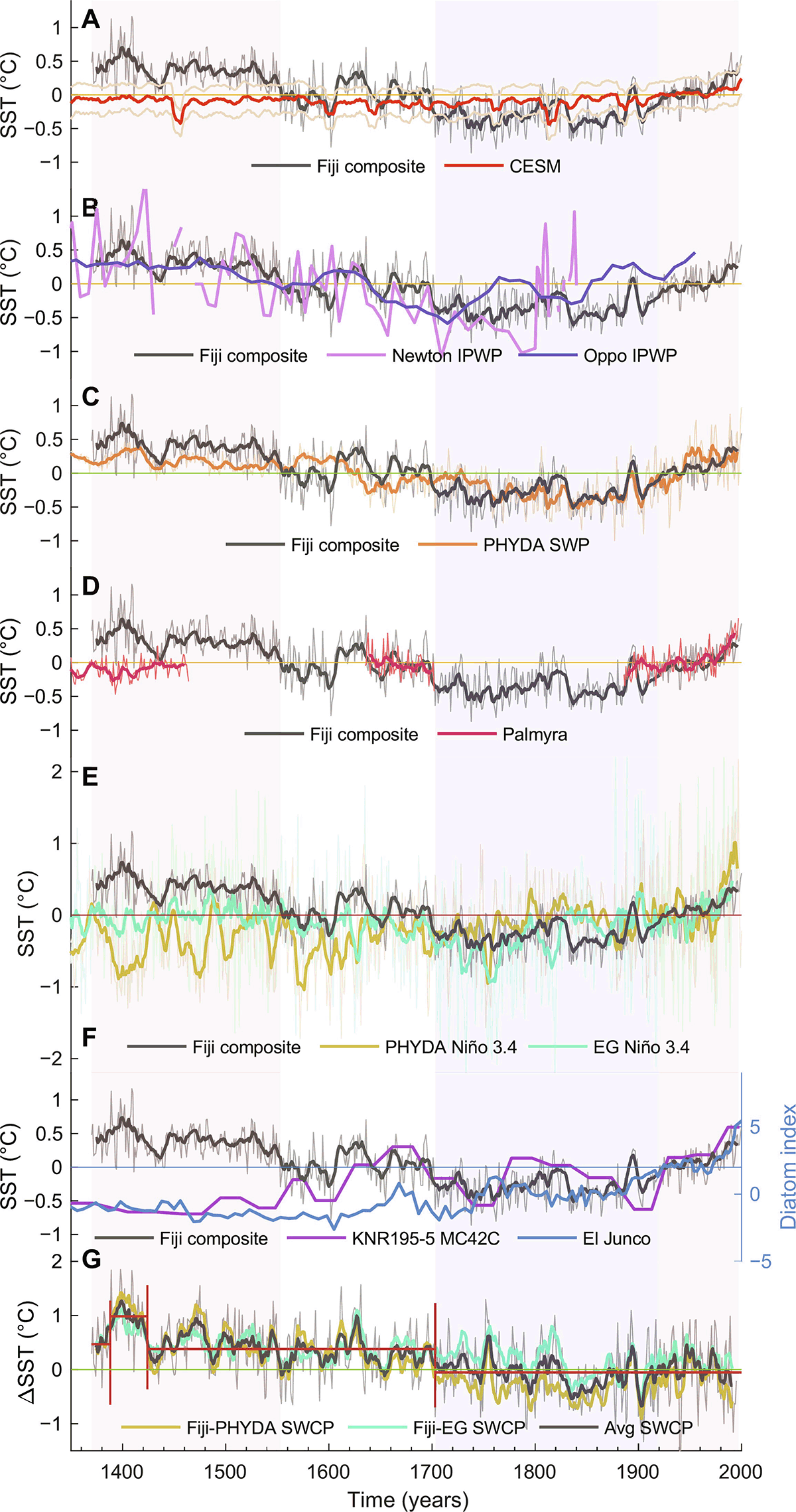 Fig. 2. Fiji coral composite annual Sr/Ca-SST record, WPWP model simulations and proxy reconstructions, and the SWCP SST gradient. The propaganda from Phys Org:Fijian coral reveals new 627-year record of Pacific Ocean climateAn international team of climate scientists have used a 627-year coral record from Fiji to reveal unprecedented insights into ocean temperatures and climate variability across the Pacific Ocean since 1370. It’s not even phrased as a link or association, it’s so weak it’s an “interaction”: The study published in Science Advances, co-authored by Dr. Ariaan Purich from Monash University and Professor Matthew England and Dr. Rishav Goyal from UNSW, shows how human-caused climate change is interacting with long-term patterns of climate variability in the Pacific Follow the long tenuous wandering path to “human derived” blah: The new coral record shows that the local ocean temperature was warm between 1380 and 1553, comparable to the late 20th and early 21st centuries. However, when combined with other coral records, the Pacific-wide warming observed since 1920, largely attributed to human-derived emissions, marks a significant departure from the natural variability recorded in earlier centuries. No. The coral record does NOT show this: The record also shows that present ocean temperature is the highest for the past 653 years. And there are no implications for millions of people either, other than we should stop wasting money immediately: The work provides new insights to understand how climate trends are leading to shifts in weather patterns and more extreme weather events that will have significant implications for millions of people living in the Indo-Pacific region.osystems across the vulnerable Pacific Island nations.” The money line comes next– the whole point of gouging a hole in a 600 year old coral is to advertise the renewable industry and justify trillion dollar government policy mistakes. What is a line like this doing in a press release of a scientific coral study? The study provides further motivation for the global community to keep working towards limiting warming to 1.5ºC by developing renewable energy resources at scale, to electrify the economy and phase out coal and gas. Government funded scientists have become prostitutes for Big Government. I would love to be proved wrong. But we all know that no government funded professors could dare criticize this study. Thanks to all the supporters who help fund me so I can. REFERENCEJuan P. D’Olivo et al, Coral Sr/Ca-SST reconstruction from Fiji extending to ~1370 CE reveals insights into the Interdecadal Pacific Oscillation, Science Advances (2024). DOI: 10.1126/sciadv.ado5107 J. E. Tierney, N. J. Abram, K. J. Anchukaitis, M. N. Evans, C. Giry, K. H. Kilbourne, C. P. Saenger, H. C. Wu, J. Zinke, Tropical sea surface temperatures for the past four centuries reconstructed from coral archives. Paleoceanography 30, 226–252 (2015). Oceans2K records. (PS: When Steve McIntyre dissected the Oceans2K dataset he found many of the alkenone records in it were mysteriously cooling in the last fifty years.) Image by Kanenori from Pixabay
August 21st, 2024 | Tags: Evidence, Evidence (AGW disproved), Little Ice Age, Medieval Warm Period, Pacific Ocean | Category: Evidence, Global Warming, Marine, Marine Life | Print This Post | |
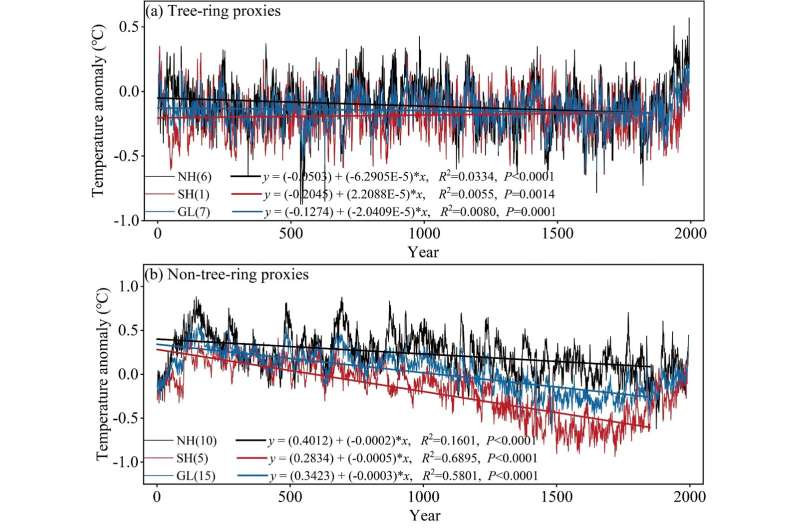
What if a few gigawatts of solar power disappeared without a warning or a cloud in the sky?Imagine a hostile force had control of half your national power generation at lunchtime and could just flip a switch to bring you to your knees? Or how about a crime syndicate wanting a ransom paid by 5pm? Steve Milloy: Communist China is setting us up for solar panel-based disaster: “Solar panels that make the electricity suitable for the power grid and which are usually connected to the web, can be “easily hacked, remotely disabled or used for DDoS [Distributed Denial of Service] attacks.” DDoS is one of the most common types of attacks, which basically try to overwhelm a system… Solar panels were outlined as a vulnerability in several scenarios, also due to the dominance of a single country, China, in the supply chain.” It’s only a week without electricity…Daniel Croft, CyberDaily (October 2023) Cyber Security CRC chief executive Rachael Falk said… that an attack on the solar grid could spark a “black start” event, which could result in the entire power grid going down. … “This could bring down an entire power grid, and it could take a week to recover,” she said. [Falk said] the threat presented by foreign-manufactured solar inverters is a recent one, as only recent models are internet-connected due to increased interest in smart home technology. “Traditionally, cyber risk with solar inverters was low because they were not connected to the internet,” said Falk. “However, as the popularity of smart home energy systems has boomed, this has changed, with most solar inverters now web connected.” The EU and the US have both had a wake up call in the last few weeksA Dutch white hat hacker got into one system a couple of weeks ago with 4 million panels in 150 countries, exposing a major flaw. That software glitch in American Enphase inverters was fixed quickly once they were aware of it, but how many other doors remain open? Only two weeks ago another group called Bitdefender claimed that 20% of the worlds solar panels and 195 gigawatts of capacity, had been at risk of cybercrime for months. Rooftop solar management software by Solarman and Deye (both Chinese solar manufacturers) is used by 2 million “solar plants” and 10 million devices. Hackers could have been able to take control of the inverters (which could “change the way the inverters interact with the grid”. They could also steal quite a lot of data, including real time GPS locations and production. What if they could target individuals? Apparently those issues were reported in May but are now patched too. (I guess no one would be mentioning any issues which are not patched, would they?) SecurityBrief has the gory details. Whatever threats exist in the Netherlands, Australia is a sitting duckEven at lunchtime in winter, sometimes half of the Australian national grid power comes from solar panels. That’s 12 gigawatts of solar power out of 25 gigawatts in toto. (And it’s similar in WA). Here in the renewable crash test dummy, fully 58% of the solar inverters that are connected in to the internet come from companies headquartered in China. (And the rest are headquartered elsewhere, but who knows, maybe they’re made in China too, where 70% of the worlds solar inverters come from?) 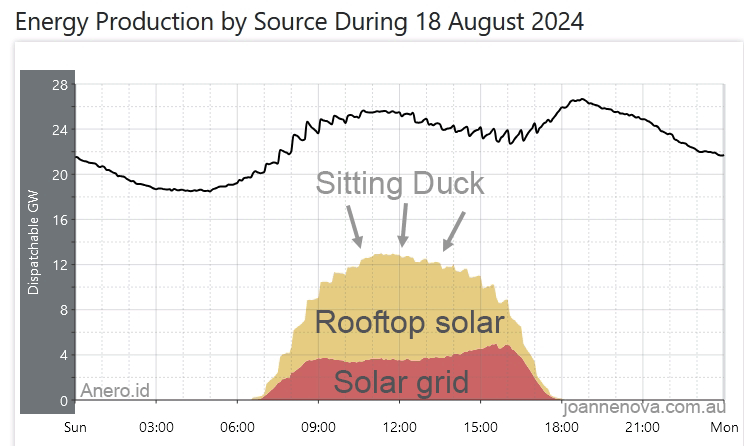 Solar power is a large part of the Australian NEM, even in winter. The black line is total generation. The NEM includes NSW, QLD, Vic, Tas, SA. (Source: Anero.id) So Cyber-expert Falk gave us that warning of a black start disaster in October last year, and how far have we got? By January we were redoing our cybersecurity plans, but somehow still forgetting about smart home devices like solar inverters and control of our national critical infrastructure. But, not to worry, by February we had the news that we were hiring Standards Australia, to develop “a roadmap”. (That’ll stop them!) Meanwhile we’re still going gangbusters on solar installations. We can always rely on the government to White hat hacker shines spotlight on vulnerability of solar panels installed in EuropeBy Nikolaus J. Kurmayer | Euractiv An ethical hack of solar panels in the Netherlands has revealed their vulnerability to cyber attacks, prompting industry calls for more rigorous safety assessments. A Dutch white hat hacker could have gained control of millions of smart solar panel systems, reports investigative outlet FollowTheMoney, using a backdoor. The findings confirm a 2023 report by a Dutch agency which found that converters, essential parts of solar panels that make the electricity suitable for the power grid and which are usually connected to the web, can be “easily hacked”… A report by the EU’s own cybersecurity agency from 24 July found that the union is ill-prepared for a concerted attack on its energy infrastructure, whether by a foreign state or by malicious insiders. How much will that cost?We need to test and possibly replace inverters and fix the software: A report by the Perth’s Cyber Security Cooperative Research Centre “recommends assessments be conducted on all solar inverters sold in Australia, with identified vulnerabilities requiring remediation. The report also says cyber security ratings should be introduced for solar inverters and IoT devices more generally, as well as recommending solar inverters with identified serious cyber vulnerabilities be banned from retail sale in Australia. Thanks to Marc Morano of Climate Depot. August 20th, 2024 | Tags: Cybersecurity, Solar Energy (PV) | Category: Australia, Big-Government, China, Global Warming, Solar Power, UK | Print This Post | | How much money has the world wasted because of some tree ring studies?A Chinese group has looked at all the different kinds of 2,000 year long proxies in the PAGES dataset and found that history looks quite different depending on which proxy you pick. Only the tree rings show the HockeyStick shape that matches the climate models. In other proxies, temperatures have fallen for most of the last 2,000 years, especially in the Southern half of the world. And even after the recent warming, we are not yet back to the temperatures the Romans lived through. So yet again, we see that that current temperatures are not unusual except according to tree rings, which we know are affected by rising levels of CO2. (The paper does not mention CO2 or carbon or fertilizer). “All the evidence points out that we are still far from a complete understanding of the Common Era temperature variability at hemispheric and global scales,” says Professor Yang.” “We show that the millennial cooling of annual mean temperatures is likely a global phenomenon.” The world according to tree-rings is at the top, and other proxies, below:
The map showing that the proxies are spread around the world. There are not that many proxies stretching back 2,000 years: 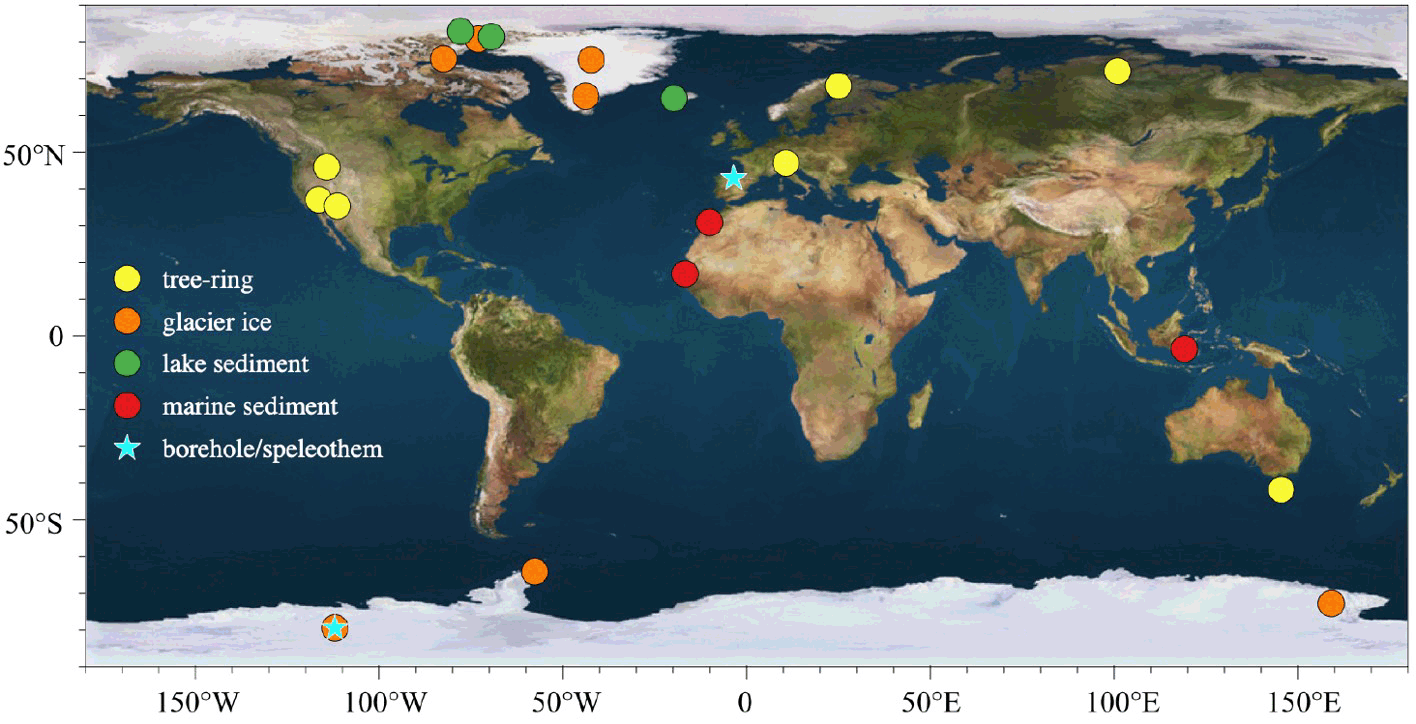 Figure 1 Locations of the proxy data used for the temperature reconstructions over the past 2000 years. The paper looked closely at how all the proxies responded to volcano eruptions, and tree rings do seem to be useful. But without acknowledging that trees love carbon dioxide and grow faster with the fertilization effect of extra CO2, it feels like they are dancing around the point. They said tree rings capture the variability of shorter periods (less than 200 years) but that non tree ring proxies were better for variations longer than 200 years. The news that matters the most to mum and dad voters is that they found a significant long term cooling trend, but that information is buried in the text. And as so many proxies have shown, global warming started back in the late 1600s, long before human emissions of CO2 started. UPDATE: Look at the non-tree-ring proxy — the warming began in the Southern Hemisphere before 1700AD. See also the 120 proxies of Christiansen and Ldundqvist, and the signal in China. What started that? Climate modelers have no idea. It wasn’t cars and coal power. It wasn’t man-made CO2. We don’t understand the big forces that drive our climate, yet we make you pay for your imaginary sins anyway. Study finds temperature reconstructions during the Common Era are affected by the selection of paleoclimate dataKeep reading → August 17th, 2024 | Tags: Hockey Stick Graph, Little Ice Age, Medieval Warm Period, Paleoclimate, Roman Warm Period | Category: Global Warming | Print This Post | |  Every person here is breathing out 40,000 ppm CO2 Elon is scratching for a reason to keep worrying about CO2In the interview with Donald Trump, Elon Musk tried to argue that we ought be limiting carbon dioxide because we are too close to 1,000ppm where people get headaches. Not to put too fine a point on it, but we breath out air at 40,000 ppm fifteen times a minute for our entire lives. If 1,000 ppm gave us a headache or made us nauseous, we’d have to hold our breath every time we kissed someone. @ElonMusk: The point I was making is that, even if CO2 did not cause global warming, it is uncomfortable to breathe air with >1000 ppm of CO2. Given that the outdoor ppm away from cities is now ~420 (lol), it is already getting close to 1000 ppm indoors in cities at times. You can buy a cheap CO2 monitor and measure this for yourself. As the global base level of CO2 keeps increasing, it will cause air quality in cities to feel stuffy and unpleasant, resulting in drowsiness, poor concentration and eventually headaches and nausea. That would not be a good future. And then he quotes CO2meter.com which, ahem, sells CO2 meters, and has an incentive to wildly overstate the problems with CO2, which they do. CO2 is not the problem, the stale air and other pollutants cause headaches and sleepinessThe point of CO2 meters is not so much to warn us about excessive CO2 levels, but to indicate how well the room is ventilated. CO2 levels are just an indicator for air quality. Air with higher CO2 levels usually also has higher levels of organic compounds, humidity, body odour, mold, chemicals from furniture and paint (like formaldehyde) and potentially viruses too. When people report headaches and nausea, the high CO2 levels are not the issue, it’s the bioeffluence that causes problems. When researchers do cognitive tests with pure CO2 added to clean air, performances don’t suffer. The stale air is the problem, not the CO2. (See Zhang, and Misra where they compared the cognitive effects from badly ventilated air and clean air with high CO2 levels up to 3,000ppm. Problems disappear when they use fresh air plus higher CO2.) Well ventilated rooms may also be cooler rooms, which might explain why results so often contradict each other. Classrooms are at 1,000ppm “typically”While outdoor air is 420ppm, indoor levels of CO2 are commonly 1,000ppm in classrooms every day, and can rise as high as 3,000ppm if all the windows are shut. The recognized occupational health and safety levels for long term working exposure are 5,000 ppm for 8 hours straight, five days a week. It’s no big deal. The National Collaborative Centre for Environmental Health (Canada) measured school and buildings and advises that “Typically, in an occupied classroom situation, the recommended level of ventilation would correspond to a CO2 level of approximately 1000-1100 ppm“. Furthermore, they said the “lowest level at which a human health effect (i.e. acidosis) has been observed in humans is 7,000 ppm, and that only after several weeks of continuous exposure in a submarine environment”. The occupational limits for CO2recommended by the American Conference of Governmental Industrial Hygienists (ACGIH) are 5000 ppm (TLV-TWA) and 30,000 ppm (TLV-STEL), based on the direct effects on acidification of the blood. — via Marc Morano and Climate Depot
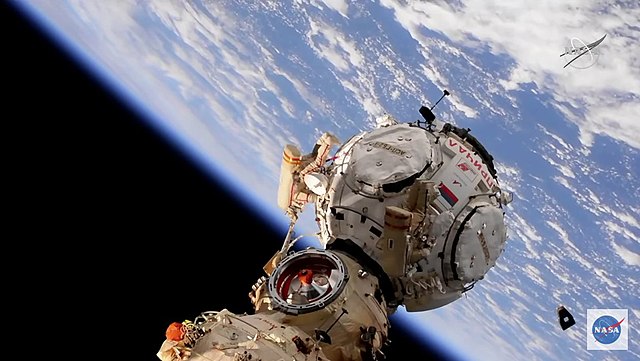
At NASA The Office of the Chief Health and Medicial Officer reports that a typical spacecraft works at around 3,000-7,000 ppm (or o.3-0.7% CO2). The recommended exposure is 5,000, and the permissible exposure limit is 10,000 ppm. Although the flight surgeons found levels of nearly 7,000 were safe and “didn’t affect performance”. On Apollo 13, CO2 levels rose to 20,000ppm. Sweating and shortness of breath became a problem above 30,000 ppm. Submariners typically live with CO2 levels of 2,000- 5,000 ppm, and when a small sample of sailors was tested at 600, 2500 or 15,000 ppm, the researchers couldn’t find any difference in results from an 80 minute test on decision making. (Rodeheffer at al) Likewise another study at the Johnson Space Centre, people did cognition tests at 600, 1,200, 2,500 and 5,000ppm and there was no dose response effect. Results look rather random. Lowther et al looked at 51 studies in 2021, and found nothing conclusive in terms of harms from CO2 below 5,000ppm. Most studies were confounded, results were conflicting. Teams of researchers are hunting to find another problem “due to CO2”. If there was a strong negative effect of CO2 it would have shown up by now. Instead CO2 is only associated with occasional headaches and nausea — probably because it is high in crowded rooms with little ventilation. One large review in 2019 was described as showing CO2 affected people at levels as low as 1,000ppm, but the paper itself points at the confounding data and uses the words “possible” and “potential effects” and concludes “we need more studies.” UPDATE: Commenters Alan Klein and Mr Farnham points out the safety limits for Australian coal miners (NSW) is 1.25% CO2 which is 12,500ppm, and that is for 8 hour shifts. Brief excursions up to 3% (30,000ppm) are acceptable. See comment #17 for more details. REFERENCESLowther, Scott D., Sani Dimitroulopoulou, Kerry Foxall, Clive Shrubsole, Emily Cheek, Britta Gadeberg, and Ovnair Sepai. 2021. “Low Level Carbon Dioxide Indoors—A Pollution Indicator or a Pollutant? A Health-Based Perspective” Environments 8, no. 11: 125. https://doi.org/10.3390/environments8110125 Mishra AK, Schiavon S, Wargocki P, Tham KW. Respiratory performance of humans exposed to moderate levels of carbon dioxide. Indoor Air. 2021 Sep;31(5):1540-1552. doi: 10.1111/ina.12823. Epub 2021 May 15. PMID: 33991134. Rodeheffer CD, Chabal S, Clarke JM, Fothergill DM. Acute Exposure to Low-to-Moderate Carbon Dioxide Levels and Submariner Decision Making. Aerosp Zhang X, Wargocki P, Lian Z, Thyregod C. Effects of exposure to carbon dioxide and bioeffluents on perceived air quality, self-assessed acute health symptoms, and cognitive performance. Indoor Air. 2017 Jan;27(1):47-64. doi: 10.1111/ina.12284. Epub 2016 Mar 7. PMID: 26825447. h/t to Willie Soon, Marc Morano and Climate Depot. Photo: NASA/Mark T. Vande Hei (taking some images of the Russian modules) Jan 2022
|
Jo appreciates your support to help her keep doing what she does. This blog is funded by donations. Thanks!
 Follow Jo's Tweets
   
 
|
|||
|
Copyright © 2026 JoNova - All Rights Reserved |
||||












Recent Comments