The failure of European energy policy has become easy to see lately although the usual suspects want to replace imported coal and gas with more green energy. They double down on the green energy policies that have failed. You couldn’t make this up, but here it is!
None of this is surprising in the light of the failure of the German energiewende – the green energy transition that has been driven by the resurgent Greens since the 1990s.
This video from the Five Dock Climate Realists describes the German Trifecta of Failure – failure on the three sides of the energy policy triangle – price, security and emission reduction.
Wow. What does it take to get a democratic government to stop picking winners in socialist electrical generation? It takes a war, a 50% price rise, and the possibility that 4 in 10 households might be reduced to third world conditions within months.
Share the word — no country on Earth has lots of intermittent renewables AND cheap electricity.
Energy bosses have called for more Government support for households facing a ‘truly horrific’ winter, with as many as four in 10 people potentially falling into fuel poverty before the end of the year.
Energy bills for the 22 million British households not on fixed-term deals rose 54 per cent to just under £2,000 a year on average in April, the last time the Ofgem price cap was reviewed.
The clean Green transition was supposed to reduce costs, create jobs, and set people free, instead the experiment failed everywhere it was done. “Free” energy turned out to be a high maintenance, unenvironmental expensive fantasy loaded with hidden costs:
Analysts have warned of a further jump in the price cap from October, which could see the typical household paying £600 more per year.
Chris O’Shea, chief executive of Centrica, said the situation would get ‘much worse’ without intervention, while EDF’s chief executive, Simone Rossi, said its vulnerable customers could be spending £1 in every £6 of their income on their energy bills.
And the UK government is only considering dropping Green Levies.
Net Zero Watch has called for an end to the subsidies and produced The Factsheet: The cost of green levies (pdf).
According to the Daily Telegraph, “government officials are examining whether the controversial levies – used to fund renewable energy subsidy schemes – could be phased out gradually or dropped altogether….”
Green levies cost the UK economy about £11 billion a year in total, putting £150 a year on the average household electricity bill, and a further £250 per household on the annual cost of living, a total of £400 per household per year. The levies also depress wages and rates of employment.
Dr John Constable, Net Zero Watch director of energy, points out the renewable firms are making out like bandits:
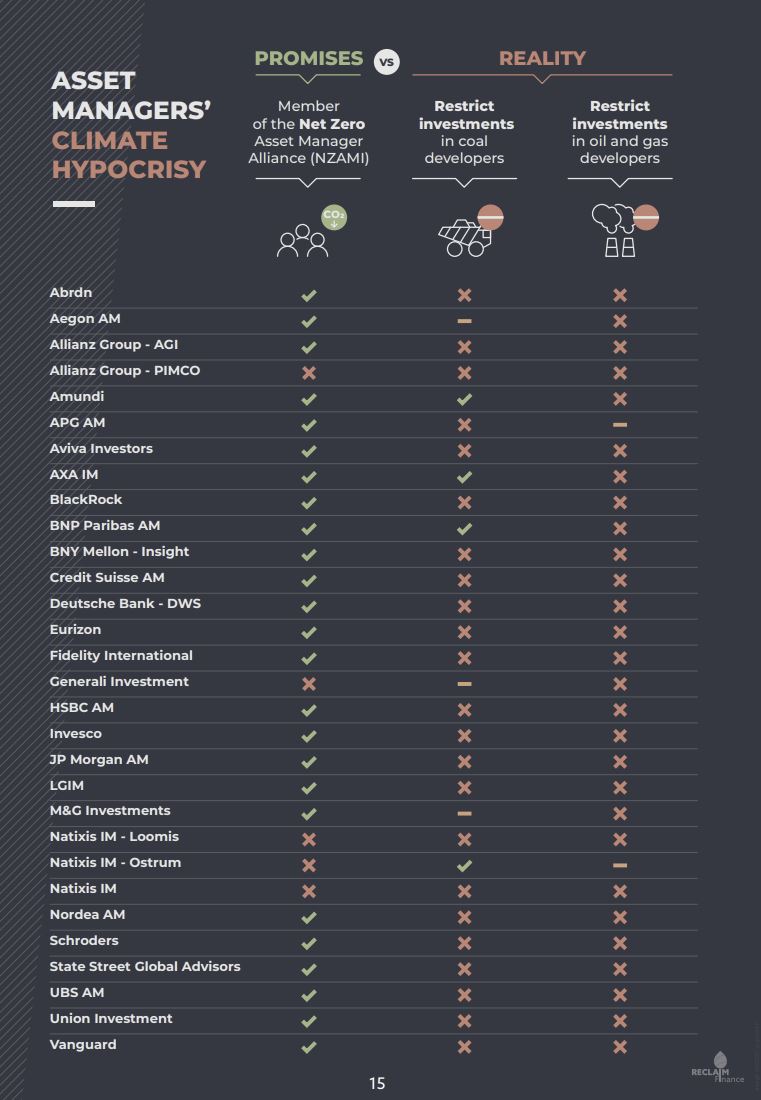
Is there any better proof that “believing” in climate action is just a fashion statement? For all the talk of the end of fossil fuels, the biggest and most powerful funds in the world sign up for their “Net Zero” clubs but pour money into oil, gas and coal, hither thither, anyway.
The 30 biggest funds in the world manage €42.5 trillion in assets. These funds are so big, they can move markets if they want too…
Soak in that hypocrisy
Larry Fink starred at Davos and other events pontification for years on the importance of “tackling climate change”, how it’s an investment risk, and on how “climate change will upend” the way we do business, and how we need to do “long termism“. But he’s the CEO of BlackRock, the largest asset management fund in the world and they don’t mind at all they profit from all the fossil fuels. They joined the Net Zero Asset Manager Alliance, but do almost nothing. Indeed, vocalizing about what bad investments fossil fuels are while investing in them, is like a reverse pump and dump. They’re just scaring off the competition.
Poor old journalists and NGO’s are flummoxed, but at least they are paying attention:
This sort of contradiction wreaks havoc with the Occupy crowd.
Climate Crisis? Fund Managers Are Sticking With Fossil Fuel
A new report alleges broken promises on the part of bankers and asset managers who just a year ago pledged to fight global warming.
Tim Quinson, Bloomberg
None of the world’s largest asset managers has definitively called on fossil-fuel companies to stop the development of new oil and gas projects.
Surely, one would think, given all the climate-conscious talk coming from Wall Street bigwigs like BlackRock Inc. Chief Executive Officer Larry Fink, that the investment industry would be using all of its muscle to press the world’s worst polluters to reduce their production of dangerous greenhouse gases.
Instead, the opposite is true.
Together, 30 of the biggest asset managers have at least $550 billion invested in oil, gas and coal companies that have expansion plans, and even more alarmingly, they continue to provide “fresh cash to companies that are ignoring climate science,” said Lara Cuvelier, sustainable investment campaigner at Reclaim Finance, a nonprofit which published a scorecard Wednesday grading investment firms on their environmental commitments.
Big Government is supposed to fear the free press who criticize it — When the press fear the government, it follows the press prints Fake News. It’s just an arm of Big Government.
Justin Trudeau has invented a Social Credit system for journalists. What could possibly go wrong — Apart from death. corruption and wasted money. It explains a lot — like why virtually none of the news media in Canada covered the Truckers Rally, the problems with vaccines, or discontent among the unacceptable working class people. Apart from Rebel News, the other media outlets were afraid of losing their QCJO, or their subsidies, their income tax breaks, and their right to get into government events.
It’s the oldest trick in the Dictators playbook — make the critics get a license. It’s as bad as it sounds. An anonymous panel sits in secret and assesses something called the Qualified Canadian Journalism Organisational Licence or a QCJO. Not surprisingly Rebel News did not get a license. The invisible bureaucrats claimed that only 1% of Rebel News is “news” and therefore it doesn’t qualify. Which means Rebel News are banned from government events, and punished and downranked on social media (even more than they already are), and their subscribers can no longer claim their subscription costs as a tax deduction. In return Rebel News are suing Justin Trudeau.
Ask yourself if the invisible bureaucrats will get bigger or small paypackets if Canadians vote for Bigger-leftier-governments? Which kind of “journalists” will make the bureaucrats richer?
Rebel Commander, Ezra Levant, points out 99% percent of Canadian Media outlets are dependent on Big Canadian government. 1,500 news media companies in Canada took $61 million in funds from the Canadian Government and none of them reported it.
Thanks to Eric Worrall at WUWT who points out that last year the Biden administration introduced tax breaks for “local media” which are worth as much as $25,000 per journalist.
Biden’s tax breaks for local media an effort to turn them into ‘versions of leftist NPR or PBS,’ critic says
Published November 15
The tax break would allow eligible local media organizations, including newspapers, digital news websites and television stations to receive a tax credit of $25,000 per journalist they employ, and $15,000 for the following four years. The tax break can be claimed for up to 1,500 journalists.
He who is owned by Big Government is unlikely to be too critical of it. The fact that the US government wants to pay off the legacy media shows how important the legacy media is to the government. The fact that the public don’t want to pay for the same media show how poorly it serves them.
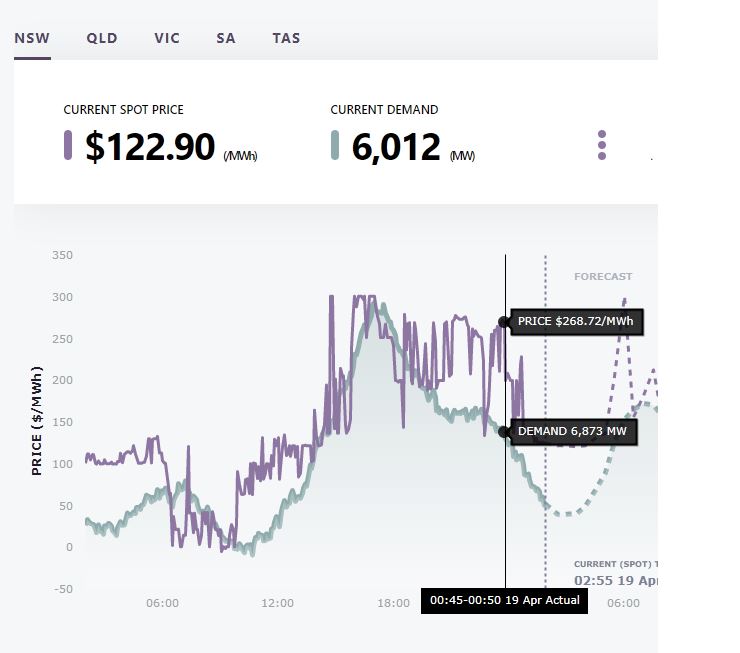
There’s been mayhem quietly running on the Australian electricity market this month. Shh. April used to be an easy month on electricity markets — it’s not summer and not winter, and nothing is stretched. At least not in theory. But this month prices have been running at $150 – $250 per megawatt hour. This is a big rise, even from last month when prices were often $70 – $120 in the big three states. To put that in perspective, six years ago in March, wholesale electricity prices were a tiny $30 – $60.
Last month a couple of units in a Victorian plant suffered a fire. Then on April 1, a single coal turbine at Liddell was retired, and then there was a wind drought, and now, lo, behold “we have lift-off”! Prices are now consistently running at $200-$300 per MWh, and often spend most of the day above $100. Hey, but it’s only been a few weeks.
Don’t blame Russia: Less coal, means more expensive electricity.
The headline makes it sound like coal outages are to blame, when really the only thing keeping electricity prices down in Australia are the coal plants:
…EnergyQuest chief executive Graeme Bethune said the sharp spike in domestic prices was not the result of additional exports of gas from the east coast.
“The spike in domestic gas prices does not appear to be due to any increase in LNG export volumes. In February Gladstone shipped an average of one LNG cargo per day but slightly less at 0.9 cargoes per day in March and in the first half of April,” Mr Bethune said.
“Nor do increases in electricity prices appear to be closely correlated to coal prices. Newcastle thermal coal prices reached a record $US430/tonne in March but were $US276/tonne by mid-April.”
Instead, outages at key coal-fired power plants in Victoria and NSW appear to have caused the spike in both power and domestic gas prices, along with a seasonal fall in solar generation as autumn rains set in across the NEM.
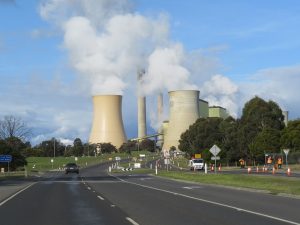
In late March a fire at a coal storage facility at EnergyAustralia’s Yallourn power plant in Victoria’s Latrobe Valley took two of its four generators out of service, stripping 700 to 750MW of power from the system. On April 1 AGL took the next step towards the eventual closure of its Liddell plant in the Hunter Valley, retiring a 500MW unit from the facility.
Mr Bethune told The Australian the winter outlook for east coast gas prices very much depended on the stability of the coal-fired fleet in the NEM.
On an unrelated note: There’s a war. Why do Australian gas suppliers have spare gas to sell?
“If Japan wishes to replace Russian cargoes and the US and Qatar focus on replacing Russian gas in Europe, there is certainly an opportunity for Australia to go a long way towards replacing Japan’s Russian LNG,” the report said.
Don’t most of the Northern Hemisphere want to “get off Russian gas”? Aren’t they supposed to be beating a path to other gas suppliers?
This was actually written by Mark Lawson. We are collaborating on a collection of papers covering the main problems with intermittent energy. He appears frequently in The Spectator and he is a published writer in his own right. His website.
Key points
The use of hydrogen as the medium of a power export market has an obvious, major flaw. Unlike coal or gas, hydrogen can be created anywhere where there is water, wind and sun. Why should any country import the gas when they can make it on their own territory?
Hydrogen is not like LNG. It is much harder to put into liquid form, is much more likely to leak and has different properties which make it a far more dangerous gas.
Hydrogen has been used as a feedstock in many industrial processes for decades, but the vast bulk of the gas is consumed in the same place it is made, from methane and steam. This is a cheaper method of manufacturing than by using electricity.
Energy losses from converting electricity from renewables into hydrogen and then back again at the other end means that it is less wasteful to use a transmission line. These can now carry power over thousands of kilometres. A battery is also a more efficient and safer means of storing power, at least compared to hydrogen.
Hydrogen is already used widely in industrial applications and certain specialised power applications such as fuel cells for submarines, but it has no role at all as a means of transmitting or storing power. Its main role is as a comforting fantasy for activists hoping for the green nirvana.
The worst idea of a bad lot
If we had to hand out awards for the worst idea among all the proposals for generating and storing “clean” energy, then the large-scale use of hydrogen as a sort of alternative to LNG would be a major contender for the top prize.
The very concept of using hydrogen as a means of storing power from countless “pie in the sky” solar, wind and photovoltaic projects has a major, obvious flaw which the many very smart, driven individuals involved in the area (mining billionaires come to mind) have apparently failed to spot.
Unlike power from coal and gas green power can be generated anywhere, and almost any country that can be named has at some point talked about becoming the “Saudi Arabia of wind” as UK Prime Minister Boris Johnson put it. In other words, why would, say, Japan, import horrifically expensive power from elsewhere when they can make horrifically expensive power in their own territory, including coastal waters?
This point was forcefully made by Professor of Engineering at the Australian National University, Andrew Blakers, in the Australian edition of The Conversation, an online site for academic articles, in early April (1). He says that in the March 2022 budget the federal government set aside hundreds of millions of dollars to expand Australia’s green hydrogen capabilities. These funds are supposed to help create a major green hydrogen export industry, particularly to Japan, for which Australia signed an export deal in January.
However, he also points out that Japan has more than enough solar and wind energy to be self-sufficient in energy and – assuming all that energy is harnessed – does not need to import either fossil fuels or Australian green hydrogen. Whether or not you agree with Professor Blakers that Japan can realistically meet all of its energy needs from local renewable energy the country can certainly generate hydrogen locally.
Background
Hydrogen is currently used as a feedstock for many industrial processes such as treating metals, producing fertilizer, and processing foods. Petroleum refineries use hydrogen to lower the sulphur content of fuels. Almost all of that commercial hydrogen comes from the traditional extraction method relying on steam and natural gas. And for good reason – this is by far the cheapest way of extracting hydrogen.
Proponents of renewable energy, however, now want to build hectares upon hectares of wind farms and solar energy generators to make hydrogen by passing an electric current through water. This involves putting two bare ends of a wire attached to a power source into the liquid. Hydrogen bubbles off the wire plugged into the negative side of the source, or cathode, and oxygen comes off the positive or anode wire.
The idea is to store this hydrogen in some way, preferably in liquid form like LNG, then ship it off to where it is needed as a replacement for fossil fuels in applications such as creating steel, generating electricity, powering electric vehicles, shipping and aviation. This is basically the vision set out in a 2019 report (2) produced by the impressively named Council of Australian Governments Energy Council Hydrogen Working Group, chaired by Australia’s chief scientist of the time, Professor Alan Finkel. This report set out pathways for developing such a trade, but it was full of recommendations for developing pilot projects and building supply chains. There was nothing about actual commercial opportunities. Like the bulk of recommendations in green energy the emphasis was on government action in order to create this export market, preferably by creating demand. Commercial interest would follow, or so it was hoped.
Should this hydrogen market come into existence vast amounts of hydrogen would be required but, as was not mentioned prominently in the Finkel report, the process of making, condensing and shipping hydrogen is known to be technical challenging and wasteful.
Professor Blakers cites an estimate that converting energy to hydrogen, shipping it to where it is needed and then converting back into energy could consume 70 per cent of the energy generated. Michael Liebreich, a senior contributor to BloombergNEF (new energy finance) wrote in 2020 (3) that as an energy storage medium, hydrogen has only a 50 per cent round-trip efficiency – far worse than batteries. He estimated that hydrogen-powered fuel cells, turbines and engines are only 60 per cent efficient – far worse than electric motors – and far more complex. As a source of heat, hydrogen costs four times as much as natural gas. As a way of transporting energy, hydrogen pipelines cost three times as much as power lines, and ships and trucks are even worse, he says.
Another factor that is particularly significant in Australia is the need for large quantities of very clean water for the process. This may not be an issue for the small pilot projects that will be funded by government grants, but it will probably preclude large-scale commercial production.
Activists who talk so glibly about using hydrogen to store energy are no doubt thinking of Liquid Natural Gas, which is now the basis of a thriving international trade using purpose-built container vessels. Thanks to enormous projects on the North West shelf and in Queensland, Australia’s exports in LNG are now double those of thermal coal by value.
The international trade in LNG started growing in the 1960s with the large scale adoption of techniques for liquifying the gas in giant facilities called “trains” and for keeping it liquid for long periods in what amounts to giant thermos bottles. LNG requires low temperatures, minus 160 degrees Centigrade, but the gas itself is a source of energy and some of that energy can be used to power the liquification process. Once at that temperature the liquid form of the gas can be stored relatively safely at atmospheric pressures. Apart from a couple of accidents when the technology was new, LNG has an impressive safety record.
All that occurred without the mixed blessing of government direction. The technical problems of shipping LNG were worked out, the facilities were built and customers were found to buy the output before the general public was fully aware of the general usefulness of being able to trade gas across oceans.
As noted, Hydrogen has been produced on a large scale for some time, albeit from steam and methane, but the bulk of it is consumed on the spot. Up to the 1960s hydrogen was also used in town gas pipelines, usually contributing around 10 per cent of the mixture in a still mainly methane system. This became uneconomic with the advent of the large-scale LNG industry.
Unlike LNG, hydrogen presents considerable difficulties in its storage and use. It is a much smaller molecule than methane, so seals and pipes that would comfortably prevent methane leakage do not keep hydrogen in. The liquification temperature for hydrogen is much lower than that of methane, specifically minus 253 degrees centigrade or just 14 degrees above what physicists call absolute zero – you can’t get any colder – and so requires considerably more energy to achieve and maintain. The alternative is to store the gas under very high pressures.
This leads to the problem of safety. Without getting into technical details, hydrogen has different burning and explosive properties to that of LNG and, as noted, a greater tendency to leak.
It is a far more dangerous substance than LNG. History buffs will recall the explosion and fire that destroyed the German airship the Hindenburg in 1937, which used hydrogen to stay afloat. The technology of airships was abandoned after that but the few such aircraft still in service use helium rather than hydrogen to stay aloft. At the very least, major hydrogen systems will require a stringent set of safety rules and procedures which may have to be learned the hard way.
Then there is the problem that switching to hydrogen is not just about slapping a hydrogen tank on an existing engine or using existing pipelines. Everything will have to be redesigned and rebuilt, all at eye-watering cost.
Faced with these inconvenient facts, activists offer counterarguments that range from the feeble to the ridiculous.
They claim that green power will be so cheap the wastage from using hydrogen to store the power will not matter. Really? Refer to the chapters in this book on renewable energy, in any case if it’s so cheap why wouldn’t each country create its own power and never mind any export market? If energy has to be shifted around internally, why not reduce the losses and use a transmission line? If power has to be stored then massed batteries may be almost as ridiculous a solution, but at least it would be cheaper, more efficient and (probably) safer than a hydrogen storage unit.
Another argument is that hydrogen can be stored cheaply in salt domes. These geological features are a key part of the formation oil deposits. The salt can be extracted comparatively easily to form large, underground pockets for gas storage, or so it is hoped. There are development projects in Europe and in the US looking at salt domes but the last word in this area such be left to another BloombergNEF report.
“Storing hydrogen in large quantities will be one of the most significant challenges for a future hydrogen economy. Low cost, large-scale options like salt caverns are geographically limited, and the cost of using alternative liquid storage technologies is often greater than the cost of producing hydrogen in the first place.” (4)
Activists also point to hydrogen’s possible use in town gas supplies. That is at least possible, but town gas mains are now run at much higher pressures than they were in the 1960s, and have been designed for methane, not hydrogen. There may well be safety issues.
There are already niche uses where the advantages of hydrogen outweigh the disadvantages such as in rocket fuel and fuel cells for submarines. However, the use of hydrogen as a means of storing and retrieving energy was the subject of considerable research long before the present activist enthusiasm but, unlike LNG, no technological solution permitting its commercial use in the power system has emerged.
To judge by the large amount of nonsense spoken and written about its use, the main value of hydrogen is not commercial at all. The gas’s main value has been to provide comfort to activists. It is one of the many fantasy stories they tell themselves in the expectation of some day reaching green nirvana, somewhere over the rainbow. It is about as much use as any other fantasy story.
References
(1) Australia plans to be a big green hydrogen exporter to Asian markets – but they don’t need it. The Conversation, April 4.
(2) Australia’s National Hydrogen Strategy, COAG Energy Council
(3) Liebreich: Separating Hype from Hydrogen – Part Two: The Demand Side, October 16, 2020.
(4) Hydrogen Economy Outlook – Key Messages, BloombergNEF, March 30, 2020
The real cost of backing up the intermittent provision of wind and solar power has been spelled out in a comprehensive model that has achieved virtually no coverage in the public discussion of energy issues. This is a scandalous situation that reflects the ignorance and virtually criminal negligence of the journalists and commentators of the nation. This is a short version of the report.
According to all the people who are supposed to know about these things the road to net zero is clear and the days of the coal power are numbered because wind and solar power are so much cheaper. How much cheaper? Well the inputs of wind and sunbeams come free of charge, so how much cheaper can you get!
The CSIRO GenCost study is regarded as the last word on the matter and who can challenge the authority of the CSIRO? It is disappointing to find that the study is full of holes and dubious assumptions. The biggest hole of all is the failure to account for the full cost of firming the intermittent inputs. This is currently provided by the much maligned coalers and it comes free of charge to the wind and solar industries. See here for the frog and centipede relationship between conventional power and the predatory parasites of the RE industry.
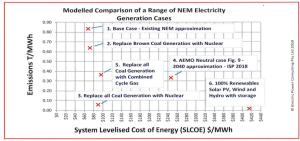
In November 2020 a group of consultants tabled a report in the NSW Parliament with the results of some elaborate modelling work to generate the total System Levelised Cost of Energy (SLCOE) which is defined as — “…the average cost of producing electric energy from the combination of generation technologies chosen for the system over its entire lifetime”
The models include additional transmission costs for various options including replacing brown coal with nuclear energy, replacing coal with gas and 100% RE with hydro and storage.
SUMMARY OF RESULTS
The best policy option to control costs and minimise emissions would appear to be to replace coal generation with nuclear power.
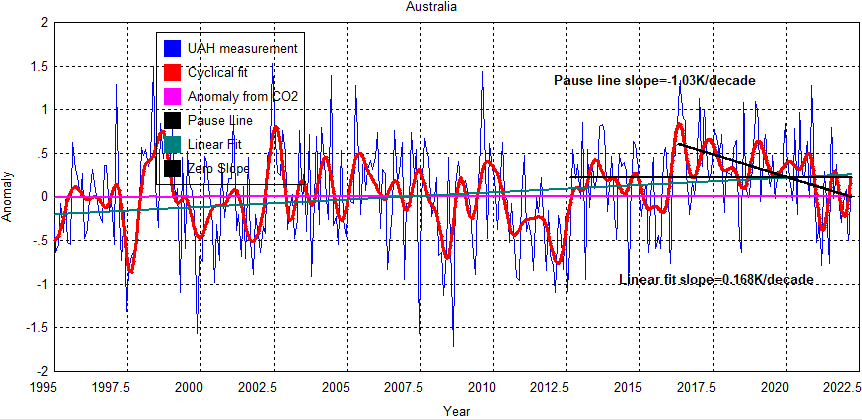
Across the continent downunder, “the new pause” in temperatures is now 9.6 years long as measured by the most reliable system there is — UAH satellites.
If and when we hit the Ten Year Pause, the National Climate Alarm Centres will all issue press releases, just like the other headline events, right? Just like the “Worst bleaching since last year”, “Hottest day since records began” in 1993. Six hot days in a row in one city of Australia.
Which model predicted that temperatures in Australia would do “net nothing” for a decade?
The length of the zero slope pause line is now 9.6 years.
Technically, temperatures have been falling according to the UAH Satellites since May 2016.
Satellites are obviously better for global and continental temperature trends
Assuming we care about trends that is, and not just one-second records. The UAH satellites circle continuously, and cover the entire continent. They don’t just measure 100 small points with thermometers, next to airports and incinerators, but 7 million square kilometers of area.
Some smarty pants will say UAH is bad, because it doesn’t match the land thermometers like RSS does. But that IS the point, RSS was adjusted to match the hyper-adjusted junk on land, and now they’re all terrible.
I explained before why UAH really is so much better:
UAH agrees with millions of calibrated weather balloons released around the world. RSS now agrees more with surface data from equipment placed near airports, concrete, air-conditioners and which is itself wildly adjusted.
In the latest adjustments UAH uses empirical comparisons from satellites that aren’t affected by diurnal drift to estimate the errors of those that are. RSS starts with model estimates instead.
Two particular satellites disagree with each other (NOAA-14 and 15). The UAH team remove the one they think is incorrect. RSS keeps both inconsistent measurements.
Diurnal drift probably created artificial warming in the RSS set prior to 2002, but created artificial cooling after that. The new version of RSS keeps the warming error before 2002, but fixes the error after then. The upshot is a warmer overall trend.
UAH uses a more advanced method with three channels. RSS is still using the original method Roy Spencer and John Christy developed with only one channel (which is viewed from three angles).
We are now alert to the failure of the green energy transition and even more alarming for genuine environmentalists is the fact that “decarbonization” policies are wreaking more havoc on the planet than global warming ever will. That has been going on for decades in plain sight and Michael Moore gave a glimpse of that ugly picture in his documentary film Planet of the Humans. No wonder that the usual suspects tried to close him down, happily without success. Still I have not seen it mentioned lately, certainly not in the “progressive” press.
Bill Stinson of the Energy Realists of Australia has compiled a record of environmental and human rights devastation through ten phases of wind and solar power production, from sourcing minerals to the disposal of work out windmills and solar panels and the remediation of damage (what remediation did you say?)
Phase 1 – Raw material sourcing – Environment Destruction.
Phase 2 – Raw material mining
Phase 3 – Raw material processing – Environment Destruction, Human Rights Abuse, Toxic Waste
Phase 4 – Approval – Supply Chains – Modern Slavery, Human Rights Abuse
Phase 5 – Fabrication – Large Scale Environment Destruction
Phase 6 – Transportation “Throughout the solar PV manufacturing process all of the materials and products must be shipped to and from more than a dozen countries around the world in large barges, container ships, trains or trucks – all powered by non-renewable oil.”
Phase 7 – Construction – Environment Destruction, Tenuous Supply Chain, Toxic Waste
Phase 8 – Operation – Environment Destruction, Flora and Fauna Destruction,
Phase 9 – Demolition and Rehabilitation
Phase 10 – Disposal – Environment Destruction, Toxic Waste
I have been expecting a shakeout in the RE industry for some time because in Australia more and more providers are feeding into a static market. In recent years the demand in the grid has possibly even declined due to the flight of power-intensive industries although the demand for power is projected to increase a great deal in future due to population growth and the anticipated explosion of numbers of electric vehicles (not to be confused with the explosion of the EVs themselves.)
I think the inflated projections of the rise of EVs are rubbish but that is another story.
RE developers in Australia are frustrated by delays in connection due to inadequate infrastructure (poles and wires) and they want the taxpayers to kick in $20 billion of capital expenditure to get them out of trouble. According to our planners in AEMO and associated lobby groups this will pay for itself many times over in a decade or two. In their dreams. Long before that the industry will implode when the impossibility of the transition becomes impossible to conceal when Liddell and Eraring go off line.
The big news about the travails of the wind industry overseas is the increase in construction costs which could be as much as 30% over the last year. At first, it was a supply chain problem due to the pandemic, now the supply chain issues are aggravated by the war and worse is to come as the inflation rate in the economy at large flows into the wind industry. Worse again is the pinch on lithium and other rare earths that will also get a great deal worse.
Even before the latest round of inflation the offshore wind industry in Britain was in trouble. Inspection of the books of the leading wind providers found that the costs of deep-water construction and maintenance were much larger than expected.
All in all it is a fascinating time to watch the end game of the RE fantasy playing out although it has some way to run due to the amount of capital that the woke finance industry and people like Twiggy Forrest are prepared to commit – with some help from the taxpayers of course.
We are approaching a tipping point in the electricity system where there will not be enough dispatchable power available to get through windless nights. When solar and wind power are both out of action at the same time, clearly the lights will go out unless there is 100% backup from conventional power. Forget about grid-scale storage, there is none in sight for the foreseeable future that is feasible or affordable.
The RE enthusiasts get excited every time they record more penetration of wind and solar into the grid. They don’t appear to notice that the same AEMO data that record increasing penetration, also show zero penetration on windless nights. That is especially clear in South Australia where there is always a deficit when the wind is low overnight. They depend on brown coal power from Victoria to keep the lights on, and no amount of additional RE capacity will help.
Those periods of zero penetration are like the holes in the wall of a dam, or gaps in the fence around a paddock of sheep or cattle, or gaps in a flood protection levee. If the dam has a gap in the wall it ceases to function as a dam, the holes in the fence allow the stock to get out and gaps in a flood protection levee eliminate the protective effect.
Building more installed capacity of RE does not help on windless nights because when next to no power is being generated, increasing the installed capacity of the generators by a factor of five, ten or twenty still delivers next to nothing.
To see what that looks like in practice, see the chart from a paper by Paul McArdle who has been studying the low wind problem for many years. Jo Nova reproduced the chart in a recent post.
Bribery is no way to build an empire. Putin’s intelligence and military bureaucrats didn’t believe in the Russian Empire, and they kept the cash they were supposed to use for bribes in Ukraine. Then lied about the bribes and ultimately left Putin in a precarious position. But they too are vulnerable. Indeed Ukrainians are suffering. Russians are suffering. There are few winners and many losers.
Great civilizations are built on trust. Millions of people work most efficiently when they all know the rules, and everyone has a voice. We used to have that.
Comments here by David Evans on the article by Daniel Hannan
The details are only now emerging, and they help explain why Russia is losing in Ukraine and, indeed, why autocracies are often terrible at fighting wars.
By annexing Crimea and taking Donbass, in 2014 Putin tipped Ukraine into becoming majority western-oriented:
Until 2014, Ukraine was fairly evenly split between, to borrow 19th century Russian terminology, Westernizers and Slavophiles. Some Ukrainians wanted to join the institutions of the free world, including NATO. Others preferred, if not a merger with Russia, at least a special relationship with what they saw as the sister nations to their east and north. When Putin annexed Crimea and effectively detached parts of the Donbas region, he removed millions of Russophile voters and thereby gave Ukraine a solidly pro-Western majority.
Putin had thus unwittingly created what was, from his perspective, an intolerable situation. The last thing he wanted was a kindred population on Russia’s border, speaking a cognate language but moving toward liberal multiparty democracy. So he began to prepare for a further and more decisive military intervention.
Bribery was supposed to make a takeover easy, but the bribery bureaucrats took the money for themselves:
From at least 2015, the FSB’s [Russia’s Federal Security Service] Fifth Service was charged with preparing the ground. Large sums were set aside to suborn Ukrainian civil and military leaders. The idea was that when the moment came, senior Ukrainians, such as mayors, regional governors, generals, and police chiefs, would switch sides, opening the gates to their paymasters.
But the FSB’s bosses never believed an invasion would happen. And so, Russia being Russia, they siphoned the cash off into yachts in Cyprus and numbered Swiss accounts.
Imagine the scene when, toward the end of 2021, Putin called his spy chiefs in and asked them to confirm the bribes had been disbursed and that key Ukrainian institutions would throw in their lot with the Russian invader. The terrified FSB leaders assured him that, yes, all was well while desperately trying to find a way out of the hole they had dug for themselves.
Running away was not an option. Their former colleague Alexander Litvinenko had fled to London … [but] was assassinated with polonium in 2006. Another former agent, Sergei Skripal, had moved to the sleepy English town of Salisbury, but he was poisoned with Novichok in 2018 by two GRU operatives.
So the bureaucrats tried to torpedo the invasion by leaking the plans to the US:
It looks as if they did the only possible thing in their position. They sought to prevent the invasion from happening so that their embezzlement should not come to light. The way they appear to have done so is to have told their Western counterparts what was being planned, hoping that, once Putin knew that his plot had been uncovered, he would drop it. Hence the detailed knowledge that Britain and the United States had about what was coming — knowledge that their governments made public and that Putin lamely denied.
Corruption hobbled the military too:
It soon emerged that much of the money set aside for the modernization of the Russian military had also been diverted into private bank accounts. Tanks lacked basic spare parts. Weapons systems failed. But, again, no one wanted to be the bearer of bad news.
Why autocracies fail but democracies succeed — freer speech:
This brings us to a counterintuitive truth. Democracies, supposedly soft, decadent, and convulsed in culture wars, often turn out to be better at fighting than brutal dictatorships. This is not because their people are braver or more virtuous — it’s because they have systems in place that allow for greater transparency and speedier error correction.
Fascinating. It all fits, and explains much. Probably true.
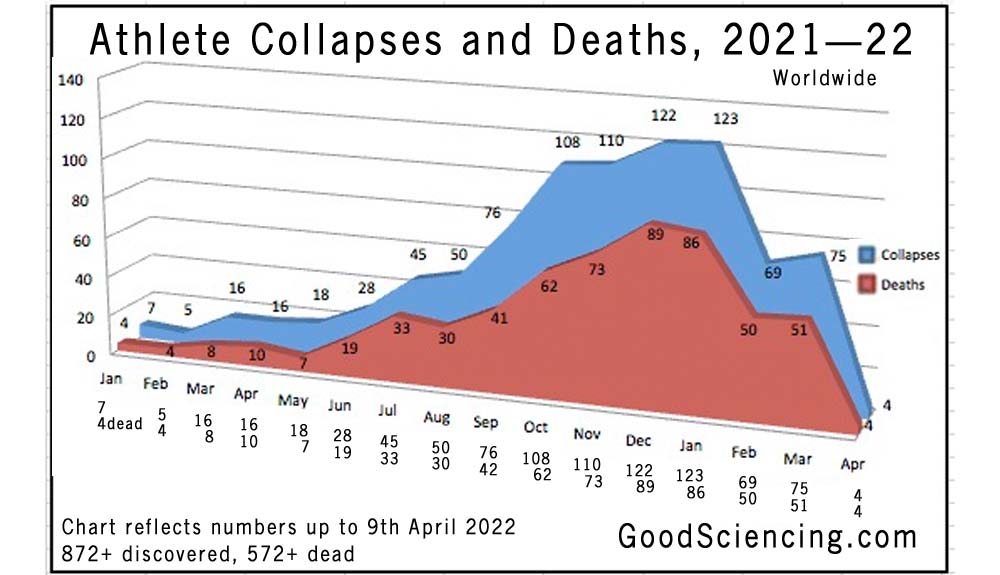
There are people tracking all the reports of athletes suddenly collapsing and dying in their prime, or heartbreakingly, even in their teens. This isn’t a definitive study, but where are the answers and why don’t we know them? There are a hundred million reasons to supply data that shows vaccines are “safe and effective”. If our health really did matter, and the incidence of sudden deaths in athletes was the same as every other year, where are those studies? Why aren’t we discussing this on the news?
Some of the collapses and deaths listed here may have nothing to do with vaccines, the anonymous researchers admit and declare that. They want the full data, we all want the data. But it’s nowhere to be found. The medico’s and football clubs, and the Department of Health have gone from bragging about getting their boosters on Twitter to saying nothing. They are not so keen anymore to report or declare vaccination status.
The rise in mid 2021 start at the same time a massive experimental medical program starts. It might be coincidence, but if it’s normal, they would be saying so, with open statistics and data, not shutting down the conversation, and sacking football managers.
The mainstream media still are not reporting most, but sports news cannot ignore the fact that soccer players and other stars collapse in the middle of a game due to a sudden cardiac arrest. Many of those die – more than 50%.
There has been a rise in reports of athlete sudden collapses and deaths since July last year. | Goodsciencing.com
What’s a normal year?
A review of sudden cardiac deaths in sport found about 29 a year mentioned in medical literature. A different study of the US found about 70 annual deaths across 38 different sports. There are more deaths listed in the peak months in that graph above than usually occurred in an entire year.
The International Olympic Committee in Lausanne, Switzerland, studied documents from international data banks from 1966 to 2004. Those documents indicate 1,101 sudden deaths in athletes under 35 years of age, an average of 29 athletes per year, the sports with the highest incidence being soccer and basketball. (NIH Document)
A study by Maron on sudden death in US athletes, from 1980 to 2006 in thirty-eight sports identified 1,866 deaths of athletes with cardiac disease, with a prevalence of hypertrophic cardiomyopathy.
More people are writing to tell us that in many cases, we didn’t mention a person’s vaccination status. There is a good reason for that. None of the clubs want to reveal this information. None of their sponsors want to reveal it. The players have been told not to reveal it. Most of their relatives will not mention it. None of the media are asking this question. So what should we do? Stop this now? No, we will collect as much information as we can, while it is still available, because eventually, more information will come out, and we will be here to put it together. Will it mean anything? We don’t know. What we do know is that there is a concerted world-wide effort to make this information go away, so that fact alone tells us it must be collected, investigated and saved so other researchers can look at it to see if there are any useful patterns.
Clubs Hide Vaccination Information Now
Here is a demonstration of how sports clubs do not want the injuries of deaths of their players to be associated with the COVID vaccines. It tells the story of why they will not report which of their players has been vaccinated and when. Sunderland FC manager Lee Johnson suggested that the COVID vaccines may have caused the heart issues for his goalkeeper, Lee Burge. The club then sacked the manager.
As a director of The Australian Environment Foundation I am delighted we were able to bring Benny Peiser out from the UK.
Bookings need to be done in the next few days!
Australian Environment Foundation
Dr Benny Peiser who heads up the London based The Global Warming Policy Foundation, is visiting Australia and speaking at three major events in Sydney 26 April, Brisbane 27 April and Melbourne 28 April.
Benny Peiser
Dr Peiser has written extensively on domestic and international climate policy and has appeared on numerous media outlets to contest global warming alarmism and demonstrate the cost of policies being proposed to address it.
His visit is especially timely given the European – indeed global – energy crisis and the key issues of energy and the environment that are prominent in the Australian federal election campaign.
What can the UK tell us about renewable electricity? Benny Peiser points the way ahead on renewables based on the UK and world experience. He is a climate change expert and a complete Renaissance Man who brings a contemporary and historical social perspective to the issue, as well as deep knowledge of the science and policy solutions.
As an example of his breadth of interests his name is literally written in the sky with a minor planet bearing his name, in honour of his work on “near earth objects and impact hazzards”. He is a former member of the German Greens, holds a PhD in Cultural Studies for a thesis examining the history, archaeology and natural history of Greek problems at the time of the ancient Olympic Games.
Nigel Lawson, Margaret Thatcher’s Chancellor of the Exchequer founded the GWPF in 2009, and under Peiser’s direction it has become a major source of climate realist policy in the UK.
The event includes lunch and drinks so prices vary from $135 ($100 for students) or more. See the link for options. Book a table of ten and get a discount!
The AEF has invited Benny Peiser to visit Australia to deliver the Bob Carter Commemorative Lecture for 2022. Dr Peiser will speak on “The Global Energy Crisis, Net Zero Emission Targets and the War in Ukraine” at the Hawthorn Arts Centre, starting at 6:30 pm.
Sadly, not for Western Australians, Tasmanians, the NT, South Australia or New Zealand this time. Perhaps it’s time to arrange some other events for skeptics?
We use cookies to ensure that we give you the best experience on our website. If you continue to use this site we will assume that you are happy with it.












Recent Comments