
By Jo Nova
Spare us from being the Boring Nation
Today is the last day to put in a submission. Extended now to Nov 10th!
The Nanny State wants to reduce speed limits to save lives, instead of building better roads
Lord help us — a few bureaucrats who probably have never driven past Parramatta think our country roads will be safer at 70 or 80 kilometers an hour. By making road trips 10 to 30% longer, and 100% more boring, they may even kill more people than they save.
When every trip becomes a longer trip there will be more drivers still on the road at dusk and in the dark. Every extra hour on the road is an hour less to sleep or an hour less with family and friends. So drivers will either be more tired or more lonely. And when a four hour trip becomes a five hour trip, some will choose not to go. Some weddings will be a bit smaller, hospital visitors a bit rarer. Tourism will suffer. Businesses will close.
The repercussions of this change is a burden on so many aspects of our lives, most of which the “safety modelers” didn’t even think of. We are in effect slowing the whole nation. It will lower productivity, raise the cost-of-living, increase social isolation, causing mental health damage and depression. On the nation with one of the lowest population densities on Earth, it is some kind of anti-human plan to increase the distances between us. Technology brings us together, but bureaucrats push us apart. It will reduce health care in country areas, and limit holidays all over the country. Add some heart attacks, suicides and divorces to the mix. Almost none of which the “modeled” costs include.
Australia — the slow nation?
What price the reputational damage as Australia becomes known as a tedious nanny state of quaking chickens afraid to drive at normal speeds on straight, dry highways with hardly any traffic? How many tourists will be turned off — bored away? How many skilled migrants will balk at moving to a grandma nation?
Any driver with sense can already slow to 90 km/h when the road is rough, the weather bad, or the traffic heavy. Changing the signs just forces safe drivers to crawl on good roads in good conditions, while the reckless ones keep being reckless — they will just have to dodge the slow cars.
The deadline for submissions about this is today, Monday. (click here.) UPDATE: Extended to Nov 10th
Just [a day] left to have your say on country road speed limits
Australians have just a few days left to have their say on a Federal Government proposal to reduce speed limits on rural and regional roads.
The Federal Department of Transport is seeking feedback on a proposed reduction of the speed limit on roads outside of built-up areas where there are no sign-posted speed limits.
A consultation paper released in conjunction with the review suggests speed limits could be reduced to 80km/h on sealed roads and 70km/h on unsealed roads.
David Littleproud, leader of the National Party says:
“Regional Australia have lost over $3300 a kilometre in federal funding to maintain our roads, our national highways.
“This is about saying regional Australia doesn’t matter and that we’re not going to fix your roads, we’re going to let them crumble and you’re just going to have to drive slower.
The window for public feedback closes this coming Monday, October 27.
For more information or to have your say on the Department website click here.
This could be one of the more absurdly incompetent, biased reports I’ve ever seen
Consultation Regulatory Impact Analysis, Sept 2025
It’s like the researchers added in every benefit they could think of, forgot almost all the real costs, and ignored the twenty other variables that matter. One of their core points is that people die on country roads 11 times more often than city people do. Strangely, this is “per capita” not “per kilometer”? How did they not bother to do this properly?
Also strangely, they seem to think that these rates should be the same. Country deaths are “over-represented” they say. It’s like hoping that workplace accidents on oil rigs will be as low are they are for check-out chicks at Coles. I mean, we want them to be less, but we don’t stop drilling until they are.
If speed was the main killer why are the inner regions at 100km/h so much safer than remote regions at the same speed?
Statistics show that the big killer on Australian roads is the distance from the major cities, not the speed limit. In very remote areas the speed limit is the same as the inner regional areas, but the death rates are twice as high.
-
The annual road-death rate per capita for Australia in 2024 was ~ 4.78 deaths per 100,000 population. But there is much higher risk in regional/remote areas:
- Major cities: ~ 2.0 deaths per 100,000 population.
- Inner regional: ~ 9.1 deaths per 100,000.
- Outer regional: ~ 12.4 deaths per 100,000.
- Remote: ~ 18.4 deaths per 100,000.
- Very remote: ~ 22.2 deaths per 100,000
— REFERENCE: Road Trauma Australia 2024. Statistical Report on fatalities and hospitalized injuries from road crashes in Australia, Bureau of Infrastructure and Transport Research Economics (BITRE). p7
Could it be that more people die in these areas because the roads are worse and if they crash it takes them 2 hours longer for the ambulance or flying doctor to get there (if they are lucky)?
The cause of deaths on remote roads is probably due to roads being in poor condition, with people driving run-down 40 year old Holden Commodores without ABS, and dealing with fatigue from driving ten hours in a row on a Chico roll and Barbecue chips. Ask yourself if slower driving speeds will solve that?
Ask yourself if a go-getting nation would fix deaths on bad roads in old cars by making new cars drive slower on good roads, or by building better roads, increasing prosperity and making newer cars more affordable?
Freight costs up just 10%? I don’t think so…
Truck drivers have strict fatigue limits. Some one-day return runs will now become two-day jobs with overnight stops. The modelers claim freight costs rise just 10 %, but once duty-hour caps are breached, costs jump 30–50 %. They also claim trucks will emit less CO2 because they’ll be driving slower — yet we’ll need more trucks to move the same freight in the same time.
Australia moves roughly 80 billion tonne-kilometres of freight by road each year (BITRE 2024). This keeps our mines, farms, supermarkets and petrol stations in operation. Even a 5 % system-wide productivity loss adds billions in costs — all feeding into regional produce prices, construction materials, and rural tourism.
What’s the cost of rebuilding trade-routes?
The nation is set up for 100km/h travel. Distances from cattleyard to cattleyard, petrol station to petrol station were all planned for human drivers at 100 kilometers an hour (except in WA where it is 110km/h and the NT where it 130 km/h). If we mess with that, all kinds of little things will break. More food will be wasted on longer hauls that have to sit overnight. Some crops may no longer make it to market in time. On the edge of the “travel day” farmers may have to change crops. Routes and rest stops will have to be shifted. Patterns will have to be moved. It all costs.
Reducing road noise will help… the kangaroos to sleep at night?
The paper claims slower driving speeds will save lives because traveling slower reduces noise pollution and that “therefore” will improve sleep. Say what? We are talking about 750,000 kilometers of roads that mostly don’t have houses beside them? Are we worried about REM sleep in Bunyips?
It’s like this report was written by a high school student in Ultimo.
To reinforce their point (and their incompetence) they cite a US study where people were “willing to pay $8.83 annually” to reduce it. Ouch, that much? (It must be a typo? p61)
Furthermore, they say, there was a Swiss study that estimated deaths would be reduced if cars drove slower. That team modeled the effect of reducing city speeds to 30 kilometers an hour, and the Australian team are extrapolating that to unpopulated areas at the back of Bourke and beyond at 100km/h? But, hey, it might save some kangaroos.
Getting carried away, they tell us slower speeds will improve traffic flow. (More proof they’ve never gone west of Parramatta). They have so little evidence of benefits, clutching at straws, they dig out a twenty year old study of peak hour traffic in an urban situation that shows reducing speeds to 60km an hour “may improve traffic flow”. (p62) Which will be a huge benefit the next time there is a peak hour rush at Cunnamulla.
They’re obviously desperate to find things to fill out the benefits column…
Words not mentioned in the consultation paper include: dusk, tourism, divorce, sleep loss, darkness, night time, poverty, business closure and cost of living.
With a careless flick, some bureaucrats will make Australians poorer and more isolated, then, when financially stressed people who are driving older cars crash more often — the bureaucrats will reduce the speed limits again.
Traffic safety is so much more complicated that a computer model
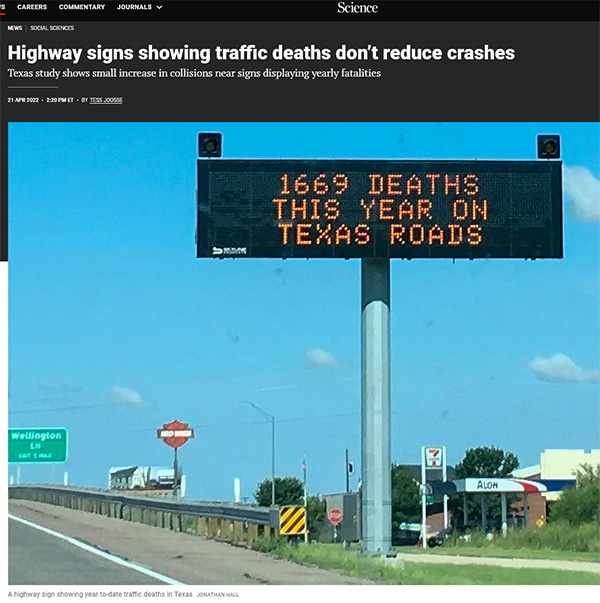 Some bright sparks in Texas put up glowing death toll score board message in neon lights near a highway in Texas. They were sure they’d save lives, but the study showed the giant death toll messages actually increased accidents by 1%.
Australia could make this kind of mistake on a national scale. Let’s not do that.
h/t another Ian, El Gordo
REFERENCE
Consultation Regulatory Impact Analysis, Sept 2025
Car image at the top by Cortex Zone from Pixabay






In the UK, in 2014 there were about 2500 miles of roads with a 20mph limit, by 2023 that had approximately tripled. The KSI stats haven’t really changed much in that time.
And they’ve been widely reducing other speed limits down as well.
https://upload.wikimedia.org/wikipedia/commons/thumb/d/d0/Killed_on_British_Roads_1926-2024.png/960px-Killed_on_British_Roads_1926-2024.png
That doesn’t stop the authorities claiming success and expanding 20mph zones to try and make it the national urban default by stealth.
281
They tripled because in 2023 Wales reduced the default urban speed limit from 30mph to 20mph. The Welsh hate it.
220
Anton,
30 Km/hr in Manly Central feels like you are crawling
Next Step for Greenies – Person walking in front of your car with Red Flag and like Yellow Loolipop Stop/Go you will have to pay for them!
The Creep down Hume Highawy to Melbourne is unbearable – pull out to pass at 110 Km per Hour and slowly creep past over 10 Km
We should go with Swiss 130 Km/hr Dry, 110 Km/hr Wet
As Top Gear Showed on Modern Brake Car Test in NT – standards were based on 1950s Cars Capabilities
250
“Person walking in front of your car with Red Flag”
Green jobs …
Auto
00
Yes wales did, but there’s been loads of other local schemes and London, and I think Scotland wide is coming soon.
70
Oh well all the camels that’ll soon be the main transport mode will be safe!
140
The only reason the government wants to reduce the speed limit is because they know people will speed, get caught CHACHING, CHACHING $$$$
130
As well as the money from speeding fines, there is ample evidence that Australian and British governments have people who hate cars and work hard to get cars banned, and/or more expensive, and/or more for the elite instead of for everyone qualified and/or not for the elderly people, not for the elderly cars, not big cars but small, not powerful engines but tiny, etc etc.
I used to enjoy big cars like 308 cu in (5 litre) V8s in Holden Statesman, Ford Fairmont. Did 500 km Kalgoorlie to Perth in 5 hours, 256 km Jabiru to Darwin in 2 hours several times, 888 km Melbourne to Sydney or the other way in 9 hours, about a dozen times. Many more trips between towns like these, Post Office to Post Office. Never a hint of any emergency, but it needs high concentration all the way. Geoff S
Geoff S
50
Proving something I’ve said for some time: whatever a leftist government gets away with somewhere in the world, you can bet will subsequently be rolled out everywhere.
It’s like they’re all competing with each other to be the most authoritarian, “Look what WE got them to do, LOL!”
290
100k limit on secondary roads is fair, but on freeway or motorway south from Sydney it should go from 110 to 120 as it’s a very easy dual carriageway to drive on, no sharp bends or steep gradients. the M1 going north across the Hawkesbury has both and in places requires 90 or 100 limit.
211
Because, at present, putting speed cameras up out in the boondocks isn’t profitable enough.
90
And having police cars with speed camera and occasional flashing lights is even more expensive
30
But far more effective.
20
More the point, since the 1970s Australian freeways have been built for 130kmh standard speeds, not 110kmh speed limits.
“Standard speeds” means the cambering on curves, lines of sight, breaking distances, etc.
You are actually safer driving on them at 130kmh because at 110khm they are trying to drop you off the inside of a curve.
If you car’s suspension and wheel alignment is set up right it is actually quite possible to drive hands free for extended distances on Australian freeways (not something I’d advise doing as there can be other factors in play such as other traffic, wandering animals, weather, etc.) in ideal conditions.
50
Potholes and cracked pavement.
40
In Australia road speed limits are managed by each state, so a federal limit does not make sense. Your table from Road Trauma Australia clearly shows that more needs to be done to prevent road deaths outside metropolitan areas.
Please note that the acceptable risk for Australian is around 1000 road deaths per year, 10 by guns, 0 for air travel and 5 for sharks.
163
oh and another thing, most of the road deaths in the regions are generally locals, the explanation is that because you have driven that route many many times you become complacent. Single vehicle accidents are another story, one which is too dark to publish here
123
This>is true, but once again they mostly appear to be in the under 30 group – same in urban areas. Another problem noted with poor arterial road surfaces ( Bruce Highway north of Mackay) is the increase in travelers towing caravans and boats which end up overturned on the side of the road. Nonetheless regulating or revising down the speed limit will cause more frustration and more impatience leading to an increase in fatalities.
150
>most of the road deaths in the regions are generally locals, the explanation is…
… because most of the kilometres driven in the regions are by the locals
220
“Most of the road deaths in regions are locals” is as stupidly obvious as saying “most of Victoria’s road deaths are Victorians”.
Where else would they be driving?
India?
152
There should be zero shark related deaths. Ban sharks.
160
Eat sharks!
120
What a ‘flakey’ idea……
140
Don’t be silly- we merely need to reduce the speed of sharks. Restricted sharks will be unable to attack less swimmers and surfers.
80
What % of accidents are a direct cause of alcohol, drugs , vehicle maintenance or idiocy??
110
How many iatrogenic deaths are acceptable?
30
“west of Parramatta”
Sherly you jest. Within 400 kms of Parramatta there are town names so interesting that if I visited the region I would go to each one and have my picture taken beside a sign with the name. And I would want to know the origin of the name.
90
Been to Widgiemooltha?
41
That’s in Ireland or Wales is it??
30
Yes. Used to regularly pass through when working out of Kalgoorlie. Lots of Roos down that way.
00
Somebody was reputed to have lost their car when they drove out into Lake Lefroy, a very large salt lake there. Car was bogged, and when driver returned later, car had vanished. Also road to Norseman was a single bitumen road going over high crests. Always a hairy drive – you never knew when somebody was in the middle when driving over the crests.
[Please, this is all headed off topic. –Jo]
20
This is all part of the Left’s war against that product of capitalism they most hate, the private motor vehicle.
They have always done everything they can to restrict and tax its use and do whatever they can to restrict the massive FREEDOM given by the car because the Left fundamentally hate freedom
And there is zero evidence that lowering speed limits which are already sensible saves lives. Do they want someone with a red flag walking in front of every car?
This false claim arises from some taxpayer-funded “academic” “research” done some years ago in South Australia “finding” that supposedly excessive speed was the cause of many accidents. That was based on police reports but not proper forensic accident investigation which the police never did unless fatalities were involved.
However that “research”, being taxpayer-funded gave the answer that the Government wanted and it was used an excuse to remove the speeding tolerance traditionally afforded to Australian motorists which was +10% which was the tolerance permitted on the accuracy on Australian speeds until June 2006*. Now by law speedos must read LOWER than the actual speed by up to 10% + 4 kph so at an actual 100kph the speedo might read 114kph, but not less than the actual speed.
So because speedos can only read faster than the actual speed, it is already falsely causing motorists to drive slower than they otherwise would be permitted to anyway unless they independently check their speed with GPS.
In fact being forced to drive at an unreasonably slow speed may contribute to accidents more because of driver boredom and being forced to monitor their speed constantly thus keeping their eye on the speedo and not the road.
Also, most Australians don’t realise that until about 1978 (NSW), 2006 (NT), on country roads with no posted speed limit there was NO LIMIT. It didn’t mean you could drive as fast as you wanted however, you were still expected to drive at a safe speed according to the conditions. But it wasn’t conducive to raising fine revenue and removing freedom.
Now, removal of this speeding tolerance due to a potentially under-reading speedo and the false claim that speed waa a major cause in most accidents, set the Government on a path to major revenue raising by enforcing virtually zero tolerance on minor speeding and further ruthless warfare against the freedom-loving private motorists.
I just drove to Sydney and back and I estimate that there was around 100 speed cameras on the trip including instantaneous speed cameras, mobile speed cameras, average speed cameras and mobile phone and seat belt cameras as well, a further intrusion of the Nanny State into the privacy of your vehicle cabin. Also, on thst road, 110kph is an inappropriately low speed. It should be 120 to 140kph. I believe it was originally designed for a much higher speed limit than 110kph.
Unfortunately with this enquiry, which I hadn’t heard of until Jo pointed it out, most people will not have heard of it and will not respond. This the Left make another “win” and remove another freedom.
* https://www.trafficlaw.com.au/speedos.html#:~:text=(Displayed%20speed%20minus%20true%20speed,anywhere%20between%20100kmh%20and%20114kmh.
390
This is all part of the Left’s war against that product of capitalism they most hate, the private motor vehicle… there is zero evidence that lowering speed limits which are already sensible saves lives. Do they want someone with a red flag walking in front of every car?
Yes, of course. With a hammer and sickle on it.
340
The hammer represented industrial workers and the sickle represented those who work on the land. Today in many Western countries we have outsourced our industries to China and our farm land is increasingly built on or covered in solar panels, even in Britain. The only people left for the hammer and sickle to represent are the political commissars.
30
Over in NZ, the incoming government reinstated all the speed limits to 100km and some areas increased them to 110km. The previous labour government dropped all the speed limits in urban areas. The incoming National Coalition reinstated the urban 50km limit except around schools. So its the communist agenda plus the UN and WEF who are causing the fuckery with common sense regulations. They want to piss you off as you go about your daily lives and business. Just ditch the commie govt, they will bankrupt Australia if they get 2 more terms.
130
They have all the terms they need already.
Motor cars and machinery are my pet hates. As Herc Scott said 100 years ago, “They break you buying bloody duplicates”.
The r e d fag idea predates Herc’s call. But don’t tell the current government. They would use it to “Create” amployment.
20
In NSW alone, back in the1950s and 60s, the annual death rate through road deaths was over 1000, and the Pacific “Highway” between Newcastle was a notorious contributor to that count. Now that contribution is low, perhaps vanishingly small. How so?
Try straightening the road, changing from two lanes to 4, and even adding slow vehicle lanes to that, merging lanes, overpasses and even visible road signs and we’ve got fewer much more traffic, shorter trip times and fewer deaths. Better add a good road surface. into that list.
Speed? Increased from an average of about 30mph (48 kph) to better than 80 kph.
80
I opposed its introduction, but was proven wrong. Compulsory breath testing was the driver of the reduction in road deaths.
30
In the late 70s the road death toll in NSW was 1450. With twice the number of cars driving much faster the toll these days is about 350, a quarter of what it was. Add the doubling of cars and it is now effectively one eighth. Ted1 put his finger on the reason, less drunks but also seat belts, better cars and better, but not great, roads.
20
130kph, according to my civil engineer brother who first worked on building a freeway all the way back in the early ’80s.
It’s been 130kph designed standard speed since the ’70s.
40
If the government claims that they are doing something for ‘your safety’, be sure that their motivation for promoting a particular change is fueled by something entirely different. It will make touring Australia by private vehicle practically impossible.
I see this latest move as another nail in the coffin of a free and accessible Australia.
In addition to this latest proposal, we now have other ‘initiatives’ that limit our access to this great country. Some areas have been handed back to minority groups, based on historical considerations. More recently we have the UN 3030 initiative, where our access to a significant portion of our land and waterways will be prohibited ‘to allow nature to return’. Another is the limiting of access due to ‘biosecurity risks’, by the installation of signs on practically every gate on every road in outback Australia.
To truly address the issue of road safety, we could start by fixing up our roads, by rigorously enforcing our existing road laws, and by keeping poorly trained drivers off the roads. In recent years there has been an observable increase in the number of vehicles running red lights, as well as showing very poor road sense.
260
“More recently we have the UN 3030 initiative, where our access to a significant portion of our land and waterways will be prohibited ‘to allow nature to return’.”
Unless “nature” needs to be demolished to build solar and wind generators, and new transmission lines to connect the electricity to the users.
140
More than ever Australia needs a pro-science, pro-reason, pro-freedom, anti-Nanny-State Government.
Unfortunately Australia is a virtual One Party State with the most extreme Left Government it has ever had and with no conservative opposition political party.
Thus the Labor Party Government is doing whatever it pleases without restraint.
It’s vitally important that thinking Australians put their efforts behind actual conservative parties (not fake conservative Liberals) at the next election.
270
” It’s vitally important that thinking Australians put their efforts behind actual conservative parties (not fake conservative Liberals) at the next election. ”
Yes, David, a lovely dream.
But just by looking at the last results you forgot the AEC.
90
It would be more productive if the Coalition split over Net Zero and the Nats attracted splinter groups to form a new coalition.
Barnaby stays with the Nats and Hastie comes across to join the party, along with other Liberal heretics. Without doing the sums I think its possible to win the next election.
41
Not with Littleproud as Leader. Back during the last drought, when he was Minister for Agriculture and Water Resources he accepted the bureaucracy’s line that there was no more water for the farmers at the same time as the Murray and Murrumbidgee were being run at near flood levels to keep Lake Alexandrina fresh.
All he need to do to find out that the bureaucrats were lying to him was go visit a town, any town, downstream of Albury or Yass and look at the river levels.
50
Agreed, Littleproud has to be replaced, Canavan has the ability but lacks the numbers.
31
The Left reason that when they impose their “15 Minute Cities”, rebranded in Australia as “20 Minute Neighbourhoods”, on we non-Elites, we won’t need cars anyway. We’ll all be confined to those free range prisons.
Australia has become a horrifying example of what happens when a country no longer has a conservative party and the Left can do whatever they please toward achieving their Orwellian dystopia.
220
Deaths per 100,000 instead of per km. What a joke.
I live in NE Vicdanistan, just to go to the shops I’m looking at a 90km round trip. How many city folk get to do that? Anyone up here who has to drive to a work place each day is probably doing close on 500km a week just in traveling to work, that’s 25k per annum, long before you factor in a weekend drive to the shops or heaven forbid a holiday.
On that stretch of road, (to town), I’ve got potholes that are due to start pre-school, grass often nearly a metre high which restricts vision from roads entering and single lane bitumen seals with heavily eroded edges. No wonder that people are dying.
The last fatality in this area occurred a couple of years back, a woman towing a horse float ran off the road on one of the single sealed sections and collided with the ditch beside the road. It was dry, daytime and the sun was on the side, not along the road. The incident would most likely not have happened if the road was sealed full width, allowing a little more room for correction if a horse shifted or similar.
Any sensible traffic count on this road would have resulted in a number that confirmed a single lane as insufficient for the traffic volumes. We all pay fuel tax on these roads yet they just crumble to pieces with the obvious outcomes, (as mentioned above).
The solution. Lower the speed limits. No. The solution is to fix the roads.
340
Have you looked at Melbourne , Sydney and Brisbane in the last 10 years? One way commutes of 50+km per day are not uncommon.
Lote of people live in Geelong and commute to Melbourne city. Pakenham to Melbourne city. Gold Coast to Brisbane city. Gosford to Sydney city. Blue mountains to Sydney city. Pakenham is 64km from the City. Geelong to Melbourne City 75km.
I have known people over the years who have spent the best part of 4 hours on their daily commute. I did at least 90 minutes each way for a few years but only around 45km each way through congested Sydney goat tracks that became roads.
170
Drive the M1 on any morning here, south of Brisbane, and you’d swear everybody who lives in Brisbane works on the Gold Coast while all those living on the Gold Coast work in Brisbane.
80
I was just doing that the other day, and I’d swear everyone living in Sydney and Cairns were also driving to work in Brisbane! Sheesh!
00
Yes, but they aren’t doing it on the roads described. I drive some of them on occasion, and have been driving them for nearly 50 years and traveling on them over 60.
They are a dangerous disgrace.
Back before the ALP got into power in Vicdanistan for the first time in nearly 30 years (power they have held for 33 of the last 42) Victoria had by far the best country roads in the nation. It also had the best highways, the best education system, the best health system, and the cheapest electricity in the world.
40
Small town near me, geriatric population for most of the year, had the speed down the main drag and past a school (about 30 students ) reduced to 40 kph. As always public option was solicited, most of which didn’t want the reduced limit. Speed reduced regardless.
Old curmudgeons ask questions that those in authority despise.
1/ When was the last recorded accident in this town.
answer, sometime in the 1960’s.
2/ How serious was this accident was anyone injured.
answer, No it was a minor accident.
Solution to non problem reduce the speed limit to 40kph anyway. great opportunities for the highway patrol to make a bit of revenue during the holiday periods of Christmas and Easter when there is a huge influx of holiday makers. Still no accidents though.
At this time on a Monday morning you could fire a cannon up the main drag, not a hope of hitting anything. Even if someone reported this “disturbance” on any given day, plod would have to come a minimum of 30 kilometres away, if that shop was open. Next best option 60 kilometres away if they aren’t busy. Next best option about 100k kilometres away.
230
Sambar, I can see a new “revenue raiser” here with new speed cameras popping up everywhere to catch out unwary drivers…..what could possibly go wrong !
90
If you speak of the town I’m thinking of, there was a man killed by the roundabout at the end of the main drag. I forget the details but people usually drive slowly there anyway. The only exceptions would be the hooligans who ignore speed limits whatever they are.
I drove up the highway to said town on Friday, doing 100kph. Some clown roared up behind me and then flew past disappearing into the distance. They seem to think that speed limits, double white lines and careful courteous driving aren’t for them.
70
Even so, it’s not enough to simply cite accident numbers. How many were caused by excessive speed alone? Drink driving? Drug driving? Forgot your glasses? Not paying attention? Faulty steering or brakes? Fiddling with a phone? Just plain stupid?
I recall these questions being asked many years ago, when it was clear that, just like ‘Covid deaths’, they were fudging the numbers. If the steering broke but you were doing 75 in a 70, then excessive speed was the cause. When caught out, they simply changed the category to ‘Speed was a factor’. Dodgy bar stewards, the lot of ’em.
110
Good points Ian.
I’d add that cars with:
1) soft suspension
2) excellent road noise suppression and
3) loud stereos
contribute to detachment from reality and a false sense of security inside cars. I find that it helps if I open a window so I can hear the road around me and get cool fresh air to keep me alert, especially on long runs.
I also live a fair way out of town on a pot-holed main road but when they widened and improved it they reduced the speed limit to 80kph. On the new dual-lane over-taking sections, police sit at the end and book sensible folk for doing 90 to over-take. On all those new sections 100kph would be safe. Further speed limitations would merely frustrate all drivers.
We only see a few Govt sponsored TV ads promoting road safety and responsible driving. I’m a fan of “grim reaper” type ads but using actual cases. Maybe fines or prison time could be reduced if the guilty drivers participated in educating other road users. My mother died in a head-on MVA in 1977 and while I never felt animosity towards the guilty party I would like to have seen him talking about the “accident” on TV as a form of society education. (He was injured, banned for a decade, lost his driver job and regretted his impatience).
10
150
“This 10.4 per cent increase indicates existing road safety measures, including speed cameras, are not adequately addressing the problem.”
Like the answer to a lack of solar power at sunset is ‘more solar needed’, obviously the answer to road accidents is more speed cameras needed.
With modern computer in cars they could easily limit every vehicle to the speed limit anytime they liked, if that was the real solution.. however the fact they haven’t means they are not trying to reduce the road toll anyway.
40
Speed cameras have never been about saving lives, they have always been about raising revenue.
Red light cameras do actually work at saving lives, even if not every intersection has one fitted at any given time, because you never know if that box up there has a camera in it or not.
But it has been known by the traffic engineers since at least the ’80s the speed cameras have bugger all effect. Live sized cardboard cutouts of cops with speed guns have significantly more effect on slowing and calming traffic, and actual police cars, with highly visible paint jobs, that are actively enforcing the road rules have even greater effect.
But what those two measures do is produce less revenue than speed guns.
The best way to make people stick to the speed limit is to require every car to be fitted with a operating radar detector and then set up low powered radar emitters all over the place so that you never know if a cop is tagging you with a speed radar because you detector is always telling you you’re being pinged.
40
It should be noted that a lot of single vehicle, single occupant “accidents” on country roads, particularly involving young males, are believed to be actually suicides by driving into trees etc..
230
Experienced some B and C roads in western Victoria last weekend thanks to Google maps taking me off A roads to save time.
Discovered pot holes everywhere, including on the A roads, with many roads restricted to 80 and 60 km/h with semi permanent signs reporting road damage – seems it’s cheaper to put up signs than it is to fix the roads.
270
Exactly right.
We drove earlier this year with a caravan from Goondiwindi to Inglewood in Qld (National Route 42) which must be one of the most hated roads in Queensland. Besides potholes the sealed two lane road which is a truck route was heavily deformed with ruts and a raised centre line peak. On top of that it undulated so much that 100kph speed limit was not possible – more like 60 sometimes less. We sometimes had to drive on the centreline and even completely on the wrong side of the road to prevent damage. Even the trucks slowed down so their tandem trailers stayed coupled.
Damaged door catches in our van and shook up all our van contents. Just Terrible.
120
(US article.)
210
Don’t forget the war on meat.
170
Especially red (beef) meat….
80
Bumped as a reply
FWIW
“Trump Administration Unleashes America’s Cattle Power”
https://hotair.com/headlines/2025/10/26/trump-administration-unleashes-americas-cattle-power-n3808206
10
They just do not want us driving, being independent, or living out here.
This is all in line with the UN Agenda 2030 “sustainability goals” limitations, all set out in nice friendly colours by the UN, dreamed up initially by the unelected effete of the WEF.
These politicians doing the UN/WEF bidding haven’t the slightest idea of real life, and I think it actually frightens them.
210
Nothing turned the people more against government over reach and politicians in America than the 55 MPH speed limit. Oh, how the people hated it.
Look on the bright side: Tie it to climate change action and run against it and start winning elections.
150
Call it the Meat And Octane Party.
150
There are 2 reasons there is a higher per capita rate of fatalities in rural areas and they are that firstly, the current vehicle technology is that if you have a stack below 80 kmh, you are likely to survive. Above that, and you have a higher risk of it being fatal. Rural people spend more of their time driving at 100 kmh than urban drivers, so given both cohorts make driving mistakes at about the same rate, it means the rural drivers will be more likely to have a higher rate of fatality.
Secondly, with the strict speed laws we have, most drivers spend too much time watching their speedo and not watching the road. In fact, most speedos are also in marked increments of 10 – 20 kmh and they are also a significant distance below the road view. Consequently, drivers have to take their eyes off the road and then try and work out exactly what their speed is as it is not directly marked. While they do this the car can travel a fair way at 100 kmh. It is even worse for motorbike riders as once they take their eye off the road, they can lose their line of balance, and this is probably why there is an increasing number of motorbike fatalities each year. When bike riders go to advanced riding classes, they make them tape over their speedos to stop riders watching them and so reduce the risk of coming adrift.
These increased fatalities are mainly a problem of government over-regulation and nanny-statism, i.e. to fix the issue the government needs to go away.
190
Your first point is particularly well made. That issue and the safety of the particular section of road should rightly inform the setting of speed limits.
I am encouraged by the technology in modern cars. In particular the heads up displays in some cars make the current speed and speed limit appear to be on the windscreen so there is no need to take your eyes off the road to scan the speedo will assist with your second point.
Anything which increases the margin of safety should be on the minds of those responsible for marking and maintenance of roads.
40
Use your cruise control?
20
“They also claim trucks will emit less CO2 because they’ll be driving slower”
But they will be driving for longer periods. Most of us know it, but for those who don’t, a 500 klm trip at 100 kph takes 5 hours to drive, but the same trip at 80 kph takes 6.25 hours, so, while the CO2 emissions will be lower at 80 kph, the vehicle will be emitting CO2 for an extra 1.25 hours per trip.
170
But the power required goes up with the square of the speed.
If the motor efficiency was the same at all speeds like electric vehicles you will always go further on a tank or charge the slower you go unless pushing a head wind.
In low wind conditions, my diesel sedan gets maximum range at around 80kph. A combination of the aerodynamics and engine efficiency curve.
30
The emmissions will be directly proprotional to the fuel consumed.
So if the distance is the same , journey time is irrelavent , only the L/100km matters.
If you reduce the L/100km, the total ltrs used will be lower and total emmissions will be reduced.
But. every vehicle will have a specific optimum efficiency speed range.
10
Rolling resistance is almost linear from 80km/hr to 100km/hr, wind resistance is squared. So for a lightly loaded car, lowering the speed will improve the fuel economy by a large degree. For a truck, where rolling resistance often dictates, the change will be less, but still some improvement.
The issue comes to cost. You pay for transport by a combination of distance AND time. If the distance stays the same but the time goes up by over 20% you can expect that the cost of freight will also increase.
Strange that this isn’t clearly defined in the government propaganda.
I wonder why?
110
Some trucking companies penalise drivers who take longer than is required for the journey.
It’s the Govt that needs limiting and not highway speed.
00
Same as cars, are they not tuned to be most fuel efficient at 100 kph, or is that false? So if cars are all now only allowed to do 80kph, their efficiency reduces and therefore fuel consumption goes up along with vehicle emissions. I’ll have to do some web searching to see if I’m wrong.
50
It is possible they may be “tuned” and” geared” for peak efficiency at a particular speed, but any reduction in efficiency at lower speeds will be minimal compared to the reduced power required and consequent reduction in fuel usage.
As Rick W said , the power is proportional to the square of speed .
00
That incorporates “The Rolls Canardly factor” but doesn’t itemise it
00
Gear ratios are closely matched to optimal engine rpms and efficiency for a given speed. It could well be that a truck doing 110kph or 100kph could emit less CO2 for a given trip than one doing 80kph.
And time is money so even more costs to the consumer.
180
And pollies will just give themselves pay rises to compensate.
Pity we can’t.
100
Politicians get a taxpayer funded, privately plated, car and a taxpayer funded fuel card.
Unless the system has changed, in which case it will now be even more beneficial to the pollies.
30
Back in the 1990s, while serving in the ADF, when travelling in convoys on the way to and from exercises, we were speed limited to 80km/h.
It was extremely tedious, in fact very fatiguing. I have even had a micro-sleep while driving on the first stage of the day, due to the tedium (and the others in the vehicle already being asleep after an early start.)
As to maintaining a slower speed, of course we’ll be told to use cruise control (if we have it). Personally I do not use it, as it just doesn’t understand the nuance or finesse of driving corners with varying radius or camber.
A funny thing I noticed in 2021, after February/March in particular, was the increase in the sheer number of single vehicle accidents on our regional roads. Previously, it had been rare. Suddenly, on any 100km+ trip there would be evidence of another single vehicle having just run off the road.
I wonder what happened on a population-wide scale around that time …
200
Slower speeds, straight roads and constantly checking my speedo are what fatigues me.
Roads that have some corners keep the driver engaged in driving.
100
The problem in Australia is that the Government thinks every act of stupidity has to be met with ever more regulation, as if that could outlaw stupidity. No further regulations are necessary. Parents and schools need to teach people correctly.
The fundamental problem with Nanny Statism is that the Government thinks it can stop people doing stupid or irresponsible things when it does neither except make sensible people suffer.
220
What a pity the bureaucrats who are forever committing acts of stupidity don’t complete the feedback loop and regulate themselves out of existence.
80
I have often said that you can have all the protections in the world, but they won’t stop idiots from killing themselves.
And I am not talking about suicides.
There was the case of the woman who bypassed safety barriers and climbed onto the tracks of a roller coaster to recover her phone but was struck and seriously injured a few years ago.
60
Unfortunately they kill and maim others too.
20
I wonder if they’ll start using one of their popular slogans…
“if it saves one life…”
I detest that slogan.
161
But we can use that slogan against them, too. Raising speed limits on some roads will reduce fatalities (this is not a joke). So, if it saves just one life…
90
I was taught by the person who wrote the bible on road design in Vicdanistan, (the original blue road design book published by Vocroads before they turned it into a multi volume mess).
His comments regarding cross roads on rural roads would open your eyes. If an intersection was 15m across, then at 100km/hr any vehicle on either the main or the cross road, would only be on that road for about half a second. If the cars are 10 seconds apart, then simple maths would find that if the cars NEVER looked, just drove through the intersection, then the accident rate would be about once every 400 seconds. (Obviously when you stretch this to 5 minutes apart the numbers fall off a lot further).
His studies of accident frequency rates indicated that, (using the same spacing data as above), the rate was once every 350 seconds. In other words, people must have been increasing the chance of an accident. The cause was obvious, slowing down at the intersection BEFORE entering.
Note, I do not advocate, (and nor did Robin Underwood), that intersections should be uncontrolled. He was merely pointing out that we should NOT make it worse. If you are going to slow vehicles down then you must make ALL sight lines long and sensible to allow for stopping/avoiding a collision.
50
Yes, I note that every time I come to a rail crossing in the country… I can see a train a Km away, but am still expected to stop, then start from zero kph and cross the tracks in first gear, spending ten times as long exposed on the tracks.
10
My main road currently has a team with a tracked excavator with a mowing head removing vegetation so we can now see around corners. Money well spent.
20
Sorry Wal, meant green.
I detest that slogan too.
20
Australia is regressing at such a rapid rate, it’s difficult to keep up.
Every day there’s some new atrocity against science, reason, freedom, common sense, decency, morality or the very essence of Australia itself.
The damage already done by this Government is so severe, it might not even be fixable even if a conservative party is elected (not the fake conservative Liberals who promise more of the same).
130
https://sites.psu.edu/siowfa15/2015/09/18/is-driving-faster-safer/
People will just do what speed they want to anyway.
When you slow traffic down you create “bunching”, frustration, road rage and recklessness, more so in town than the open road, but we’ve all been stuck behind “Captain cararact” doing 60 on the highway as they’re hunched over the wheel squinting like Mr Magoo, or stuck behind some oldie who still thinks there should be someone walking in front of the car waving a white flag.
Pedal to the metal to overtake at the first opportunity.
160
I recall reading about a Canadian study which I can longer find online from some years ago and its finding was that people who consistently travelled slightly above the speed limit (which in Australia would be a major source of speeding fine revenue for tue Government) were actually involved in fewer accidents than those who obsessively obeyed the speed limit.
But Australian Government policy is focussed on automated revenue raising, not safety.
And if everyone became compliant with the speed limit revenue would drop and new offences would have to be invented or speed limits lowered, as in this present case under discussion.
130
Ooh, the control freaks won’t like that study!
100
How many megalitres of Chardonnay were guzzled during the compilation of this “report”?
TOTALLY about having a “solution in search of a problem”, or a variant thereof.
Having driven on a LOT of Oz roads, from dirt tracks (gazetted) to multi-lane expressways, as well as a few in Canada, USA, UK, etc., I have noticed a few things.
Oz “Speed Kills”?
Not really. It is the sudden stop / change of direction that re-arranged human tissue. This is why we can have aviation and space flight and land vehicles that can travel at over 15 miles per hour without turning the occupants to mush. How many cyclists are killed or critically injured simply falling off their mounte, each year?
Roads are expensive by any standard. They are also commonly of sub-standard design; stupidly short entrance and exit ramps on Freeways, for starters. Old “engineering joke:
Mechanical engineers build weapons.
Electrical engineers build guidance systems.
Civil engineers build TARGETS.
Any other motor cyclists out there had any “interesting encounters” with the special white paint used on Zebra crossings and line-marking in general?.
“Responsibility” seems to be just another “Unilateral gentleman’s agreement”.
80
Do people still drink Chardonnay?
Pinot Gris (Grigio) these days. 😉
30
Stop that.
10
Talking of stupidly short entrance and exit ramps on freeways, when in Los Angeles and San Francisco the transition from low speed city streets onto freeways often felt like making the jump to light speed in Star Wars. Just put the pedal to the metal and hope for a gap in the traffic when the lanes merge.
And I don’t recall ever driving in the left most lane other than to experience the terror of doing so. Speed limits seemed to be erected only for the benefit of those with an interest in such things.
20
Try Dubai in rush hour!
10
Thanks for the heads up Annie. Not that I’ll be driving but I’ll be there in a couple of weeks.
I’m hoping to answer Richard Ayoade’s question in Travel Man. We’re here but should we have come?
20
I miss the courtesy shown by drivers in the UK, though it’s not as prevalent as it once was. Even so, if you find yourself in the wrong lane, you just pop your indicator on and a gap will miraculously appear. Her in Oz, it’s a mistake to indicate because traffic in the lane you’re trying to enter will just bunch up. I have resorted to driving Australian-style: wait for a gap that’s ‘just’ big enough, then swerve into it without warning. Otherwise, you might be there all day.
I’ve also learned that leaving a safe gap to the car ahead infuriates the driver behind. Weird how so many people are in a rush to get to the job they hate.
100
This is bad news but it won’t be long before self-driving cars are available in the outback. Then the speed limit won’t matter too much and – hooray – we shall all be able to drink and drive again!
30
Stupidly low speed limits are an easy cash cow for government – the traps are always where it’s easy to exceed the limit not where it’s dangerous to do so because there’d be no money in that.
Meanwhile on the other side of the world I’ve just had the pleasure of a European road trip with limits 20% higher than in Australia and at times doing more than double the Australian limit. Strangely enough I’m still here to tell the tale.
110
70kmh, so high? They could make a federal speed limit of 15kph and reduce fatalities to zero. Finding why they don’t is a good exercise in identifying the other important variables that these small-minded desk-bound invertebrates ignore.
100
Very good Jo, I sent one off yesterday. Here’s a bit of it-
“In amongst your vague and trumped-up statistics I fail to see the major factor of country fatal accidents, the trees and kangaroos. Listening to the Govt propaganda on road accidents a person would swear there are no kangaroos or trees beside the roads in Australia, yet the size of the roo bar industry would clearly show this is wrong.
Why do we have any trees at all within 5m of a road boundary? They are fatal, a lethal danger giving a motorist no time or space to manoeuvre should they need to use more than the road surface, be it wildlife or a downed tree or another vehicle. All trees near a road should be cleared, for not only are they an impact danger themselves, they encourage roos to hide amongst them until a motorist is right upon them. A cleared roadside will make roos more visible at a better stopping distance, and encourage them to congregate elsewhere where there is cover.
Until your statistics include accidents and deaths from wildlife they will remain just political misinformation and propaganda.
Your ideas of speed are naturally blown apart by motorsport, drivers are often at 200kph on a piece of gravel road without a problem, so it is the vehicle itself and the driver that makes a danger, not the speed limit. Perhaps you should look to yourself for the drivers you are letting loose on the road in country areas, and the vehicles you allow to be sold.
A ute is for carrying heavy loads, not going fast, and selling them as a dick extension is sure to let drivers exceed their abilities. Large tyres, heavy suspension and the stiffness of springs makes an empty ute fall far behind a car in road grip, and yet a ute designed as a comfortable car to drive will be dangerous when loaded with a ton.
I’ve never seen a licence test that includes skidpan skills, yet there are some excellent computer games/sims that do exactly that. Of course it is mainly wasted because of the fascination with front-wheel-drive, once they are sliding the driver is just a passenger holding the steering wheel. You probably don’t know that to pull a FWD out of a slide you have to accelerate, yet everyone just wants to brake.
I build rally and racing cars in a workshop Monday to Friday, so I may have different views on this, although those views are forged in ‘how to make a car safe in a high-speed crash’, not like ANCAP giving away points for having a camera or a computer.
Overall, 1300 people being killed on the road is nothing, there were 14,000 excess deaths in the year after the Govt introduced the Covid vaccines, yet no-one in Govt cared. The deaths from riding horses in all our history until 1920 were quite acceptable, and dying in a road crash is the same, its a risk of using the roads. I would be unsurprised if I die the same way, but its better than a heart attack sitting in an office!”
170
Karens love to over-regulate. Ban this, restrict that. Some roads should have a limit of 200 km/h. Like the Hume Hwy.
100
I don’t know the first thing about rural roads in Australia, but in the USA (which also lots of wide open spaces and rural roads) one of the biggest causes of accidents is the local fauna. In our case, it is mostly deer. They are far and away the ‘deadliest’ animal in America as measured by number of deaths caused (almost exclusively via motor vehicle collisions). I would assume the same is true of the local wildlife in Australia’s rural areas. Rural regions will always have a higher death total due to there being (1) more distance per trip and (2) more cute furry ambulatory speedbumps popping up out of nowhere (3) lack of [nearly] immediate medical assistance.
90
Pretty well Steve. Roos used to be isolated to more rural areas, but now you see dead roos via the road on main approaches to eg. Melbourne Victoria. So, even amongst semi- suburban areas. Hit a roo in small/ medium car and the vehicle is an insurance write off. Plus they have a habit of going through windscreens during impact injuring occupants. Lower speeds also wont reduce that hazard either- very often the roos literally jump into the path of an incoming vehicle. Reducing the speed limit from 100 to 80, would do nothing for that phenomena.
70
How will lowering of the speed limits prevent tourists driving on the wrong side of country roads, leading to head on collisions? Many tourists from populous countries have no experience of driving in our wide brown land.
51
Oops…posted in wrong thread!
00
Happened to a great niece recently on the semi-urban fringe of eastern Melbourne.
Fortunately she survived unhurt, the car and kangaroo didn’t.
20
Deer are one of the dangers here too. We encountered a huge one over the Black Spur, (NE Vic), as well as a huge grey kangaroo, a mob of wallabies and the usual wombats, foxes. Lots of wildlife. One (luckily small) wombat ran out in front of us; my husband slowed down and went to the left of it when it suddenly reversed its course, with a predictible result. There are so many of these ‘protected’ species that they are being hit all the time around here.
Recently a couple we know had their vehicle written off, luckily not themselves, when a huge deer jumped straight at them in the nearby town in broad daylight by the local secondary school when they were already going slowly. The low speed limit was no help in avoiding that terrifying experience
70
Add emus.
And the possibility of a kangaroo jumping into the side of your vehicle
40
That happened to a workmate near Widgiemooltha (There’s that name again…) Slowed to a crawl to avoid Roos on the road, when one came tearing out from the side and crashed into the vehicle. Made quite a mess of a door.
10
That happened to us near Marysville on the way down Mt Gordon to Narbethong. I was driving, slowly because of the fog and suddenly there was a sound like rocks hitting the car (a Volvo 244). No sign of the kangaroo or wallaby; it jumped out from behind a ditch and bushes and damaged every LH panel. My husband saw it as it jumped into us. I stopped and got out to see how the animal fared and it sat up and looked up as if to say ‘what was that?’ and then hopped away back into the bush. In the meantime we had the bother of an expensive panel job.
20
Re “Reducing road noise will help… kangaroos sleep at night?”
Explaining the realities to a tourist complaining about not seeing kangaroos on a daylight drive –
Kangaroos are smarter than tourists. In the heat of the day you retire to a convenient shade. Then emerge evening and night.
20
Thanks Jo, for the notice on this proposal and for facilitating possible comment submissions. Just submitted then.
70
A little bird also told me you were low on chocolates. Can’t have that!!!. More incoming.
70
Thank you Ross!
20
https://richniches.com/fascinating-autobahn-accident-statistics/
Mandatory junking of old unroadworthy cars, mandatory defensive driving training to get a licence with 5 year refreshers, national mandatory lifetime loss of licence for hooning (like WA does after 3 offences), mandatory $200 fines/3 demerit points for sitting in overtaking lanes (I hate those people, and it’s illegal under rule 125) is a start.
Maybe car manufacturers could spend the money on integrated roll cages rather than on silly worthless tech gadgets too.
50
Unroadworthy cars don’t generate easy revenue for the government. Speeding enforcement does. ONE hooning offence, your car gets crushed, no licence for ten years and if you drive and are caught 5 years in the slammer. Provide accessible venues where hooning may take place. Ambulances optional and pay per view. The Romans had the Coliseum.
Sitting in overtaking lanes is too hard to enforce and will not generate revenue so won’t happen.
I’m told a full 4 point harness is illegal in Queensland in road cars BTW according to my mechanic who is a rally driver.
60
Is there no limit to Australian Nanny Statism?
It’s sickening.
90
John Connor II,
Funny: you wear the name of a rebel, but are on-board with all these bureaucratic delights. The above pattern reminds me of the COVID years.
Give a bit of thought to each of those wishes — in the real world. Don’t you think the most likely outcome is that the government would make each one utterly ineffective as far as road safety goes, but still mightily inconvenient and expensive.
50
I used the word “mandatory” to demonstrate what the pen pushers could and should do IF they were serious about reducing the road toll, by tackling the idiot and arrogant drivers in plague proportion.
Do you object to other mandatory requirements like driving tests, L & P plates, impounding of cars, demerit points too? All there not to punish but to protect people from themselves and others from them.
Effective laws are necessary unless you fancy a Mad Max world. No apology from me.
11
John Connor II,
Sorry, didn’t mean to offend you; was only inviting you to give it more thought, perhaps after putting on your sceptical spectacles.
It’s a little surprising that you don’t agree that there can be a world of difference between what a new rule says it’ll do and what it actually achieves. For example, the bureaucrats loved their Working with Children Certificate — so high-sounding — but it turned out not as good as hoped. Naturally, there’s to be a bureaucratic solution.
As to your list: not sure I’m all that much of a fan of *any* of them. I certainly wouldn’t miss L and P plates (and their daft reduced speed limits), impounding or demerit points.
20
You didn’t. Too thick-skinned for that.
Allow me to elaborate.
Hooning – already law (so no new law needed) in WA. No reason to not make it national.
Anyone LIKE hoons or think we should go easy on them?
Road rule 125 – again, already a law so no new law needed, just active enforcement.
No cost to do so as police can do it when on daily patrol.
Mandatory defensive training to get a licence – already a requirement in a lot of countries, a common requirement for some companies here and hundreds of businesses across Oz offering said training.
Old/unroadworthy cars – remember Gillard’s Cash for clunkers program?
No revenue for the govt, but helps get deathtraps off the roads.
So, the deal is this: the point of a driver’s licence is to attempt to ensure that drivers act responsibly, follow the law and road rules while driving.
The fact that Jo’s post exists just shows that the basics aren’t enough and existing laws need to be expanded and toughened to act as a more decisive deterrent to the morons out there, because they’re not doing it for themselves.
No, it’s not govt overreach or totalitarianism like Covid, as it’s highly selective not a blanket policy.
I hope you understand my thinking better and see how my post and my rebellious name are in fact not contradictions, as my index finger is getting sore from typing.
00
John Connor II,
Thanks for the extra details. I still don’t agree.
Rather than wear out my own index fingers (I use both), I’ll bring it down to my fundamental problem with the reflexive write more rules solution to problems. As you note, the police don’t enforce rule 125 very well, yet there it is on the books. Another thing we used to see was signs up saying what police were *especially* enforcing at the time (Operation Condor: police now enforcing seat belt laws).
What the police already have in the road rules is a smorgasbord. That means the power is with the police, not the people writing the rules. Giving the police even more to choose from (especially vague, subjective offences like “hooning”) is nice for them, but it’s a lottery whether they’ll choose to enforce *your* preferred rules in your preferred way.
10
“Mandatory junking of old unroadworthy cars, ”
There is no way I’m swapping my 1983 car for something that talks back, slams the brakes on unexpectedly, tries to take over the steering when I’m changing lanes, or keeps nannying me about speed limits. ..or if it has explosives in the steering wheel and dash, an automatic gearbox or front wheel drive! I can park quite well, look over my shpulder and not at a screen, and can handle the tail stepping out when I want it to..
I wouldn’t mind a small, lightweight, turbocharged modern engine though..
100
The feature packed high tech car I just sold didn’t try to take control in any way, so you need only choose the right car with the right features to dump the 80’s Victa.
Manual windows, no power steering or A/C? No thanks.😁
11
I’ve mentioned this before –
One of the observations on the 70 mph to 55 mph speed reduction in USA was
“That takes driving across Texas from a journey to a career”
71
Sorry Ian, accidental red, was scrolling.
20
That’s OK Annie.
I use the system of scoring put up here by a poster of old whose name I don’t recall –
“1 red = 10 green”
20
Glad to oblige Ian, if only accidentally! 🙂
00
It was initially done to save fuel, but the truck rigs were optimized to 70 mph. Then they claimed it would save lives. Actuarial analysis eventually showed that for every life saved, two people would die of old age.
10
Lowering speed limits is the perfect encapsulation of reductio ad absurdum.
60
I find driving one of the most boring tasks on God’s Green Earth. The quicker I get there the better.
Government – providing solutions that don’t work to problems that don’t exist while costing lots of money.
60
Great work, Jo. I like this line from the submission –
If you express your true sentiments they won’t publish it.
I can’t see that there’s anything naive about this Designed to get your back up and if you say so they know who you are. Then you’re on “the list”. The holders of the list probably say “it’s him again”. Nevertheless I’ve submitted a short, succinct comment.
If this is the agency you can see they’re very busy doing things for our own good. They even have
Of course they do.
100
Well I used the word “bloody” in my submission. Does that mean it will not be published or submitted. After all the idea of the whole thing is “bloody” stupid.
00
Perhaps the insidious motive behind this is to make EVs more economical at these lower speeds then claim they have longer range to remove the range anxiety that stops a lot of people considering getting one
20
Tee hee, I told them I was from the Department of Common Sense. I’m on the list. Again.
70
Country road speed limits has already started for our rural road. Down to 80 from 100. This is a welcome move, as said road has been under distress from periodic potholes and dangerously frayed edges to be safe at 100kph or even 80kph. Whilst I applaud the welcom move, I suspect that the financial health of the local council coffers isn’t too flash which means that Rural councils are sucking on the hind teat as far as State and Federal government allocations are concerned. Suffice it to exclaim: Poor fella, my country road!
30
The only reason the government wants to reduce the speed limit is because they know people will speed, get caught CHACHING, CHACHING $$$$
30
The big cause of road deaths on open roads is head-on collisions. and if you slow everyone down then the number of cars you pass going in the opposite direction increases in inverse proportion squared to your speed – so your risk of death from head on collision goes up not down. And of course you have more tired and frustrated drivers that exacerbate the problem
20
While bad roads do have some influence in the high death rate on our roads, in my view the major problem is the patently poor education and training of drivers. Surely, someone in clever country would have to have enough brains and common sense to realize, that if you put a granny or uncle, who can’t drive properly themselves, in charge of training of a young driver, you can not expect to end up with a good and competent driver. Get a donkey to teach them, and you end up with donkeys! If the government is serious with tackling the poor driving issue, they must cancel the private tuition system (i.e. the L plates) and establish driving schools like the TAFE courses used to be, run by trained and experienced personnel, and the duration of the course must be several weeks, where the theory and driving skills will be taught. The driving rules may also need an overhaul.
00
As far as I know, there is nothing taught about how to avoid a head-on collision, which is why so many occur. It was only today I saw an article on Drive saying you should not swerve to avoid a roo or wombat, just brake steadily and hit it. That doesn’t work so well for another vehicle coming head-on.
50
I recall many many years ago the Victorian state government reduced the Hume Freeways 110 kph speed limit down to 100. Anyone else old enough to recall that? This was a reaction to the number of road deaths in Victoria, not just on the Hume. I think that reduction lasted about six months before the 110 kph was reinstated.
You only have to watch dash cam videos on Dash Cams Australia (Facebook/YouTube) to see that its got nothing to do with speed limits or skills. It won’t matter how much experience and training a driver has. If the driver has a “don’t give a ^&%$”, and “it’s all about me” accidents and deaths will continue to happen. Reduction of speed limits will NOT fix the problem, increasing driver training and relevant skills will not fix the problem. Taking licenses off recalcitrant drivers won’t fix the problem. How many times have you heard of the police pulling someone over who’s lost their licensee, no rego, etc.
In the dash cam videos You can see what the cause of a lot of the accidents are, it’s driver inattention, i.e. distraction, be that phones etc, or the idiotic driver safety assistance systems in your car. Aggressive driving, the “get the hell out of my way” attitude of some drivers, (Seems to be a lot of tradie utes in this category), impatience, “I’ll make that yellow light”, running a red because they driver was distracted, or just didn’t care at all. “I’ll cross that double line to overtake you on the corner”. “I won’t come to a complete stop at the stop sign” and actually take the time to look for vehicles and not just blow through the intersection. “I can make that right hand turn before the car” which is heading straight through the intersection and beats me. The drivers who think that you have to give way to the right at roundabouts
I ride a motor bike and most of the above scenarios I’ve seen, so I ride like everyone is out to get me. You get the idiot motorbike riders who think lane splitting at 100 + kph is perfectly acceptable, and that they don’t need to wear gloves, boots jackets etc, because it won’t happen to me.
Then there are most drivers who think they are a good driver and better than average.
Of course the advanced driver assistance safety systems that means cars get five stars, but can still kill you because of mechanical issues like seats breaking away from their supports. I’ve had my “driver safety system – (ADAS), slam on the brakes on the freeway because the radar “saw” a car in front of me slowing, that was actually in a slip lane leaving the freeway. I’ve had the brakes slammed on as I was reversing out of my driveway because the sensors saw a car on the opposite side of the road, no where near me! I’ve had the car scream “brake” at me because there was a pedestrian standing at a roundabout in the safety island waiting to cross the road. I’ve had the steering wheel pulled to the left as I dodged to the right to miss one of the many potholes on the roads in the country areas. The system has beeped at me when I’m turning or changing lanes because it thinks there is something there, when I’ve already done my head check, and there’s nothing there, so I’m now distracted, “thinking what the hell are you on about”?
The other thing with this driver safety systems is too many rely on it and don’t double check, bit like treating AI answers as being the truth.
90
I was under the impression that most of those “driver assist thingamybobs” could be turned off.
Am I wrong with that impression?
My car is too old and cheap to have any thankfully. They would really irritate me.
40
Most, but not all can be turned off and you have to dig through multiple menus to find the options. Unfortunately, it seems the most annoying ones turn themselves back on every time you restart your car.
40
The ADAS in my wife’s Mercedes CLA 250 is really annoying. It’s “ghosting’ all of the time, for no good reason. Scares the crap out of you. I drove it home once from our beach property on secondary roads. So Victoria, endlessly swerving to miss potholes. After about 15 mins the ADAS just turned off, because it had been triggered so many times. Basically, just gave up.
40
Yes, that and the observable fact that public serpents get off making ever more restrictive rules for people to live by.
40
https://www.youtube.com/watch?v=GahRUG2f1ME&t=43s
10
I knew a guy who had a driving school in Toowoomba. Some years back there was a taxpayer funded program to give high school kids professional driving instruction. A whole ONE hour per kid. He also gave classroom talks about driving. Was not allowed to mention possibility of maiming, dismemberment and death as the little snowflakes might get upset. I’d want that foremost in their sensibilities and if they get upset, make sure it doesn’t happen to you by being alert and situationally aware.
70
Yet these same people don’t mind scaring kids to death with tales of climate doom.
60
Trying to assist EV transition, slower highway speeds increases EV range.
sarc.
40
Dennis, I know you were trying to be sarcastic, but it actually could be a factor. If “they” think cow farts/ burps affect the world’s temperature, its not beyond possible that there is also some belief that lower speed would encourage EV uptake. Because we cant promote EV hesitancy, can we?
20
Only just opened the blog to see the topic. But we certainly have experience in the NSW Central Tablelands of the new 80kph speed limit, as our main road (24km in from a highway) has just had its 100kph limit reduced to 80kph. We understand that this reduces the liability of the Dept of Main Roads to maintain the road.
It appears that some locals have objected enough to this reduction to have knocked down most of the signs. Obviously a sign of extreme frustration, as they will only be erected again.
50
Unless I am misreading something it appears that the deadline may have been extended to 10 Nov 2025.
Am I interpreting that correctly?
https://www.infrastructure.gov.au/have-your-say/regulatory-impact-analysis-reduce-open-road-default-speed-limit
[Post Updated. Thank you! – Jo]
51
It seems so, hopefully word will spread and more people write something-
“days remaining 14 of 42 “
20
My submission :
I feel that rural people are generally discriminated against by both state & federal governments . This outrageous abomination of a proposal will make getting around rural areas more tedious and time consuming . The longer trip times will add to driver fatigue . This is a dangerous and unhelpful proposal . The city based idiots who came up with this nonsense must REALLY hate rural people ! The current speed limits were set when we were all driving about in HQ Kingswoods with drum brakes all round , no traction control & no ABS . Cars have improved considerably since then so I propose that on sealed rural roads the speed limit be raised to 110km/h . On unsealed roads we should be able to drive according to conditions as we always have .
The proposed reduction to the speed limit is either an act of hatred against rural people or just a money grab via speed fines . There is NO possibility that this proposal could improve road safety , quite the opposite ! Bin this proposal without further ado !
I should have read some of the comments above first as there were some good ideas there that I could have added . I had to suppress the urge to use stronger language …. maybe I should have just let fly ??
40
For freedom-loving and thinking people, it’s terribly depressing living in an extreme Nanny State as Australia has become.
31
Complacency!
Now that I have mentioned this here, some of you might say ….. “Hey! I remember that.”
In 1970, A journalist at the Herald Sun in Melbourne introduced perhaps the most successful newspaper campaign of the 20th century. The “Declare War on 1034” campaign (and that figure of 1034 was the road toll in 1970 ….. JUST for the State of Victoria alone) For the sake of comparison the road toll in Victoria for 2024 was 284, and even that number is more than 13% higher than for the previous ten years in that State.
Read that again ….. the road toll for just Victoria alone in 1969 was 1034.
Consider that the toll for the WHOLE of Australia in 2024 was 1300, and that was 5% higher than the year before.
Every day of the year, the Sun had the red banner at the top of the paper with this ‘logo’ and then the number at the start of that day.
I distinctly remember it, and just how successful that campaign was, and at end of year the toll was reduced to 860, 16% less than the previous year’s high point, and it fell consistently each year thereafter.
How quickly we forget how horrendous it once was, and how much car safety has improved, considering the population of Australia has more than doubled since that time, 1970.
So, this looks to me suspiciously like another agenda.
Tony.
Link – https://halloffame.melbournepressclub.com/article/harry-gordon
70
I remember driving across Germany after work, traveling at 210kph for 6 hours and when I hit the Dutch border at 2:00am I was forced to slow to 120kph because of the speed laws. I went from being as wide awake as is humanly possible to struggling to stay awake in just 5 minutes and only just made my destination. Slow driving is a real killer if you’re tired or driving at night and these laws will invariably lead to more deaths and the response will probably be to limit the speed even further. Germany has a lower per capita road toll than Australia and they don’t have speed limits on the autobahn, other than your car’s rev limiter but we can’t mention this.
120
Perhaps the reduction to 80 Kph should be limited to gravel roads?
20
Most new cars have satnav so it would not surprise me if the nanny state has discussed tracking vehicles to issue speeding fines. So much easier than mucking about with cctv infrastructure.
10
I didn’t read all of your article, Jo, so apologies if it covered this: In the USA, blanket speed limits came in in 1974 and was repealed in 1996. In 1975 (one year after the 55 mph national speed limit took effect), the fatality rate was 3.35 deaths per 100 million vehicle miles traveled (VMT). In 2024, it fell to 1.20 per 100 million VMT—a 64% decline overall since 1975, driven by vehicle safety improvements, seat belt laws, and other factors despite higher speed limits. [Grok]
So, while lower speed limits may technically save lives (the death rate is zero at zero speed limit), it is important that regulations do actually serve the people – and the people and their goods need to get where they are going in a reasonable time. Simply shifting more freight by rail and sea would reduce the death rate on the roads and make the roads easier and cheaper to maintain.
30
(the death rate is zero at zero speed limit)
You are ignoring the deaths from heart attack and stroke resulting from the frustration of sitting there and the zero speed enforced on the emergency vehicles…..
Or did you mean zero speed limit meaning no speed limit?
20
Couldn’t possibly allow a Referendum about it, could we?
30
Speed limits were reduced in rural France a few years ago and this was one of the triggering factors for the Gilets Jaune movement. Eventually it was left to local government, but the Departements ar rather slow to upgrade road signs and many of them simply declared that henceforth and 80kmh sign actually meant 70kmh. Also it wa often not clear where the boundaries betwen Departements were. The result was chaos.
In London a regulation came into force several years ago by which vehicles with larger internal combustion engines had to pay a daily charge if they wnet into an area that was only a little inside the outer orbital motorway (M25). It was enforced by number plate recognition cameras and a computer that cross-checked numbers against engine size. Happily there has been a revolution in the power of handhald machine tools thanks to materials allowing stronger magnets in electric motors, and storage of more electricity in rechargeable electric batteries. The result is that you can carry an angle grinder in a large pocket that will take down the metal pole carrying the camera, and an amrs race has ensued. It is possible that the London Council will run out of patience first.
80
Just yesterday in my car, I heard a US Dem Senator blathering on about the danger of ‘authoritarian’ Trump.
Good Gawd.
It’s difficult to take.
This after years of locking us in our homes.
Forcing an ineffective and hazardous untested medical injection.
And using the the monopoly internet media corps to silence criticism.
The elite across the world have become separated from reality.
And most of this originates in the University system.
I have trouble seeing the path out of what is amounting to the continuous mass hysteria of the managerial elite.
Except the ELE collapse of the knowledge and managerial hierarchy to kick off the second Dark Age.
Gender neutrality, anti-human ideology, ‘words are violence’… septum piercing.
Simple unmitigated self destructive hysteria.
Cultural anorexia.
Birthed by runaway affluence.
Us normal citizens are being left to watch them hang witches and cut the hearts out of living sacrifices in their high temples of ‘science’ and ‘progressivism’.
Calling us racist, deplorable, and phobic the whole way down.
60
Too bad we can’t get Brocky’s views on the subject…
20
When the PopulistAustralia party comes to power, let’s have a MINIMUM speed limit of 70kph on the big roads.
20
Nothing is easier than calculating distance at 2km a minute, out of town that is where we should be at. 120kph 2km a minute 90kph 1.5km a minute 60kph 1km a minute.
00
I’d hazard a guess that normalising for km travelled would result in a roughly equal rate of deaths/km travelled whether city or country
00
Not quite. Country drivers drive about twice as far so it halves the rate. But given country roads are such poor quality and speeds are higher I think a higher toll is inevitable.
00