Image by Filmbetrachter from Pixabay
By Jo Nova
The Experts thought PET plastic was impossible to degrade naturally
WWF tell us it will take 450 years for a plastic bottle to break down. The US EPA says it will take up to 1,000 years. And the UN says “plastic is forever”. But now that we’ve banned plastic straws and picnic spoons, and changed our shopping bags and spent hours sorted our rubbish, it turns out bacteria have already evolved to capture the energy left in the plastic. And furthermore, they weren’t just in one shallow bay, they found them spread throughout the world’s oceans.
Presumably there will be some microbes working on our landfill that we don’t know about. If not now, then soon.
How much of our recycling is just a waste of time and money?
Life on Earth was never going to leave a free meal sitting around
In 2016 researchers found one sort of bacterium in a Japanese recycling plant was able to live off the plastic waste. Now we know that the enzyme PETase breaks down plastic, and that it is found in marine bacteria too. Researchers looked at 400 sites around the world and found the plastic-chewing-enzyme in (by golly) 80% of them.
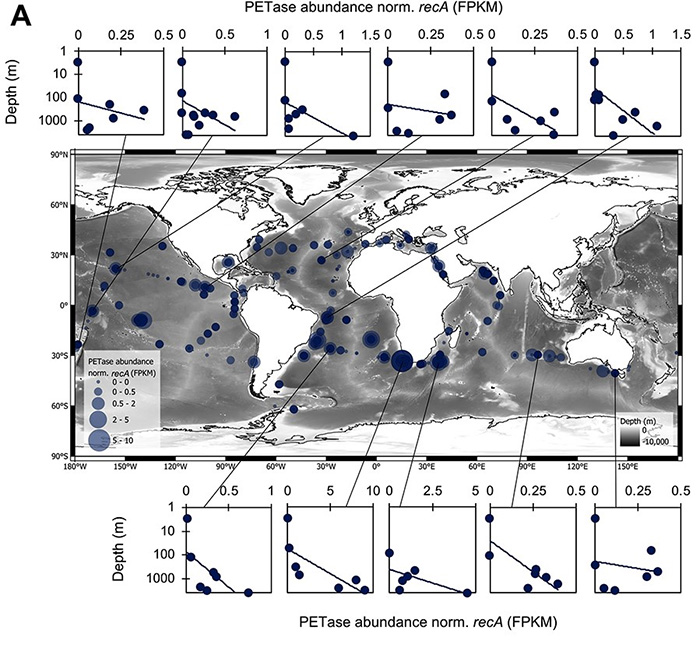
A previous study looked for any enzymes that degrade any kind of plastic bond and came up with 30,000 candidates. They also were more likely to be found in areas with a lot of plastic pollution. All over the world, a whole new ecosystem is rising out of the mud. With a library of some 200 million microbial enzymes across the land and sea, and quadrillions of bacteria flexing their mutations, it was only a matter of time.
Plastic is just a different form of C-H-O waiting to be converted into CO2 and water.
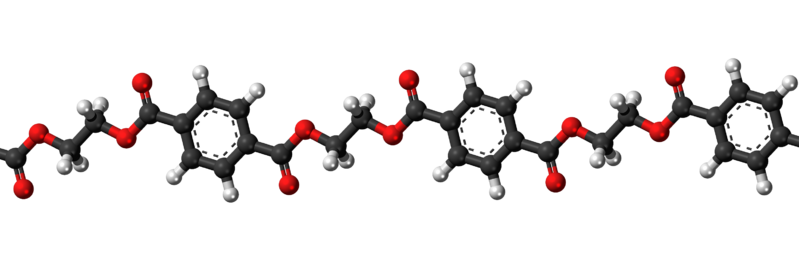
Polyethylene-terephthalate (PET) Artist: Jynto
The time to panic is over….
Plastic-eating bacteria discovered in the ocean
ScienceDirect
A large-scale global study by scientists at KAUST (King Abdullah University of Science and Technology) revealed that these marine microbes are widespread and genetically prepared to consume polyethylene terephthalate (PET) — the tough plastic used in everyday items like drink bottles and fabrics.
For decades, scientists believed PET was almost impossible to degrade naturally. That belief began to shift in 2016, when a bacterium discovered in a Japanese recycling plant was found to survive by consuming plastic waste. It had developed a PETase enzyme capable of dismantling plastic polymers into their building blocks.
Yet it remained unclear whether oceanic microbes had developed similar enzymes independently.
Using a combination of artificial intelligence modeling, genetic screening, and laboratory testing, Duarte and his team confirmed that the M5 motif distinguishes true PET-degrading enzymes from inactive look-alikes. In experiments, marine bacteria carrying the complete M5 motif efficiently broke down PET samples. Genetic activity maps showed that M5-PETase genes are highly active throughout the oceans, especially in areas heavily polluted with plastic.
And the bacteria were found right down to the 4,000 meter mark showing that evolution can’t be stopped, and bacteria will find a way.
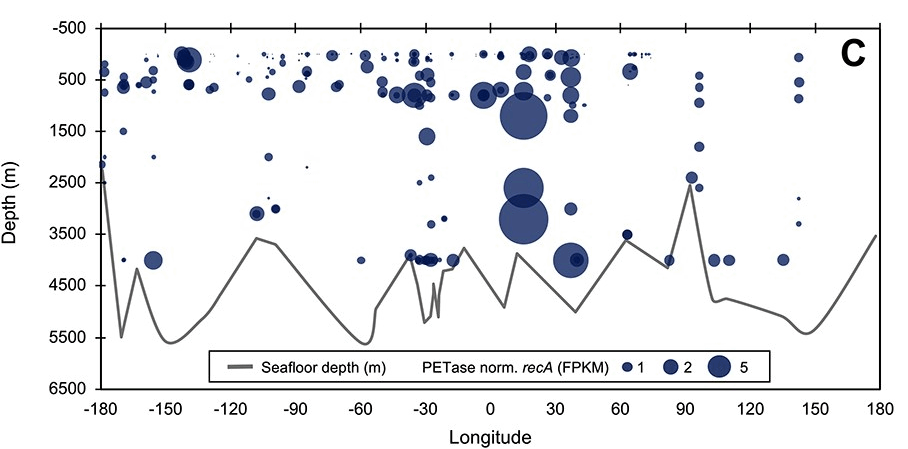
https://academic.oup.com/ismej/article/19/1/wraf121/8159680
The discovery highlights a growing evolutionary response: microorganisms are adapting to human pollution on a planetary scale.
Although this adaptation reveals nature’s resilience, Duarte cautions against optimism. “By the time plastics reach the deep sea, the risks to marine life and human consumers have already been inflicted,” he warns. The microbial breakdown process is far too slow to offset the massive flow of plastic waste entering the oceans each year.
Whatever you do, don’t drink out of paper straws. You risk getting more ‘forever chemicals’ from paper straws. They had to line them with something?
REFERENCE
Intikhab Alam, Ramona Marasco, Afaque A Momin, Nojood Aalismail, Elisa Laiolo, Cecilia Martin, Isabel Sanz-Sáez, Begoña Baltá Foix, Elisabet L Sá, Allan Kamau, Francisco J Guzmán-Vega, Tahira Jamil, Silvia G Acinas, Josep M Gasol, Takashi Gojobori, Susana Agusti, Daniele Daffonchio, Stefan T Arold, Carlos M Duarte. Widespread distribution of bacteria containing PETases with a functional motif across global oceans. The ISME Journal, 2025; 19 (1) DOI: 10.1093/ismejo/wraf121






Good news.
But plastic in the oceans is not caused by Western nations.
Plastic usage, such as convenience products like disposable eating utensils and free supermarket plastic bags, should thereforw not be banned as they have been in Australia.
It mostly comes from countries in South and South East Asia where they throw their rubbish just about everywhere, including into rivers. And especially India although that is not cited as among the top five in the following report as they are not an ASEAN member, but a partner.
Can you believe, even the fully woke reality and science-denying WEF admits to it? So just imagine how bad these nations REALLY are;
The Left seek to ban plastics in the West (even though most have no clue what “plastic” actually is and the fact that just about everything contains it) not because ocean plastic is a problem from the West but because it represents convenience products. And the Left like to destroy everything that is convenient or nice for non-Elites.
The focus on plastic waste should be on Third World countries not the West. Teach Third World people not to litter.
440
Much plastic used to be (still is?) “recycled” from European Countries by packing it up and sending it to Asia where it can be “treated,” aka chucked in the river for a fee. I love how a Lefty’s mind makes that ok, even crows about it.
I often muse on the idea that bacteria will get so good at eating current plastics that the bumper will disappear off your car or (insert billion useful ways we employ plastic here) and then we have to find a solution.
271
That’s mostly true, but it neglects to take into account that a whole lot of western plastic gets sent to recycling centers in Asia …. whereupon it is dumped into a river that flows to the sea. Plastic recycling is not only a scam, it is actively harming the environment by transporting plastic waste from countries with strict environmental laws to countries with lax environmental laws. American and European natural environments would be far better off if plastic waste was handled at home by stashing it in a landfill (perhaps one seeded with plastic-eating bacteria) or burning it for thermal energy in a municipal incinerator.
Another thing not taken into account is a very large chunk of ocean plastic doesn’t flow out of rivers, it flows over the side of commercial fishing boats. The Great Pacific Garbage Patch in particular is mostly commercial fishing waste.
https://theoceancleanup.com/press/press-releases/over-75-of-plastic-in-great-pacific-garbage-patch-originates-from-fishing/
171
Let us not forget the U.S. Aircraft carrier which visited Brisbane a couple of years ago. When leaving they dumped all their garbage into the ocean just beyond Moreton Island. Caused a stink when it washed up on the beaches of the Sunshine coast and Bribe island. Don’t point the finger at Asia entirely.
41
I’m old enough to remember when Sydneysiders did it to themselves.
“I don’t care what they say, I’ll swim Bondi” said Tom undeturd.
30
Dumped in rivers, you mean like this.
https://www.youtube.com/watch?v=wVnMBGXVVUI
60
And here is a river in India so full of rubbish that you can’t see any water.
https://youtu.be/pmryr65iTwM
Yet we in Australia have our plastic convenience products banned even though they were always disposed of correctly (and in the case of free supermarket bags, they had multiple secondary uses and were not “single use” as per the Left’s Big Lie).
It’s the same BS as with CO2, the Second and Third World and China gets to do whatever they please while we in the West (except TRUMP’s USA) are made to suffer.
280
Ha Ha I live rurally never had a rubbish collection service evah. We did use those free plastic bags to store what we couldn’t dispose of at home until we went past a recycling centre, but hey they were bad for the environment so banned. Forced into having the new 3 bin system ( at great expense) reading the blurb about what is now required to be environmentally friendly and there in black and white the recommendation that I use a PLASTIC BIN LINER.
Sometimes the stupid makes me laugh, other times the very same stupid makes me cry.
So now I am expected to buy what was supplied free to do the same job. I really am struggling!
340
I still drink from plastic straws and use plastic cutlery for picnics. I’ve had the straws and forks etc for decades. They come out nice and clean from the dishwasher. Only idiots throw good plastic away.
00
I always find it hilarious when wokesters protest against “plastic” but just about everything they are wearing or touching is a synthetic polymer of some kind. And they got to their protest location using coal and oil.
It was particularly hilarious watching Thunberg cross the Atlantic in her hi tech carbon fibre yacht with no clue that carbon fibre itself is made from polyacrylonitrile which itself is made from oil, along with the matrix polymers and just about everything else on the yacht. The cluelessness of the Left is staggering.
340
The plastic that is so evil in some forms is also promoted in others.
So, plastic bags, straws etc BAD, and yet if I go to the supermarket it’s very difficult to buy many products that are not wrapped in plastic. Fresh meat, nah, high tech vacuum packed on meat trays, all good, cucumbers shrink wrapped, all good, individual cheeses separated by plastic film, all good. Go to the deli, anything purchased is first wrapped in a plastic bag then wrapped in paper, all good, eco bananas, with one end dipped in a red petro based wax, costing more and actually more demanding on the environment but promoted as “good” for the planet. The hypocrisy is staggering.
A light enquiry as to why meat, fish etc is individually packaged and you will be told for food safety and the consumers protection. Actual reasons are to increase profits, smaller portions can command higher per gram unit price and of course don’t ever ask how long that piece of steak has been on the shelf. Flash packaging for these produces is SPECIFICALLY designed to keep the product looking fresh while providing up to 28 days shelf life.
Oh, and by the way, so many of these flash packaging materials are made up of multiple layers of different materials to prevent oxygen ingress or nitrogen egress that they are not recyclable either!
230
I once managed to get a wokester in a pub to strip naked by pointing out everything that he was wearing that contained artificial substances.
I got tossed out for the night, he got banned for life for being an idiot.
The staff stood by and watched while it happened, and were pissing themselves laughing all the way through it.
The idiot went out the door naked and carrying his clothes, where he was promptly arrested by a passing cop for indecent exposure. 😀
110
“The Left seek to ban plastics in the West ”
Reading the above it is to the credit of the Left that it seeks to ban plastics, However do the “Right” want to see an ever increasing tsunami of plastic scattered far and wide?
Yet again you chastise “the Left” this time for their efforts to ban plastic. Are you suggesting that the Right is and should be encouraged to generate an ever increasing tsunami of plastic.? And your sneering comments about Greta Thunberg are both distasteful and totally unnecessary.
033
Plastic pollution, where it exists in mostly Third World countries not Western ones, is a behavioural problem, not a plastics problem.
Thunberg is a particularly destructive individual and deserves to be called out.
And you do realise that just about everything today is made out of or contains synthetic polymers, right? To avoid them you’d have to revert to a much more primitive lifestyle. And if you want to avoid inexpensive energy as well, like most wokesters, you’d have to revert to the Stone Age.
300
It’s a general problem nowadays in that first world countries are perceived as contributing more heavily, compared to third world countries, to environmental problems and climate issues. The way Australia is trending, we may not have to worry about being classed as a first world country in the near future, so any Lefty that has a guilt complex can breathe a sigh of relief.
Firstly, a “climate change sceptic” is a term that is not synonymous with a person who is “anti-environmental”. Usually it’s the opposite. We are people who don’t want whales or eagles maimed by wind turbines. We don’t want landscapes and bush land scarred to accommodate unreliable sources of energy.
There is this irrational idea that first world countries are more responsible for AGW because they produce more emissions per capita. WTF?! If removing the net amount of CO2 from the global atmosphere will supposedly reduce the overall amount, how does it matter if Australia halves its paltry 1% global contribution? Especially when China, India and the USA continue emitting at current levels.
Australia probably has the most climate change idiots per capita, just saying. Happy to be contradicted, but it’s pretty hard to defend the indefensible.
40
This is behind a paywall, so you may not be able to see the full story.
https://www.heraldsun.com.au/subscribe/news/1/?sourceCode=HSWEB_WRE170_a_DDG&dest=https%3A%2F%2Fwww.heraldsun.com.au%2Ftruecrimeaustralia%2Fpolice-courts-victoria%2Fantifascist-leftwing-group-planned-brick-attacks-on-police-before-chaos-erupted-in-cbd%2Fnews-story%2Ffdbf1cca5287782f6d1004f600f66649&memtype=anonymous&mode=premium&v21=HIGH-Segment-2-SCORE
These unhinged Leftists spoke about throwing bricks at police before the March For Australia Protest. Then they deny those claims and try to project them on to international “guest speakers” who allegedly did not represent their values or advice. To be fair, it seems they only threw rocks, not bricks (the Melbourne University crowd may have misconstrued the missile of choice).
30
It is the warm nations – in cold places, plastic burn good, hot.
10
The best way to dispose of plastic if it can’t be recycled economically is to burn it in low pollution furnaces to make heat and generate power with the most emissions being just harmless CO2 and water.
Even fully woke places like New York City and Europe do it, and yet fully woke Australia steadfastly refuses. Why?
Plastic has about the same energy content as oil, e.g. polypropylene 46.4, polyethylene 46.3, residential heating oil 46.2, diesel 45.6, crude oil 41.9 MJ/kg. It is therefore a useful fuel.
361
Australia should be recycling plastic and we are much cleaner than most other countries, but burning plastic and using it for fuel would be the intelligent way to handle this so called pollution problem.
271
The problem with recycling plastic is that 90% of it just isn’t recyclable, and the manpower and time you need to dedicate to finding the 10% that is makes it economically unviable unless you can ship it somewhere that labor is basically free.
130
The problem is that the plastic waste doesn’t fly itself to the recycling centre. How many truck trips and how much fuel should we burn recycling some plastic?
Unless there is some super special high cost to making plastic in the first place (which there doesn’t appear to be or it wouldn’t be dirt cheap) then why are we recycling it — just to reduce landfill?
I would prefer to see less packaging in stores for the sake of “presentation” (and not preservation), but as long as customers keep preferring to buy the tiny item surrounded by a big plastic frame — that doesn’t seem easy to stop.
121
Jo the great conundrum of food packaging in particular, is the packaging in many instances costs almost as much as the produce that people want.
For example back in the day, and I am talking a long time ago, a stubbie that held the beer was the most expensive part of the deal. Glass bottle, metal cap, paper label, final package rap all added up to be significantly more than the beer. The bit that is thrown away, not consumed, was the most expensive part. Crazy. Those lovely nitrogen filled packages of Atlantic salmon were a huge part of the cost, once again almost rivalling the cost of the fish. Multi layers of polymers held together with adhesive, a little bit of fish, then a nitrogen flush before the final seal. Same with vacuum packed meat. Take these costs off and the price of fish is significantly reduced. Why is it packed this way, well research said people didn’t like the smell of fish, supermarkets demanded a long shelf life (28 days ) and oh so convenient for the modern busy life style. Look at the cost per 100 grams versus buying fresh, but hey apparently these sorts of comparisons are either to hard or people are simply to lazy. Bottles of pasta sauce, not quite as bad but still the throw away bit costs as much as the consumed bit.
Older packaging like canned products didn’t suffer from this cost comparison , cans were and still are cheap to make, pack, recycle but suffer from a lack of “marketing appeal”
10
What happened to reusable products?
Beer bottles in NZ, Belgium, Germany and a host of other countries are returnable , refillable and reused. Have been since at least the 1960s. A penny or so return fee means that boy scouts and other charity groups will collect them and return them and make some cash for their causes. Has worked well for decades. Why are there idiot countries that dont go back to the pro-environment practises of our grandparents?
00
There are many countries now incinerating plastics as you have mentioned. These include Austria, Belgium, Denmark, Finland, Germany, Japan, Netherlands, Singapore and Sweden.
An excellent discussion of this approach is “Save the oceans stop recycling plastic” by Mikko Paunio, GWPF.
50
I am wondering if 10-50-100 years down the line there are going to be unintended consequences of these plastic-eating bacteria. Like they start eating ships, buoys, piers, off-shore wind turbines, desalination plants, and a bunch of other stuff we don’t want them eating. Or if they work their way up into river systems and into groundwater aquifers and start eating land-based plastics.
80
Plastic and oil eating bacteria such as Marinobacter, Oceanospiralles, Pseudomonas, and Alkanivorax are natural and already exist in the environment and are not known to have caused problems, only benefits.
Many years ago I did hear about oil-eating bacterial contamination of an oil well but could not find any reference online.
160
Some articles on it.
https://ixwater.com/oil-well-infections
https://pubmed.ncbi.nlm.nih.gov/33864491/
https://link.springer.com/article/10.1007/s11274-021-03080-9
https://www.redorbit.com/news/science/1112692737/oil-eating-bacteria-clean-up-oil-spill-091212/
Nature finds a way:
https://microbiomejournal.biomedcentral.com/articles/10.1186/s40168-019-0652-3
https://www.sciencedirect.com/science/article/abs/pii/S1369703X18300159
https://response.restoration.noaa.gov/about/media/who-thinks-crude-oil-delicious-these-ocean-microbes-do.html
There’s even a recently discovered bacteria munching away happily on the RMS Titanic.
90
That’s a good question Steve. It will happen, then we will redevise plastic by adding a chlorine group or a something to foil their enzymes, and the arms race will continue. There will be long life plastics and short life plastics…
40
They’re welcome to eat all the off-shore wind turbines, and white elephant desalination plants like the one we have in SA.
Bur seriously folks, it’s inevitable that given enough time natural selection will produce microbes that can degrade any novel organic compound. As Jo writes, ‘life on Earth was never going to leave a free meal sitting around’.
Human technology will respond by protecting existing structures or building new ones, as we have always done. We’ll accept that plastic degrades eventually, just as timber does; nothing is eternal in the material world.
210
PET is a polyester and can be easily digested.
I used to work with a company that reprocessed 50-100 tons of PET into unsaturated polyesters for fibreglass use.
The quality went from poor to worse (and worse) and eventually they stopped recycling because cleaning the reactors of gunk took them out of action for too long.
And polycarbonate is a polyester too, with “end caps” on each molecule. Once that “end caps” is removed the whole chain will be split down for food for bacteria in no time at all.
130
CO2 is the catalyst that makes it possible to breakdown hydrocarbons. It separates the hydrocarbon molecules.
As the CO2 increases in the ocean bacterial breakdown hastens.
30
Another scientist who conflates natural adaptation with evolution. And this from someone who is well known for calling out fake science.
516
Struggling ever so hard with your own strawman. Whatever.
122
A typical seagull-style comment that doesn’t contribute anything to the conversation.
01
In recent years, scientists have identified a number of organisms with an ability to eat away at common plastics. These include engineered enzymes, mealworms with an appetite for Styrofoam and a type of bacterium with an ability to break down PET plastics in a relatively short space of time.
Waxworms are another exciting example. These are the caterpillar larvae of the wax moth and act as destructive parasites in beehives by feeding on the beeswax, much to the disdain of beekeepers. But earlier research has found that these critters also have quite an appetite for plastic, with an ability to chew through it, digest it, and turn it into ethylene glycol, a type of alcohol.
Led by Dr. Christophe LeMoine and Dr. Bryan Cassone, researchers at Brandon University’s Department of Biology have been investigating the mechanisms underlying this unique behavior. Their work reveals that the plastic-devouring abilities of the waxworm can be tied to a species of gut bacteria, which they managed to isolate and prove actually thrive on a diet of plastics.
https://news.brandonu.ca/2020/03/04/plastivores-remarkable-waxworms-devour-plastic-waste-in-bu-study/
Good old gut microbiome strikes again.
Now for microplastics inside all of us.
100
Whatever you do, don’t drink out of paper straws. You risk getting more ‘forever chemicals’ from paper straws. They had to line them with something?
Have purchased wrapped single use Bamboo Straws for the Back of the House & They like them
For me – Carry in Glovebox, to use when I get a Macca’s Chocolate Thickshake – the paper straws were abysmal, going soggy and collapsing
110
I hate paper straws. It’s almost worth going overseas to enjoy them.
But here’s a handy hint, you can even legally buy them online from Victoriastan or request them if you state on your order that you have a medical condition requiring their use.
If you have a medical excuse the Gestapo won’t legally be able to smash your door down at 3am to seize your stash of plastic straws.
The following sounds bizarre but it’s straight from the Victoriastan Government.
How did this happen?
How did a country of pioneers and brave ANZAC heroes come to this level of extreme Nanny Statism?
The Left destroy everything.
191
Paper straws are so hated that I reckon an election winning promise for a state politician would be if they relegalised plastic straws for all people, not just the disabled.
121
The Donald did it! By EO soon after inauguration.
Long live the King!
80
Paper straws are so hated
That we managed to keep a “stash” of the old plastic straws which we miraculously converted into MULTIuse plastic straws.
OTOH I do need to remember to rinse them out randomly
50
I’m sure there is a hell of a lot more energy used to make those useless paper straws compared to how easy it is to make plastic ones. You only have to look at the videos on you-tube as to how they make plastic straws vs paper ones. I now carry reusable straws in the car and I get annoyed when i forget them when I get a frozen coke at Maccas. Don’t get me started on bamboo “cutlery”, the mouth feel alone, bleahhhhh.
70
Might be hard to get this message across to the greenies – many of them haven’t yet accepted the idea of evolution by natural selection.
81
Spare a thought you a young, enthusiastic archeologist in the year 5025, who’s digging, ferreting about for evidence of ancient civilisations (ours). Leave him something to find and write a paper about – straws, cups, whatever.
You’re doing a good deed for future generations.
70
Plastics ain’t no Huon Pine. These trees hang around for thousands of years. They are immune to almost all forms of rot and bugs. There are broken branches sitting in swampy ground that do not decay.
Plastic, aluminium and steel boats are yet to outlive those made from Huon Pine:
https://www.boatsales.com.au/editorial/details/the-remarkable-story-of-104-year-old-huon-pine-patrol-boat-58653/
The remarkable story of 104-year-old Huon pine patrol boat
Modern bulk cargo vessels are not much value after 20 years. Rust and fatigue are their nemesis.
100
Active ingredient, methyl eugenol. Considered by some to be a possible human carcinogen.
30
The worst on-land plastic rubbish that I encountered was in the Maasai territory in Kenya and Tanzania. Plastic bags blowing around in the villages comprising of mud huts made from cow dung and urine, full of smoke and darkness. Mind you the cattle herders had mobile phones as trunk calls are passe.
80
Similar experience in the Phillipines decades ago, plastic bags blowin in the wind everywhere sadly the truely destitute gathered them up and used them as fuel to cook a meagre meal. Few plastic bags bits of palm frond and hey presto an almost endless supply of cooking fuel.
20
The elephants would still have been making trunk calls.
00
Aha! You made a cunning stunt!
00
UK hedges and road edges are full of bags for life…
00
This also applies to soil bacteria. Decades ago a soil applied fungicide was used to treat/ control certain soil diseases in tree crops. Most notable of these was for the control/ treatment of Phytophthora in Avocadoes. Metalaxyl (Ridomil 50G) could be applied as a granule treatment and provided spectacular results for a number of years. Then, there were reports from farmers that the product was not working. So, first suspicion was resistance. A common phenomenon for crop protection products of all types. Someone did some “science” and it was discovered that a soil bacteria was in fact “eating” or degrading the applied fungicide. Same observation- the fungicide was a lovely food source of C,H and O in concentrated form. That, after continual use of the fungicide the bacterial numbers were high enough to affect efficacy.
70
Primary degraders of soil applied metalaxyl were :
– Pseudomonas spp. (e.g., P. fluorescens, P. putida, P. aeruginosa)
– Bacillus spp. (e.g., B. subtilis, B. megaterium)
– Flavobacterium sp.
– Rhodococcus spp. and Arthrobacter spp. (less common)
40
Acidithiobacillus ferrooxidans eats steel via accelerated microbial corrosion and oxidises ferrous iron to ferric iron for energy.
Also used for bioleaching.
20
FWIW
From experience you get vastly accelerated destruction of galvanised iron water pipe if it is within the drip line area of Athel Pine (Tamarix aphylla).
I wonder if something like that is involved?
30
Even with the Exxon Valdez, the beaches not cleaned of oil sludge were cleaned naturally in a similar time. Nature exploits the stored energy in hydrocarbons. There will be no more coal, oil or gas because dead woody vegetation is now consumed. Only humans are crazy enough to ignore free energy thanks to a 37 year old story about the dangers of CO2.
120
Yes, most of the clean up was hugely wasteful and expensive as nature would have done the job quite effectively and better without the damage caused by the high pressure water blasters to clean rocks etc which damaged organisms attached to the rocks.
Even fully woke Gulag AI agrees with me.
80
Don’t forget the seabird that was “de-oiled” at great expense and became an orca (IIRC) delicacy immediately after release
50
Go back a bit further to 1967 and the Torrey Canyon in the English Channel. Great concerns about the effects on the environment, can recall from somewhere in the back of my head that several years after this disaster lobster fishers and oyster and mussel growers were experiencing record catches. Open to correction as I can’t find any references.
40
The prime minister Harold Wilson sent planes to bomb the Torrey Canyon in order to set fire to the oil and sink the the ship. Large quantities of detergent were also sprayed from boats onto the oil slicks. Most of what was done to combat the pollution turned out to be either ineffective or damaging. The article below, published 3 years ago, gives and interesting account of what happened.
55 years ago bombs rained down on Cornish seas to sink the stricken Torrey Canyon
https://www.cornwalllive.com/news/history/55-years-ago-bombs-rained-6862832
20
20
Can’t really see what this addition to rather old news changes.
113
It is counter action against the propaganda war waged in the public mind by politically corrupted hysterics*.
The origin fake science grift of the many that plague us now and are the true threat to humanity.
It helps the humans to understand that that humans are not the problem.
That they are equal participants and self perpetuating and self adjusting bio system that has been perpetuating and self adjusting long before that system produced them.
And will likely continue long after them.
And there’s the added pleasure of making the grifters mad.
*Example: Renewable energy is perfectly fine for certain things. But no, zealot grifters and political opportunists come in and demand Net Zero.
And you get Australia, the UK, and Germany.
Not to mention the threat to priceless art.
And the 50 year corruption of academic science perpetrated nearly entirely by the UN.
Consensus science gets you the Tuskegee experiment and vaccine mandates.
Because uncorrupted science would inform that vaccines that vaccinate would not require universal compliance.
The polio vax was voluntary.
And I didn’t have to check my name off a list when I got it.
01
I want to see a bacteria that will eat wind turbines and reduce them into useful compost for agriculural land and majestic vistas.
160
Apart from plastic straws, the most welcome return to sanity (public as well as mine personally) would be to get rid of those b. horrible paper bread packet fasteners.
60
I agree with you Ken Stewart. Those fasteners are infuriating and I throw them away. I’ve kept some plastic ones to use when needed.
10
Sulfate reducing bacteria are amazing. They cleaned up the massive Ixtoc-1 oil spill in a short time. They eat hydrocarbons like polyethylene, or oil, using aqueous sulfate ions as the source of oxygen to oxidize the hydrocarbons.
We used them in our zinc smelter. We had to treat groundwater to remove zinc and other metals. The bioreactor filled with SRBs was fueled with ethanol. The bugs ate the ethanol, and the sulfate, and precipitated out the metals as sulfides, which were then recycled to the smelter. The resulting treated water was drinkable.
140
Clever little chaps, aren’t they?
40
I’ve seen first-hand wood grubs from our native forests devour plastics.
30
So the wood grubs are giving you plastic fertiliser. How is your plastic lawn going. 🙂
00
This is not that new I had a workmate who did her masters on this , that was 25 years ago
00
What?!? There are bacteria that convert plastics into water and – duh duh dah – CO2? Those bacteria are contributing to global warming and we had better eradicate them. Grant money please.
40
Although the ability of certain microbes to decompose plastics is good news we still need to be concerned with plastic pollution. I am surprised that only one commentator, John Connor II, has mentioned micro-plastics. Do we want more nano particles inside our vital organs? Micro-plastics can even cross the blood-brain barrier. What will be the long term consequences of accumulating nano-particles of various plastics inside our brains be, I wonder?
01
I was taking you seriously ’til then.
11
I think you have outed a ROyBOT.
Only a bot would not understand that the knife and fork are to cut your food up to make it smaller and therefore easier to digest.
00
Try googling “Bioaccumulation of microplastics in decedent human brains” for an article on this subject published in Nature earlier this year.
00
The news it only new if one has accepted the narrative that all plastics are from “fossil fuels” and that all plastics are poison. Neither is true in the case of PET- it was originally made from plant carbohydrate, and it always has decayed into its constituent organic materials. If there is such a thing as forever plastics, PET was never one of them.
Great to have isolated one of the agents for decomposition for PET, and to have established that it is everywhere. It certainly helps dismantle the narrative – but that was a lie from the beginning.
20