Image by Filmbetrachter from Pixabay
By Jo Nova
The Experts thought PET plastic was impossible to degrade naturally
WWF tell us it will take 450 years for a plastic bottle to break down. The US EPA says it will take up to 1,000 years. And the UN says “plastic is forever”. But now that we’ve banned plastic straws and picnic spoons, and changed our shopping bags and spent hours sorted our rubbish, it turns out bacteria have already evolved to capture the energy left in the plastic. And furthermore, they weren’t just in one shallow bay, they found them spread throughout the world’s oceans.
Presumably there will be some microbes working on our landfill that we don’t know about. If not now, then soon.
How much of our recycling is just a waste of time and money?
Life on Earth was never going to leave a free meal sitting around
In 2016 researchers found one sort of bacterium in a Japanese recycling plant was able to live off the plastic waste. Now we know that the enzyme PETase breaks down plastic, and that it is found in marine bacteria too. Researchers looked at 400 sites around the world and found the plastic-chewing-enzyme in (by golly) 80% of them.
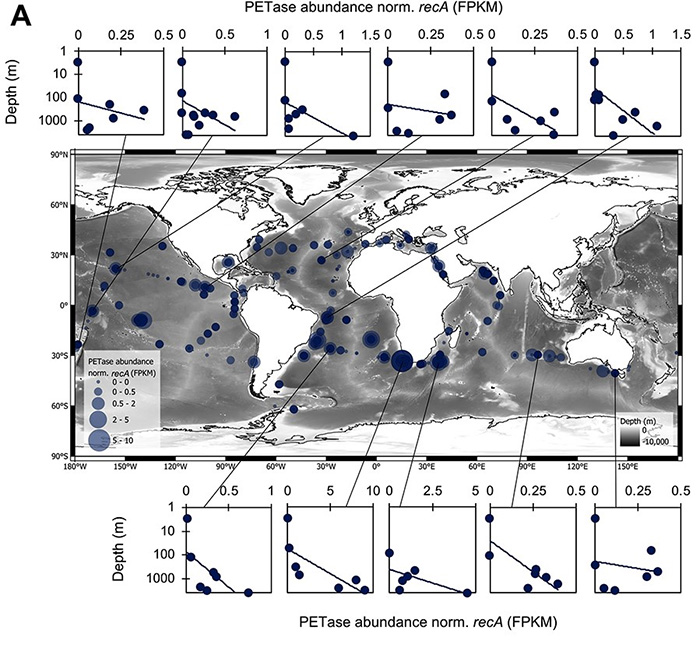
A previous study looked for any enzymes that degrade any kind of plastic bond and came up with 30,000 candidates. They also were more likely to be found in areas with a lot of plastic pollution. All over the world, a whole new ecosystem is rising out of the mud. With a library of some 200 million microbial enzymes across the land and sea, and quadrillions of bacteria flexing their mutations, it was only a matter of time.
Plastic is just a different form of C-H-O waiting to be converted into CO2 and water.
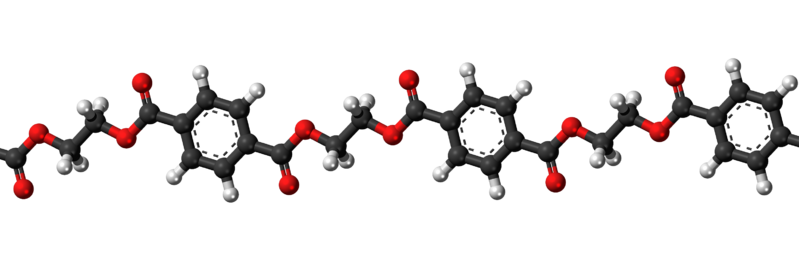
Polyethylene-terephthalate (PET) Artist: Jynto
The time to panic is over….
Plastic-eating bacteria discovered in the ocean
ScienceDirect
A large-scale global study by scientists at KAUST (King Abdullah University of Science and Technology) revealed that these marine microbes are widespread and genetically prepared to consume polyethylene terephthalate (PET) — the tough plastic used in everyday items like drink bottles and fabrics.
For decades, scientists believed PET was almost impossible to degrade naturally. That belief began to shift in 2016, when a bacterium discovered in a Japanese recycling plant was found to survive by consuming plastic waste. It had developed a PETase enzyme capable of dismantling plastic polymers into their building blocks.
Yet it remained unclear whether oceanic microbes had developed similar enzymes independently.
Using a combination of artificial intelligence modeling, genetic screening, and laboratory testing, Duarte and his team confirmed that the M5 motif distinguishes true PET-degrading enzymes from inactive look-alikes. In experiments, marine bacteria carrying the complete M5 motif efficiently broke down PET samples. Genetic activity maps showed that M5-PETase genes are highly active throughout the oceans, especially in areas heavily polluted with plastic.
And the bacteria were found right down to the 4,000 meter mark showing that evolution can’t be stopped, and bacteria will find a way.
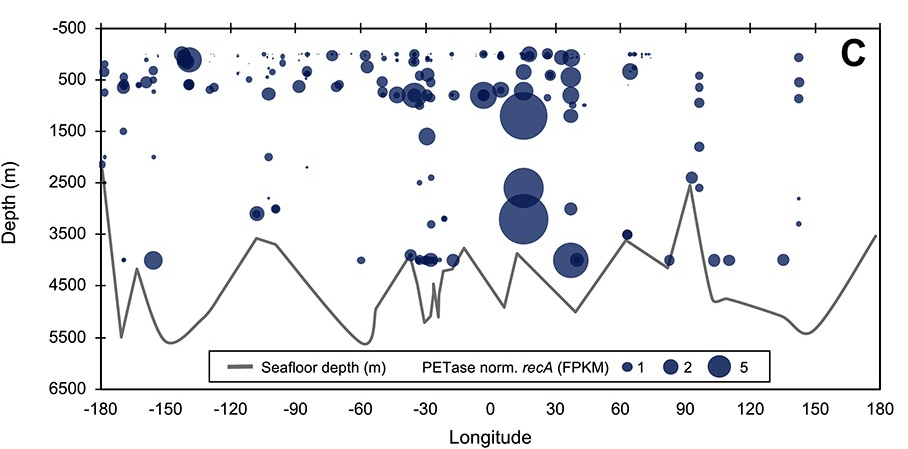
https://academic.oup.com/ismej/article/19/1/wraf121/8159680
The discovery highlights a growing evolutionary response: microorganisms are adapting to human pollution on a planetary scale.
Although this adaptation reveals nature’s resilience, Duarte cautions against optimism. “By the time plastics reach the deep sea, the risks to marine life and human consumers have already been inflicted,” he warns. The microbial breakdown process is far too slow to offset the massive flow of plastic waste entering the oceans each year.
Whatever you do, don’t drink out of paper straws. You risk getting more ‘forever chemicals’ from paper straws. They had to line them with something?
REFERENCE
Intikhab Alam, Ramona Marasco, Afaque A Momin, Nojood Aalismail, Elisa Laiolo, Cecilia Martin, Isabel Sanz-Sáez, Begoña Baltá Foix, Elisabet L Sá, Allan Kamau, Francisco J Guzmán-Vega, Tahira Jamil, Silvia G Acinas, Josep M Gasol, Takashi Gojobori, Susana Agusti, Daniele Daffonchio, Stefan T Arold, Carlos M Duarte. Widespread distribution of bacteria containing PETases with a functional motif across global oceans. The ISME Journal, 2025; 19 (1) DOI: 10.1093/ismejo/wraf121