By Jo Nova
The Renewable Age of Waste has arrived
How do you make a solar plant perform best at breakfast and dinner time — when humans need it most? Just build three times as much generation as you *need* and throw away most of what it produces in the middle of the day….
Solar panels peak at midday but demand for electricity is highest when everyone goes home and turns on the oven, the dryer and plugs in a Cybertruck. But that’s no problem when you have billions of taxpayer dollars to waste — just burn the money building generators that spend most of the day working at minimal efficiency. Then call that waste “Economic Curtailment” — supposedly because it not economically worth operating the equipment. This happens when wholesale prices have gone negative and solar plants are *choosing* to blow away the megawatts most of the day.
Profligate waste is not just a rare event but our national energy policy.
Looking at the graph below, “Availability” is what they could have produced on the left. But what they actually contributed to the country is shown on the right.
“Keeping up with the curtailment”
By Dan Lee at WattClarity
Rising levels of curtailment are increasingly shaping development decisions for both greenfield and brownfield projects across the solar and wind fleet…

Welcome to the ““The National Program of Electrified Futility.””
Dan Lee points out we are throwing away 1.5 Terrawatt-hours in Network curtailment and about 5.7 Terrawatt-hours in Economic curtailment. He argues that 1 Terrawatt-hours is roughly what a turbine at Gladstone Coal fired Power Station made in 2025. In other words — we’re throwing away the output of a full power station.
Ominously the rate that curtailment is rising at is faster than production is growing. It was inevitable that renewable energy would reach this point. Gradually, because intermittent generators often work and fail “together”, every extra unit of intermittent generation is slightly more useless than the one before.
And in the AEMO latest Quarterly report we see that the rate of economic curtailment has suddenly grown.
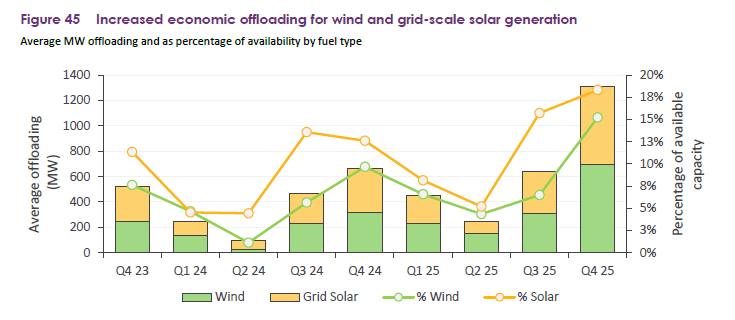
AEMO Economic Curtailment Q2, 2025
Welcome to the The National Program of Electrified Futility.
Waste is no longer an exception — it is the operating model.
Photo by Prashanthns






I think that we had to reach this WASTE and economic lunacy and yet today only a few percentage of the voters have even started to wake up.
Of course as an added bonus the Labor, Greens and Teals parties seem to ignore the fact that they are systematically destroying our environment as well.
Again, every 15 to 20 years we’ll have to replace this toxic, unreliable W & S mess and start all over again and the cost will be horrendous.
410
I believe a lot of credit must go to the Sky News presenters and their many qualified guests who for years now have been exposing the net zero emissions related Renewable Energy Target and transition away from coal and gas fuels with thorough examination and facts.
Maybe the Coalition Dutton Plan for adding nuclear power stations and plants and commentary for and against as well.
220
That’s sort of the equivalent of the BS “quantitative easing” to describe when the Government prints money without any backing by physical commodities like gold or any asset or productivity backing.
300
Can this be real?
40
Definitely ‘YES’ – very real and a ‘feature; of the system.
The argument that ‘the sun is always shining somewhere’ means building solar ‘everywhere’.
So, when the sun is shining ‘everywhere’, there is too much unneeded power.
Conversely and often pushed behind the curtain, when the sun is not shining everywhere there is no power so we start using very expensive battery power then gas/coal/diesel/…..
Blind Freddie needs to speak to Albosleezy and BOBowen to point to these obvious truths
140
The tragedy is that Australia might be stuck with this hugely expensive, inefficient and unreliable system with no limit to the amount of extra money that needs to be spent. It will drain all Australia’s remaining wealth.
There is up to a 7 year delay procuring new gas turbine generators, probably similar or longer for power stations.
As I said in the previous thread.
Australia’s energy crisis is not soluble any time soon, even if we got a rational non-Lib/Lab government in every single state and federally, and even then, there would be the usual lawfare from the Left and bureaucratic delays.
Even refurbishment of the few remaining power stations might not be possible because companies that do it will be busy building new power stations in pro-energy countries.
280
DM,
Any person with average analytical skills can deduce the obvious solution.
Australia urgently needs to start building new hydrocarbon powered electrical generators, modern replacements for those closed down in the last 20 years. It does not matter if coal or gas powers them. Local site economics will sort that choice within a day of study. It is very simple.
Not simple is the state of understanding by voters of our electricity needs for the immediate to distant years. People have been bombarded to states of excusable confusion by fiddling influencers with weird private missions.
People with “green” on their C.V. are among the culprits. They need to be called out, person by person, then charged with crimes when identified. Those who have seriously damaged our national economy, taking it from one of the best to one of the worst in the world since 2000, cannot expect to be free of punishment. The dollar cost is enormous. There is no claimed benefit that stacks up.
If any reader here is uncertain why new coal and gas plants are the solution, please ask and I will explain.
Geoff S. Scientist.
270
Where is Blind Freddy when you need him?
140
It is hard to believe that in my lifetime Sydney’s p0wer was generated AT Bunnerong, Balmain and White Bay (And maybe others I can’t recall0, so far as I know with coal mined on site or diesel.
In time those urban stations gave way to Lake Macquarie, with a number of more modern generators.
In. the ’60s they moved inland to Liddell with 4 x 500mw generators, and Wallerawang with 2 500MW.
Then one bright sunny day (it must have been) in from memory February 1980 they, with 6 x 660MW generators under construction at Vale’s Point and Eraring, placed an order with Toshiba for an additional 6 x 660 MW generators for Bayswater and Mt Piper.
These last 6 were on spec, anticipating the end of cheap oil as OPEC raised the price. However the North Sea countries dug up their oil and thwarted OPEC, and made those generators surplus to requirements. Contracts for Bayswater had already been let so it went ahead. Mt Piper wasn’t built till the ’90s.
They would, however have turned out to be a major factor for the cheap power we had from the turn of the century.
Correct me if I’m am wrong.
00
This mess was easily predictable . In fact they were told how much of a folly the ruinables were many times by many people .
But they plowed on regardless .
All that they have done is cause massive damage to farmland , native forests , destroyed rural landscapes and done massive damage to the economy that will take decades to pay off .
Speaking of follies : It is now reaching the point where the cost of the Snowy 2.0 fiasco would have paid for 4 large scale nuclear power stations that would have provided affordable power for up to a century but we are now saddled with a white elephant that will never add a single KWh of energy to the grid .
All justified by fake science based on nothing but lies .
And after all of that expense : they will still need some form of dispatchable base load generation with the stability of the heavy spinning mass of a turbine and generator to keep the grid stable .
What a clown show .
420
BTW here’s the UN’s projection for life expectancy until the year 2100 and much higher in all the countries of the world.
And even Africa is much higher by 2100 and with an extra 2 billion more people by 2100. See UN data.
Again, where is their dangerous CC or even their so called existential threat or CC emergency or…..?
https://ourworldindata.org/grapher/future-life-expectancy-projections
140
Unfortunately once you point out the curtailment problem, the Blob and associated “industries”, AKA subsidy harvesters, will not call it waste, but will call it an opportunity.
Then they will offer MORE subsidies for bigger commercial and house batteries. And the spiral will continue.
180
Hi All,
And we note from the chart that, unsurprisingly, there remains a great big zero output from solar all through the night, every night of the year. Bowen and Co. don’t seem to understand that no amount of “augmentation” can change that fact.
With the loss of profitability brought about by the increasing curtailment of both utility-scale solar and wind there is now a race by the grifters to build grid-scale batteries, not so much as to add to long-term storage, but to continue to gather the lucrative subsidies and to cash in on the morning and evening price spikes.
The result, clearly, is even more profligate waste, environmental damage, and an increasing risk to life from the known risk of fires, explosions and toxic pollution that result from the potential for thermal runaway in this battery technology.
Thanks Jo,
Paul Miskelly
350
Paul M,
Nice comment, thank you for your experience.
I have been trying for years for a way to clear the propaganda from the minds of voters, so they can accept and respect and act on the theme of your comment. To date, I have failed. Have you had any recent flashes of inspiration to combat this problem? Geoff S
140
Not such a bright idea then.
sarc
70
Living offgrid with solar power, under a tree
https://va.media.tumblr.com/tumblr_t8xpxzOlad1ajo5ne.mp4
70
That guy has a series of similar videos of stealth living.
20
Yep, with limited solar power due to the surrounding forest, and trying to run an air con and a fridge, etc., that’s really going to work. Sorry for being skeptical.
40
Extract from The Dutton Coalition Plan published during the 2022-2025 term of government
140
“meeting our international climate change targets”
The first step for any non-Labor government – change targets, like reliable, dispatchable, cheap energy systems
80
Also zero emission nuclear doesn’t require spinning backup, or voltage and frequency correction.
80
People need to get serious about making prosecutions for this scam which has economically destroyed Australia. The best legal minds need to be put to it.
200
While agreeing with you David I would like to point out that the Paris Agreement on emissions reduction target was presented at the Conference late 2015 and signed 2016, the Net Zero addition was presented at the Glasgow Conference late 2021.
Prime Minister Morrison was urged by US President Biden and UK Prime Minister Johnson and others to sign an agreement, but he declined and instead said Australia has “an aspirational goal” and subject to development of new technologies (nuclear power stations zero emissions for example) and without damage to the Australian economy.
Opposition Leader Dutton followed up with Dutton Plan for revision of the electricity supply by building five large capacity nuclear power stations and two smaller (SMR) plants. To replace already shut down coal fired power stations using existing development approved and used locations and existing transmission lines nearby, in other words replace lost generating installed capacity and increase by whatever is recommended for future demand. All existing technologies to be retained for the time being and the future decided when decision time arrives, for example wind turbines up to 25 years operating life.
40
Dennis, it’s all very well that Morrison didn’t pick up Net Zero commitments in 2015-16 but we know he did in November 2021.
Even though the voters were never asked, Morrison and Frydenberg signed us up to a Net Zero Target anyway for the Glasgow convention.
This was a sell-out by the Liberals and Nationals and meant they had nothing to campaign on 6 months later at the 2022 election where they lost. They stood for nothing. And every election where they continued this policy of support for The Blob against the people, they lost more.
130
Hi Jo, there were left leaning international media criticisms about Prime Minister Morrison’s “aspirational goal” and not signing the agreement at Glasgow September 2021 that I remember reading at that time, my other interest then was the AUKUS partnership agreement being signed after the COP while President Biden and Prime Minister Morrison were still in the UK.
This link from Morrison explains;
00
Another link, please consider the words, commitment but no formal agreement signed!
00
It appears that AEMO warned in 2025 that, by 2027, major solar farms in southeast Australia may be forced to curtail more than one third of their power generation “due to delays in building transmission infrastructure”
The concept of lost generation is surely best left as a sociological descriptor?
100
The idiocy of building all these wind and solar projects in regional and remote areas is just astounding. In Victoria we have these wind plants constructed from one end of the state to the other. Solar similar. They’re the furtherest distance away from the main electricity demand- Melbourne city. My judgement is that all sensibility was thrown out the window and the promise of construction jobs won the day- particularly with the Labor government, so influenced by the CFMEU. Plus CLIMATE CHANGE. ( have to use capitals, it sounds much more scary) Now, there will be a blame game. All those nasty protesting farmers impeding the great decarbonisation process. How dare they?
160
I remember during the Gillard Federal Labor Government period it was reported that having received a briefing about the costs of building dedicated transmission feeder lines from wind and solar installations many locations needed she described what she had been told about the costs “gold plated poles and wires”.
Despite the original Labor RET 32% being legislated for State Government to follow up on, as they have primary responsibility for electricity supply and land development applications approval (with local government input), public lands, and so on, that the Federal RET was Rudd-Gillard Labor governments creation.
What is ignored was the attempt by Abbott Coalition 2015 to repeal the Labor RET legislation but the hostile Senate opposed the bill, but they did support removal of Labor’s Carbon Tax 10% on electricty bills and hidden Emissions Levy of 10%, plus GST 10% on the bill total of course
00
Climate change economics.
20
What will happen is that all the renewable supporters will say we just need more batteries to fix the problem. Or worse, we need another Snowy Hydro II pumped hydro like project. They’ll propose building one in each state. Probably, like many I watched a video of a senate estimates involving Gerard Holland from the Page Institute and a Victorian Labor senator. The latter was absolutely clueless about how an electricity grid worked. We are not led by the brightest and best folks. It’s hard to see any of this madness being reversed or amended without some seismic event happening. Possibly something like a full east coast black out might do it. Except that ironically coal or gas generation would save the day.
120
I am amazed when I read that Snowy 2.0 Project will add to the generating capacity of the system and not that it is a back up support system for intermittent, unreliable, wind and solar installations. Indeed, PM Turnbull when he announced Snowy 2.0 said that the electricity required to pump the water back up the hill would be from wind turbine installations when the electricity they supply is not needed for grid purposes.
Another vested interests taxpayer funded project?
90
We know his son has large wind investments, this guarantees their income.
50
” I am amazed when I read that Snowy 2.0 Project will add to the generating capacity of the system ”
Any links Dennis ?
40
It was Prime Minister Turnbull promoting the just announced Snowy 2.0 Project, and would have been published, but here from my memory bank that thankfully has near instant recall when prompted by questions asked or read.
20
One link Ronin
10
Thanks Dennis.
10
I don’t have issues with overbuilding intermittent energy PROVIDING
1. It is funded by private money;
2. Is only paid for energy delivered (and not paid for curtailment); and
3. Compensates dispatchable energy sources for the costs of their curtailment before being paid for intermittent power deliveries.
My reasoning is illustrated by personal circumstances. My house is in cloud today and the solar panels are running at less than 10%. My battery is under 70% charged.
I would think seriously about putting more panels on the roof just to deal with days like these.
110
I do not have a problem with solar battery providing it operates off-grid.
Anything leaning on the grid is parasitic to the grid. There is some prospect of connection fees increasing to reflect nearer true burden but there is now precedence for the government just paying for a capital return on grid generating assets rather than any power output. And households with solar/battery connected to the grid are a powerful lobby and are so far winning because there is so much pushback on the environmental damage for all the extra infrastructure.
The retail price in South Australia is already beyond where off-grid system is economically viable against buying at retail price.
Our home could be easily run off 10kW of solar and 30kWh battery that has unsubsidised cost less than $20k. Insurance would be in the form of a generator – around $3k for current auto start and silenced diesel.
There will be a growing market for off-grid connection in Australia. As volume for such system increases, the gear will be better packaged and priced. A large household does not need a generator bigger than 1kW to prevent a battery of 60 hour duration going flat. But you do not find tiny auto start silenced diesel generators of that size. But they are getting close to that.
The prospect for Australians to live off-grid in luxury is now realistic thanks to Chinese manufacturing efficiency.
70
Agreed. Life just keeps getting better for those who can afford it. Worse for those who can’t.
50
Curtailment is only part of the true picture.
The solar farms in South Australia actually made no money in Q4 2025. The tiny output was paired with average price of $14/MWh. So their income in the wholesale market was just $2.4M. The is before they pay for FCAS that they require to operate.
Where SA leads. Australia follows in this race to de-industrialisation and world record grid power prices.
Eraring cannot close until Tomago closes down or after Snowy 2 is operational. Loss of Tomago will kill Labor in NSW and Federally.
It is now common knowledge that the real cost of Snowy 2 is nudging $40bn. It is yet to dawn that it is an energy consumer, not a generator. Round trip losses are much higher than LFP batteries particularly if you consider a battery at the load compared with a battery 4,000km round trip from SA to SA.
Most places would rightly regard $40bn for another big energy consumer when there is an energy shortage as more than a bit insane.
150
I am thinking that the EnergyDome system might be an answer.
First built in Sardinia in 2020. It uses CO2 for storing electricity. CO2 under pressure as liquid and expanded when a turbine is needed. Gas is then re-pressurised (and cooled) until needed. The hot water from cooling is stored and reused. 75% efficiency and uses standard (and common) equipment. Can store about 12 hours.
Google is building a pilot plant for an AI centre, possibly more to follow. Finland seems even more enthusiastic.
21 Mar, 2025
Energy Dome, a global leader in long-duration energy storage (LDES), is expanding its presence in Victoria, supported by the Victorian Government, to accelerate the deployment of its breakthrough CO2 Battery technology. This innovative storage solution will help strengthen Victoria’s energy system and support the state’s transition to renewable energy.
Given the bureaucratic impasse I don’t expect this will be built in Victoria, but PERHAPS we might get Malinauskus taking another scheme from the Vics?
10
My first question is why use CO2 under pressure for storage.
Suspending disbelief I read on until I got to “supported by the Victorian Government”.
Do not walk away from the project. RUN!
40
Forrest Gardener:
CO2 is either a gas or a liquid (depending on pressure) at room temperature.
The CO2 is stored in gas cylinders as used for many years. When the pressure is released the CO2 cools, so it is heated by water saved from the previous cooling stage. The heated gas (now at higher pressure) drives a turbine (at fairly low temperature around 400C) and is then cooled for storage with heating mostly saved (as water).
Yes, but the Victorian Govt (if that term is justified) won’t be doing anything about this process. It is people like engineers at Google (USA, Europe and India and the Finland Electricity Authority who like the ready use when needed and plan a 1600MW unit and the 75% efficiency. There are others e.g. Wisconsin Alliant Energy, and in India (apart from Google)
Energy Dome expects its [CO2 battery] to be 30% cheaper than lithium-ion.”
CO2 batteries also have advantages over other types of large-scale power storage units, like pumped-hydro, because they can be built relatively quickly and with comparatively small footprints,
20
Will Snowy Hydro 2 blow out to 25 billion $? Even the Australian newspaper has said we should think carefully about wasting any more billions of $ on this very expensive battery.
Here Robert Parker includes some interesting facts about SH 2, compared to Nuclear energy.
https://www.youtube.com/watch?v=gHl2vkwihvA
20
The real cost is now close to $40bn. That includes the power lines.
The majority of people do not yet realise it is a net load. It will consume a huge amount of energy once in operation. Just another cost of intermittency that passes to the keeper because their ABC has been thoroughly scammed by all this nonsense.
60
Thanks Rick and I heard about that 40 billion $ blowout on Sky News Outsiders program, but I can’t seem to find a link.
BTW how would you calculate a percentage for a capacity factor for SH 2?
IOW would the average % be higher than W 24% and S 15% for eastern Australia?
10
Last discused in the Australian (paywalled) on 18 February: https://www.theaustralian.com.au/business/snowy-20-project-cost-spirals-to-40bn-threatening-australian-farmland/news-story/19a5ce036f1e34d2513c6c6e5f41c2dd
Cost blowout includes transmission links. HumeLink, now at $13m/km, has its latest cost estimated at $4.8bn, and I believe this won’t cover its extension to Snowy 2. As the article states, another 2000 line towers, approx. two/km, are required to connect Snowy 2. That makes another 1000 kms of lines at $13m/km, or another $13bn.
When you ask about CF, do you mean CF or efficiency?
40
Summarising the $40bn cost estimate paragraph in the article:
Dams, pumps, tunnels, generating equipment: Spent so far: $8bn. Estimated total: $12bn. Expected final cost: $15 to $18bn.
Transmission lines: $20 to $25bn
Original total project cost: $2bn.
30
Sorry Rick I didn’t notice but Robert Parker claims in his short video that SH 2 has a capacity factor of about 17% compared to Nuclear 92%.
I’m sure he’s an Engineer and would know the CFs, but do you think he’s about right?
20
What I do understand is that Snowy 2.0 cannot possibly be cost effective, a cost-benefit analysis if carried out must have been ignored.
By the way, part of the cost relates to Snowy Hydro, government owned private company, became wholly Federal Government owned when they acquired the shareholdings of participating State Governments, NSW and VIC I think, and from memory the buyback was $6 billion of the project costs.
50
Capacity factors do not have much meaning once intermittent generators are introduced.
Pumped hydro are load shifters. They are energy consumers. So the more they are used the more they consume.
Snowy 2 has same rating for pumping and generation so counting losses, it will need to pump for more time than it generates. Around 20% more. So at 100% utilisation, it could generate for 40% of the time and pump for 60%. The likelihood of pumping 60% of the time is very remote. It will only happen if there is plenty of sand wind capacity through the wee hours.
It will mostly be required during evening peaks. Lets say 3 hours a day or say 12%. So likely range for generating will be somewhere between 12 and 40%. Depending on the availability of wind or even coal to pump. It could be attractive to coal power stations to work harder through the day if wind and solar are low.
Assuming the project gets to completion, those of us still living will know how it operates as early as 2035.
60
The operation of Snowy 2.0 is intimately linked to that of the Tumut system via the Talbingo reservoir. Bruce Mountain helpfully explains.
https://esdnews.com.au/snowy-2-0-doesnt-stack-up-against-batteries/
As currently operated, Tumut 3 (the largest generator), which effectively controls the discharge and recharge of Snowy 2.0, has a capacity factor of about 12%.
30
You would have to say they’re actually building Snowy Hydro pumped hydro in the wrong place. Where pumped hydro has partially worked overseas is when you use coal generated electricity to pump the water uphill. So, pump water uphill overnight. I seem to recall Michael Shellenberger talking about this. Perhaps there was a site in the US? Anyway, it should have been built close to the Latrobe Valley Victorian brown coal generators. Just north of the Latrobe Valley, are mountains – maybe not quite as high as the Snowy Mountains, but probably high enough to allow water to run downhill. But what would I know?
30
Regarding Pumped Hydro, I’ve read numerous commentary from those that would know about this technology, that there are actually very few suitable sites / areas in Australia that could accommodate viable Pumped Hydro schemes. Then I’ve also read posts/reports on LinkedIn and such from Pro “renewables” ideologists saying there are many suitable locations for it, even the relatively flat Western Australia topography, so it’s difficult to cut through the chaff on fact or fiction.
I suspect the pro Pumped Hydro ideologists were of the same intellect as those in Government / bureaucracy that selected the Dalrymple Height/ Eungella Range in Central QLD for the previous Queensland state Labor government’s proposed “largest Pumped Hydro in the WORLD!!” project where they allegedly select the location from looking at topographical maps for suitable fall of the land, with zero consideration for soil types, stability, weather events (huge tropical rainfall), communities etc. Fortunately this project was scrapped by the current state government.
In short, it seems it is extremely expensive, low output, land area hungry and ill suited to Australian geology.
20
For a good discussion of pumped hydro problems, recommend “Pump Up the Storage”: https://dothemath.ucsd.edu/2011/11/pump-up-the-storage/
Includes a good discussion with calculations.
20
LNP, Labor and Greens all condemn the lignite fired stations. They want them gone. So I would bet pointless having pumped hydro in the vicinity of that fuel source.
20
The obvious question is, how much coal-fired capacity, or gas-fired capacity, could be bought for that 25 billion, or for the 40 billion that RickWill quotes?
30
Snowy Hydro 2 ….. you know, Pumped Storage.
Run the water ‘down the hill’ to generate power.
Pump the water ‘back up the hill’ to replenish the upper storage.
It’s a nett consumer of power, in other words uses more power to pump the water up the hill than it generates when the water is running down the hill.
We do have an example we can look to to see what sort of thing we are looking at for the sake of comparison.
We have Tumut Three. Even though it started operations back in 1973, the record keeping by the AEMO only started in 1998.
Since that time, Tumut Three has been operating at a monumentally whopping humungous Capacity Factor of, umm ….. 4.2%!!
In that time, you know, since the start of the 1998 record keeping, Tumut Three has delivered a huge 15.47TWH of power into the grid.
You know, 4% more power than Bayswater delivered ….. just last year!
Yeah! I know. Snowy hydro will get more use than that ….. eh!
Tony.
PostScript – Hmm, wouldn’t the other intermittents of choice, wind and solar love to have that sort of life span, now 53 years.
110
“‘Pump the water ‘back up the hill’ to replenish the upper storage.
It’s a net consumer of power, in other words uses more power to pump the water up the hill than it generates when the water is
running down the hill.”
Only those unconstrained by reality or problems of inconsistency, (2+2 can equal 5 if that’s a desired result in a utopean world)
could believe the above.
40
Some years ago there was a proposal by a local farmer to build a desal plant on the coast between Bermagui and Bega, powered by an SMR or a recommissioned submarine reactor, to pump water 24/7/365 up to Eucumbene dam, being part of the Snowy Hydro, all the gear for power generation and distribution is in place, all it needs is water to power it.
Can’t be much sillier than the current SH2 cluster.
20
Revised wind turbine outputs on the 2026 ISP draft are wishful thinking! Again we see ideology prioritised over actuality.
“Assumed wind capacity factors were revised sharply across several REZs in the latest ISP, with multiple zones now modelled with assumed wind capacity factors above 40%.”
Source: David Leitch
https://wattclarity.com.au/articles/2026/02/how-realistic-are-those-wind-capacity-factor-assumptions-in-the-draft-2026-isp/
30
I suspect this post will earn minus points.
Capacity curtailment..
Spinning reserve..
Grid reliability?
How much is paid for potential versus actual output?
I wonder how the ROI calculations for both wind and solar farms are being adjusted.
Grid generation is now problematic no matter the source at system level outputs. Solar panels on building roof tops have changed the dynamics of the system. And any business/family that owns their roof top will continue to consider the option of adding more panels, since the seasonal variation in output limits the actual effectiveness.
Though the limitation in WA appears to be the loss of residential feed in tariff, if a larger than 5kw inverter is installed. A relatively large battery would be required to offset that. And the expected life time of batteries is still TBD. Still risky?
The only winners appear to the be Chinese.
May you live in interesting times.
10
My original off-grid battery using large format LFP was set up in 2012 and it is still doing its job today.
I could replace that battery from Amazon for $1440. It cost $2500 back in 2012. Sp prices have come down even considering the high inflation for everything else. If that battery went today, I would look at doubling the size of the household battery and getting a changeover switch so I could use that battery on power outage. For now, it is nice to know I have an option for the fridge and freezer. I would have likely lost the freezer contents during the last 16 hour outage but for that system.
A battery suitably sized fo daily load has a 2 year payback when charged using the free Solar Sharer energy. So even if it achieves its 10 year warranty, it will pay back many times over.
30
I may be wrong, but my understanding is that we do not just “throw away” the unwanted solar (and wind) generation – we pay for it whether we need it or not. Then if we don’t need it we don’t use it. That last bit could be called “throwing it away” but …….
The difference between what we do and just “throwing it away” is that when you just throw it away it costs the producer what it cost to produce, but when we have solar energy that we don’t need we still have to pay the full retail green-boosted price. So solar (and wind) producers can go on installing new unwanted facilities for ever, knowing that they will be paid monstrously high prices for all of their potential production whether or not it is needed. When roof-top solar owners have to stop generating energy so that they don’t get hit with charges (innocuously called “negative prices”), the solar ‘farms’ are being paid very handsomely for exactly the same thing. Only a truly evil government that has no concern whatsoever for the well-being of its citizens could come up with a system like this.
10
Consumers pay Retail Price each quarter and electricity usage charges.
On a separate line is Service To Property Charge and that contains the hidden costs/expenses of wind, solar, batteries, dedicated new feeder transmission lines, subsidies for profit as incentives to invest in the transition and RET, etc.
20
None of the new AEMO guaranteed return contracts are for assets currently producing.
All existing wind and solar only have the RET. It is now worthless hence the need for all the new AEMO contracts. No one but a few government insiders and project proponents know the details but you can bet they are based on an agreed ROI for an agreed capital expenditure. Proponents will be paid irrespective of their revenue in the wholesale market. They may have an upside benefit if they can earn above their agreed minimum return.
That income will come directly from taxpayers. Grid electricity prices are already too high. They may look at increasing the connection fee to reduce the tax burden. Increasing the connection fee will aim to extract more from those leaning on the grid but not pulling much energy from it. Ultimately it just encourages those who can afford the capital to just completely disconnect from the grid.
40
” Only a truly evil government that has no concern whatsoever for the well-being of its citizens could come up with a system like this.”
That seems to be what the crowd in Canberra are like, it doesn’t change much with change in govt either.
30
Something that intrigues me is the choice for original Labor RET 32% later ignored by Albanese-Bowen and raised to RET 82% after 2022.
I have been advised and have read about the engineering and economics based principles that no more than 30% of unreliable intermittent supply should be installed and with 100% back up support for periods when the wind and solar are not supplying what is needed, and the short back up supply to avoid grid destabilising batteries are discharging until the controllable generators take over.
It should be based on cost and benefits analysis, ruining a perfectly good power station fleet generators system makes no sense, and pursuing net zero even less sense.
20
The RET has not been increased. It was a Howrd government invention It was set at 500GWh or 0.25%. Rudd increased it to 41TWh. Then Abbott pulled it back to 33TWh.
The RET will be extinct in 2030. Hence all the new AEMO guaranteed ROI contracts. LGCs are trading for $4/MWh today. So peanuts. It would buy you a tonne of lignite though- say 5MWh of heat.
10
Labor RET slashed 2015
https://www.architectureanddesign.com.au/editorial/industry-news/abbott-s-slashing-of-ret-jeopardises-australia-s-l
00
I checked some more and The Abbott government reduced Australia’s Large-scale Renewable Energy Target (LRET) from 41,000 GWh to 33,000 GWh in 2015, which effectively lowered the renewable energy target to about 32% of electricity generation by 2020. This change was part of a broader policy shift that also included stricter regulations on wind energy and exemptions for emissions-intensive industries.
Albanese Labor after 2022 increased RET to 82%
Howard after Kyoto Agreement signed 1997 target for renewable energy was not specifically wind and solar, all offers considered including wave generators and it was not legislated target but part of the Kyoto emissions target range of options.
00
Welcome to the The National Program of Electrified Futility.
Waste is no longer an exception — it is the operating model.
The systematic waste is almost elegant in its stupidity. Rooftop solar, which is busy crowding out grid-scale solar, is government-supported by the Small-scale Renewable Energy Scheme. The rooftop rollout is a key feature of the Bowen Masterplan – and ‘too cheap to meter’ electricity can just be given away through the Solar Sharer Offer.
Obviously, an ‘out of left field’ event. Nobody could have foreseen this.
40
And adding to the underlying inflationary pressures because of taxpayer funded government rebate incentives.
30
Don’t know if others have mentioned this previously but I just tumbled to it when I researched the AGL offer of “3 for Free” which is their attempt to change home higher power use hours to around mid-day.
Today’s research, prompted by this excellent article, suggested a new word game much akin to “economic curtailment” which is “subsidise your own savings”.
Got an sms a couple of weeks ago advising me the free hours offer was available but as I have solar panels and solar hot water couldn’t see it being of any benefit unless maybe we dutifully turned off the solar just before the happy hour(s) started and remembered to turn it back on after. Concerned at potential wear and tear of turning off/on might have so flagged the email as spam and moved on.
Apparently if you have a smart meter you can join the offer however the deal is your usage outside the “free” hours goes to 47.73c per kWh whereas their existing Smart Saver plan charge is 43.63c per kWh. So potential +4.1c hourly extra charge x the other 21hours of use.
10
Shedding unusable by grid solar electricity supply middle hours of sunny days is one factor, but the smart meter roll out is lagging far behind scheduled timing as most property owners are not cooperating voluntarily, also a shortage of electricians.
30
That’s an outright ripoff, who do they think they are kidding.
30
Utility: Google AI says;
Electrified Futility is a good phrase given Futility is Utility but with a big F for Fail or Foolish.
10
forget about logic the left do not operate on logic.
They are the crash test dummies not the real people.
reality will eat them alive and when I say eat them alive I mean the left will eat them, go and look at the photos of Bolsheviks in 1912 with their bright eyed players all but a select few were unshot in 1927, they eat each other. Catabolism is a big part of the left, death and killing is a feature.
40
during june sunrise is around 7:00 AM and sunset is around 5:00 PM
there will be almost no solar power at 7:00 AM and none at 7:00 PM even with one bazillion solar panels
00