By Jo Nova
Careful, your subsidies are showing…
The more we make, the more we waste. The trend is clear and it’s so Soviet.
Spring is the season with the most wasted renewable production, and each spring is more wasteful than the one before.
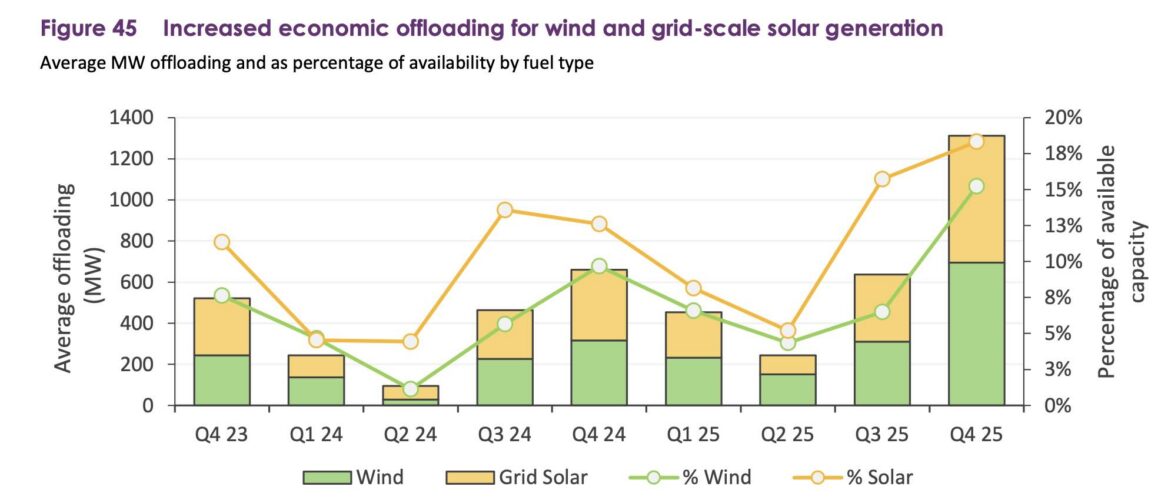
There are two sorts of “curtailment” where the generator has to shut off production. Network curtailment happens when a a transmission line is already at capacity, or a line is down . But Economic Curtailment is rapidly becoming the big drain. It occurs when there was such a glut of power that prices went negative. Generators were producing something so useless they had to pay people to take it away. Investors flee at this point. This is hidden under jargon called “Offloading” which sounds a bit like 4-wheel driving with a lisp. I mean, they could have called it “toxic energy.
From the AEMO Q4 report
“During Q4 2025, total economic offloading of wind and grid-scale solar generation averaged 1,312 MW, the highest quarterly average on record (Figure 45). This exceeded the previous peak set in Q4 2024 by 653 MW (+99%).
Grid-scale solar economic offloading rose sharply, increasing from 343 MW to an all-time high of 618 MW (+275 MW, +80%). As a share of average grid-scale solar availability, offloading increased from 13% to 18%.”
So nearly one fifth of all the electricity that solar panels produced was tossed in the bin. And about 15% of wind turbine capacity. In South Australia an extraordinary 59% of potential energy from solar was lost. In total, some 7.2 Terawatt hours of renewable electricity was thrown away last year, because it was made at the wrong time or in the wrong place. As Dan Lee describes it on WattClarity,
” 1 TWh is roughly equivalent to the entire production from Gladstone Power Station Unit 4 in 2025″
So we’re wasting about 7 turbine units…
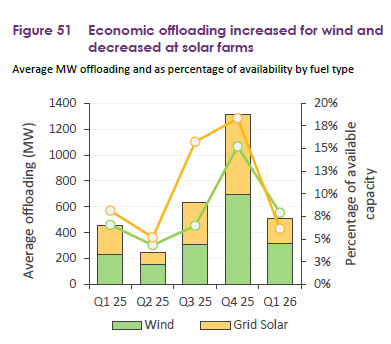
In the latest figures for the first quarter of 2026 the curtailment figures are back down again, but they are still higher than the same time last year. The inexorable rise of “curtailment” continues season by season.
This is not the same as the “waste” of having spare gas or coal generators because they are despatchable, and wind and solar are not.
Unlike most things, as we make more wind and solar power generators they wont get more efficient, not in a net production kind of way.
REFERENCES
See also Reneweconomy