By Jo Nova
They must have been disappointed
Psychologists have finally run a massive test of climate communication strategies, — and they all fail.
A new megastudy of more than 13,000 Americans tested the ten most cited climate-messaging strategies drawn from 157 previous papers. Twenty-four co-authors from five countries were involved. They wanted to find the paragraph — the killer framing — that would change beliefs, shift behaviour, or, ideally, persuade people to part with some cash. They didn’t find it.
Probably the most newsworthy finding is that there is a vast pool of grant money available to study rehashed minutiae of how to sell weather-changing sorcery to the jaded public. It’s a full time Blob Psy-Op machine to “nudge” the voters. If only they spent some of this money checking the science before they fine tuned the fear campaign?
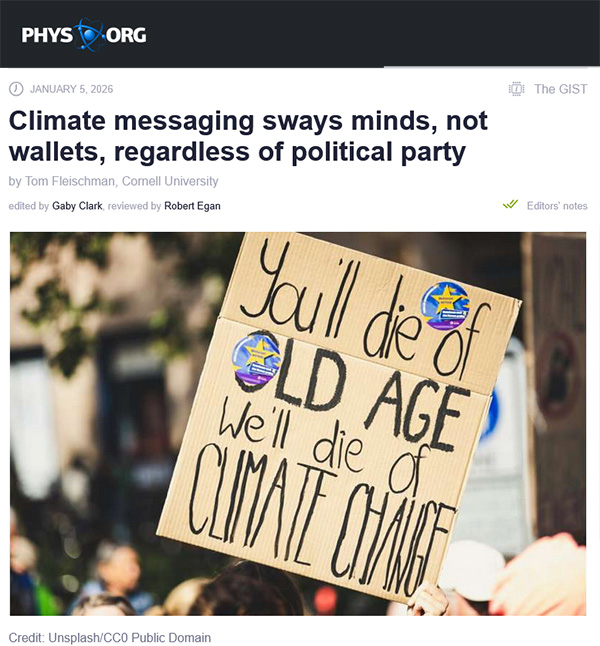
This is a Psy-Op machine in search of a slogan
They call this research “science” but it’s more like corporate message-testing in advertising. And it’s done for free at universities to help the industry. The goal here is not to understand the human condition, it’s to sell a carbon tax or a solar panel.
The study would not have been cheap — They not only surveyed thousands of people, but they did it before a ‘treatment’ and again afterwards. The ‘treatment’ they offered people was to read a few short paragraphs of what the researchers thought was a persuasive message — but in reality was just a rehash of themes they have been beating us over the head with for years.
They were hoping to find a useful phrase that reached Democrats or Republicans and pulled out some cash, or shifted behaviour. But they did not hit paydirt. The results were so bad, they even had to admit they barely moved the dial. Despite the massive numbers taking the survey, they could barely reach statistical significance on anything. It was a wash…
PhysOrg: In a study involving more than 13,000 participants in the U.S., several messaging strategies were shown to move the needle—albeit slightly—in attempts to strengthen pro-environmental attitudes and behaviors regarding climate change. None, however, was effective in spurring people to put their money where their mouth is.
Basically a few people seemed more convinced about climate change after their ‘treatment’ (for the next five minutes) but almost none of them cared enough to donate money to stop it.
The paper almost never gives answers as solid percentages, probably because the absolute numbers were so pathetic. One percentage they supplied was that “treatment conditions increased belief in climate change by 1.16 percentage points….” And remember, this is the result a few minutes after being exposed to the key paragraph. A week later it will be nearer to 0%.
They were also surprised at what they didn’t find– political division: “And, perhaps most surprisingly, messages’ persuasiveness varied little between Democrats and Republicans.”
So after years of politicization and polarization the researchers were surprised to find that that Democrats and Republicans were both human? If they could have found some difference, it would have been the headline — Democrats, open to persuasion! Republicans, sticks-in-the-mud!
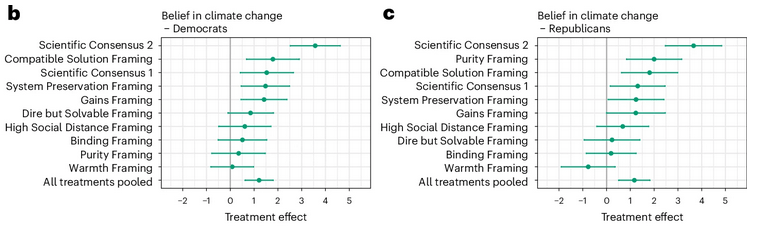
The ten themes are explained at the bottom: Essentially the Republicans were slightly more moved by the patriotic maintenance of the “purity of American land”. Democrats were slightly more moved by being nice to people and touchy feely stuff.
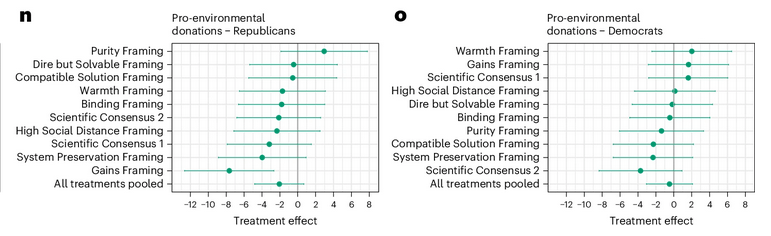
When reading these graphs (they have about 45), the dots on the right of the zero line, were theoretically “positive” and therefore changed opinions (if we ignore most of the error bars).
Ironically, the only dot below with any statistical significance is the one that suggests that making claims of economic or jobs gains to Republicans will reduce donations. Obviously, Republicans just don’t believe that stuff anymore.
Consensus is still the only winner (for them)
The main argument for believers is still the profoundly anti-science line that truth is what the annointed Gods of Science say.
But every time anyone mentions the Petition Project, we win
When it came to changing beliefs, the “consensus of experts” was the most reliable argument to influence people. New readers may not be aware the Petition Project was an extraordinary survey of scientists in the US which proved that there was no consensus. Nearly twenty years ago, 31,000 scientists including 9,000 PhD’s were willing to sign a strong statement of dissent. Naturally, the legacy media didn’t mention it, even though it was a larger, longer list than any the believers ever arranged. So most people have never heard of it.
Bizarrely, in their theme called Scientific consensus 1 — the researchers talked about the “expert consensus” but also tried to also ‘innoculate’ readers against the Petition Project. And they may have done more harm than good. In trying to debunk the Petition Project they inadvertently opened the average persons eyes to news that there was a scientific debate and it has been surpressed. In contrast Scientific consensus 2 (which didn’t mention the Petition Project) was received as more persuasive in almost every situation. The only time Consensus type 1 was a winner (for believers), was when it worked on Democrats to elict a few more donations. In that case talking to climate activists about “the battle” reminds them of which side they are on in this tribal war. They may feel like the victims battling a big machine (31,000 evil denier scientists!).
The only thing we really learn in the MegaStudy is just how much money The Blob has thrown at polishing its communication memes in order to squeeze a tiny bit more compliance with climate grift and graft.
PS: One of the 24 authors was the infamous Stephan Lewandowsky, well known for studying skeptics by placing surveys on sites that hate and mock them. This is the man who once surveyed a 32,000 year old respondent. He’s still around.
_________________________________________
APPENDIX: The ten top favourite climate-messaging treatments:
- Binding framing — Argues that mitigating climate change aligns with patriotic, family, and religious values.
- Scientific consensus 1 –Emphasises scientific agreement on human-caused climate change and explicitly inoculates against sceptical narratives, including the Petition Project.
- Scientific consensus 2 –Emphasises scientific agreement on human-caused climate change and inoculates against a vague “fake debate” strategy, without naming specific dissenting groups.
- Dire but solvable framing –-Stresses that climate change consequences are severe, but solutions exist.
- Compatible solution framing –Argues climate mitigation can be achieved while remaining consistent with free-market principles.
- Gains framing –Highlights benefits and positive outcomes from mitigating climate change.
- High social distance framing — Focuses on climate harms affecting a socially distant group (e.g., Chinese farmers).
- Purity framing — Frames mitigation as protecting the purity and cleanliness of American land.
- System preservation framing — Argues that climate mitigation helps preserve the traditional American way of life.
- Warmth framing — Appeals to caring for fellow citizens and social compassion.
REFERENCE
Voelkel, J.G., Ashokkumar, A., Abeles, A.T. et al. A registered report megastudy on the persuasiveness of the most-cited climate messages. Nat. Clim. Chang. (2026). https://doi.org/10.1038/s41558-025-02536-2