
Image by Vilius Kukanauskas from Pixabay
By Jo Nova
It’s a cult science
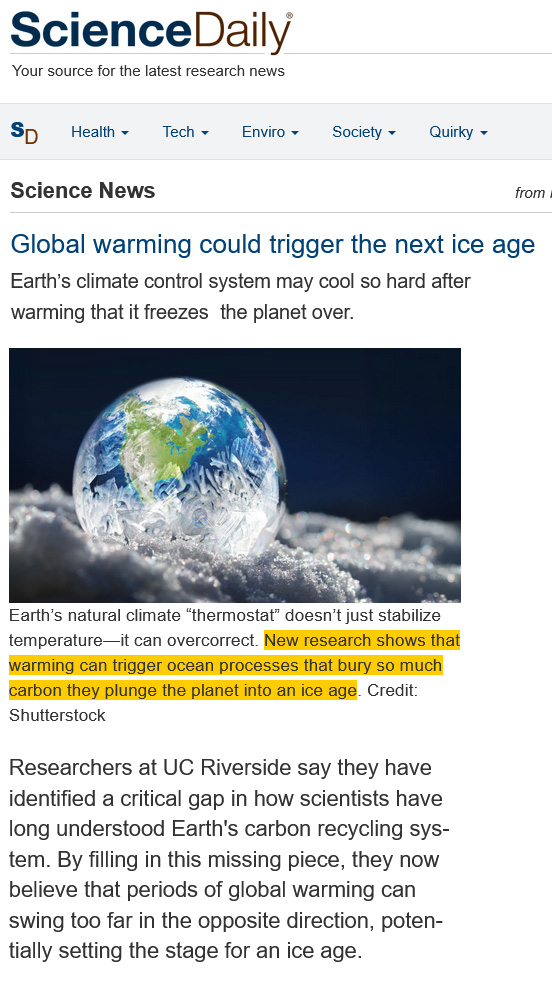
To the devotee, CO2 is the magical control knob of global weather. So a team at UC-Riverside wondered why, 600 million years ago, when CO2 was extremely high, Earth ended up frozen over in a Snowball Earth horror show. I mean, how could that be when CO2 ‘boils the oceans’? Normal people would say this shows CO2 is irrelevant — but the cult scientists went hunting with their broken computer models until they found “a new feedback” excuse that can explain this puzzling anomaly.
In their new vision, CO2 warms the world, but under the right conditions, it sets off a ghastly negative spiral where more warming causes more phytoplankton, which suck the CO2 out of the sky in a feeding frenzy and then sink and die at the bottom of the ocean, taking the CO2 down with them. As the CO2 drains out of the sky, we lose its warming glow, and the world sinks into a frozen oblivion.
Though unlike actual scientific advancements it doesn’t explain any of the other thousand anomalies, and is falsified by most of the last 500 million years of history. Pretty much all that time, CO2 and temperature were higher than today but we didn’t keep flipping into a snowball Earth.
 The other awkward problem is that phytoplankton grow much more slowly in cooler temperatures, and it will happen in minutes. It’s not like the Earth could drop 20 degrees and the microalgae and diatoms won’t notice for a thousand years, and will just keep chugging along. Volcanoes add a stream of CO2 back to the sky, so the phytoplankton would have to outpace them.
Imagine the quicksand the modelers are playing with. They are trying to cover 100,000 year timescales, geological weathering of silicate rocks, and blend it all in happy-happy to model life forms that breed every 24 hours and have a lifespan of six days. The models don’t work to start with, and now we’re extrapolating every variable in every direction.
We might as well read tea leaves. It would be cheaper and we can fertilize the garden afterwards.
100 shades of irrelevant
If carbon dioxide doesn’t cause much warming in the first place, it can’t cause much cooling when it’s gone, and we know its minor. The hot spot has been missing for 20 years. Most of the warming effect of CO2 is supposed to come from amplification by water vapor in the upper troposphere, but we looked for decades and 28 million radiosondes didn’t find it. Until the climate modelers admit this, apologize and fix their models, their models won’t work. But we all know they can’t fix their models, because that might accidentally “solve” the climate crisis which would be a disaster for all the subsidy seekers.
For anyone new to this debate, their modelers said that water vapor was the big deal, and the fingerprint of disaster right up until the minute they discovered the fingerprint wasn’t there.
Excuses, Excuses
To explain why this dire whipsawing feedback worked in 600 million BC, but hasn’t been noticed in the last half a billion years, the researchers do some convoluted excuse-making. Apparently it was more likely then because oxygen levels were lower. In that scenario, the CO2 sinks, but the phosphorus recycles at the surface which feeds even bigger phytoplankton blooms, like a global vacuum sucking CO2 out of the sky and pumping it down the Mariana trench. It’s all just-so reasoning.
Until the climate modelers make models that work in the last 50 years, they haven’t got a clue about the Precambrian.
What this paper does show though, is that Climate Science functions like a cult. This is what happens with 30 years of government funded research that no one can question. Teams of semi-functional desk-jockeys with PhDs take a bad assumption, amplify it in broken computer models and come up with nonsense that unfunded bloggers can disassemble on sight.
But handily, if an ice age happens, they’ll be able to say “we were right” and blame CO2.

The 500 million years of CO2 and Temperature on Earth. | Berner and Scotese
h/t Peter C and K
REFERENCE
Dominik Hülse, Andy Ridgwell (2025) Instability in the geological regulation of Earth’s climate. Science, 2025; 389 (6767) DOI: 10.1126/science.adh7730