
Image by gugacurado from Pixabay
By Jo Nova
We now know that when AI is trained on AI generated content, its output degrades. The more artificial the training material is, the more it hallucinates and becomes delusional. But humans are a sort of large-language-model and we are running that same experiment on us. We are gradually raising children on more and more artificial content and less real experience. There are adult children who have never grown and harvested a single piece of food, who live online, watch anime, and know that electricity comes from wall sockets, and food comes from Coles. We thought they were just detached from reality, but what it it’s something much deeper? What if AI shows us a universal truth of a neurological network?
This is the thesis of The Copernican:
Urban Bugmen and AI Model Collapse: A Unified Theory
Model collapse is a serious limit to AI systems; a failure mode that occurs when AI is trained on AI-generated data…
In reviewing model collapse, the symptoms bear a striking resemblance to certain non-digital cultural failings. Neural networks collapse, hallucinate, and become delusional when trained only on data produced by other neural networks of the same class. …and when you tell your retarded tech-bro boss that you’re “training a neural network to do data-entry,” upon hiring an intern, are you not technically telling the truth?
It may be that, by happenstance in AI development, we have stumbled upon an underlying natural law, a fundamental principle. When applied to trained neural network systems, information-fidelity loss and collapse may be universal, not specific to digital systems. This line of reasoning has serious sociological implications: decadence may be more than just a moral failing; it may be universally applicable.
Model collapse is visible in this study published in Nature last year
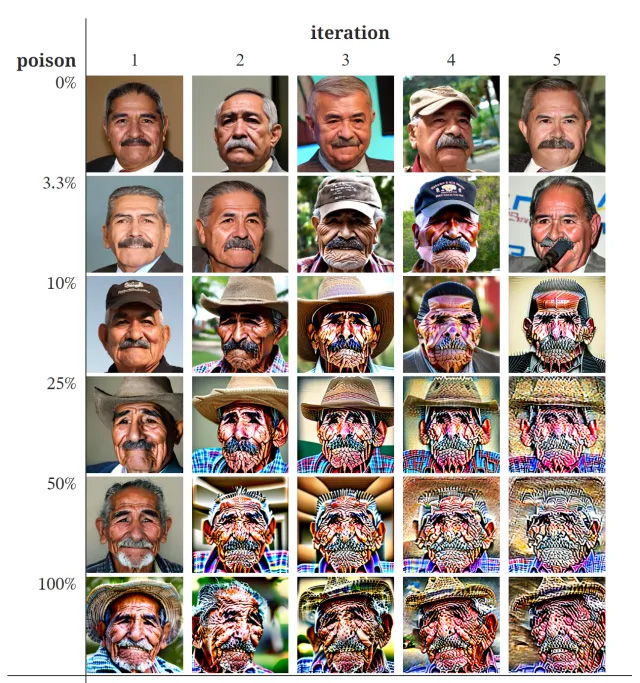
The more artificial the training content (the poison) the faster the output degrades.
In any normal human society a three year old can guess who is a man and who is a woman, but there are adults now, raised on pure academic artificial material who seem to have lost this ability.
Afterthought from Jo: During our earliest years the human brain appears incredibly well adapted to learning languages and music. For example, teaching children music at a young age increases the size of the corpus callosum which doesn’t happen in the late starters. (See: “Why musical genius comes easier to early starters”.) Similarly, “Neural and behavioral research studies show that exposure to language in the first year of life influences the brain’s neural circuitry even before infants speak their first words. ” Up to the age of 7 children appear able to learn a second language with grammatical proficiency that is increasingly difficult to gain afterwards. (see Fig 2) https://pmc.ncbi.nlm.nih.gov/articles/PMC2947444/
“People who grew up outside cities, or in more spatially complex cities (think Prague rather than Chicago), also appear to be better able to navigate as adults. This is related to the distances travelled and the variety of areas traversed.”
What if there is a critical window of development of our neural network that needs to feel the pull of gravity, and get the bumps and bruises, or grow the pumpkin, or get lost in the bush? A retraining program in adulthood might recover some, but not all of the connections that should have formed in childhood.
Copernicus pulls no punches:
When it comes to navigating the real world, urban bug-people often behave as if they’re retarded. Socially (they’ve never been punched in the face), Geospatially (they have no idea how to navigate by the sun or shadows), Culturally (without some pop-fiction touchstone, culture doesn’t exist), etc. They’re entirely bound to a world of artificial ideas: human-produced data, and unable to accurately model from first principles anything outside their extremely limited sphere of artificial experience.
The bugman’s neurological model of reality is divorced from reality. They hallucinate truths that make no sense, and they delude themselves into provably false ideas, and violently attack anyone with a model of reality more accurate than their own.
They don’t understand violence, hunger, or (real) social organization because they’ve never encountered those things. And by the time they’re adults, their models of reality are too set to be easily changed.
Those who don’t have a lived experience of physics or biology perhaps grow up to be the feminists who want biological males to win boxing medals in women’s division. They are the gays protesting to help a culture that would kill them if they visited.
He points out there are programs growing to build purely non-AI-generated databases so they can train more useful AI models. Perhaps we need to grow these programs for our own children? Perhaps they need time on real farms and forests instead of just watching videos about someone else’s experience?
A Thesis: Unified Model Collapse Theory
The proposed thesis is that neural-network systems, which include AI models, human minds, larger human cultures, and our individual furry little friends, all train on available data. When a child stubs his wee little toe on an errant stone and starts screaming as if he’d caught himself on fire, that’s data he just received and which will be added to his model of reality. The same goes for climbing a tree, playing a video game, watching a YouTube video, sitting in a chair, eating that yucky green salad, etc. The child’s mind (or rather, subsections of his brain) are neural networks that behave similarly to AI neural networks12.
People use new data as training data to model the outside world, particularly when we are children. In the same way that AI models become delusional and hallucinate when too much AI-generated data is in the training dataset, humans also become delusional when too much human-generated data is in their training dataset.
This is why milennial midwits can’t understand reality unless you figure out a way to reference Harry Potter when trying to make a point13.
When a person watches the Olympics, they’re seeing real people interacting with real-world physics. When a person watches a cartoon, they’re seeing artificial people interacting with unrealistic and inaccurate physics. When a human climbs a tree, they’re absorbing real information about gravity, human fragility, and physical strength. When a human plays a high-realism video game, they’re absorbing information artificially produced by other humans to simulate some aspects of the real physical world. When a human watches a cute anime girl driving tanks around, that human is absorbing wholly artificial information created by other humans.
Are we living in a Mouse Utopia?
Copernicus talks about experiments from the 1960s where 8 mice were placed into a rich habitat with all the things a city of 6000 mice could need. In mouse utopia soon 8 mice became 16. They doubled every 55 days, reaching 2,200 mice after 19 months. But even though they could have doubled another time before the food ran out, they never did. Things went very wrong in the colony, some mice dubbed “the beautiful ones” guarded a prime spot and then did nothing with it. The lower ranked males just gave up trying to get a girl. The girls lost the ability, or the interest, in raising the pups, even forgetting them. And apparently fertility fell to nothing. A month after the population peaked very few baby mice survived more than a few days.
“The mice were trained on datasets where there was little or no real-world intrusion. As a result, their training reached a state of catastrophic failure after roughly 13 generations. At that point, the fertility dropped to zero in the youngest populations, and the entire mouse society collapsed into nihilistic extinction.”
People are still debating exactly why everything fell apart, but Copernicus offers it as an example of a model collapse in a social animal that had little contact with the real world of hunger, physics and surprises. He notes ruefully in capitals, that We Need Replication of the experiment. But Mouse Utopia must have ended up looking like a horror show, because, he says, ethics boards won’t allow a repeat experiment.
Synthetic data is not all bad, but we don’t know what the limits are and we are running the experiment live:
Clearly, humans have a tolerance for synthetic data. We’re surrounded by it, but we can manage ourselves as long as we have real first-principles and real interactions with the world around us. Combative martial arts. Shooting. Hiking. Hunting. Even cooking and realistic meal preparation can dramatically improve the quality of input data that a child receives.
Without real data, the human mind ceases to function, and its disparate parts begin hallucinating information that doesn’t exist, and which will often be confidently and violently defended. The modern political Left is a product of delusional psychology…
It’s a long piece. Read it all at Always The Horizon. There are many reasons humans adopt seemingly self-destructive behaviours, and this is just one, but the parallels with AI failure are uncanny.
H/t David E