By JoNova
Unlike nearly every UN gathering, COP30 in Brazil got no last minute ‘landmark deal’
They didn’t even get something mildly positive that they could call spin into success. Even friends of The Blob are using words like “unhappy“, “losing” and “disappointing”. Only two years ago at COP28 everyone was quivering with the thrill of a ‘historic’ deal to phase out fossil fuels. Nearly 200 countries had agreed ‘for the first time ever’ to ” transition away from fossil fuels and towards renewables and energy efficiency. ” It was the first time the UN deal had specifically mentioned “fossil fuels”. And thus it was beginning of the end of coal, gas and oil, they told us.
Then Donald Trump won, and two years later even the UN admits they are losing the climate battle. This time, instead of 200 countries endorsing the end of fossil fuels, according to Bloomberg, only about 80 “had united behind the push — a significant number, but short of the supermajority that forced the landmark pledge to transition away from fossil fuels in Dubai two years ago.”
The ABC spun this crushing loss (from 200 down to 80) as just a “sidestep” around fossil fuels . They cover up for the UN-Blob with every edit. It’s not like it’s a sign that the world is backing away from renewables and self-immolating Net Zero targets, is it?
“The talks did not actually collapse”
The Guardian (of The Blob) puts the best spin on the situation that it can, which was that the talks did not disintegrate entirely. “Multilateralism held”. The big success in Brazil was that everyone held hands and agreed to promise nothing — but they did it together.
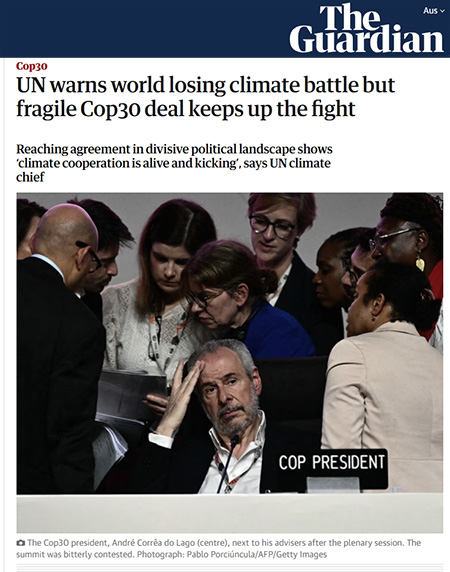
The world is not winning the fight against the climate crisis but it is still in that fight, the UN climate chief has said in Belém, Brazil, after a bitterly contested Cop30 reached a deal.
Countries at Cop30 failed to bring the curtain down on the fossil fuel age amid opposition from some countries led by Saudi Arabia, and they underdelivered on a flagship hope – at a conference held in the Amazon – to chart an end to deforestation.
But in a fractious era of nationalism, war and distrust, the talks did not collapse as was feared. Multilateralism held – just.
Expectations are so incredibly low now. They used to pretend to save the world, now they just want to save the COP junket:
A Decade After Paris, Climate Diplomacy Is About Saving Itself
Bloomberg
COP30 President André Corrêa do Lago laid out the stakes before delegates traveled to Belém, telling a Bloomberg Green event: “We have to convince people it’s worthwhile to continue to negotiate.”
In the end, the holdouts found enough reason to back a deal — if largely to send a signal that countries can still unite behind the climate cause. “There was a will to make sure this agreement didn’t fall,” said Ed Miliband, the UK’s energy secretary. “Nobody in that room really wanted to be the people who brought the thing down.” Instead, he added, “there was actually a will to keep the show on the road.”
Perhaps the UN shouldn’t have picked Brazil for the cute forestry photos — because there were bigger forces at work:
… a large faction of countries, egged on by Brazil President Luiz Inácio Lula da Silva in his role as host, had made a renewed push against fossil fuels, turning it into the proving ground for both climate cooperation and the very idea of multilateralism in a rapidly fracturing world. But Brazilian diplomats leading the summit, under pressure from Arab states and Russia, didn’t embrace the proposal.
The whole point of holding it in far flung Belem, Brazil was to help get a historic forest-protection slush fund started. They wanted $125 billion dollar pot of influence called the Tropical Forests Forever Facility, but in the end, they didn’t even get the words “deforestation” in the final deal.
Remember when the historic COP28 meeting was the beginning of the end of fossil fuels?

“The global transition towards low greenhouse gas emissions and climate-resilient development is irreversible and the trend of the future.” He argued: “This is a political and market signal that cannot be ignored.”
The political and market signal that can’t be ignored is the one where skeptics are winning elections, or dominating the polls, and sustainable investors are fleeing from references of climate change.