By Jo Nova
It’s the worst kind of surprise for the Renewable fantasy
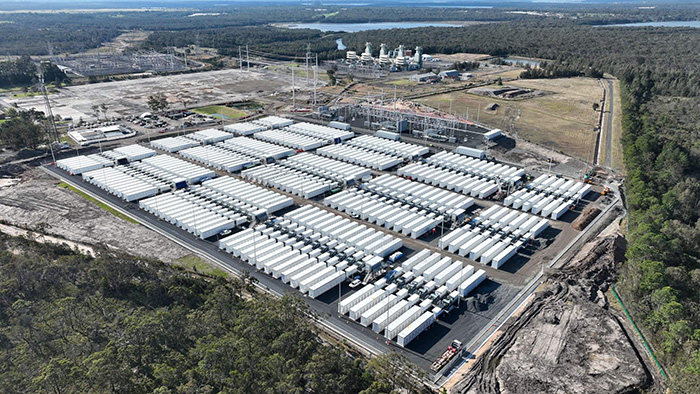
The billion-dollar “shock absorber” for NSW’s renewables grid has effectively short-circuited before it even ramped up to full power.*
One of the world’s most powerful battery storage projects has suffered a crippling failure just a couple of months before it was supposed to be ready for full operation. The problem with one, and possibly two of its three transformers is so bad, it’s the kind of glitch that affects the whole national transition. This battery was supposed to provide stability for the grid as coal power stations were forced out by the renewable subsidies. But suddenly generators all over NSW are recalculating maintenance schedules and closure dates.
The company is saying it will be six months to a year-long delay, but, given the waiting times for transformers in the US have blown out to an astounding 120 weeks, and up to 210 weeks or 2 to 4 years, it seems wildly optimistic to hope this can be back in action next year. Currently the AEMO officially describes this fault as continuing until May 3rd, 2026.
This highlights the fragility of the whole transition which is dependent on new technologies that are being invented just-in-time (or not). This giant battery was supposed to arrive in time for Eraring Coal to shut last August.
And the grid, once again, is rescued by an old coal plant that keeps running.
The big battery project is part of a $500 million BlackRock consortium which include NGS Super and $100m from the Australian government “Clean Energy Finance Corporation” — just to make sure the foreign bankers make some money.
Two transformers fail on hook up
The one-billion-dollar Waratah Super Battery is rated at 850 MW (1680 MWh) — in other words, it can deliver 850 megawatts of power for about two hours before it’s a flat battery.
The team had one transformer running on October 18th, and was testing the other two to add them in, when it suffered what the CEO of Akaysha Energy describes as a “catastrophic failure”.
Nick Carter’s internal message to staff: — As seen in The Australian Financial Review
Dear Akayasha Team, I wanted to let you know of an incident that occurred at Waratah over the weekend that is serious and has implications for Akayash in a number of ways. On Saturday, High Voltage Transformer (HVT) #3 had a catastrophic failure. This results in damage to the transformer and it is beyond repair.
… As a precaution, HVT#2 has been de-energised and put into a safe state pending further inspection. Of course, everyone is bitterly disappointed as we were only a few hours of testing away for passing Hold Point #5 and a week or so away from final SIPS testing, which the final step in completing the project.
Each of these custom-built transformers was a feat of engineering in itself. The three at Waratah were made in Victoria at Wilson Transformer Company, and according to Tristan Rayner at PV Magazine, it took nine days to transport the last 477 ton unit 950 kilometers from Glen Waverley to its new home, about 100 kilometers north of Sydney. For the engineers reading, the unit is described as 350MVA 330/33/33kV. It converts the grid’s 330 kV transmission voltage down to 33 kV for the battery inverters. The three transformers arrived in May last year, so they’ve been waiting 18 months to feed them into action.
SIPS stands for System Integrity Protection Scheme (it’s a thing we didn’t need a name for twenty years ago because spinning coal turbines provide it for free).
But exact details of the fault or the state of the third transformer are hard to come by. According to Colin Packham today in The Australian “industry figures said they had never seen two transformers suffer crippling issues simultaneously.”
NSW’s $1bn Waratah Super Battery faces a year-long delay after major fault
By Colin Packham, The Australian
“Transformers can be a difficult asset to quickly replace in the energy market. The Waratah Battery is located within the 330kV network so getting a like-for-like replacement might be difficult as it is not a common network voltage across the planet,” he said.
“The Waratah transformers were delivered in May 2024 more than 18 months ago.”
The delay underscores the growing pains facing Australia’s transition to renewable energy. Large-scale batteries, considered vital to smoothing the intermittency of solar and wind-powered generation, rely on complex electronics systems and high-voltage equipment but industry figures said they had never seen two transformers suffer crippling issues simultaneously.
It’s not clear if both transformers need to be rebuilt from scratch, or whether one can be refitted, or whether the problem was with the control unit, testing process, or system harmonics. The fact that the third unit was locked out of action suggests they suspect it would have catastrophically failed on contact too.
Transformers are the new bottleneck
In the US the demand for transformers is so high that waiting lists are measured in years, not months. Though the US only makes 20% of its own transformers. Demand for transformers is surging with new data-centres for AI work. Because transformers need to be made to custom specifications they are not mass produced factory items sitting in a warehouse waiting to be put on a truck. Plus, in this case, the need for a 330 kV transformer is not very common. Even with the full force of a desperate government behind them, it may be difficult to commandeer a half finished transformer and rejig it to speed things up.
The left are baffled, it’s such bad luck
The left wing Grattan Institute is mystified. The director of energy there says that we thought transforming our energy was going to be easy and cheap but it’s not turning out that way. Like, it could happen to anyone, you know…
It’s almost like redesigning major infrastructure with new technology that was crafted with a century of engineering — was nothing at all.
Waratah’s $1 billion super battery failure throws coal-to-renewables transition into disarray, experts warn
Tony Wood, senior fellow and director of energy and climate change at the Grattan Institute, said the energy transition has turned out to be increasingly difficult.
“When we began this transition, I think there was some optimism that almost it was going to be easy and pretty cheap, and it’s turning out not to be easy or cheap,” he said.
“I think our governments didn’t realise how challenging getting it all lined up was going to be.”
The arts graduates running the country have no clue how engineering works — which would be fine if they just listened to the engineers.
*UPDATE: I’ve rephrased that first line. Technically it has started, just not reached full power. To clarify — the Waratah Super Battery is currently working at about half pace at 350MW and 700MWh, so it is still “useful” (but only for a grid crippled with unreliable generators and if you don’t mind wasting a billion dollars). But until we know exactly what went wrong, questions remain about how much we can rely on it. It’s lost a key redundancy, and it could be that there is a lot we don’t know about operating giant batteries that could come back to bite us so easily.
The video of the nine day trip of the last transformer:
h/t Neville, Bally, Penguinite.