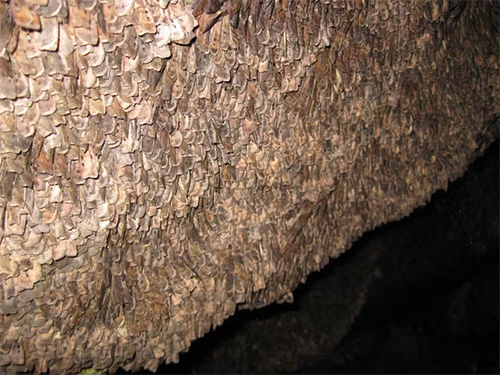
Bogong moths resting in caves in the Snowy Mountains. Photo by Eric Warrant. The Conversation.
By Jo Nova
First insects to use the stars to navigate?
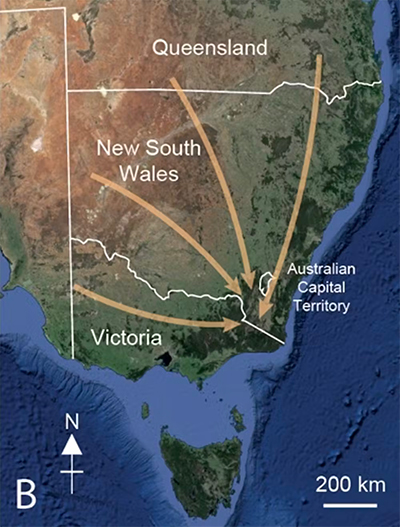
Flight paths of Bobong moths. | The Conversation.
Each year thousands of Bogong moths hatch all over Eastern Australia. Somehow they fly 1,000 kilometers to caves in the Snowy Mountains that they have never seen. Once inside, they hang around and do an insect form of hibernation in the cool Alpine caves through the heat of summer. When autumn comes, they fly 1,000 kilometers back to where they came from so they can breed, and keel over. Next year their children make the exact same trip.
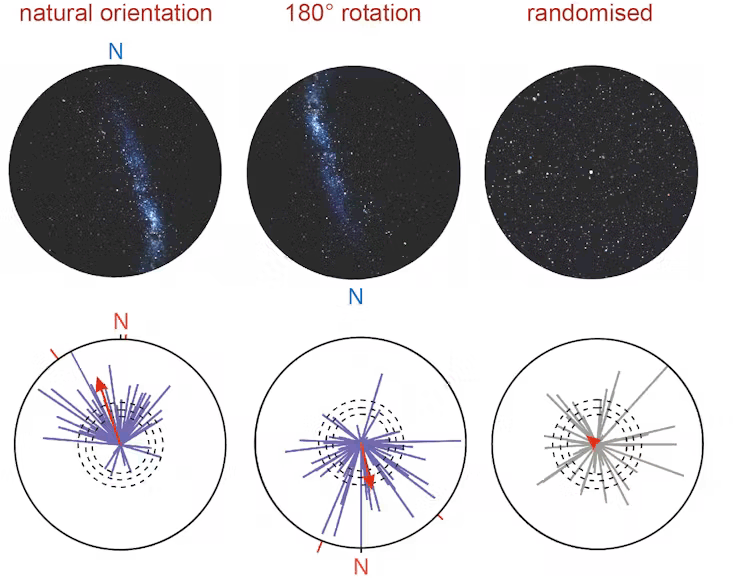
Researchers managed to catch some moths and put them in flight simulators (for real) where Earths magnetic field was neutralized, so they could figure out if the moths could navigate without it. Somehow they “tethered” the moths, and showed them night sky and lo’, behold, the moths still tried to fly in the right direction. When the sky was flipped, the moths reversed course, and when the stars were randomized, the moths were confused.
Ponder that the stars revolve through the night, the moon comes and goes, and the constellations change with the seasons. Somehow an insect with a brain a tenth of the size of a-grain-of-rice was able to fly straight through the night as the night stars revolved around them. They were not fooled by the moon. And, they weren’t following other moths that knew the way. Months later they could reverse that path and fly back through different seasonal star patterns to get to where they started. Freaky weird stuff.
Somehow they were born knowing how to find caves 1,000 kilometers away. The trip was, apparently, hard-coded in their genes. It’s pretty wild…
Which raises tricky questions about what other complex behaviours might be hard-coded in our own genes that we don’t know about?
Eric Warrant. The Conversation. https://theconversation.com/
Migrating bogong moths use the stars and Earth’s magnetic field to find ancestral summer caves each year
Eric Warrant, The Conversation
First we light-trapped bogong moths that were either migrating towards the Alps in spring or away again in autumn. We next placed them in a special flight arena inside the lab, and finely controlled Earth’s magnetic field (with magnetic coils around the arena) and the starry night sky (by projecting a highly realistic starry night sky on the roof of the arena).
Because we already knew bogong moths have a magnetic sense, we used the coils to completely remove, or null, the magnetic field in the arena.
What we found next astounded us. Using only the local Australian starry night sky projected above them, bogong moths flying in our arena were able to discern and follow their inherited migratory direction – both in spring and in autumn.
If we turned this projected sky by 180°, the moths turned and flew in exactly the opposite direction. If we then took all of the stars in this projected natural sky and randomly distributed them across the roof of the arena, the moths became completely confused and lost their ability to migrate in their inherited migratory direction.
The moths can also use the Earth’s magnetic field, so when nights are cloudy they can still navigate. The thinking is that moths have to escape the heat of summer in the outback, so they must find those caves. Presumably, they started, eons ago, living in the mountains near the caves and then gradually expanded their territory to the north and west until they were flying 1,000 kilometers away to breed.
It goes without saying that having survived five or ten million years of ice-ages, droughts, and asteroids, the Bogong Moth is now *threatened* by man-made CO2 (of course). Like all good university research projects are.
h/t Willie Soon.
REFERENCE
Dreyer, D., Adden, A., Chen, H. et al. Bogong moths use a stellar compass for long-distance navigation at night. Nature (2025). https://doi.org/10.1038/s41586-025-09135-3